
Acids, Bases and Salts
Acids, Bases and Salts carried 4 to 8 marks in the 2026-27 sample paper and the 2025 and 2026 board papers, and it gave the Chemistry case-based question in all three of those board papers (pH once, salts twice). Expect one to three MCQs on indicators, pH, water of crystallisation or the chlor-alkali process, sometimes an Assertion-Reason, and a 2-mark question on salts or on diluting an acid.
Marks are most often lost on the formulae of baking soda, washing soda, bleaching powder and Plaster of Paris; on reading the pH scale the wrong way round (a lower pH means more hydrogen ions); on writing "add water to acid"; and on assuming that every salt is neutral.
Revise in 5 Minutes
Indicators
| Indicator | Acid | Base |
|---|---|---|
| Litmus | blue → red | red → blue |
| Methyl orange | red | yellow |
| Phenolphthalein | colourless | pink |
| Turmeric | yellow | reddish-brown |
Olfactory: onion, vanilla, clove oil lose their smell in bases.
Reactions
- Acid + metal → salt + hydrogen (pop test). Zinc also gives hydrogen with sodium hydroxide.
- Acid + carbonate or hydrogencarbonate → salt + water + carbon dioxide. Lime water turns milky () and clears with excess gas: .
- Acid + base or metal oxide → salt + water (neutralisation, exothermic). Non-metal oxides are acidic ().
- In water acids give (as ); bases give ; alkalis are soluble bases. Their ions conduct electricity; distilled water barely conducts.
- Dilution is highly exothermic: add acid to water slowly, stirring.
pH
- Below 7 acidic, above 7 basic; lower pH = more . Strong acids (HCl, sulphuric, nitric) ionise fully; weak ones (acetic, citric, carbonic) do not.
- Body 7.0-7.8; acid rain below 5.6; tooth decay below 5.5; antacids (milk of magnesia) for acidity; baking soda on bee and ant stings.
Salts
- Strong acid + weak base → acidic (); weak acid + strong base → basic (, ); both strong → neutral.
| Chemical | Formula | How it is made | Use |
|---|---|---|---|
| Sodium hydroxide | soap, paper | ||
| Bleaching powder | disinfecting water | ||
| Baking soda | antacid, soda-acid extinguisher | ||
| Washing soda | glass, permanent hardness | ||
| Plaster of Paris | plaster casts, toys |
- Baking soda on heating: . Baking powder = baking soda + tartaric acid.
- Plaster of Paris sets with water: .
Traps
- pH 3 is more acidic than pH 5. Not every salt is neutral.
- Chlorine at the anode, hydrogen at the cathode, sodium hydroxide near the cathode.
How to use this page: try each question on paper first, then read the answer. The marks against each step show what an examiner looks for. The 1-mark MCQs and Assertion-Reason questions are in the quiz at the end, together with questions that test how well you understand the chapter; every quiz answer comes with its explanation.
Short Answer Questions (2 and 3 Marks)
Question 1 (2 marks)
(a) Pinky's mother adds a pinch of baking soda to pakora batter. Why do the pakoras turn out soft and spongy? Write the chemical equation for the change in baking soda on heating.
(b) Write the chemical equation for the making of baking soda from sodium chloride.
Answer.
Model answer:
(a) When the batter is fried, the heat breaks down the baking soda and carbon dioxide gas is given off. The gas forms tiny bubbles in the batter, so the pakoras puff up and become soft and spongy.
(b)
Marking scheme:
- (a) On heating, baking soda gives off carbon dioxide gas, which makes the batter puff up and become spongy (0.5) — 0.5 marks
- — 0.5 marks
- (b) — 1 mark
Question 2 (2 marks)
A paper mill near Nepanagar uses bleaching powder to whiten wood pulp.
(a) Write the chemical name of bleaching powder and the equation for its preparation.
(b) Give two other uses of bleaching powder.
Answer.
Model answer:
(a) Bleaching powder is calcium oxychloride, . It is made by passing chlorine gas over dry slaked lime:
(b)
- To disinfect drinking water, that is, to kill germs in it.
- To bleach cotton and linen in textile mills.
Marking scheme:
- (a) Calcium oxychloride, ; made by passing chlorine over dry slaked lime: (0.5 + 0.5) — 1 mark
- (b) Any two: bleaching cotton and linen in textile mills; bleaching washed clothes in laundries; as an oxidising agent in industries; disinfecting drinking water; 0.5 each — 1 mark
Question 3 (3 marks)
Four unlabelled test tubes contain distilled water, dilute hydrochloric acid, dilute sodium hydroxide solution and sodium carbonate solution. You are given only a bottle of phenolphthalein and some clean droppers. How will you identify the liquid in each test tube?
Answer.
Model answer:
- Put a little of each liquid in four clean tubes and add a drop of phenolphthalein. Two turn pink: these are the two basic liquids, sodium hydroxide and sodium carbonate. Two stay colourless: hydrochloric acid and distilled water.
- Add one colourless liquid, drop by drop, to a portion of a pink solution. If the pink colour disappears, that liquid is hydrochloric acid, because it neutralises the base. The other colourless liquid is distilled water.
- Now add hydrochloric acid drop by drop to each pink liquid, and keep adding it after the pink colour has gone. The one that then starts to fizz and give off carbon dioxide is sodium carbonate. The one that never fizzes is sodium hydroxide.
Marking scheme:
- Add phenolphthalein to a little of each: two turn pink (sodium hydroxide and sodium carbonate, both basic); two stay colourless (hydrochloric acid and distilled water) — 1 mark
- Add each colourless liquid drop by drop to a pink solution: the one that removes the pink colour is hydrochloric acid; the other is distilled water — 1 mark
- Add the hydrochloric acid drop by drop to each pink liquid and keep adding after the pink colour has gone: the one that then fizzes (gives carbon dioxide) is sodium carbonate; the one that never fizzes is sodium hydroxide — 1 mark
Question 4 (3 marks)
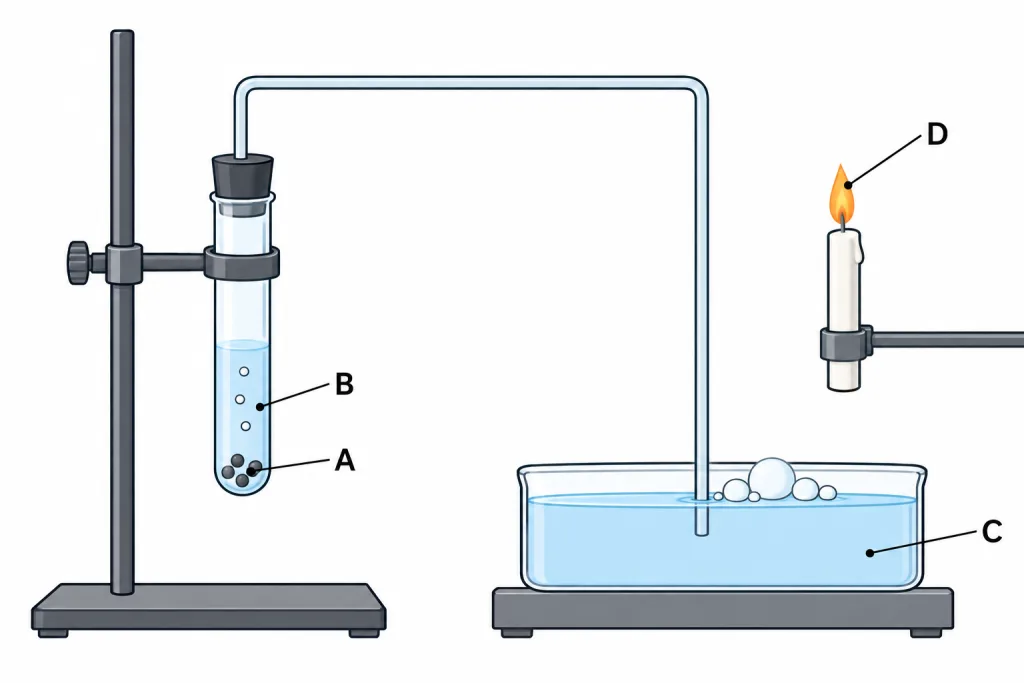
Sana set up the apparatus shown in the figure. The test tube has zinc granules A in dilute sulphuric acid B. The gas formed is passed into soap solution C, and a burning candle D is brought near the soap bubbles.
(a) Name the gas and state what happens when the burning candle is brought near a bubble.
(b) Write the balanced chemical equation, with state symbols, for the reaction in the test tube.
(c) What would Sana observe if she used copper turnings in place of the zinc granules? Give a reason.
Answer.
Model answer:
(a) The gas is hydrogen. When the burning candle is brought near a bubble filled with it, the bubble bursts and the gas burns with a pop sound.
(b)
(c) No bubbles of gas would form, because there would be no reaction. Copper is less reactive than hydrogen, so it cannot push hydrogen out of the acid.
Marking scheme:
- (a) Hydrogen; the bubble bursts and the gas burns with a pop sound (0.5 + 0.5) — 1 mark
- (b) — 1 mark
- (c) No gas bubbles / no reaction (0.5), because copper is less reactive than hydrogen and cannot displace hydrogen from the acid (0.5) — 1 mark
Question 5 (2 marks)
(a) Write the formulae of potassium sulphate and ammonium chloride. Name the acid and the base from which each is formed.
(b) Group these salts into the sulphate family and the chloride family: , , , .
Answer.
Model answer:
(a) Potassium sulphate, , is formed from sulphuric acid and potassium hydroxide. Ammonium chloride, , is formed from hydrochloric acid and ammonium hydroxide.
(b) Salts with the same negative part belong to one family.
- Sulphate family: and .
- Chloride family: and .
Marking scheme:
- (a) : sulphuric acid and potassium hydroxide; : hydrochloric acid and ammonium hydroxide (0.5 + 0.5) — 1 mark
- (b) Sulphate family: , ; chloride family: , (0.5 + 0.5) — 1 mark
Question 6 (3 marks)
Write balanced chemical equations, with state symbols, for the reactions that take place when:
(a) a magnesium ribbon is dropped into dilute sulphuric acid;
(b) dilute hydrochloric acid is poured over marble chips;
(c) dilute sulphuric acid is added to sodium hydroxide solution.
Answer.
Model answer:
(a)
(b) Marble is calcium carbonate:
(c)
Marking scheme:
- (a) ; formulae and balancing 0.5, state symbols 0.5 — 1 mark
- (b) ; formulae and balancing 0.5, state symbols 0.5 — 1 mark
- (c) ; formulae and balancing 0.5, state symbols 0.5 — 1 mark
Question 7 (2 marks)
Rohit poured water into a small amount of concentrated sulphuric acid in a glass beaker. The mixture spurted out and the beaker cracked.
(a) Why did this happen?
(b) How should he have mixed the two?
Answer.
Model answer:
(a) Mixing a concentrated acid with water gives out a lot of heat (it is highly exothermic). When water is poured into the acid, the heat is produced in a small amount of liquid, so the water boils at once and throws out drops of acid. The sudden heating in one place can also crack the glass.
(b) He should have added the acid slowly to the water, stirring all the time. The large amount of water then takes up the heat safely.
Marking scheme:
- (a) Mixing a concentrated acid with water is highly exothermic; when water is added to the acid, the heat is produced in a small volume, the water boils and splashes out with the acid, and the glass cracks from the local heating — 1 mark
- (b) The acid should be added slowly to water, with constant stirring — 1 mark
Question 8 (3 marks)
Two acid solutions, X and Y, have the same concentration. X has a pH of 1 and Y has a pH of 3. Equal lengths of clean magnesium ribbon are dropped into equal volumes of each.
(a) In which solution will the fizzing be faster? Why?
(b) Which of the two could be hydrochloric acid, and which could be acetic acid?
(c) Enough magnesium is added to use up all the acid in each flask. When both reactions are over, which flask will have given more hydrogen? Give a reason.
Answer.
Model answer:
(a) The fizzing is faster in X. A lower pH means more ions in the solution at a time, and magnesium reacts with these ions to give hydrogen.
(b) X could be hydrochloric acid and Y could be acetic acid. At the same concentration, hydrochloric acid gives far more ions, so its pH is lower.
(c) Both flasks give the same amount of hydrogen. They hold the same amount of acid. The weak acid gives fewer ions at a time, but as these are used up it gives more, so it only takes longer to finish.
Marking scheme:
- (a) In X; its lower pH means it has more ions at a time, so it reacts faster with magnesium (0.5 + 0.5) — 1 mark
- (b) X: hydrochloric acid; Y: acetic acid (0.5 + 0.5) — 1 mark
- (c) Both give the same amount (0.5): both flasks hold the same amount of acid, and the weak acid goes on giving hydrogen ions as they are used up, so it only reacts more slowly (0.5) — 1 mark
Question 9 (2 marks)
Common salt is called a raw material for many chemicals. Name any four chemicals made from it, and write their formulae.
Answer.
Model answer:
- Sodium hydroxide,
- Bleaching powder,
- Baking soda,
- Washing soda,
Marking scheme:
- Any four, 0.5 each: sodium hydroxide ; bleaching powder ; baking soda ; washing soda ; hydrochloric acid ; chlorine ; hydrogen ; sodium carbonate — 2 marks
Question 10 (2 marks)
(a) Write the balanced chemical equation for the reaction of carbon dioxide with sodium hydroxide solution.
(b) What does this reaction show about the nature of non-metallic oxides? Name one more oxide of this kind.
Answer.
Model answer:
(a)
(b) A base reacts with carbon dioxide to give a salt and water, which is what a base does with an acid. So non-metallic oxides are acidic in nature. Sulphur dioxide, , is another example.
Marking scheme:
- (a) — 1 mark
- (b) They are acidic: like acids, they react with a base to give a salt and water (0.5); e.g. sulphur dioxide, (0.5) — 1 mark
Long Answer and Case-Based Questions
Question 11 (4 marks)
The water of the swimming pool at a sports complex in Pune is tested every morning. Its pH should stay between 7.2 and 7.8. If the pH falls too low, the staff add sodium carbonate; if it rises too high, they add a little dilute hydrochloric acid. One Monday the pH was 6.8. On Tuesday, after too much sodium carbonate had been added, it was 8.6.
(a) Was the water acidic or basic on Monday? Which of the two chemicals did the staff add that day? (1 mark)
Answer.
- Slightly acidic, as the pH was below 7; sodium carbonate (0.5 + 0.5) — 1 mark
(b) Why does sodium carbonate raise the pH of the water? (1 mark)
Answer.
- It is the salt of a strong base (sodium hydroxide) and a weak acid (carbonic acid), so its solution is basic — 1 mark
(c) On Tuesday, which chemical would bring the pH back to about 7.4? Write the balanced chemical equation for its reaction with sodium carbonate. (2 marks)
Answer.
- Dilute hydrochloric acid, as the water had become too basic — 1 mark
- — 1 mark
OR
(c) After a night of heavy rain, the pH of the pool had fallen a little. (i) Rainwater conducts electricity, but distilled water hardly does. Why? (ii) Why did the rain lower the pH of the pool? (2 marks)
Answer.
- (i) Rainwater has substances dissolved in it from the air (acids from gases such as carbon dioxide, and salts) that give ions, which carry the current; distilled water has almost no ions — 1 mark
- (ii) Carbon dioxide (and other acidic gases) dissolved in the rain make it slightly acidic, forming carbonic acid, so adding rainwater lowers the pH — 1 mark
Question 12 (4 marks)
At a chemical plant near Bharuch, electricity is passed through brine B, a concentrated solution of sodium chloride, as shown in the figure. Gas X collects over electrode P, which is joined to the positive terminal, and gas Y over electrode Q, which is joined to the negative terminal. Solution Z is drawn off from near Q.
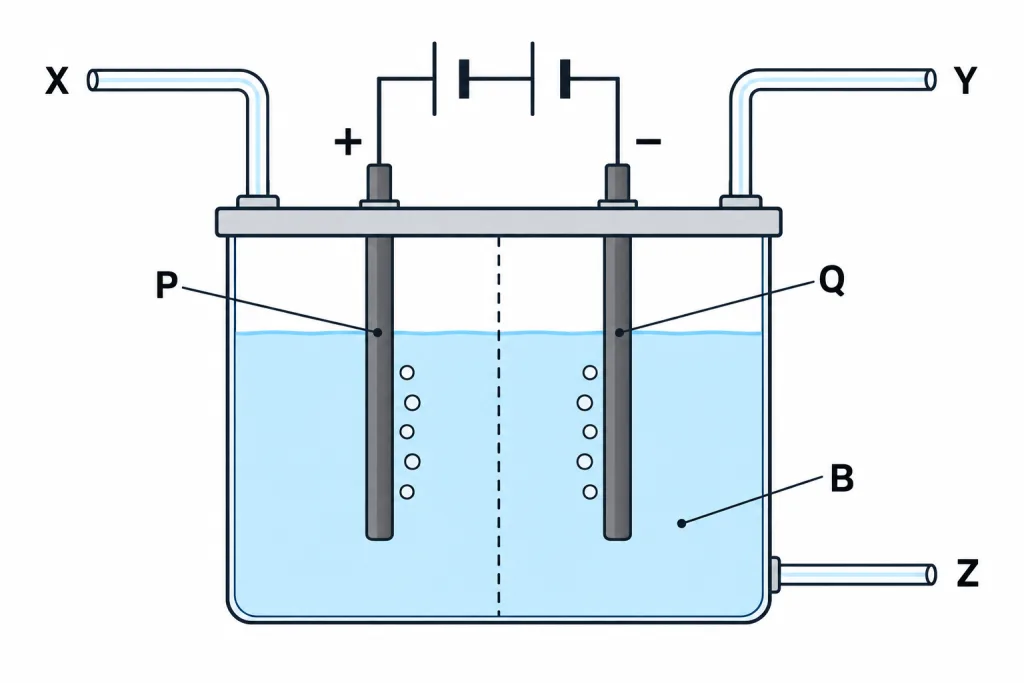
(a) Name the gases X and Y. (1 mark)
Answer.
- X: chlorine; Y: hydrogen (0.5 + 0.5) — 1 mark
(b) Name the substance in solution Z. Why is this process called the chlor-alkali process? (1 mark)
Answer.
- Sodium hydroxide (0.5); the products are chlorine (chlor) and sodium hydroxide, an alkali (0.5) — 1 mark
(c) Write the balanced chemical equation for the process. The brine has a pH of 7 at the start. What happens to the pH of the solution near Q as the process goes on, and why? (2 marks)
Answer.
- — 1 mark
- The pH rises above 7 (0.5), because sodium hydroxide, an alkali, collects near Q (0.5) — 1 mark
OR
(c) The plant also makes hydrochloric acid by joining two of its products. Which two? Write the equation, and give one use each of hydrogen and of hydrochloric acid. (2 marks)
Answer.
- Hydrogen and chlorine: — 1 mark
- Hydrogen: as a fuel, making margarine, or making ammonia for fertilisers (any one); hydrochloric acid: cleaning steel, making medicines and cosmetics, or making ammonium chloride (any one) (0.5 + 0.5) — 1 mark
Question 13 (4 marks)
Aman weighed a clean, dry boiling tube (20.00 g), then the tube with some blue copper sulphate crystals (25.00 g). He heated it until the solid had turned completely white and no more steam came off, let it cool, and weighed it again: 23.20 g. In the next period, his class recrystallised sodium carbonate from water and got crystals of washing soda. These crystals look dry, but they too contain water of crystallisation.
(a) What mass of water was driven off from the copper sulphate crystals? What is this water called? (1 mark)
Answer.
- 25.00 − 23.20 = 1.80 g; water of crystallisation (0.5 + 0.5) — 1 mark
(b) Write the formulae of the blue crystals and of the white powder. (1 mark)
Answer.
- Blue crystals: ; white powder: (0.5 + 0.5) — 1 mark
(c) Write the equation for the formation of washing soda crystals from sodium carbonate. Give two uses of washing soda. (2 marks)
Answer.
- — 1 mark
- Any two: in the glass, soap and paper industries; making borax; as a cleaning agent at home; removing permanent hardness of water; 0.5 each — 1 mark
OR
(c) Gypsum, , also contains water of crystallisation. What is formed when it is heated at 373 K? Write the equation, and give one use of the product. (2 marks)
Answer.
- Plaster of Paris: (name 0.5, equation 1) — 1.5 marks
- Any one use: plaster for supporting fractured bones; making toys, decorative materials or smooth surfaces — 0.5 marks
Question 14 (4 marks)
During a practical class in a school laboratory in Shillong, a bottle of dilute sulphuric acid tipped over on the bench. The teacher at once sprinkled sodium hydrogencarbonate powder over the spill until the fizzing stopped, and then wiped the bench with a wet cloth.
(a) Why did the mixture fizz? Name the gas given off. (1 mark)
Answer.
- The hydrogencarbonate reacted with the acid and gave off a gas (0.5); carbon dioxide (0.5) — 1 mark
(b) Why did the teacher use sodium hydrogencarbonate and not sodium hydroxide? (1 mark)
Answer.
- Sodium hydrogencarbonate is a mild base, safe to handle, and any extra left over does no harm; sodium hydroxide is a strong alkali that can burn the skin and would itself need care — 1 mark
(c) Write the balanced chemical equation, with state symbols, for the reaction. Why does the stopping of the fizzing show that the acid has been used up? (2 marks)
Answer.
- — 1 mark
- Carbon dioxide forms only while there is acid left to react; when no more gas comes off on adding more powder, all the acid has been neutralised — 1 mark
OR
(c) In the same class, Sahil made carbon dioxide by adding dilute acid to marble chips and bubbled it through lime water. The lime water turned milky, but after he went on bubbling the gas for a long time, it became clear again. Explain both changes with balanced equations. (2 marks)
Answer.
- Milky: insoluble white calcium carbonate forms: — 1 mark
- Clear again: with excess carbon dioxide, calcium carbonate changes to soluble calcium hydrogencarbonate: — 1 mark