
Metals and Non-metals
Metals and Non-metals carried 5 to 10 marks in the 2026-27 sample paper and the board papers of 2025 and 2026. Expect one or two MCQs on reactivity, properties, alloys or corrosion, a 3-mark "give reasons" or extraction question, and sometimes the Chemistry case study (an experiment on metals, as in the sample paper) or the 5-mark question (May 2026).
Where marks are usually lost:
- extraction equations left unbalanced (roasting, reduction, thermit-type reactions);
- mixing up calcination (carbonate ore, limited air) and roasting (sulphide ore, excess air);
- electron-transfer diagrams that show sharing, or leave out the charges on the ions;
- writing "iron rusts in water" without saying that air and water are both needed.
Revise in 5 Minutes
Physical properties: metals are lustrous, malleable, ductile, sonorous and good conductors (Ag, Cu best; Pb, Hg poor). Exceptions: Na, K are soft; Hg is a liquid; Ga, Cs melt on the palm; iodine is lustrous; graphite conducts.
Reactions of metals (Δ = heat)
- Oxygen: ; ; Cu gets a black CuO coat. Metal oxides are basic, and those that dissolve in water give alkalis; and ZnO are amphoteric. Non-metal oxides are acidic.
- Water: K, Na > Ca > Mg (hot water) > Al, Zn, Fe (steam only: ) > Pb, Cu, Ag, Au (none).
- Dilute HCl → salt + . Nitric acid gives no , except Mg and Mn with very dilute acid.
- Activity series: K > Na > Ca > Mg > Al > Zn > Fe > Pb > [H] > Cu > Hg > Ag > Au. A metal displaces those below it from their salts.
Ionic compounds: Na (2,8,1) → ; Cl (2,8,7) → . High m.p.; conduct only when molten or dissolved.
Extraction
- Low (Hg, Cu): , then . Copper by self-reduction: .
- Middle (Zn, Fe, Pb): roasting ; calcination ; reduction ; thermit + heat.
- Top (K, Na, Ca, Mg, Al): electrolysis of the molten compound. Molten NaCl: cathode , anode .
- Refining: anode = impure metal, cathode = thin strip of pure metal, electrolyte = an acidified solution of its salt; impurities fall as anode mud.
Corrosion: Ag turns black (), Cu green (basic copper carbonate); iron rusts only with air and water. Prevention: paint, oil, galvanising, anodising, alloying.
Alloys: steel (Fe + C), stainless steel (Fe + Ni + Cr), brass (Cu + Zn), bronze (Cu + Sn), solder (Pb + Sn, low m.p.), amalgam (with Hg).
Traps: calcination (limited air) ≠ roasting (excess air); Mg + hot water → ; ionic solids do not conduct.
How to use this page: try each question on paper first, then read the answer. The marks against each step show what an examiner looks for. The 1-mark MCQs and Assertion-Reason questions are in the quiz at the end, together with questions that test how well you understand the chapter; every quiz answer comes with its explanation.
Short Answer Questions (2 and 3 Marks)
Question 1 (3 marks)
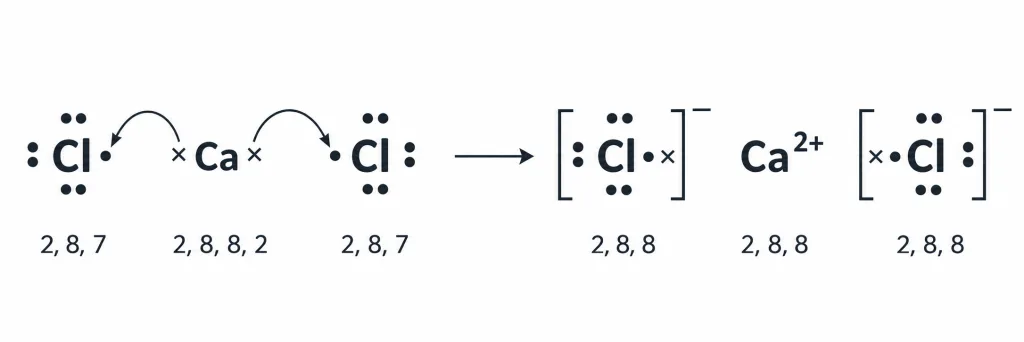
(a) Show the formation of calcium chloride from calcium and chlorine atoms by the transfer of electrons. (Atomic numbers: Ca = 20, Cl = 17)
(b) Which noble gas has the same electronic configuration as the ions formed? Why does calcium chloride have a high melting point?
Answer.
Model answer:
(a) Calcium (2, 8, 8, 2) has two electrons in its outermost shell. Chlorine (2, 8, 7) needs one electron to complete its octet. So the calcium atom gives one electron to each of two chlorine atoms, as shown in the figure. Calcium becomes and each chlorine becomes , giving .
(b) Both and have the configuration 2, 8, 8, which is that of argon. Calcium chloride has a high melting point because its positive and negative ions attract each other strongly, and a lot of heat energy is needed to break this attraction.
Marking scheme:
- Configurations: Ca 2, 8, 8, 2; Cl 2, 8, 7 — 0.5 marks
- Diagram: the Ca atom gives one electron to each of two Cl atoms (arrows showing transfer, not sharing) — 1 mark
- Ions with charges shown: and two ; formula — 0.5 marks
- Both ions have the configuration 2, 8, 8 of argon — 0.5 marks
- Strong force of attraction between the oppositely charged ions needs a lot of energy to overcome — 0.5 marks
Question 2 (3 marks)
Riya burnt a little sulphur powder in a deflagrating spoon and lowered it into a gas jar. Separately, she burnt a magnesium ribbon and collected the white ash. She added a little water to the gas jar and to the ash, shook both, and tested each with red and blue litmus paper.
(a) What would she observe in each case, and what does it show about the oxide?
(b) Write the balanced equations for the reactions of the two oxides with water.
(c) She then heats a copper foil until it is coated with black copper(II) oxide, scrapes off the coating and shakes it with water. Red litmus does not turn blue, although copper(II) oxide is a basic oxide. Why? How could she show that it is basic?
Answer.
Model answer:
(a) With the sulphur, the blue litmus turns red, so sulphur dioxide is an acidic oxide, like the oxides of other non-metals. With the magnesium ash, the red litmus turns blue, so magnesium oxide is a basic oxide, like the oxides of other metals.
(b) (sulphurous acid)
(magnesium hydroxide)
(c) Copper(II) oxide does not dissolve in water, so no alkali is formed and the litmus does not change. Only metal oxides that dissolve in water give alkalis. To show that it is basic, Riya can add dilute hydrochloric acid: the black powder dissolves and reacts to give a salt and water, , and the solution turns blue-green.
Marking scheme:
- Sulphur: blue litmus turns red, so sulphur dioxide is an acidic oxide — 0.5 marks
- Magnesium: red litmus turns blue, so magnesium oxide is a basic oxide — 0.5 marks
- — 0.5 marks
- — 0.5 marks
- Copper(II) oxide does not dissolve in water, so it forms no alkali to change the litmus — 0.5 marks
- Add dilute hydrochloric acid: it dissolves and reacts to give a salt and water (blue-green solution of copper(II) chloride), as a base does — 0.5 marks
Question 3 (3 marks)
Give reasons:
(a) The hydrogen given off catches fire when sodium is dropped into water, but not when calcium is.
(b) Ionic compounds such as sodium chloride dissolve in water, but not in kerosene or petrol.
(c) Graphite, a form of the non-metal carbon, is used to make the electrodes of dry cells and of electrolysis tanks.
Answer.
Model answer:
(a) Sodium is very reactive. Its reaction with water is so violent and gives out so much heat that the hydrogen formed catches fire at once. Calcium is less reactive, so its reaction is gentler and the heat given out is not enough to set the hydrogen on fire.
(b) Ionic compounds are made of ions. Water can pull these ions apart and surround them, so the compound dissolves. Kerosene and petrol cannot separate the ions, so ionic compounds do not dissolve in them.
(c) Most non-metals do not conduct electricity, but graphite is an exception: it is a good conductor. So current can flow through graphite electrodes, and graphite does not react easily with the substances in the cell.
Marking scheme:
- Sodium reacts so vigorously that a lot of heat is given out, enough to set the hydrogen on fire; calcium reacts less violently and the heat is not enough — 1 mark
- Water separates the ions and surrounds them, so ionic compounds dissolve in it; kerosene and petrol cannot separate the ions, so they do not dissolve (accept: ionic compounds are soluble in water but insoluble in organic solvents like kerosene) — 1 mark
- Graphite is an exception among non-metals: it is a good conductor of electricity, so current can pass through it (it also does not react easily with the electrolyte) — 1 mark
Question 4 (3 marks)
Zinc is found in nature as zinc blende () and as calamine ().
(a) Name the process used to change each ore into zinc oxide, and write the balanced equation for each.
(b) Write the equation for the step that gives zinc metal from zinc oxide.
Answer.
Model answer:
(a) Zinc blende is a sulphide ore, so it is roasted: heated strongly in excess of air.
Calamine is a carbonate ore, so it is calcined: heated strongly in limited air.
(b) Zinc oxide is then reduced by heating it with carbon:
Marking scheme:
- Zinc blende: roasting (heating strongly in excess of air), — 1 mark
- Calamine: calcination (heating strongly in limited air), — 1 mark
- Reduction with carbon: (accept reduction with aluminium or another suitable reducing agent) — 1 mark
Question 5 (3 marks)
Chromium for making stainless steel can be obtained by heating chromium(III) oxide with aluminium powder. Molten chromium is formed, and a lot of heat is given out.
(a) Write the balanced chemical equation for the reaction.
(b) Which substance is oxidised and which is reduced? Give a reason for each.
(c) What does this reaction tell you about the positions of aluminium and chromium in the activity series? Why is the metal obtained in the molten state?
Answer.
Model answer:
(a) , with a lot of heat given out.
(b) Aluminium is oxidised, because it gains oxygen and becomes aluminium oxide. Chromium(III) oxide is reduced, because it loses oxygen and becomes chromium.
(c) A metal can take oxygen away from the oxide of another metal only if it is more reactive, so aluminium is above chromium in the activity series. The reaction is highly exothermic, and the heat given out is so large that the chromium formed melts.
Marking scheme:
- (+ heat) — 1 mark
- Aluminium is oxidised, as it gains oxygen to form aluminium oxide — 0.5 marks
- Chromium(III) oxide is reduced, as it loses oxygen to form chromium — 0.5 marks
- Aluminium is above chromium (more reactive), so it can take oxygen from chromium oxide — 0.5 marks
- The reaction is highly exothermic; the heat given out is enough to melt the metal formed — 0.5 marks
Question 6 (2 marks)
Divya put three spoons of the same size and shape, made of silver, copper and stainless steel, into the same cup of hot tea. After two minutes she measured the temperature at the top of each handle.
| Spoon | Silver | Copper | Stainless steel |
|---|---|---|---|
| Temperature (°C) | 55 | 52 | 34 |
(a) Arrange the three metals in order of how well they conduct heat. Why did Divya use spoons of the same size and shape?
(b) Cooking pans are made of aluminium or steel, but their handles are made of plastic or wood. Why?
Answer.
Model answer:
(a) Silver > copper > stainless steel. The handle that got hottest carried heat up fastest. The spoons were of the same size and shape so that the only difference was the metal; otherwise a thicker or shorter spoon could change the result.
(b) The body of the pan has to pass heat quickly from the flame to the food, so a metal, which is a good conductor of heat, is used. The handle must stay cool enough to hold, so it is made of a poor conductor such as plastic or wood.
Marking scheme:
- Silver > copper > stainless steel (the hotter the handle, the better the conductor) — 0.5 marks
- Same size and shape so that only the metal is different and the comparison is fair — 0.5 marks
- The pan must pass heat quickly from the flame to the food, so a metal (good conductor) is used; the handle must stay cool to hold, so a poor conductor such as plastic or wood is used — 1 mark
Question 7 (3 marks)
Three students are talking about the rusting of an iron gate.
Aman: "Iron rusts only because of water. Air has nothing to do with it."
Bela: "Iron rusts only when both air and water are in contact with it. Rust is hydrated iron(III) oxide."
Chirag: "A coat of paint stops rusting because the paint reacts with the iron and changes it into a metal that cannot rust."
(a) Who is correct? Point out the mistake in each of the other two statements.
(b) The gate is painted, but its hinges are left unpainted because they must turn. How should the hinges be protected, and why is painting not suitable for them?
Answer.
Model answer:
(a) Bela is correct. Iron rusts only when it is in contact with both air (oxygen) and water.
- Aman is wrong because oxygen from the air is also needed. Iron kept in water with no air in it does not rust.
- Chirag is wrong because paint does not change the iron. It only covers the surface, so air and water cannot reach the iron. If the paint chips off, that spot starts rusting.
(b) The hinges should be oiled or greased regularly. Paint on a moving part would crack and rub off as the gate swings. A layer of oil or grease keeps air and water away from the iron and also lets the hinge turn smoothly.
Marking scheme:
- Bela is correct — 0.5 marks
- Aman is wrong: oxygen of the air is also needed; iron in water from which air has been removed does not rust — 0.5 marks
- Chirag is wrong: paint does not react with iron; it only covers the surface and keeps air and water away — 1 mark
- Oil or grease the hinges regularly; paint on a moving part would crack and rub off, while a layer of oil or grease keeps air and water away and still lets the hinge turn — 1 mark
Question 8 (2 marks)
An ore dug out of a mine near Udaipur contains a heavy metal compound mixed with a lot of light sand and clay.
(a) What is the sand and clay called, and why must it be removed before the metal is extracted?
(b) Suggest a simple way to remove it, and name the difference between the two materials on which your method depends.
Answer.
Model answer:
(a) The unwanted sand and clay mixed with the ore is called gangue. It has to be removed first, because heating and reducing all that extra material would waste fuel and chemicals, and it would leave the metal impure.
(b) The crushed ore can be washed in a stream of water. The light sand and clay are carried away, while the heavy particles of the metal compound settle down. The method works because the ore and the gangue differ in density.
Marking scheme:
- Gangue — 0.5 marks
- It must be removed first, otherwise the large amount of unwanted material would waste fuel and chemicals and make the metal impure (accept: to enrich / concentrate the ore) — 0.5 marks
- Wash the crushed ore in a stream of water: the light sand and clay are carried away and the heavy ore particles settle (accept any sensible method based on a difference in property) — 0.5 marks
- The difference in density (heaviness) of the ore and the gangue — 0.5 marks
Question 9 (2 marks)
Arun added the same volume of dilute hydrochloric acid to equal masses of zinc granules in test tube A and magnesium ribbon in test tube B.
(a) Write the balanced chemical equation, with state symbols, for the reaction in test tube B.
(b) In which test tube will bubbles form faster, and why? How can Arun test the gas?
Answer.
Model answer:
(a)
(b) Bubbles form faster in test tube B. Magnesium is higher than zinc in the activity series, so it reacts faster with the acid. To test the gas, Arun can bring a burning matchstick near the mouth of the tube: the gas burns with a pop sound, which shows it is hydrogen.
Marking scheme:
- — 1 mark
- Faster in B, because magnesium is more reactive than zinc (higher in the activity series) — 0.5 marks
- Bring a burning splinter near the mouth of the tube; the gas burns with a pop sound, showing it is hydrogen — 0.5 marks
Question 10 (3 marks)
Neeraj studied four metals, P, Q, R and S, and noted:
- Q reacts with cold water and gives hydrogen.
- P does not react with cold water, but gives hydrogen with dilute hydrochloric acid. A strip of P placed in a solution of a salt of S gets coated with S.
- S gives hydrogen slowly with dilute hydrochloric acid.
- R gives no hydrogen with dilute hydrochloric acid, but a strip of R placed in silver nitrate solution gets coated with silver.
(a) Arrange P, Q, R and S in decreasing order of reactivity.
(b) Which of the metals are above hydrogen in the activity series?
(c) Which of the four could be copper? A solution of a salt of S has to be stored. Which of the other metals could be used to make the container? Give a reason.
Answer.
Model answer:
(a) Q reacts even with cold water, so it is the most reactive. P displaces S, so P is above S. S still gives hydrogen with acid, while R does not, so S is above R. The order is Q > P > S > R.
(b) Q, P and S give hydrogen with dilute acid, so all three are above hydrogen. R is below hydrogen.
(c) R is below hydrogen but above silver, which fits copper. A container for a solution of S must not react with it, so it should be made of R, which is less reactive than S and cannot displace it.
Marking scheme:
- Q > P > S > R — 1 mark
- Q, P and S (all three give hydrogen with dilute acid) — 1 mark
- R could be copper (below hydrogen, above silver) — 0.5 marks
- R, because it is less reactive than S and cannot displace S from its salt solution — 0.5 marks
Long Answer and Case-Based Questions
Question 11 (5 marks)
Attempt either option (A) or (B).
(A) Refining of copper
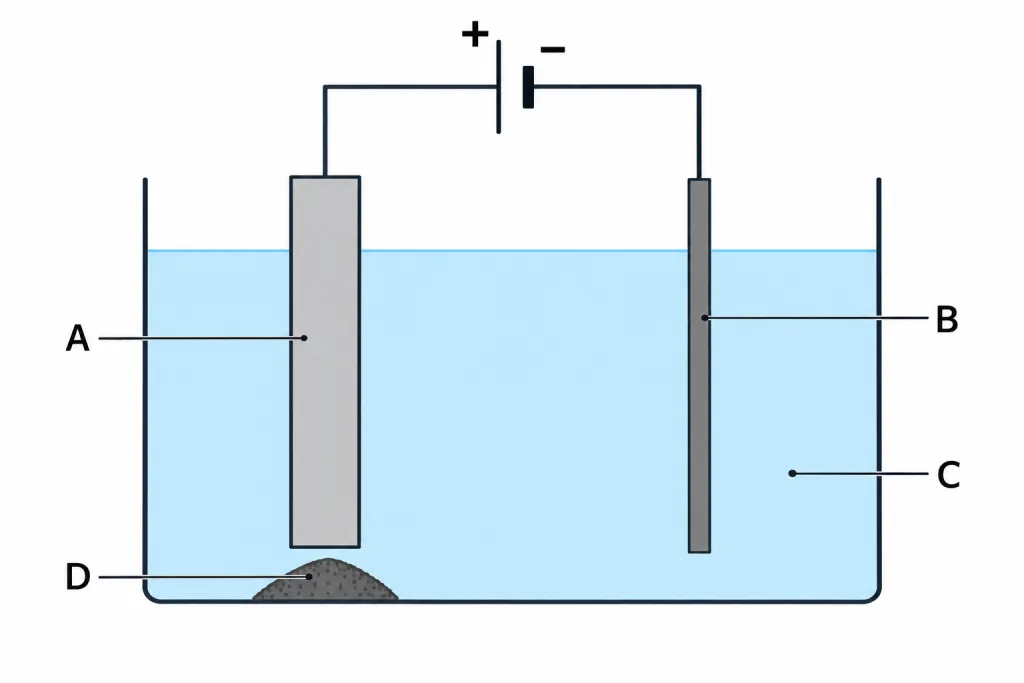
(i) Draw a labelled diagram of the set-up used for the electrolytic refining of copper. Label the anode, the cathode, the electrolyte and the anode mud. (3 marks)
Answer.
- Correct set-up: two electrodes dipping in the electrolyte in a tank, joined to a battery, the thick anode joined to the positive terminal and the thin cathode to the negative terminal — 1 mark
- Four labels, 0.5 each (in the figure: A anode, a thick block of impure copper; B cathode, a thin strip of pure copper; C electrolyte, acidified copper sulphate solution; D anode mud) — 2 marks
(ii) What happens at the anode and at the cathode when the current is passed? Where do the impurities go? (2 marks)
Answer.
Model answer:
At the anode, the impure copper dissolves and goes into the electrolyte as copper ions: . At the cathode, an equal amount of pure copper from the electrolyte is deposited: . So the anode gets thinner and the cathode gets thicker.
The soluble impurities go into the solution. The insoluble impurities settle at the bottom, below the anode, as anode mud.
Marking scheme:
- Anode: impure copper dissolves into the electrolyte as copper ions, — 0.5 marks
- Cathode: an equal amount of pure copper from the electrolyte is deposited, — 0.5 marks
- Soluble impurities go into the solution — 0.5 marks
- Insoluble impurities settle at the bottom below the anode as anode mud — 0.5 marks
OR
(B) Metals low in the activity series
(i) Mercury is obtained from cinnabar () in two heating steps. Write the balanced equation for each step with its condition, and name the first step. Why is no reducing agent such as carbon needed in the second step? (3 marks)
Answer.
- Roasting: (heated strongly in air) — 1 mark
- (on further heating) — 1 mark
- Mercury is very low in the activity series, so its oxide breaks down into the metal on heating alone — 1 mark
(ii) Complete this flow chart for getting copper from copper glance, and name A and B:
, then
Why is this second step called self-reduction? (2 marks)
Answer.
- A: heating strongly in air (roasting), — 0.5 marks
- B: copper(I) sulphide, the ore itself; — 1 mark
- No outside reducing agent is used: the ore's own sulphide reduces the oxide — 0.5 marks
Question 12 (5 marks)
Attempt either option (A) or (B).
(A) Choosing a method of extraction
(i) A factory has to extract three metals: sodium, iron and silver.
(I) Which of them may be found in the free state in nature? Why?
(II) Iron is obtained by heating its oxide with carbon. Why can the same method not be used for sodium? How is sodium obtained instead?
(III) At which electrode is the metal collected in the method you named in (II), and why there? (3 marks)
Answer.
- Silver, because it is very low in the activity series and hardly reacts with air or water — 1 mark
- Sodium holds oxygen more strongly than carbon does, so carbon cannot reduce its oxide; it is obtained by electrolysis of molten sodium chloride (electrolytic reduction) — 1 mark
- At the cathode: the positive metal ions are attracted to the negative electrode and gain electrons there, (chlorine gas, , at the anode) — 1 mark
(ii) Find the error in each equation and rewrite it correctly.
(I) (sodium in cold water)
(II) (copper in dilute sulphuric acid) (2 marks)
Answer.
- (I) The product should be sodium hydroxide, not the oxide (accept also: the equation is not balanced): — 1 mark
- (II) No reaction: copper is below hydrogen in the activity series and cannot displace hydrogen from dilute acids — 1 mark
OR
(B) Alloys
(i) Say whether each statement is true or false, and correct the false ones.
(I) An alloy is a compound of two metals with a fixed formula.
(II) Brass is an alloy of copper and zinc, and bronze is an alloy of copper and tin.
(III) Pure iron is hard and strong; adding a little carbon to it makes it soft. (3 marks)
Answer.
- (I) False: an alloy is a homogeneous mixture of a metal with other metals or a non-metal; it has no fixed formula — 1 mark
- (II) True — 1 mark
- (III) False: pure iron is soft and stretches easily when hot; a small amount of carbon (about 0.05%) makes it hard and strong (steel) — 1 mark
(ii) Electricians join wires with solder. Name the metals in solder, and give the property of solder that makes it suitable. What is an amalgam? (2 marks)
Answer.
- Lead and tin — 0.5 marks
- It has a low melting point, so it melts easily and joins the wires without melting them — 1 mark
- An alloy in which one of the metals is mercury — 0.5 marks
Question 13 (4 marks)
Sana set up the circuit shown in the figure. K is a switch and B is a bulb. The carbon rods X and Y are dipped into the substance being tested, and they are cleaned each time. She tested:
- dry crystals of potassium iodide
- potassium iodide dissolved in distilled water
- sugar dissolved in distilled water
- potassium iodide melted in a crucible (done by her teacher, using a strong flame)
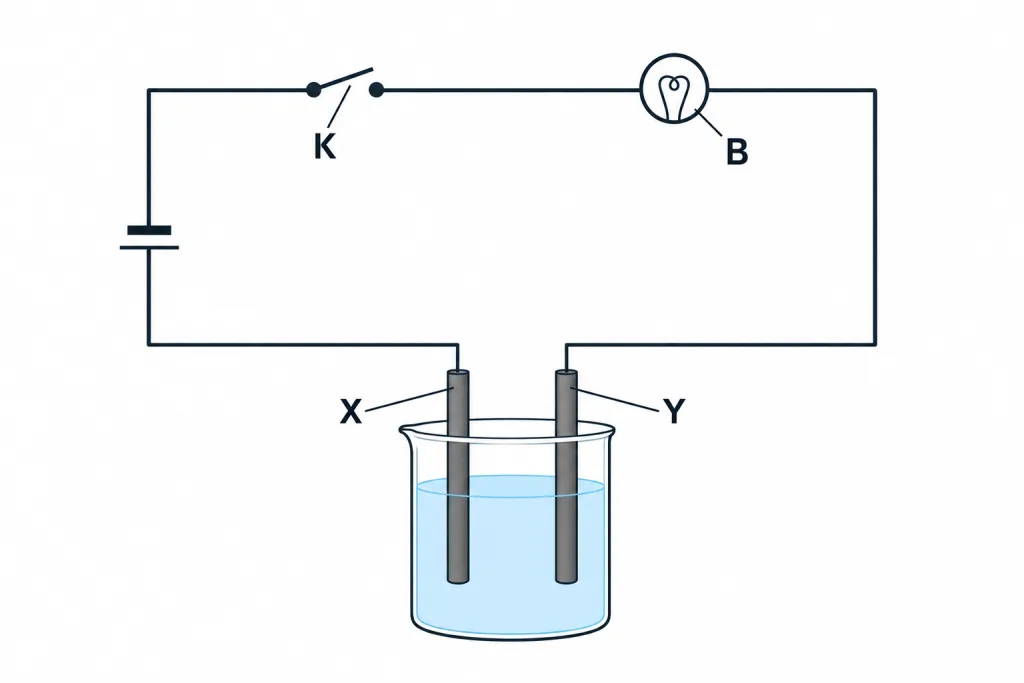
(a) In which of the four tests will the bulb glow? (1 mark)
Answer.
- Tests 2 and 4 (potassium iodide solution and molten potassium iodide), 0.5 each — 1 mark
(b) Why did Sana clean the rods before each test? What could go wrong if she did not? (1 mark)
Answer.
- Traces of the previous substance (for example potassium iodide solution) would stay on the rods and could make the bulb glow in a test where it should not, giving a false result — 1 mark
(c) Her friend says, "The bulb glows with the potassium iodide solution only because water is a good conductor." How can Sana use the same set-up to check this claim? What result should she expect, and what does it show? (2 marks)
Answer.
- Test distilled water alone with the same rods and circuit (accept: point to test 3, where the distilled water with sugar in it did not light the bulb) — 1 mark
- The bulb does not glow; so in test 2 the current is carried by the ions of potassium iodide, which are free to move in the solution, not by the water — 1 mark
OR
(c) In test 4, the current is passed through molten potassium iodide for some time. What is formed at the cathode and at the anode? Write the equation for the change at each electrode. (2 marks)
Answer.
- Cathode: potassium metal, — 1 mark
- Anode: iodine, — 1 mark
Question 14 (4 marks)
Students of a school in Puri, a town on the sea coast, left five identical iron strips of mass 50 g each on the school roof or in a cupboard for one year. They weighed the strips again at the end.
| Strip | Treatment | Where kept | Gain in mass (g) |
|---|---|---|---|
| A | none | roof | 4.8 |
| B | painted | roof | 0.4 |
| C | coated with zinc | roof | 0.1 |
| D | rubbed with oil once, at the start | roof | 2.9 |
| E | none | dry closed cupboard indoors | 0.2 |
(a) Strip A rusted badly. Why did its mass increase instead of decreasing? (1 mark)
Answer.
- Rust forms when iron combines with oxygen and water from the air (hydrated iron(III) oxide); the added oxygen and water increase the mass — 1 mark
(b) Which strip served as the control for the three coatings, and why was it needed? (1 mark)
Answer.
- Strip A (bare iron kept on the roof like B, C and D); without it the students could not tell how much each coating reduced rusting — 1 mark
(c) (i) Find the percentage increase in the mass of strip A.
(ii) The school wants to protect the iron grills of its windows. Which treatment from the table would you choose? Give a reason from the data. (2 marks)
Answer.
- (4.8 ÷ 50) × 100 = 9.6% — 1 mark
- Coating with zinc (galvanising): the least gain in mass, 0.1 g (accept painting: 0.4 g, and easy to redo on grills) — 1 mark
OR
(c) Compare strips A and E, which were both bare iron. What do they show about the conditions needed for rusting? Suggest one more strip the students could add to show that air is also needed. (2 marks)
Answer.
- E, kept away from moisture, hardly rusted while A rusted badly: water (moisture) is needed for rusting — 1 mark
- A bare strip kept under boiled (air-free) water with a layer of oil on top; it should hardly rust (accept any fair way of keeping water but no air) — 1 mark
Question 15 (4 marks)
In a class demonstration, the teacher heated four metals in air and the students noted what happened.
| Metal | What was seen |
|---|---|
| Sodium (a small piece) | caught fire at once and burnt with a golden-yellow flame |
| Magnesium ribbon | burnt with a dazzling white flame, leaving a white ash |
| Aluminium powder sprinkled into the flame | burnt with bright sparks, leaving a white powder |
| Copper foil | did not burn; became coated with a black layer |
(a) Write the balanced chemical equations for what happened to the magnesium and to the copper. (1 mark)
Answer.
- — 0.5 marks
- (black copper(II) oxide) — 0.5 marks
(b) Using the observations, arrange sodium, magnesium and copper in decreasing order of reactivity with oxygen. Why is sodium stored under kerosene? (1 mark)
Answer.
- Sodium > magnesium > copper — 0.5 marks
- It reacts so vigorously with oxygen (and moisture) that it can catch fire in the open; kerosene keeps air away — 0.5 marks
(c) The white ash of magnesium, shaken with water, turns red litmus blue. The white powder from aluminium does not change litmus, yet aluminium oxide is called amphoteric. Explain why the litmus does not change, what amphoteric means, and write the equations that show it. (2 marks)
Answer.
- Aluminium oxide does not dissolve in water, so no alkali forms to change the litmus — 0.5 marks
- Amphoteric: it reacts with both acids and bases to give salt and water — 0.5 marks
- — 0.5 marks
- (sodium aluminate) — 0.5 marks
OR
(c) Magnesium and aluminium are fairly reactive metals, yet a magnesium ribbon or an aluminium sheet left in air does not catch fire or crumble away. Why? How is this protection made stronger for aluminium window frames? (2 marks)
Answer.
- Their surface gets covered with a thin oxide layer that stops further reaction with air — 1 mark
- By anodising: the aluminium is made the anode in dilute sulphuric acid, and the oxide layer becomes thicker — 1 mark