
Chemical Reactions and Equations
Chemical Reactions and Equations carried 4 to 7 marks in the 2026-27 sample paper and the 2025 and 2026 board papers. Expect one to three MCQs, often an Assertion-Reason on exothermic and endothermic changes, and a 2- or 3-mark question on writing equations or explaining observations. The 2026-27 sample paper also set its 5-mark Chemistry long answer from this chapter.
Marks are most often lost on equations that are not balanced, on wrong formulae such as or , on missing or wrong state symbols (a precipitate is (s), not (aq)), on leaving out conditions such as heat or sunlight, on mixing up displacement and double displacement, and on naming the wrong substance as oxidised.
Revise in 5 Minutes
Writing equations
- Word equation → skeleton equation → balanced equation. Change only the numbers in front, never a formula. Atoms of each element must be equal on both sides (law of conservation of mass).
- State symbols (s), (l), (g), (aq); a precipitate is (s). Conditions go over the arrow: heat, sunlight, electric current.
- Signs of a reaction: a gas, a precipitate, a change of colour, of temperature, or of smell.
Types
| Type | Pattern | Example |
|---|---|---|
| Combination | A + B → AB | |
| Decomposition | AB → A + B | |
| Displacement | A + BC → AC + B | |
| Double displacement | AB + CD → AD + CB |
Decompositions to know
- Heat: (green → reddish-brown, smell of burning sulphur); (brown fumes).
- Light: ; silver bromide likewise (photography).
- Electric current: ; hydrogen at the cathode, volume 2 : 1.
Energy
- Exothermic: burning, + energy, quicklime + water, compost forming, diluting an acid.
- Endothermic: most decompositions, photosynthesis.
Oxidation and reduction
- Oxidation: gain of oxygen or loss of hydrogen. Reduction: the opposite. They occur together (redox).
- The oxidising agent gives oxygen and is itself reduced: in , CuO is reduced, hydrogen oxidised.
- Corrosion: rust on iron (reddish-brown), green coat on copper, black on silver. Rancidity: oxidation of fats and oils; slowed by airtight packing, nitrogen, cold, antioxidants.
Traps
- , ; gases are , , .
- Acid + base is double displacement with no precipitate.
- A reaction that needs a flame to start can still be exothermic.
How to use this page: try each question on paper first, then read the answer. The marks against each step show what an examiner looks for. The 1-mark MCQs and Assertion-Reason questions are in the quiz at the end, together with questions that test how well you understand the chapter; every quiz answer comes with its explanation.
Short Answer Questions (2 and 3 Marks)
Question 1 (2 marks)
Write the balanced chemical equation, with state symbols, for each of the following, and name the type of each reaction.
(a) Magnesium carbonate is heated strongly; magnesium oxide is left behind and carbon dioxide is given off.
(b) Aluminium powder burns in oxygen to form aluminium oxide.
Answer.
Model answer:
(a) . One compound breaks into two simpler substances, so this is a decomposition reaction.
(b) . Two substances join to form a single product, so this is a combination reaction.
Marking scheme:
- (a) — 0.5 marks
- Decomposition (thermal decomposition) — 0.5 marks
- (b) — 0.5 marks
- Combination (also accept: oxidation, redox, exothermic) — 0.5 marks
Question 2 (2 marks)
Sameer put a conical flask containing 100 mL of dilute hydrochloric acid on a balance and dropped in 3.25 g of zinc granules. The balance read 180.25 g just after he added the zinc, and 180.15 g when the fizzing stopped and all the zinc had dissolved.
(a) Why did the reading go down? Does this go against the law of conservation of mass?
(b) Write the balanced chemical equation for the reaction, with state symbols.
Answer.
Model answer:
(a) The reaction gives hydrogen gas, which bubbles out of the open flask. So 180.25 − 180.15 = 0.10 g of hydrogen left the flask and was not weighed. This does not go against the law of conservation of mass: if the gas were collected and weighed too, the total mass would be the same as before.
(b)
Marking scheme:
- (a) Hydrogen gas formed in the reaction escaped from the open flask (0.1 g), so the balance did not weigh it (0.5); it does not go against the law, as the total mass of the products including the gas equals that of the reactants (0.5) — 1 mark
- (b) : correct formulae and balancing 0.5, state symbols 0.5 — 1 mark
Question 3 (3 marks)
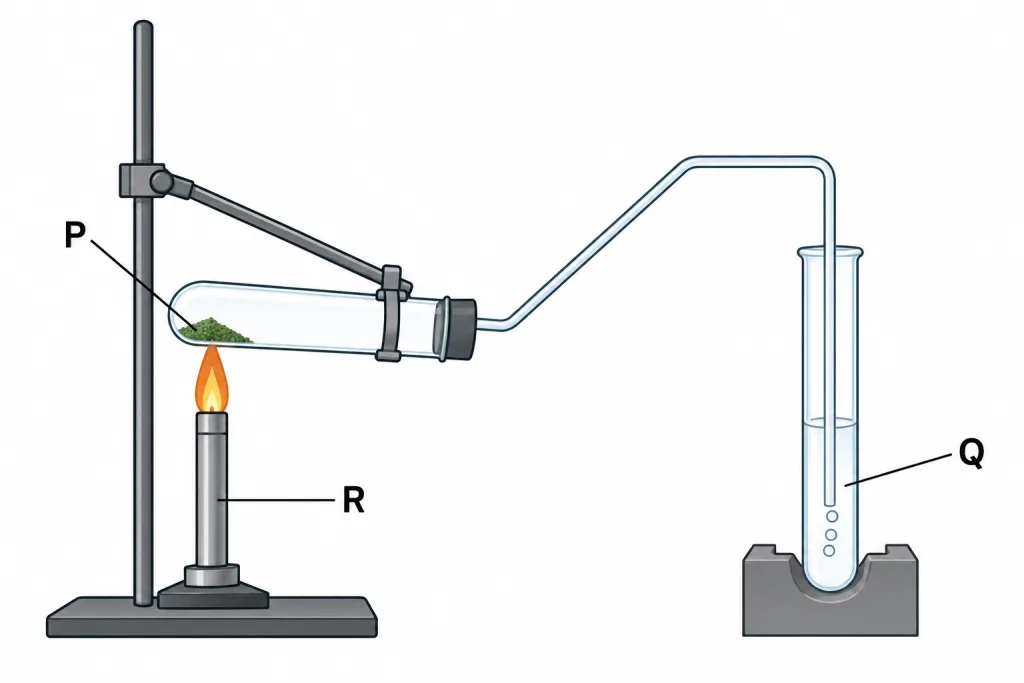
Neha heated a green compound of copper, P, in a boiling tube using burner R, as shown in the figure. The green powder slowly turned black, and the gas given off turned the lime water Q milky.
(a) Name the gas that turned the lime water milky and the black substance left in the tube.
(b) Write the balanced chemical equation, with state symbols, for the change in the boiling tube, and name the type of reaction.
(c) Before turning off burner R, Neha's teacher asked her to take the delivery tube out of the lime water. Why?
Answer.
Model answer:
(a) The gas is carbon dioxide. The black substance is copper(II) oxide, .
(b)
One compound breaks down into two simpler substances on heating, so it is a thermal decomposition reaction.
(c) When the burner is turned off, the tube cools and the gas inside it contracts. If the delivery tube is still dipping in the lime water, the lime water can be sucked back into the hot boiling tube, and the cold liquid can crack the hot glass.
Marking scheme:
- (a) Carbon dioxide; copper(II) oxide (0.5 + 0.5) — 1 mark
- (b) (also accept ), 0.5; thermal decomposition, 0.5 — 1 mark
- (c) As the hot tube cools, the gas inside contracts and lime water could be sucked back into the hot boiling tube and crack it; taking the tube out first prevents this — 1 mark
Question 4 (3 marks)
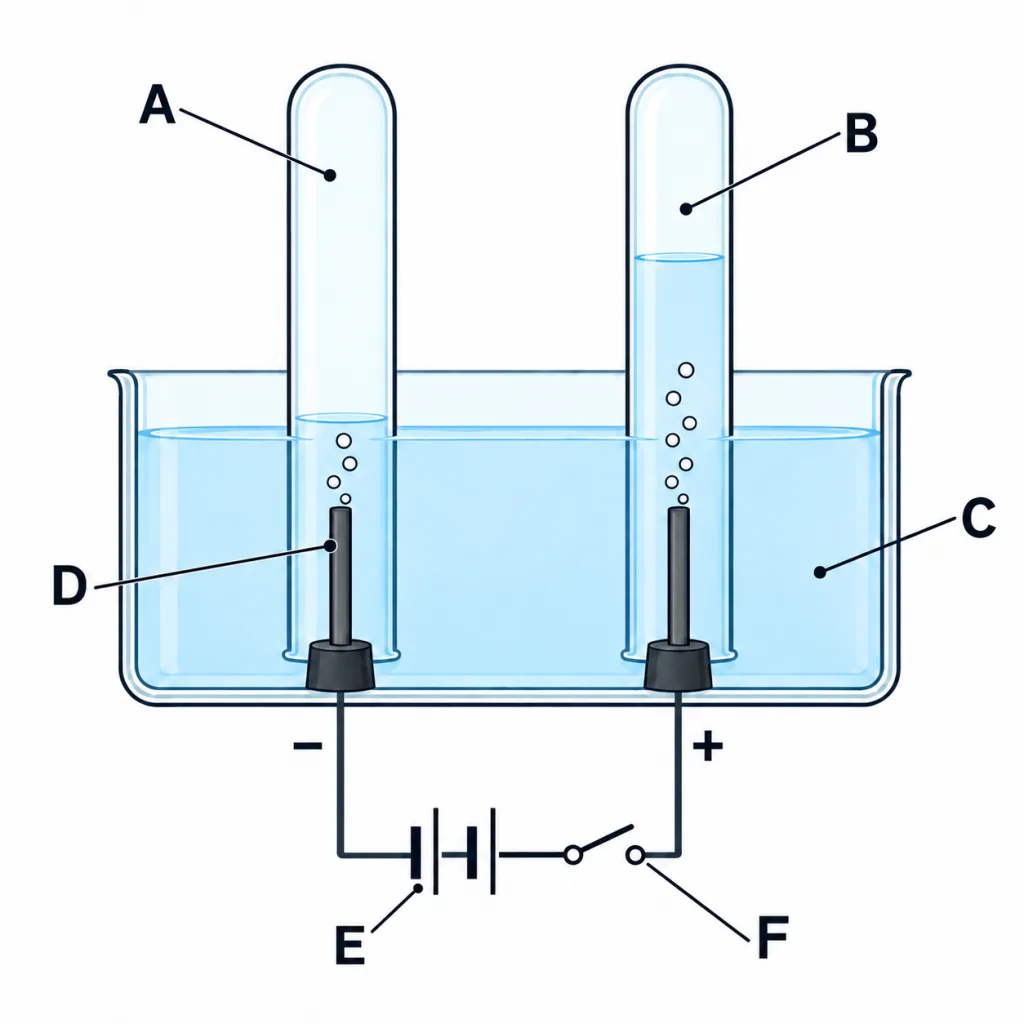
(a) Draw a labelled diagram of the set-up used for the electrolysis of water. Mark the gas collected over each electrode.
(b) Why are a few drops of dilute sulphuric acid added to the water before the current is switched on?
Answer.
Model answer:
(a) See the figure. Key: A, hydrogen gas (about twice the volume of B); B, oxygen gas; C, water with a few drops of dilute sulphuric acid; D, graphite electrode joined to the negative terminal (cathode); E, battery; F, switch.
The reaction is .
(b) Pure water is a very poor conductor of electricity. The dilute sulphuric acid gives ions in the water, so the current flows through it and the water breaks down.
Marking scheme:
- Correct set-up: two inverted test tubes full of water over two graphite electrodes in a trough, joined to a battery through a switch — 1 mark
- Labels: hydrogen over the negative electrode (cathode) and oxygen over the positive electrode (anode), with about twice the volume of hydrogen, 0.5; any two other parts correctly labelled (acidified water, electrode, battery, switch), 0.5 — 1 mark
- (b) Pure water conducts electricity very poorly; the acid gives ions in the water, so the current can flow and the water is decomposed — 1 mark
Question 5 (2 marks)
Three groups of students carried out the changes below and noted the temperature before and after.
| Set | What was done | Temperature before (°C) | Temperature after (°C) |
|---|---|---|---|
| P | Magnesium ribbon and dilute hydrochloric acid | 27 | 40 |
| Q | Solid barium hydroxide and solid ammonium chloride | 27 | 12 |
| R | 5 mL of concentrated sulphuric acid added slowly to 50 mL of water | 27 | 45 |
(a) Classify the changes in P, Q and R as exothermic or endothermic.
(b) Set Q also gave off a smell of ammonia. Pooja says, "Q cannot be a chemical reaction, because chemical reactions always give out heat." Is she right? Give a reason.
Answer.
Model answer:
(a) P and R are exothermic, because the temperature went up: heat was given out. (Diluting an acid gives out a lot of heat, which is why acid is added to water slowly.) Q is endothermic, because the temperature went down: heat was taken in from the surroundings.
(b) Pooja is not right. The smell of ammonia shows that a new substance has formed, so Q is a chemical reaction. Not all reactions give out heat; endothermic reactions like Q take it in.
Marking scheme:
- (a) P and R exothermic (temperature rises); Q endothermic (temperature falls) — 1 mark
- (b) No; the smell of ammonia shows a new substance has formed, so Q is a chemical reaction; some reactions take in heat from the surroundings (endothermic) — 1 mark
Question 6 (3 marks)
Carbon dioxide is used to put out fires. Yet when Kunal lowered a burning magnesium ribbon into a gas jar full of carbon dioxide, the ribbon went on burning. A white powder with black specks of carbon was left in the jar.
(a) Write the balanced chemical equation for this reaction.
(b) Which substance is oxidised and which is reduced? Give a reason for each.
(c) Is this a combination, a decomposition or a displacement reaction? Justify your answer.
Answer.
Model answer:
(a)
(b) Magnesium is oxidised, because it gains oxygen and becomes magnesium oxide (the white powder). Carbon dioxide is reduced, because it loses its oxygen and is left as carbon (the black specks).
(c) It is a displacement reaction. Magnesium is more reactive than carbon, so it takes the oxygen and pushes carbon out of its compound. It is also a redox reaction.
Marking scheme:
- (a) — 1 mark
- (b) Magnesium is oxidised, as it gains oxygen to form magnesium oxide; carbon dioxide is reduced, as it loses oxygen to form carbon (0.5 + 0.5) — 1 mark
- (c) Displacement: magnesium, being more reactive, takes the place of carbon and pushes carbon out of its oxide (also accept: redox reaction) — 1 mark
Question 7 (3 marks)
Give reasons:
(a) Walls whitewashed with slaked lime get a shiny finish two or three days later.
(b) Many brands of cooking oil add a little vitamin E, which acts as an antioxidant.
Answer.
Model answer:
(a) Slaked lime (calcium hydroxide) reacts slowly with carbon dioxide in the air and forms a thin layer of calcium carbonate, which gives the walls a shine:
(b) Oil slowly reacts with the oxygen of the air and turns rancid, so it starts to smell and taste bad. An antioxidant such as vitamin E slows down this oxidation, so the oil stays fresh for longer.
Marking scheme:
- (a) Slaked lime reacts slowly with carbon dioxide of the air to form a thin, shiny layer of calcium carbonate — 1 mark
- — 0.5 marks
- (b) Oils and fats are slowly oxidised by the oxygen of the air and turn rancid, so their smell and taste go bad — 1 mark
- An antioxidant slows down this oxidation, so the oil stays fresh for longer — 0.5 marks
Question 8 (2 marks)
When a candle burns, some of the wax melts and some of the wax burns. Which of these two changes is physical and which is chemical? Give one reason for each.
Answer.
Model answer:
- Melting of wax is a physical change. Only the state changes from solid to liquid. No new substance forms, and the molten wax sets into solid wax again when it cools.
- Burning of wax is a chemical change. The wax reacts with oxygen and forms new substances, carbon dioxide and water vapour, giving out heat and light. The burnt wax cannot be got back.
Marking scheme:
- Melting of wax is a physical change: no new substance forms, and the molten wax becomes solid wax again on cooling — 1 mark
- Burning of wax is a chemical change: new substances (carbon dioxide and water vapour) form with heat and light, and the wax cannot be got back — 1 mark
Question 9 (3 marks)
Neeraj dipped clean strips of four metals, P, Q, R and S, into solutions of the sulphates of the other three metals. He marked ✓ where a deposit formed on the strip and ✗ where nothing happened.
| Metal strip | Sulphate of P | Sulphate of Q | Sulphate of R | Sulphate of S |
|---|---|---|---|---|
| P | – | ✗ | ✗ | ✓ |
| Q | ✓ | – | ✓ | ✓ |
| R | ✓ | ✗ | – | ✓ |
| S | ✗ | ✗ | ✗ | – |
(a) Arrange the four metals in decreasing order of reactivity.
(b) The four metals are magnesium, zinc, iron and copper. Identify each of P, Q, R and S.
(c) Write the balanced chemical equation, with state symbols, for the reaction of R with the sulphate of P.
Answer.
Model answer:
(a) A metal forms a deposit only in the solution of a less reactive metal. Q does this in all three solutions, R in two, P in one and S in none. So the order is Q > R > P > S.
(b) Magnesium is the most reactive and copper the least, so Q is magnesium, R is zinc, P is iron and S is copper.
(c) R (zinc) displaces P (iron) from iron sulphate:
Marking scheme:
- (a) Q > R > P > S (Q displaces all three; S displaces none) — 1 mark
- (b) Q magnesium, R zinc, P iron, S copper (any two correct 0.5, all four 1) — 1 mark
- (c) — 1 mark
Question 10 (2 marks)
Ravi heated a few green crystals of iron(II) sulphate (ferrous sulphate), , in a dry boiling tube. First, drops of water formed on the cooler part of the tube and the crystals turned white. On stronger heating, the white solid turned reddish-brown and a smell of burning sulphur came out.
(a) Why did drops of water appear and the crystals turn white first?
(b) Write the balanced chemical equation for the change on strong heating, and name the type of reaction.
Answer.
Model answer:
(a) The green crystals contain water of crystallisation. Gentle heating drives this water out as steam, which condenses into drops on the cooler part of the tube, and the crystals lose their colour and turn white.
(b)
The reddish-brown solid is iron(III) oxide, and sulphur dioxide and sulphur trioxide give the smell. One compound breaks into simpler substances on heating, so this is a thermal decomposition.
Marking scheme:
- (a) The crystals contain water of crystallisation; on gentle heating this water is driven off (and condenses on the cool part), leaving white anhydrous iron(II) sulphate — 1 mark
- (b) (0.5); thermal decomposition (0.5) — 1 mark
Long Answer and Case-Based Questions
Question 11 (5 marks)
Attempt either option (A) or (B).
(A)
(i) Two white solids, X and Y, are heated in separate dry boiling tubes. X is a salt of lead and Y is a salt of zinc.
- X crackles, gives off brown fumes and leaves a yellowish solid.
- Y gives off a colourless gas that turns lime water milky, and leaves a solid that is yellow while hot and white when cold.
(I) Identify X and Y.
(II) Write the balanced chemical equation for the change in each tube.
(III) Name the brown gas. (3 marks)
Answer.
Model answer:
(I) X gives brown fumes, so it is lead nitrate. Y gives carbon dioxide, which turns lime water milky, so it is zinc carbonate; the residue, zinc oxide, is yellow when hot and white when cold.
(II)
(III) The brown gas is nitrogen dioxide, .
Marking scheme:
- (I) X: lead nitrate; Y: zinc carbonate (0.5 + 0.5) — 1 mark
- (II) (1); (0.5) — 1.5 marks
- (III) Nitrogen dioxide, — 0.5 marks
(ii) Write two things that the balanced equation tells us about this reaction. Also name one thing about the reaction that the equation does not tell us. (2 marks)
Answer.
Model answer:
It tells us:
- Hydrogen gas and oxygen gas react to form liquid water.
- Two molecules of hydrogen react with one molecule of oxygen to give two molecules of water, and the atoms of each element are the same on both sides.
It does not tell us that a spark or flame is needed to start the reaction, or how much heat is given out.
Marking scheme:
- Any two: the reactants and products (hydrogen and oxygen give water); their physical states; 2 molecules of hydrogen react with 1 molecule of oxygen to give 2 molecules of water; the number of atoms of each element is conserved; 0.5 each — 1 mark
- Any one it does not tell: the conditions needed (a spark or flame to start it); the heat given out; how fast the reaction takes place — 1 mark
OR
(B)
(i) (I) Write the balanced chemical equation for respiration of glucose in our cells.
(II) Write the balanced chemical equation for photosynthesis, with its conditions.
(III) Which of the two is exothermic and which is endothermic? Give a reason for each. (3 marks)
Answer.
Model answer:
(I) + energy
(II)
(III) Respiration is exothermic, because energy is released when glucose is broken down in our cells; this is what keeps our body warm. Photosynthesis is endothermic, because plants take in energy from sunlight to make glucose.
Marking scheme:
- (I) + energy — 1 mark
- (II) — 1 mark
- (III) Respiration is exothermic, as energy is given out; photosynthesis is endothermic, as it takes in energy from sunlight (0.5 + 0.5) — 1 mark
(ii) The tungsten used in bulb filaments is made by heating tungsten oxide in hydrogen: . Name the oxidising agent and the reducing agent. Why is this called a redox reaction? (2 marks)
Answer.
Model answer:
Tungsten oxide gives its oxygen to hydrogen, so it is the oxidising agent. Hydrogen takes the oxygen away, so it is the reducing agent.
It is a redox reaction because oxidation and reduction happen together: hydrogen gains oxygen and is oxidised, while tungsten oxide loses oxygen and is reduced.
Marking scheme:
- Oxidising agent: tungsten oxide; reducing agent: hydrogen (0.5 + 0.5) — 1 mark
- Hydrogen is oxidised (gains oxygen) and tungsten oxide is reduced (loses oxygen) in the same reaction — 1 mark
Question 12 (4 marks)
Before Diwali, Rakesh is getting whitewash ready at his home in Varanasi. He takes three buckets, P, Q and R, each with 10 litres of water at 25 °C. He adds 0.5 kg of quicklime lumps to P and 1 kg to Q. By mistake, he adds 1 kg of powdered limestone to R. He stirs each bucket and notes the highest temperature it reaches.
| Bucket | What was added | Highest temperature (°C) |
|---|---|---|
| P | 0.5 kg quicklime | 39 |
| Q | 1 kg quicklime | 53 |
| R | 1 kg limestone powder | 25 |
(a) Name the type of reaction that takes place in buckets P and Q. Is heat given out or taken in? (1 mark)
Answer.
- Combination reaction (0.5); heat is given out, so it is exothermic (0.5) — 1 mark
(b) Why did the water in Q get hotter than the water in P? (1 mark)
Answer.
- Q had twice as much quicklime reacting with the same amount of water, so about twice as much heat was given out — 1 mark
(c) Why did the temperature in R not change at all? How is quicklime made from limestone? Write the balanced chemical equation for it. (2 marks)
Answer.
- Limestone (calcium carbonate) does not react with water, so no heat is given out — 1 mark
- Quicklime is made by heating limestone strongly: — 1 mark
OR
(c) Write the balanced chemical equation, with state symbols, for the reaction in bucket Q. Rakesh's neighbour warns him not to dip his hand into bucket Q. Give two reasons. (2 marks)
Answer.
- — 1 mark
- The water is very hot and can burn the skin; the calcium hydroxide formed is a base (alkali) that can harm the skin (0.5 + 0.5) — 1 mark
Question 13 (4 marks)
At the water-testing laboratory of a municipal corporation in Bhopal, Nandini checks well-water samples for two kinds of dissolved salts. To one portion of a sample she adds barium chloride solution; a white precipitate shows that a sulphate is present. To another portion she adds silver nitrate solution; a white precipitate shows that a chloride is present.
(a) In one sample, the sulphate is present as sodium sulphate. Name the white precipitate formed with barium chloride, and the type of reaction. (1 mark)
Answer.
- Barium sulphate; double displacement (precipitation) reaction (0.5 + 0.5) — 1 mark
(b) Another sample gives a white precipitate with silver nitrate. A trainee says, "This proves the water contains sodium chloride." Is he right? Give a reason. (1 mark)
Answer.
- No (0.5); the test shows only that a chloride is present; any dissolved chloride, such as calcium or magnesium chloride, gives the same white silver chloride precipitate (0.5) — 1 mark
(c) Sample X gives a white precipitate with barium chloride but none with silver nitrate. Which of these salts could be dissolved in it: magnesium sulphate, calcium chloride, potassium sulphate, sodium chloride? Explain, and write the balanced equation for the reaction of barium chloride with any one of them. (2 marks)
Answer.
- Magnesium sulphate and potassium sulphate: they are sulphates, which give a precipitate with barium chloride; calcium chloride and sodium chloride are ruled out because a chloride would give a precipitate with silver nitrate — 1 mark
- (or ) — 1 mark
OR
(c) Nandini notices that the white silver chloride precipitate slowly turns grey if the test tube is left near a sunny window. Explain this with a balanced equation, and name the type of reaction. (2 marks)
Answer.
- In sunlight, silver chloride breaks down to give silver, which is grey — 0.5 marks
- — 1 mark
- Decomposition reaction brought about by light (photolytic decomposition) — 0.5 marks
Question 14 (4 marks)
In oil refineries, poisonous hydrogen sulphide gas is removed by reacting it with sulphur dioxide. Solid sulphur is recovered and sold:
(a) Show that this equation is balanced. (1 mark)
Answer.
- S: 2 + 1 = 3 on the left and 3 on the right (0.5); H: 4 and 4, O: 2 and 2 (0.5) — 1 mark
(b) Which substance is oxidised and which is reduced? Explain in terms of gain or loss of hydrogen or oxygen. (1 mark)
Answer.
- Hydrogen sulphide is oxidised, as it loses hydrogen; sulphur dioxide is reduced, as it loses oxygen (0.5 + 0.5) — 1 mark
(c) Name the oxidising agent and the reducing agent. Give a reason for each. (2 marks)
Answer.
- Oxidising agent: sulphur dioxide, because it gives oxygen, which removes hydrogen from hydrogen sulphide — 1 mark
- Reducing agent: hydrogen sulphide, because its hydrogen takes the oxygen away from sulphur dioxide — 1 mark
OR
(c) Traces of hydrogen sulphide in the air slowly turn silver ornaments black: . (i) What is this slow damage to a metal called, and what is the black substance? (ii) Suggest one way to protect the silver. (2 marks)
Answer.
- (i) Corrosion (0.5); silver sulphide (0.5) — 1 mark
- (ii) Any one: keep it in an airtight box or pouch; wrap it in paper or cloth; keep it away from air, moisture and eggs or other sulphur-containing things — 1 mark