
Carbon and its Compounds
Carbon and its Compounds carried 5 to 7 marks in the 2026-27 sample paper and the board papers of 2025 and 2026. Expect two or three MCQs (functional groups, isomers, homologous series, soaps), sometimes an Assertion-Reason, a 2- or 3-mark question on bonding or on the reactions of ethanol and ethanoic acid, and often the Chemistry 5-mark question (2025 and February 2026).
Where marks are usually lost:
- electron-dot structures with the wrong number of shared pairs, or with lone pairs missing on O or Cl;
- equations written without their conditions (concentrated sulphuric acid at 443 K, nickel catalyst, sunlight, acid catalyst);
- naming: mixing up -al (aldehyde) and -one (ketone), or miscounting the carbon atoms;
- calling hydrogenation a substitution reaction, or chlorination of methane an addition reaction.
Revise in 5 Minutes
Bonding: carbon (2, 4) shares electrons: covalent bonds. No (too much energy) or (6 protons cannot hold 10 electrons). Single, double, triple bonds share 1, 2, 3 pairs (; , ; ). Covalent compounds have low m.p. and b.p. and do not conduct (no ions).
Versatile carbon: catenation and tetravalency. Saturated = only C–C single bonds; unsaturated = a double or triple bond. Rings: cyclohexane , benzene . Isomers: same formula, different structures.
| Series or group | Formula or group | Ending | Example |
|---|---|---|---|
| alkane / alkene / alkyne | / / | -ane / -ene / -yne | propane / propene / propyne |
| halo | Cl, Br | chloro-, bromo- | chloropropane |
| alcohol | -ol | propanol | |
| aldehyde | -al | propanal | |
| ketone | in chain | -one | propanone |
| carboxylic acid | -oic acid | propanoic acid |
Homologous series: differ by (14 u); similar chemical, graded physical properties.
Reactions (Δ = heat)
- Combustion: ; saturated → clean blue flame, unsaturated → sooty yellow flame.
- Oxidation: (or acidified ).
- Addition: ; oil → vanaspati ghee.
- Substitution (sunlight): .
- Ethanol + sodium: .
- Dehydration: .
- Esterification: (sweet smell).
- Saponification: .
- Ethanoic acid: weak acid; vinegar is 5-8% in water; with or gives a salt, water and .
Soaps and detergents: soap = Na/K salt of a long-chain carboxylic acid; tail in oil, ionic end in water → micelle. Hard water (, ) gives scum with soap; detergents still lather.
Traps: hydrogenation is addition, not substitution; ketones start at 3 carbons; can be a ring.
How to use this page: try each question on paper first, then read the answer. The marks against each step show what an examiner looks for. The 1-mark MCQs and Assertion-Reason questions are in the quiz at the end, together with questions that test how well you understand the chapter; every quiz answer comes with its explanation.
Short Answer Questions (2 and 3 Marks)
Question 1 (2 marks)
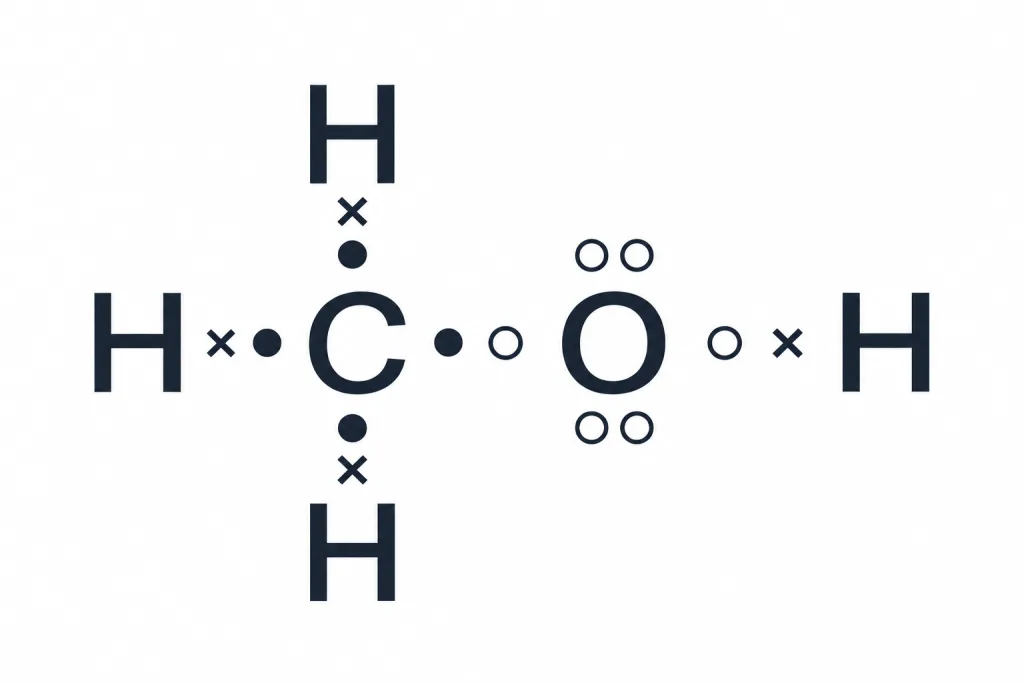
Draw the electron-dot structure of methanol, . (Atomic numbers: C = 6, O = 8) How many lone pairs of electrons are there on the oxygen atom, and how many pairs are shared in the whole molecule?
Answer.
Model answer:
The structure is shown in the figure.
Oxygen (2, 6) shares one pair with carbon and one with hydrogen, so 2 lone pairs are left on it.
Shared pairs: 3 (C-H) + 1 (C-O) + 1 (O-H) = 5 pairs.
Marking scheme:
- Correct structure: C shares one pair with each of three H atoms and one with O; O shares one pair with H (see figure) — 1 mark
- Two lone pairs on oxygen — 0.5 marks
- 5 shared pairs (accept 10 shared electrons) — 0.5 marks
Question 2 (3 marks)
Rohit named six compounds as shown. Say which names are wrong, and give the correct names.
(i) : propanone
(ii) : propanal
(iii) : butanol
(iv) : methanal
(v) : chloroethane
(vi) : propyne
Answer.
Model answer:
(i) Wrong. The -CHO group at the end of the chain makes it an aldehyde: propanal.
(ii) Wrong. The C=O group is in the middle of the chain, so it is a ketone: propanone.
(iii) Correct: butanol.
(iv) Wrong. -COOH is the carboxylic acid group: methanoic acid.
(v) Correct: chloroethane.
(vi) Wrong. The double bond makes it an alkene: propene.
Marking scheme:
- (i) Wrong: propanal (the -CHO group is at the end of the chain) — 0.5 marks
- (ii) Wrong: propanone (the C=O is inside the chain) — 0.5 marks
- (iii) Correct (accept butan-1-ol) — 0.5 marks
- (iv) Wrong: methanoic acid (it has the -COOH group) — 0.5 marks
- (v) Correct — 0.5 marks
- (vi) Wrong: propene (it has a double bond, not a triple bond) — 0.5 marks
Question 3 (3 marks)
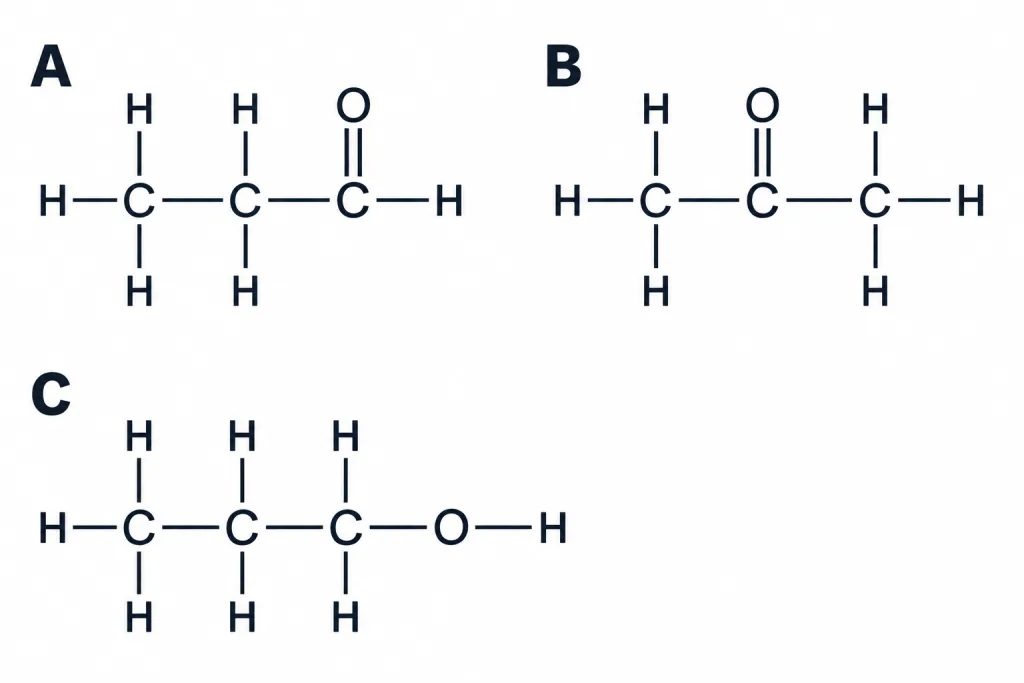
The figure shows the structural formulae of three compounds, A, B and C.
(a) Name A, B and C.
(b) Which two of them are isomers of each other? Give a reason.
Answer.
Model answer:
(a) A is propanal (aldehyde group at the end of the chain), B is propanone (C=O in the middle, a ketone) and C is propanol (an -OH group).
(b) A and B are isomers. Both have the formula , but their atoms are joined differently. C has two more hydrogen atoms, , so it is not an isomer of either.
Marking scheme:
- A: propanal — 0.5 marks
- B: propanone — 0.5 marks
- C: propanol (accept propan-1-ol) — 0.5 marks
- A and B: both have the molecular formula — 1 mark
- but different structures (the C=O is at the end in A and in the middle in B); C is — 0.5 marks
Question 4 (2 marks)
Study the table.
| Substance | Melting point (K) | Boiling point (K) |
|---|---|---|
| Potassium chloride | 1044 | 1693 |
| Propanone | 178 | 329 |
| Hexane | 178 | 342 |
(a) Why are the melting and boiling points of propanone and hexane so much lower than those of potassium chloride?
(b) Why does hexane not conduct electricity?
Answer.
Model answer:
(a) Propanone and hexane are covalent compounds made of separate molecules. The forces of attraction between these molecules are weak, so only a little heat is needed to melt or boil them. Potassium chloride is ionic, and the strong attraction between its ions needs far more heat to break.
(b) In hexane the atoms are held by shared electrons, and no ions are formed. With no charged particles free to move, it cannot carry an electric current.
Marking scheme:
- Propanone and hexane are covalent compounds made of molecules; the forces between their molecules are weak, so little energy is needed to melt or boil them — 0.5 marks
- Potassium chloride is ionic; the strong attraction between its ions needs much more energy to break — 0.5 marks
- Hexane is covalent; sharing of electrons forms no ions, so there are no charged particles to carry current — 1 mark
Question 5 (3 marks)
(a) Write the equation, with its condition, for the reaction of propene with hydrogen, and name the type of reaction.
(b) Write the equation for the first step of the reaction of methane with chlorine, with its condition, and name the type of reaction.
(c) Ethane is treated in the same two ways. Which of the two reactions can ethane undergo? Give a reason.
Answer.
Model answer:
(a)
Hydrogen adds across the double bond in the presence of a nickel catalyst: an addition reaction (hydrogenation).
(b) , in sunlight.
A chlorine atom takes the place of a hydrogen atom: a substitution reaction.
(c) Ethane can undergo only the substitution reaction. It has only single bonds, so there is no double bond for hydrogen to add across.
Marking scheme:
- ; nickel catalyst (heat); addition (hydrogenation) — 1 mark
- ; in sunlight; substitution — 1 mark
- Only substitution with chlorine: ethane is saturated (only single bonds), so hydrogen cannot add to it — 1 mark
Question 6 (3 marks)
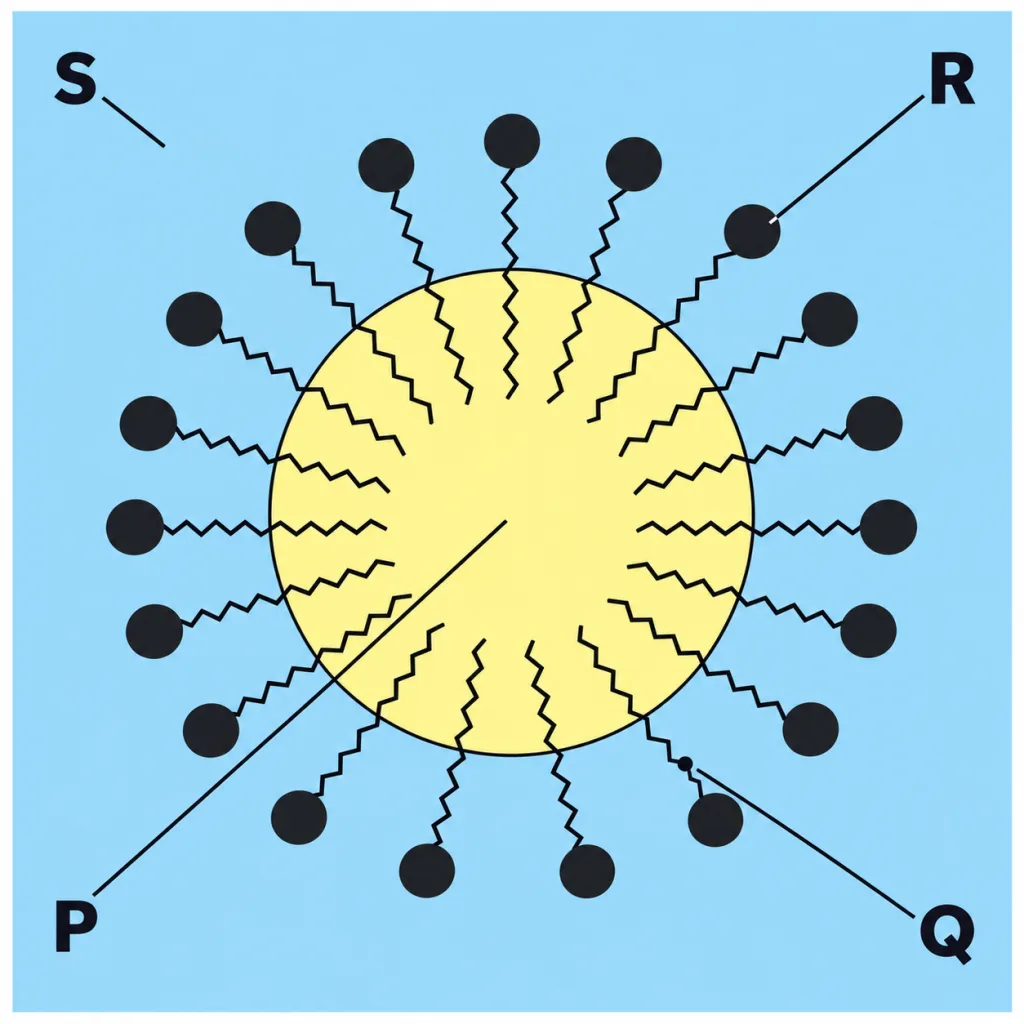
The figure shows the cluster formed when soap is shaken with water containing a drop of oil.
(a) Name the parts P, Q, R and S.
(b) Why does oily dirt not come off a cloth with water alone? How does this cluster help to remove it?
Answer.
Model answer:
(a) P is the oily dirt (the oil drop), Q is the hydrocarbon tail of a soap molecule, R is its ionic end and S is the water.
(b) Oil does not dissolve in water, so plain water just runs over the oily dirt. In soapy water the hydrocarbon tails dissolve in the oil and the ionic ends stay in the water. The soap molecules gather round the oil as a micelle, with the oil trapped inside, and the micelles stay spread in the water, so the dirt is carried away when the cloth is rinsed.
Marking scheme:
- P: oily dirt (oil drop) — 0.5 marks
- Q: hydrocarbon tail (hydrophobic) — 0.5 marks
- R: ionic end (hydrophilic head) — 0.5 marks
- S: water — 0.5 marks
- Oil does not dissolve in water; the tails dissolve in the oil and the ionic ends face the water, so a micelle forms with the oil trapped inside and is washed away in the water — 1 mark
Question 7 (2 marks)
Detergents are generally sodium salts of sulphonic acids or ammonium salts.
(a) Why does a detergent give a good lather even in hard water, while soap forms scum?
(b) Like a soap molecule, a detergent molecule has a long hydrocarbon part and a charged end. Which part dissolves in oily dirt? Why?
Answer.
Model answer:
(a) Hard water contains calcium and magnesium salts. Soap reacts with them and forms an insoluble substance called scum, so a lot of soap is wasted before any lather forms. The charged ends of detergent molecules do not form insoluble precipitates with calcium and magnesium ions, so detergents lather well even in hard water.
(b) The long hydrocarbon part dissolves in the oily dirt, because it is like oil itself. The charged end stays in the water, so detergent molecules clean in the same way as soap.
Marking scheme:
- Hard water has calcium and magnesium salts; soap reacts with them to form an insoluble substance (scum), so soap is wasted and lather is poor — 0.5 marks
- The charged ends of detergents do not form insoluble precipitates with calcium and magnesium ions, so they lather well — 0.5 marks
- The long hydrocarbon part, because it is like oil itself (hydrophobic); the charged end stays in the water — 1 mark
Question 8 (3 marks)
The ester has a fruity smell.
(a) Name the carboxylic acid and the alcohol from which it is made.
(b) Write the chemical equation for its formation, and state the condition needed.
(c) Give two uses of esters.
Answer.
Model answer:
(a) Split the ester at the group. The part with the , , comes from propanoic acid, and the part comes from ethanol.
(b)
The concentrated sulphuric acid on the arrow acts as a catalyst, and the mixture is warmed. This reaction is called esterification.
(c) Esters are sweet-smelling substances, so they are used in making perfumes and as flavouring agents.
Marking scheme:
- Acid: propanoic acid, — 0.5 marks
- Alcohol: ethanol, — 0.5 marks
- — 0.5 marks
- Condition: an acid catalyst (a few drops of concentrated sulphuric acid) and warming — 0.5 marks
- Uses: in making perfumes; as flavouring agents (0.5 each) — 1 mark
Question 9 (2 marks)
Ethanol burns in air to give carbon dioxide and water. When it is warmed with alkaline potassium permanganate, it changes into ethanoic acid instead.
(a) Write the change of ethanol into ethanoic acid, with its conditions.
(b) Why are both these changes called oxidation? What is the role of the potassium permanganate?
Answer.
Model answer:
(a)
Acidified potassium dichromate also works. With the oxygen shown as [O], it can also be written .
(b) Both changes add oxygen to ethanol. In burning, the oxygen of the air turns it completely into carbon dioxide and water; with potassium permanganate, only part of the molecule gains oxygen and ethanoic acid is formed. Adding oxygen is oxidation. Potassium permanganate supplies the oxygen, so it is an oxidising agent.
Marking scheme:
- (alkaline potassium permanganate or acidified potassium dichromate, heat); accept also — 1 mark
- Both add oxygen to ethanol; burning gives carbon dioxide and water, the other gives ethanoic acid — 0.5 marks
- Potassium permanganate is an oxidising agent: it supplies the oxygen — 0.5 marks
Question 10 (2 marks)
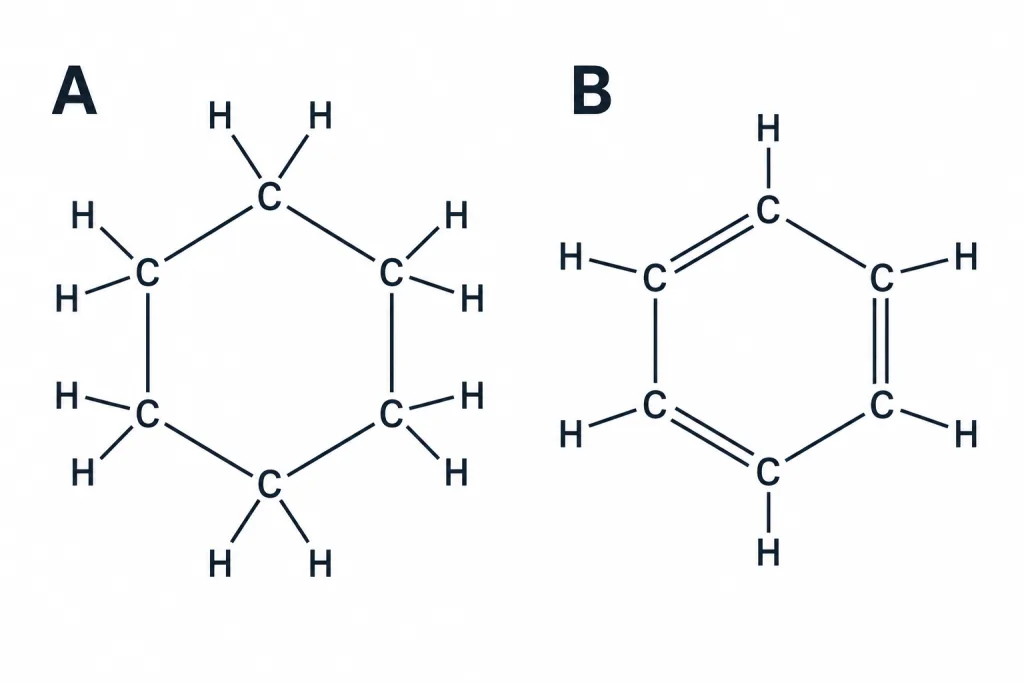
Draw the structures of cyclohexane and benzene, showing all the atoms. How does the bonding between the carbon atoms differ in the two compounds?
Answer.
Model answer:
The structures are shown in the figure (A cyclohexane, B benzene). Both have six carbon atoms joined in a ring.
In cyclohexane, , every carbon-carbon bond is a single bond and each carbon also holds two hydrogen atoms, so it is saturated. In benzene, , single and double bonds alternate round the ring, and each carbon holds only one hydrogen atom, so it is unsaturated.
Marking scheme:
- Cyclohexane: a ring of six carbons with single bonds, each carbon with two H atoms () (A in the figure) — 0.5 marks
- Benzene: a ring of six carbons with alternate single and double bonds, each carbon with one H atom () (B in the figure) — 0.5 marks
- Cyclohexane has only single carbon-carbon bonds (saturated); benzene has three double bonds in the ring (unsaturated) — 1 mark
Long Answer and Case-Based Questions
Question 11 (5 marks)
Attempt either option (A) or (B).
(A) Bonding in carbon compounds
(i) Megha says, "Carbon forms millions of compounds only because it can form double and triple bonds." Is she right? Name and explain the two properties of carbon that really account for the huge number of its compounds. (2 marks)
Answer.
- No (multiple bonds add to the variety, but are not the main reason). Catenation: carbon atoms link with other carbon atoms by strong covalent bonds, forming long chains, branched chains and rings — 1 mark
- Tetravalency: carbon has a valency of four, so each carbon can bond with four other atoms of carbon or of other elements (H, O, N, S, Cl) — 1 mark
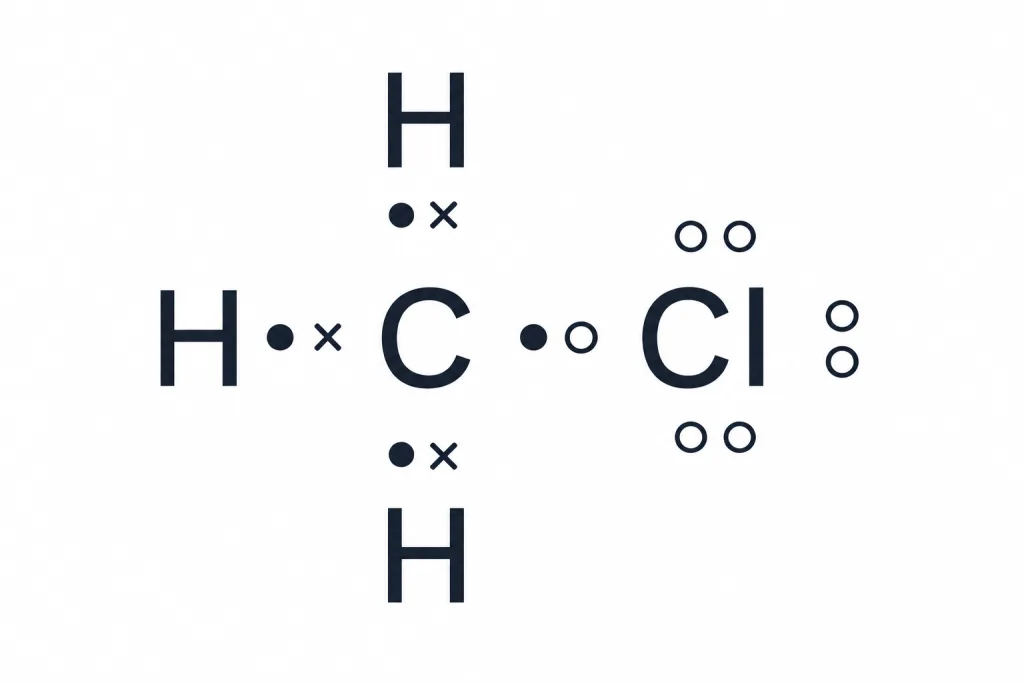
(ii) Draw the electron-dot structure of chloromethane, . (Atomic numbers: C = 6, Cl = 17) Show the lone pairs of electrons. (2 marks)
Answer.
- Correct structure: C shares one pair with each of three H atoms and one pair with Cl (four single covalent bonds) — 1.5 marks
- Three lone pairs shown on the chlorine atom — 0.5 marks
(iii) Why does carbon not form ions by losing or gaining four electrons? (1 mark)
Answer.
- Losing four electrons to form would need a very large amount of energy — 0.5 marks
- Gaining four to form is difficult, as a nucleus with six protons cannot hold ten electrons — 0.5 marks
OR
(B) Reactions of ethanol. Kiran is given ethanol and asked to carry out three changes.
(i) She has to make ethene from it. What should she do? Write the equation with its conditions, and state the role of the reagent. (2 marks)
Answer.
- Heat ethanol at 443 K with excess of concentrated sulphuric acid: — 1.5 marks
- Concentrated sulphuric acid is a dehydrating agent: it removes water from ethanol — 0.5 marks
(ii) She burns a little ethanol in a spirit lamp. Write the balanced equation for its complete combustion. What colour of flame shows that the burning is complete? (2 marks)
Answer.
- (heat and light are given out) — 1.5 marks
- A clean blue flame, with no soot — 0.5 marks
(iii) She drops a small piece of sodium into ethanol. Name the two products. (1 mark)
Answer.
- Sodium ethoxide — 0.5 marks
- Hydrogen gas — 0.5 marks
Question 12 (4 marks)
A class made this table of the first four members of the alkane family.
| Name | Formula | Boiling point (°C) |
|---|---|---|
| Methane | −162 | |
| Ethane | −89 | |
| Propane | −42 | |
| Butane | −1 |
All four gases burn in air to give carbon dioxide and water, and LPG, the cooking gas, is mostly butane.
(a) By how much do two successive members differ in formula and in molecular mass? (C = 12 u, H = 1 u) (1 mark)
Answer.
- By a unit in formula — 0.5 marks
- By 14 u in molecular mass — 0.5 marks
(b) Pentane, , is the next member. Will it be a gas or a liquid at 25 °C? Use the trend in the table to explain. (1 mark)
Answer.
- The rise gets smaller at each step (73, 47, 41 °C), so the next rise is about 35-40 °C; pentane should boil at about 35-40 °C (actual 36 °C) — 0.5 marks
- This is above 25 °C, so pentane is a liquid at 25 °C — 0.5 marks
(c) The boiling points of these four compounds are very different, yet they all react in the same way, for example when they burn. Explain both facts. (2 marks)
Answer.
- They are members of a homologous series: same general formula and same kind of bonding (all single bonds), so their chemical properties are similar — 1 mark
- Physical properties such as boiling point change gradually as the molecular mass (size of the molecule) increases — 1 mark
OR
(c) The alkanes have the general formula . Write the general formulae of the alkenes and the alkynes, and write the formula and name of the alkene with four carbon atoms and of the alkyne with three carbon atoms. (2 marks)
Answer.
- Alkenes ; alkynes — 1 mark
- Butene, — 0.5 marks
- Propyne, — 0.5 marks
Question 13 (4 marks)
In a practical test, Tanvi's teacher gives her three colourless liquids, X, Y and Z. She is told that they are ethanol, ethanoic acid and ethyl ethanoate, in some order, and she records these results.
| Test | X | Y | Z |
|---|---|---|---|
| Blue litmus paper | turns red | no change | no change |
| A clean magnesium ribbon | bubbles of gas | no change | no change |
| Smell | sharp, like vinegar | sweet and fruity | like spirit |
(a) Identify X, Y and Z. (1 mark)
Answer.
- X ethanoic acid; Y ethyl ethanoate; Z ethanol (one correct 0.5, all three 1) — 1 mark
(b) Write the balanced chemical equation for the reaction of X with magnesium. How can Tanvi test the gas given off? (1 mark)
Answer.
- (magnesium ethanoate and hydrogen) — 0.5 marks
- Bring a burning splinter near the gas: it burns with a pop sound, so it is hydrogen — 0.5 marks
(c) Y is made from X and Z. Write the chemical equation for making Y, with its conditions. Why does Y not turn blue litmus red or react with magnesium, although it is made from an acid? (2 marks)
Answer.
- — 1 mark
- The -COOH group of the acid has reacted with the -OH group of the alcohol to form the ester group; with no free -COOH group left, Y does not give hydrogen ions and shows no acidic properties — 1 mark
OR
(c) Tanvi drops a small piece of sodium into a little of Z. Write the balanced chemical equation, name the organic product, and describe a test for the gas given off. (2 marks)
Answer.
- — 1 mark
- Organic product: sodium ethoxide — 0.5 marks
- The gas burns with a pop sound when a burning splinter is brought near: hydrogen — 0.5 marks
Question 14 (5 marks)
Attempt either option (A) or (B).
(A) Carbon compounds at home
(i) Four carbon compounds found at home are listed below.
| Product | Main carbon compound |
|---|---|
| Vinegar | |
| Nail-polish remover | |
| Hand sanitiser | |
| An old dry-cleaning fluid |
Name the functional group present in each compound. Which of the four will turn blue litmus red? Give a reason. (3 marks)
Answer.
- Vinegar: carboxylic acid (-COOH) — 0.5 marks
- Nail-polish remover: ketone (C=O in the chain) — 0.5 marks
- Sanitiser: alcohol (-OH) — 0.5 marks
- Dry-cleaning fluid: halo (chloro) group — 0.5 marks
- Vinegar (ethanoic acid), because its -COOH group gives hydrogen ions in water — 1 mark
(ii) Some sanitisers contain propanol, , instead of ethanol. Do ethanol and propanol belong to the same homologous series? Give two reasons, and say which of the two has the higher boiling point. (2 marks)
Answer.
- Yes: both have the same functional group, -OH — 0.5 marks
- They differ by one -CH2- unit (14 u) (accept: same general formula, similar chemical properties) — 0.5 marks
- Propanol has the higher boiling point, as boiling point rises with molecular mass in a homologous series — 1 mark
OR
(B) Oils and fats
(i) Vegetable oils are changed into vanaspati ghee in a factory. What is reacted with the oil, what is the catalyst, and what type of reaction is this? Write the equation for the same kind of reaction with ethene, with its conditions. (3 marks)
Answer.
- Hydrogen is added to the oil — 0.5 marks
- Nickel is the catalyst (accept palladium) — 0.5 marks
- Addition reaction (hydrogenation) — 0.5 marks
- — 1.5 marks
(ii) Why is the ghee a solid while the oil is a liquid? Why are oils with unsaturated fatty acids advised for cooking? (2 marks)
Answer.
- Adding hydrogen removes the double bonds, so the ghee is saturated, and saturated fats are solids at room temperature — 1 mark
- Saturated fatty acids are said to be harmful for health, so oils with unsaturated fatty acids are preferred — 1 mark