
Electricity
Electricity carried 6 to 9 marks in the 2026-27 sample paper and the board papers of 2025 and 2026. Expect one MCQ (often on or a combination of resistors), a 2-mark question (Joule's law, resistivity, the volt, or joining resistors to get a given value), a 3-mark circuit numerical, and often the Physics 5-mark question (February and May 2026).
Where marks are usually lost:
- not converting units before substituting: mm² to m², minutes to seconds, W to kW;
- treating a series part of a mixed circuit as parallel, or the other way round;
- writing only the final number: each numerical has marks for the formula, the substitution and the unit;
- mixing up resistance (depends on the size of the wire) and resistivity (depends only on the material and temperature).
Revise in 5 Minutes
Quantities and units
| Quantity | Relation | Unit |
|---|---|---|
| Current | 1 A = 1 C of charge per second | |
| Potential difference | 1 V: 1 J of work moves 1 C | |
| Resistance | 1 Ω: 1 V drives 1 A | |
| Resistivity | Ω m | |
| Power | 1 W: 1 A flows under 1 V |
- One electron carries C; 1 C is about electrons.
- Current flows from + to − in the outer circuit; electrons move the other way.
- Ammeter in series (very low resistance); voltmeter in parallel (very high resistance); + terminal towards the + of the cell.
Ohm's law: at constant temperature . The V-I graph (V on the y-axis) is a straight line through the origin, and its slope is .
Resistance: , ; depends only on the material and its temperature. Alloys have a higher than pure metals.
Combinations
- Series: ; same current, voltage shared in the ratio of the resistances.
- Parallel: ; same voltage, the smaller resistor takes the larger current; is less than the smallest.
- equal resistors : series , parallel .
Joule's law of heating: heat produced , and : . Uses: iron, toaster, heater (nichrome), bulb (tungsten, melting point 3380 °C, filled with nitrogen and argon), fuse (low melting point, in series).
Energy: 1 kWh = 1 unit = J.
Traps
- Stretching, folding or cutting a wire changes , never .
- A rating holds only at the rated voltage: find first.
- In series the larger resistor gets hotter; in parallel the smaller one does.
How to use this page: try each question on paper first, then read the answer. The marks against each step show what an examiner looks for. The 1-mark MCQs and Assertion-Reason questions are in the quiz at the end, together with questions that test how well you understand the chapter; every quiz answer comes with its explanation.
Short Answer Questions (2 and 3 Marks)
Question 1 (2 marks)
Meera wrote in her notebook: "In a copper wire joined to a cell, electrons flow through the wire from the positive terminal of the cell to its negative terminal. The electric current flows in the same direction as the electrons." Point out the two mistakes and correct them.
Answer.
- Mistake 1: in the wire, electrons flow from the negative terminal of the cell to its positive terminal — 1 mark
- Mistake 2: the electric current is taken to flow opposite to the electrons, from the positive terminal to the negative terminal through the outer circuit — 1 mark
Question 2 (2 marks)
(a) Define 1 volt.
(b) A 12 V car battery drives charge through a headlamp. How much charge must flow through the lamp for it to receive 720 J of energy? If this charge flows in 20 s, what is the current?
Answer.
- (a) The potential difference between two points is 1 volt when 1 joule of work is done to move 1 coulomb of charge from one point to the other — 1 mark
- (b) C; A (0.5 + 0.5) — 1 mark
Question 3 (3 marks)
Answer the following about the resistance of a metallic wire.
(a) On what factors does the resistance of a uniform metallic wire depend? Show how they combine to give , and say what stands for. (2 marks)
Answer.
Model answer:
Length: a longer wire has more resistance, .
Area of cross-section: a thicker wire has less resistance, .
Material: wires of the same size but different metals have different resistances.
Putting 1 and 2 together, . The constant that makes this an equation depends on the material, and is called its resistivity : .
Marking scheme:
- Length of the wire, its area of cross-section and the material it is made of (also accept: temperature) — 1 mark
- and , so , that is, ; the constant is the resistivity of the material — 1 mark
(b) A copper wire and a nichrome wire have the same length and the same area of cross-section. The resistivity of copper is and that of nichrome is . Which wire has the larger resistance, and about how many times larger is it? (1 mark)
Answer.
- Same and , so : nichrome, about times (0.5 + 0.5) — 1 mark
Question 4 (3 marks)
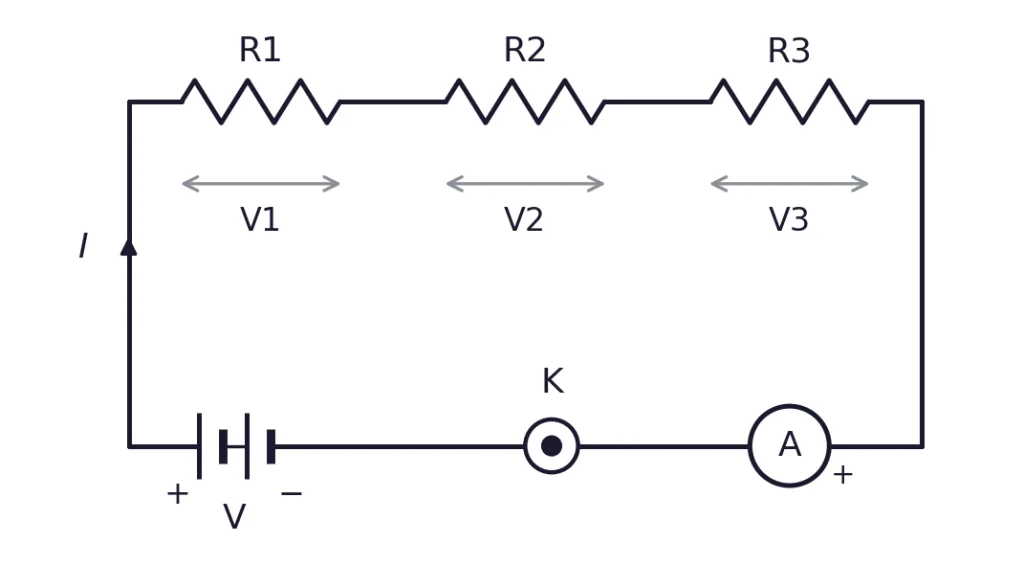
Three resistors , and are joined in series to a battery of potential difference . Show that their equivalent resistance is . Draw the circuit you use.
Answer.
Model answer:
The circuit is shown in the figure.
- In a series circuit there is only one path, so the same current flows through , and .
- The potential difference of the battery is shared among them: .
- By Ohm's law, , and .
- Let one resistor replace all three and draw the same current from the battery. Then .
Putting these together, . Dividing by , .
Marking scheme:
- Circuit with the three resistors, battery, key and ammeter in series (see figure) — 1 mark
- Same current in all three, and (0.5 + 0.5) — 1 mark
- , , and , so , giving — 1 mark
Question 5 (2 marks)
You have three resistors of 4 Ω each.
(a) How will you join all three to get (I) 6 Ω and (II) Ω? Show the working.
(b) What are the largest and the smallest resistances you can get by using all three?
Answer.
- (a)(I) Two in parallel give ; this in series with the third: — 0.5 marks
- (a)(II) Two in series give 8 Ω; this in parallel with the third: — 0.5 marks
- (b) Largest: all in series, ; smallest: all in parallel, (0.5 + 0.5) — 1 mark
Question 6 (3 marks)
In the circuit shown, the key K is closed and the ammeter A1 reads 0.5 A. The battery and the ammeter have negligible resistance.
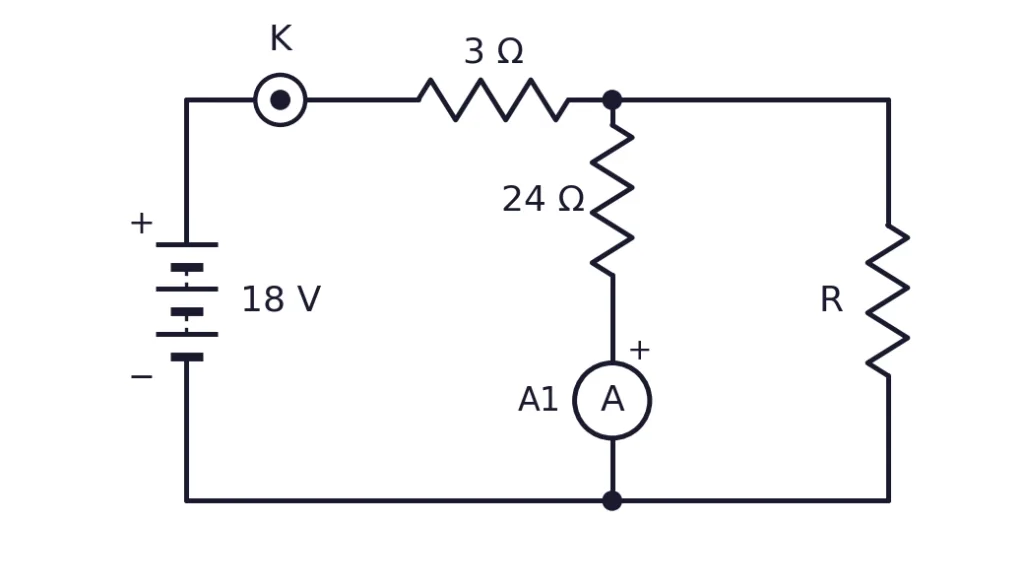
(a) Find the potential difference across the 24 Ω resistor and across the 3 Ω resistor. (1 mark)
Answer.
- Across 24 Ω: V — 0.5 marks
- Across 3 Ω: V — 0.5 marks
(b) Find the current drawn from the battery. (1 mark)
Answer.
- All the battery current passes through the 3 Ω resistor: A — 1 mark
(c) Find the value of R. (1 mark)
Answer.
- Current through R A; the p.d. across R is also 12 V (parallel) — 0.5 marks
- (check: and A) — 0.5 marks
Question 7 (2 marks)
A string of decorative lights has 44 identical tiny bulbs joined in series, and it is plugged into the 220 V mains.
(a) What potential difference does each bulb get?
(b) The filament of one bulb breaks. What happens to the other bulbs, and why? Give one reason why the lights and fans of a house are never wired in this way.
Answer.
- (a) The 220 V is shared equally: V per bulb — 0.5 marks
- (b) All the bulbs go off, because a series circuit has only one path; a break anywhere stops the current everywhere — 0.5 marks
- In a house every appliance must get the full 220 V and work on its own switch; in series they would share the voltage, and one fault or one switch turned off would stop all of them (any one reason) — 1 mark
Question 8 (3 marks)
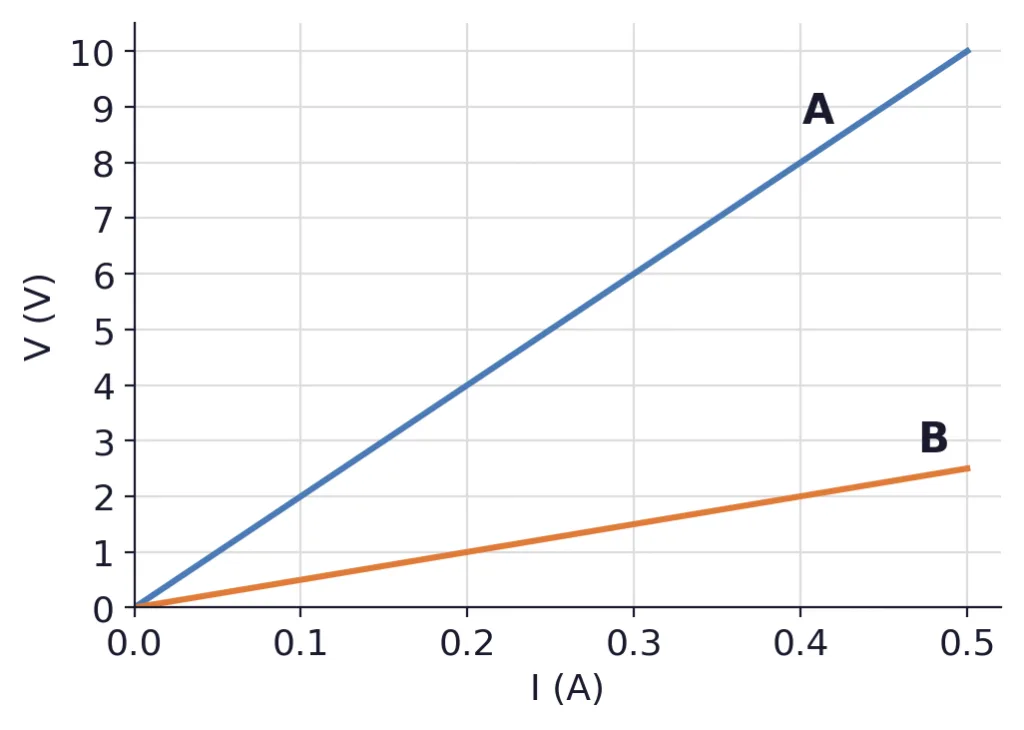
The graph shows how the potential difference V across two wires, A and B, changes with the current I through them. The two wires have the same length and thickness but are made of different materials.
(a) Find the resistance of each wire from the graph. (1 mark)
Answer.
- ; (any point on each line) (0.5 + 0.5) — 1 mark
(b) Which material has the higher resistivity? Which wire is the better choice for the heating element of a toaster, and which for the connecting wires? (1 mark)
Answer.
- A: with the same size, the larger resistance means the larger resistivity (0.5); A for the heating element, B for the connecting wires (0.5) — 1 mark
(c) The two wires are joined in series to a battery. In which wire is more heat produced every second? Why? (1 mark)
Answer.
- In A (0.5): the same current flows through both, and the heat per second, , is larger where is larger (0.5) — 1 mark
Question 9 (3 marks)
At the start of a 30-day month, the electricity meter of the Khan family read 4527.6 units; at the end it read 4752.6 units. Every day the family uses a refrigerator (on average 150 W over the whole 24 hours), three fans of 60 W each for 10 hours and five LED bulbs of 20 W each for 6 hours. The only other appliance is a 1 kW water pump.
(a) How much electrical energy did the family use each day?
(b) For how long does the pump run each day?
(c) Find the bill for the month at ₹ 6.50 per unit.
Answer.
- (a) Month: units; per day kWh (0.5 + 0.5) — 1 mark
- (b) Other appliances per day: kWh — 0.5 marks
- Pump: kWh at 1 kW, so it runs hours a day — 0.5 marks
- (c) Bill , that is, ₹ 1462.50 — 1 mark
Question 10 (3 marks)
Arjun measured the current through a thin wire at different potential differences and recorded:
| V (volt) | 0.5 | 1.0 | 1.5 | 2.0 | 2.5 | 3.0 |
|---|---|---|---|---|---|---|
| I (ampere) | 0.10 | 0.20 | 0.30 | 0.38 | 0.45 | 0.50 |
(a) Find the resistance of the wire from the first three readings. (1 mark)
Answer.
- — 1 mark
(b) Find for the last reading. Why is it different from your answer to (a)? (1 mark)
Answer.
- — 0.5 marks
- At larger currents the thin wire heats up, and the resistance of a metal wire increases with temperature — 0.5 marks
(c) Suggest one precaution Arjun should take so that his readings follow Ohm's law. (1 mark)
Answer.
- Keep the current small, or close the key only while taking a reading, so that the wire does not heat up (accept: use a thicker wire) — 1 mark
Question 11 (2 marks)
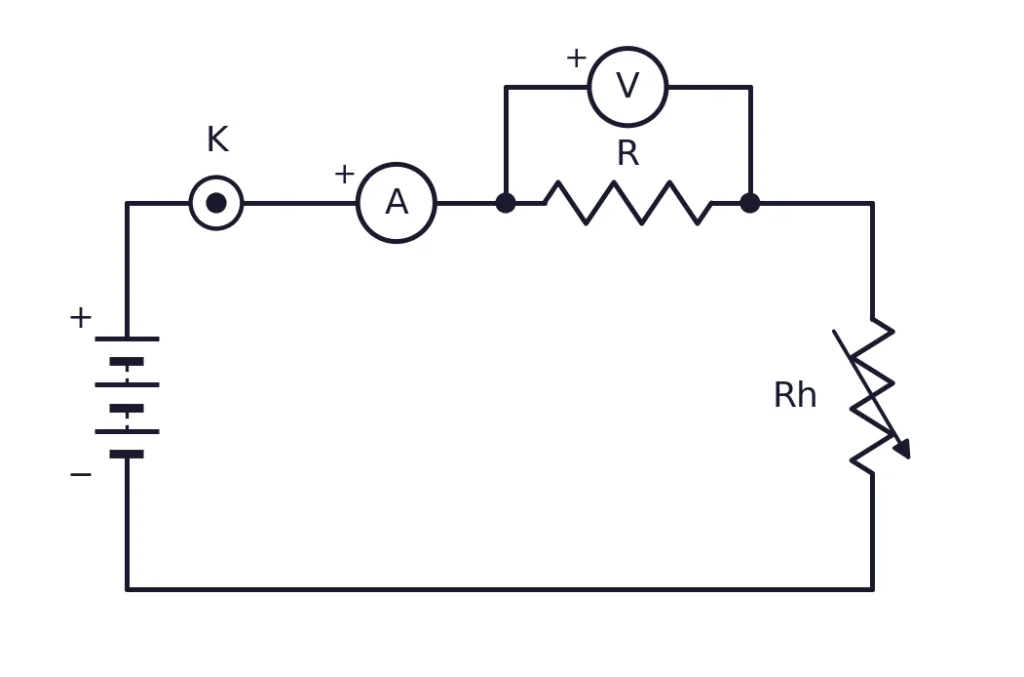
Draw a circuit diagram to study how the current through a resistor R changes with the potential difference across it. Use a battery, a plug key, an ammeter, a voltmeter and a rheostat. What is the job of the rheostat in this circuit?
Answer.
- Correct diagram: ammeter in series with R, voltmeter across R, rheostat and key in series, with + terminals of the meters towards the + side of the battery (see figure) — 1 mark
- The rheostat changes the resistance in the circuit, and so changes the current (and the p.d. across R) without changing the battery — 1 mark
Question 12 (2 marks)
(a) State Joule's law of heating.
(b) The current through a heating coil is halved, and the coil is kept on for twice as long as before. How does the heat produced now compare with the heat produced before?
Answer.
- (a) The heat produced in a resistor is proportional to the square of the current, to the resistance and to the time for which the current flows: — 1 mark
- (b) , so the heat is half of what it was — 1 mark
Long Answer and Case-Based Questions
Question 13 (5 marks)
Attempt either option (A) or (B).
(A)
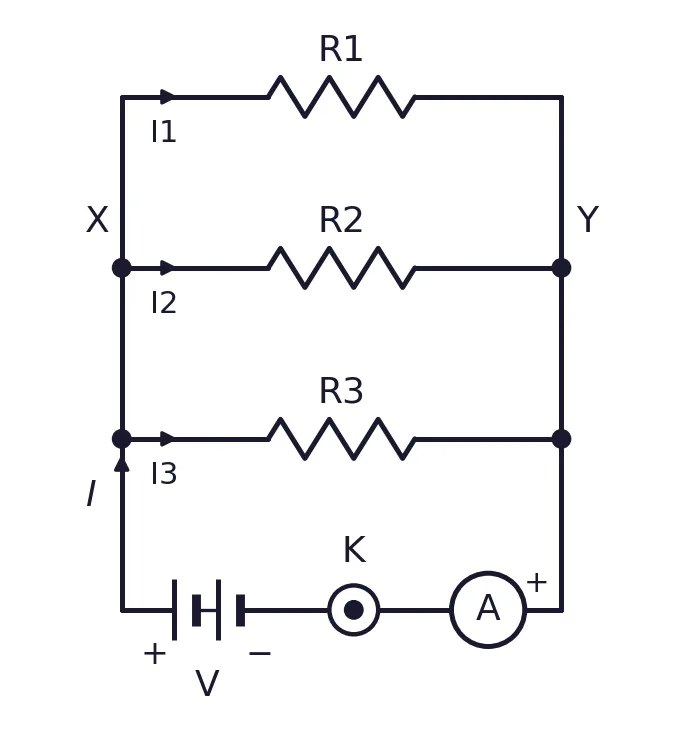
(i) Three resistors , and are joined in parallel to a battery. Draw the circuit and derive the expression for their equivalent resistance. (3 marks)
Answer.
Model answer:
The circuit is shown in the figure.
- Each resistor is joined directly between X and Y, so the potential difference across each is the same, .
- The current from the battery divides at X: .
- By Ohm's law, , and .
- If a single resistor between X and Y draws the same current, then .
So . Dividing by , .
Marking scheme:
- Circuit with the three resistors joined between the same two points X and Y (see figure) — 1 mark
- Same p.d. across each; (0.5 + 0.5) — 1 mark
- , , and , so — 1 mark
(ii) Three resistors of 6 Ω, 12 Ω and R are joined in parallel, and their equivalent resistance is 2 Ω. Find R. Which of the three carries the largest current? (2 marks)
Answer.
- , so — 1 mark
- The 4 Ω resistor (0.5): all three have the same p.d., and is largest for the smallest (0.5) — 1 mark
OR
(B)
(i) A steady current flows for a time through a resistor , with a potential difference across it. Starting from the definition of potential difference, show that the heat produced in the resistor is . What must you assume about the energy supplied? (3 marks)
Answer.
Model answer:
By definition, the work done in moving a charge through a potential difference is .
In time a current carries a charge , so .
By Ohm's law , so .
If the resistor only gets warm and does no other work, all of this energy appears as heat: .
Marking scheme:
- Work done in moving charge through p.d. is , and , so — 1 mark
- With , — 1 mark
- Assumption: all the energy supplied is changed into heat in the resistor (it does no other work, such as running a motor), so — 1 mark
(ii) A 4 Ω resistor and an unknown resistor R are joined in series across a 12 V battery. Heat is produced in the 4 Ω resistor at the rate of 16 W. Find the current, the value of R and the power used in R. (2 marks)
Answer.
- , so A — 0.5 marks
- Total resistance , so (0.5 + 0.5) — 1 mark
- Power in R W — 0.5 marks
Question 14 (5 marks)
Attempt either option (A) or (B).
(A) Ravi wants to run a torch bulb marked 3 V, 0.5 A from a 9 V battery. Take the resistance of the bulb to stay the same.
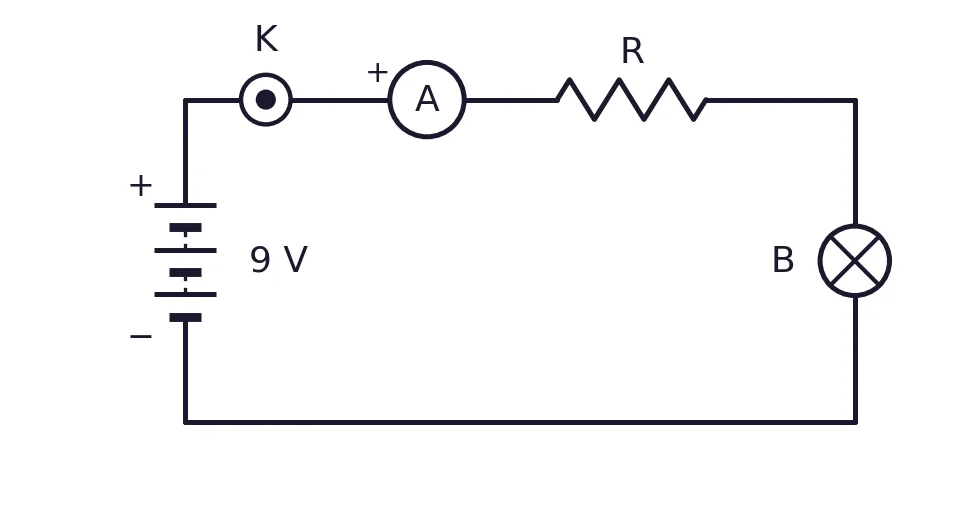
(i) Draw a circuit diagram with the battery, a key, an ammeter, the bulb and a resistor R that lets the bulb work at its rating. Find R, and the power wasted in R. (3 marks)
Answer.
- Circuit: battery, key, ammeter, R and bulb all in series (see figure) — 1 mark
- The bulb takes 3 V, so R takes V at 0.5 A: (0.5 + 0.5) — 1 mark
- Power wasted in R W — 1 mark
(ii) He now joins a second, identical bulb in parallel with the first, keeping the same R. Find the current from the battery and the potential difference across the bulbs. What value of R would let both bulbs work at their rating? (2 marks)
Answer.
- Each bulb is , two in parallel ; A and V, so the bulbs glow dimly (0.5 + 0.5) — 1 mark
- Both bulbs need A at 3 V, so R must drop 6 V at 1 A: — 1 mark
OR
(B) Rohan studies how the resistance of a wire depends on its size. He takes three wires of the same alloy, joins each in turn across the same 3.0 V battery and notes the current. (Ignore the resistance of the battery and the ammeter.)
| Wire | Length | Area of cross-section | Current |
|---|---|---|---|
| A | 1 m | 0.2 mm² | 0.6 A |
| B | 2 m | 0.2 mm² | 0.3 A |
| C | 2 m | 0.4 mm² | 0.6 A |
(i) Find the resistance of each wire. What do wires A and B, and wires B and C, show about the resistance of a wire? (3 marks)
Answer.
- : , , — 1 mark
- A and B (same area): doubling the length doubles the resistance, so resistance is proportional to length — 1 mark
- B and C (same length): doubling the area of cross-section halves the resistance, so resistance is inversely proportional to the area — 1 mark
(ii) Find the resistivity of the alloy. What current would flow through a 1.5 m wire of the same alloy, with an area of cross-section of 0.3 mm², joined across the same battery? (2 marks)
Answer.
- — 1 mark
- , so A (0.5 + 0.5) — 1 mark
Question 15 (4 marks)
A school in Jaipur had 40 filament bulbs of 60 W each in its classrooms. They have been replaced by 40 LED bulbs of 9 W each, which give the same amount of light. All the bulbs work on the 220 V supply and are on for 6 hours a day, on 25 school days a month. A filament bulb gives out most of its energy as heat and only a small part as light, while an LED bulb stays nearly cool.
(a) Why does the filament of a bulb become hot when a current flows through it? (1 mark)
Answer.
- The source spends energy to keep the current flowing through the filament's resistance; this energy is given out as heat (), the heating effect of current (also accept: the moving electrons keep colliding with the metal ions and pass their energy to them as heat) — 1 mark
(b) The filament bulb and the LED bulb give the same light. Which of the two changes a larger fraction of the electrical energy it uses into light? Use the data to explain. (1 mark)
Answer.
- The LED bulb (0.5): it gives the same light while using only 9 W instead of 60 W, so much less energy is lost as heat (0.5) — 1 mark
(c) How much electrical energy, in kWh, does the school save in a month? What is the saving in money at ₹ 8 per unit? (2 marks)
Answer.
- Power saved W kW; hours in a month h (0.5 + 0.5) — 1 mark
- Energy saved kWh; money saved , that is, ₹ 2448 (0.5 + 0.5) — 1 mark
OR
(c) Find the total current drawn by the 40 bulbs from the supply before and after the change. Why does the smaller current also mean that the school's wiring heats up much less? (2 marks)
Answer.
- Before: A; after: A (0.5 + 0.5) — 1 mark
- Heat in the wires is ; the current becomes times as large, so the heat in the same wires becomes times (about ) (accept: heat depends on the square of the current) — 1 mark
Question 16 (4 marks)
Many rechargeable torches use a lithium cell. The cell in Tenzin's torch is marked "3.7 V, 3000 mAh". The rating 3000 mAh means that the cell can give a current of 3000 mA (3 A) for one hour, or a smaller current for a longer time, before it needs to be charged again. On its normal setting, the torch draws a current of 0.6 A.
(a) How much charge, in coulombs, can the fully charged cell deliver? (1 mark)
Answer.
- C — 1 mark
(b) For how long can the torch run on its normal setting on one full charge? (1 mark)
Answer.
- s hours — 1 mark
(c) How much energy is stored in the fully charged cell? What is the power of the torch on its normal setting? (2 marks)
Answer.
- J, about J — 1 mark
- W — 1 mark
OR
(c) How many electrons pass through the torch in one second on its normal setting? (Charge on an electron = C) On its bright setting the torch runs for only 2 hours on a full charge. What current does it draw then? (2 marks)
Answer.
- electrons per second — 1 mark
- A (accept: mA) — 1 mark
Question 17 (4 marks)
The heating coil of Mrs Rao's room heater, rated 1100 W, 220 V, broke near one end. The coil was 2.2 m long and had a resistance of 44 Ω. The electrician cut off the broken 20 cm piece and fitted the remaining 2.0 m of the same coil back into the heater.
(a) Is the resistance of the repaired coil more or less than before? Give a reason. (1 mark)
Answer.
- Less (0.5), because the resistance of a wire is proportional to its length and the coil is now shorter (0.5) — 1 mark
(b) On the same supply, will the repaired heater give out more heat or less heat every second than before? Why? (1 mark)
Answer.
- More (0.5): the voltage is the same and , so a smaller resistance gives a larger power (0.5) — 1 mark
(c) Find the resistance of the repaired coil, and the power and the current of the heater now. (2 marks)
Answer.
- — 0.5 marks
- W — 1 mark
- A — 0.5 marks
OR
(c) The heater's plug is fitted with a 5 A fuse. Will the repaired heater blow it? What is the shortest length of this coil that can be used on the 220 V supply without blowing the fuse? (2 marks)
Answer.
- Yes (0.5): it draws A, which is more than 5 A (0.5) — 1 mark
- Need ; the coil has per metre, so at least m, the original length (0.5 + 0.5) — 1 mark