
The Human Eye and the Colourful World
The Human Eye and the Colourful World carried 1 to 8 marks in the 2026-27 sample paper and the board papers of 2025 and 2026; with the Light chapter it always makes up 12 marks. Expect an MCQ on the parts of the eye or on a defect (presbyopia came in both 2025 and 2026), a 3-mark question that usually needs a diagram (rainbow, myopia and its correction, the Tyndall effect), and sometimes the 5-mark question (sample paper) or part of a case study on the prism (2026 second board).
Where marks are usually lost:
- defect diagrams without the far point or near point marked, or with the wrong lens;
- saying that the eye lens moves, or that the lens-retina distance changes, during accommodation;
- mixing up the causes of hypermetropia (short eyeball) and presbyopia (weak ciliary muscles);
- explaining the blue sky or the rainbow by reflection alone.
Revise in 5 Minutes
Parts of the eye: cornea (most of the refraction), iris (controls the size of the pupil), pupil (lets light in), eye lens (fine focusing), ciliary muscles (change the lens curvature), retina (light-sensitive screen), optic nerve (signals to the brain). The image on the retina is real and inverted; the brain makes us see it upright.
Accommodation: distant object → ciliary muscles relax, lens thin, focal length long; near object → muscles contract, lens thick, focal length short. The lens-retina distance never changes. Normal eye: near point 25 cm (least distance of distinct vision), far point infinity.
| Defect | Cannot see | Image falls | Cause | Correction |
|---|---|---|---|---|
| Myopia | far objects | in front of retina | long eyeball or over-curved lens | concave lens, (far point) |
| Hypermetropia | near objects | behind retina | short eyeball or long focal length | convex lens (image of 25 cm object at near point) |
| Presbyopia | near objects, with age | behind retina | weak ciliary muscles, stiff lens | convex or bifocal lens |
Cataract: cloudy eye lens, removed by surgery.
Prism: light bends towards the base at both faces; mark i, e and the angle of deviation D. Dispersion: white light → VIBGYOR; red deviated least, violet most. An inverted second prism recombines the colours into white light.
Rainbow: droplets refract and disperse sunlight, reflect it internally and refract it again; seen with the Sun behind you.
Atmospheric refraction: air layers of changing density bend light: stars twinkle (point sources), planets do not (extended), stars seem higher near the horizon, sunrise about 2 min early and sunset 2 min late, flattened Sun at the horizon, wavering objects over hot air.
Scattering: Tyndall effect (beam seen in smoke, mist, colloids). Very fine particles scatter blue most; large particles scatter all colours (white clouds). Blue sky; dark sky in space; red danger signals (least scattered).
Common mistakes: a glass slab gives no spectrum; the eye lens never moves when it focuses.
How to use this page: try each question on paper first, then read the answer. The marks against each step show what an examiner looks for. The 1-mark MCQs and Assertion-Reason questions are in the quiz at the end, together with questions that test how well you understand the chapter; every quiz answer comes with its explanation.
Short Answer Questions (2 and 3 Marks)
Question 1 (3 marks)
(a) On a misty night the beams of a car's headlights are seen as bright paths in the air. Name this phenomenon and state what causes it.
(b) Smoke rising from an incense stick looks bluish against a dark background, but the steam from a boiling kettle looks white. Explain why.
Answer.
Model answer:
(a) This is the Tyndall effect. The mist has tiny water droplets. They scatter part of the headlight beam sideways, some of it reaches our eyes, and so we see the path of the beam.
(b) The colour of scattered light depends on the size of the particles. Incense smoke has very fine particles, and these scatter mainly the shorter wavelengths, so the smoke looks bluish. Steam is made of much larger water droplets, which scatter all the colours about equally, so the scattered light is white.
Marking scheme:
- The Tyndall effect — 0.5 marks
- The tiny water droplets of the mist scatter part of the light sideways into our eyes, so the path of the beam is seen — 0.5 marks
- Incense smoke has very fine particles, which scatter mainly the shorter wavelengths (blue) — 1 mark
- The water droplets in steam are much larger and scatter all colours nearly equally, so the scattered light looks white — 1 mark
Question 2 (3 marks)
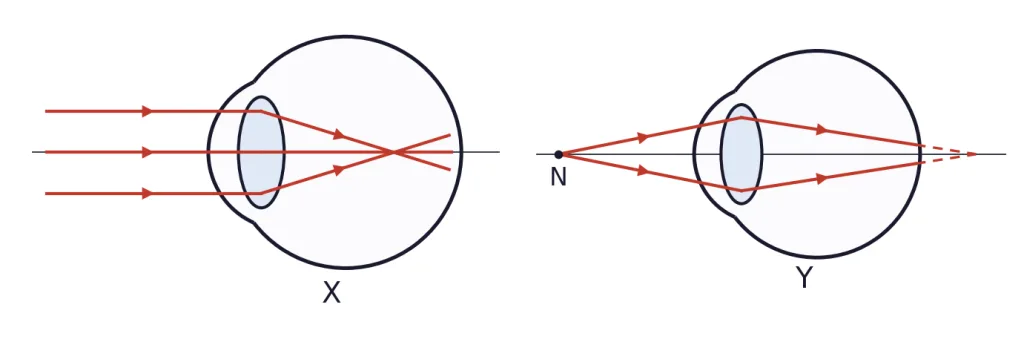
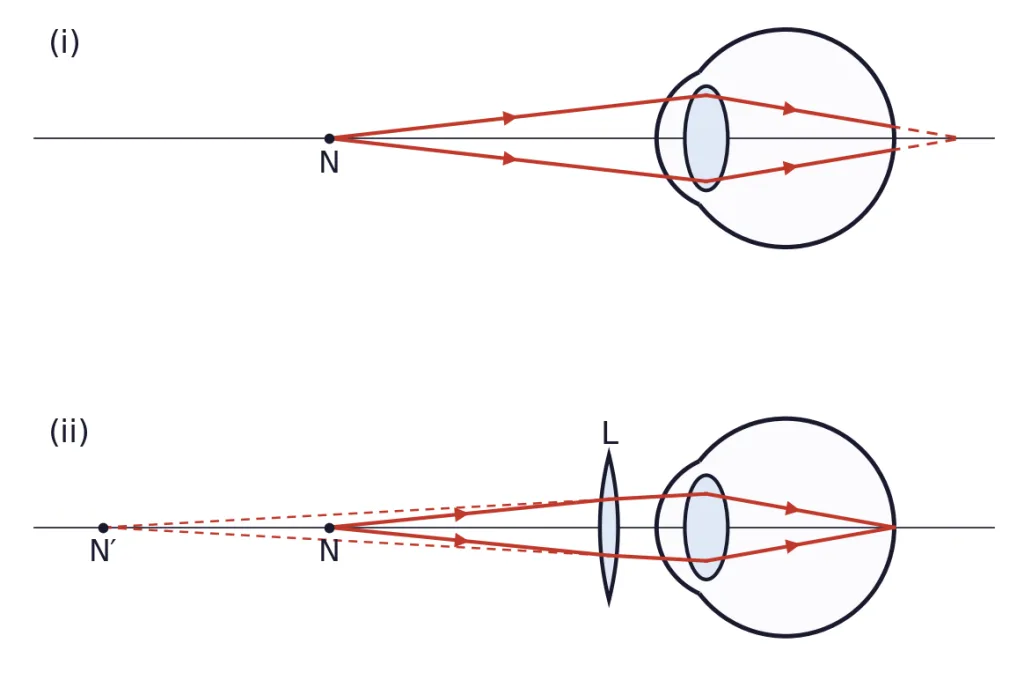
The figure shows how light from an object forms an image in two defective eyes, X and Y. For eye X the object is very far away; for eye Y, which belongs to a 12-year-old, the object is at N, 25 cm from the eye.
(a) Name the defect of each eye and the kind of lens that will correct it.
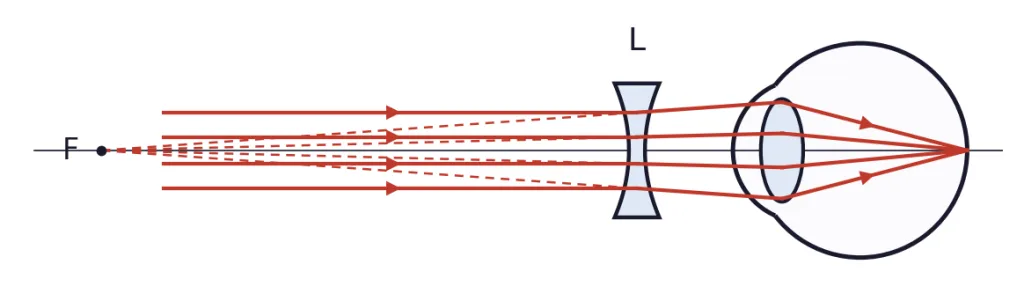
(b) Draw a ray diagram to show how the correcting lens helps eye X to see the distant object clearly.
Answer.
Model answer:
(a)
- In eye X, parallel light from a distant object comes to a focus in front of the retina. This is myopia, corrected by a concave lens.
- In eye Y, light from an object at 25 cm would come to a focus behind the retina. This is hypermetropia, corrected by a convex lens.
(b) The ray diagram is shown in the figure. The concave lens L spreads the parallel rays so that they seem to come from F, the far point of eye X. The eye can focus light from its far point, so the rays now meet on the retina.
Marking scheme:
- X: light from a distant object meets in front of the retina: myopia; concave lens — 1 mark
- Y: light from a near object would meet behind the retina: hypermetropia; convex lens — 1 mark
- Diagram: concave lens in front of eye X; parallel rays diverge as if from the far point F and are focused on the retina — 1 mark
Question 3 (2 marks)
The image formed on the retina is real and inverted.
(a) How does the information in this image reach the brain?
(b) Why do we still see objects the right way up?
Answer.
Model answer:
(a) The retina has a very large number of light-sensitive cells. When light falls on them, they are activated and produce electrical signals. The optic nerves carry these signals to the brain.
(b) The eye only makes the image; the seeing is done by the brain. The brain works out the signals it gets and shows us things as they really are, the right way up.
Marking scheme:
- The light-sensitive cells of the retina are activated by light and produce electrical signals, which the optic nerve carries to the brain — 1 mark
- Seeing happens in the brain: it works out the signals so that we see things the right way up — 1 mark
Question 4 (3 marks)
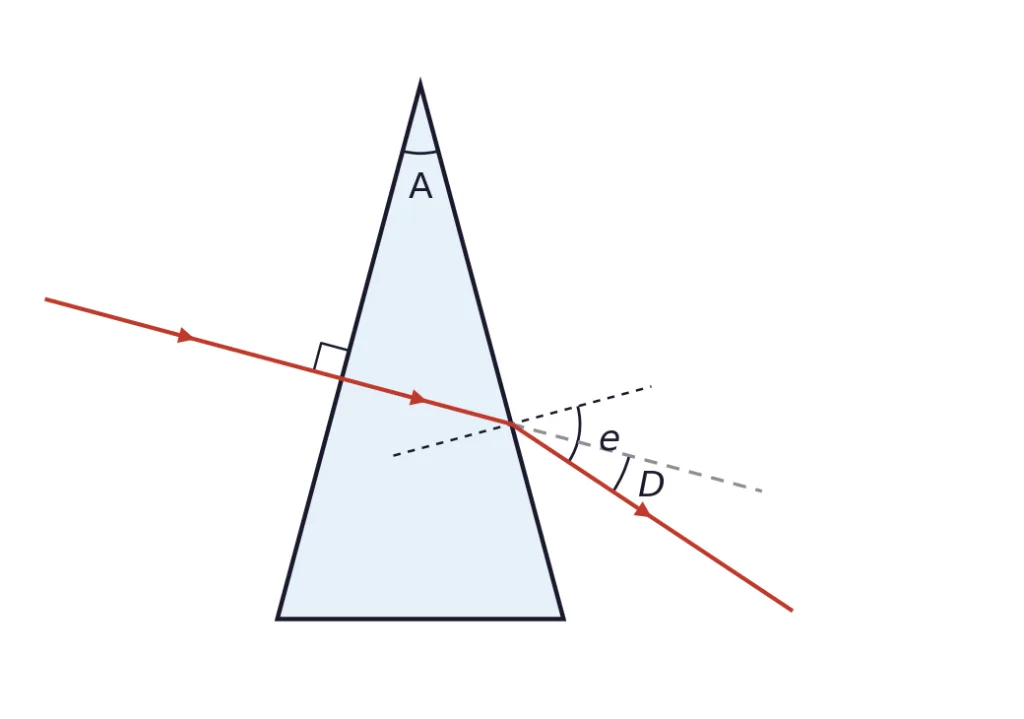
(a) A ray of light falls normally (along the normal) on one face of a glass prism whose angle is 30°. Draw its path through the prism and out of the second face.
(b) Why does the ray not bend at the first face?
(c) If the prism were made of a glass of higher refractive index, how would the angle of deviation change?
Answer.
Model answer:
(a) The path is shown in the figure (A is the angle of the prism). The ray goes straight into the glass. At the second face it meets the surface at an angle equal to the angle of the prism, 30°, and bends away from the normal, towards the base, as it comes out into air. The angle of emergence e and the angle of deviation D are marked in the figure.
(b) The ray falls along the normal, so its angle of incidence is zero and its angle of refraction is also zero. It slows down in the glass but does not change direction.
(c) The angle of deviation increases. Glass of higher refractive index bends the ray more at the second face.
Marking scheme:
- Ray goes straight into the glass at the first face — 0.5 marks
- At the second face it bends away from the normal, towards the base of the prism — 1 mark
- Normal at the second face and arrows on the ray drawn — 0.5 marks
- The angle of incidence is zero, so the angle of refraction is also zero; the ray only slows down — 0.5 marks
- The angle of deviation increases — 0.5 marks
Question 5 (3 marks)
Give two differences between the dispersion of light and the scattering of light, and give one example from nature of each.
Answer.
Model answer:
- What happens: in dispersion, white light splits into its seven colours (a spectrum). In scattering, light striking tiny particles is sent off in many directions.
- Cause: dispersion happens during refraction, because light of different colours bends through different angles. Scattering happens because of particles in the path of light, such as air molecules, dust, smoke or tiny water droplets, and how much of each colour is scattered depends on the size of the particles.
Examples: the rainbow is due to dispersion by raindrops. The blue colour of the sky, or the beams of sunlight seen in a misty forest, are due to scattering.
Marking scheme:
- What happens: in dispersion white light splits into its seven colours; in scattering light is sent off in many directions by particles — 1 mark
- Cause: dispersion happens on refraction because different colours bend by different amounts; scattering happens when light strikes tiny particles such as air molecules, dust or water droplets — 1 mark
- Examples: rainbow (dispersion); blue sky or sunbeams seen in a misty forest (scattering) (0.5 each) — 1 mark
Question 6 (2 marks)
A beam of white light passes through a glass prism placed with its base downwards. On the screen, red is at the top of the spectrum and violet at the bottom.
(a) Why is violet at the bottom?
(b) What will be the order of the colours if the prism is turned upside down, with its base upwards?
Answer.
Model answer:
(a) A prism bends light towards its base, which is downwards here. Violet light bends the most and red the least, so violet ends up at the bottom of the spectrum and red at the top.
(b) With the base upwards, every colour is bent upwards instead. Violet is still bent the most, so now violet is at the top and red at the bottom.
Marking scheme:
- A prism bends light towards its base; violet bends the most and red the least, so violet ends up lowest — 1 mark
- The order reverses: violet at the top and red at the bottom — 1 mark
Question 7 (2 marks)
Define:
(a) the power of accommodation of the eye;
(b) the near point and the far point of a normal eye, giving their values for a young adult.
Answer.
Model answer:
(a) Power of accommodation: the ability of the eye lens to change its focal length, so that it can focus both nearby and distant objects on the retina.
(b) Near point: the closest point from the eye at which an object can be seen clearly without strain. For a young adult with normal vision it is about 25 cm (the least distance of distinct vision).
Far point: the farthest point up to which the eye can see objects clearly. For a normal eye it is at infinity.
Marking scheme:
- The ability of the eye lens to change its focal length, so that both nearby and distant objects are focused on the retina — 1 mark
- Near point: the closest point at which an object is seen clearly without strain, about 25 cm — 0.5 marks
- Far point: the farthest point up to which the eye sees objects clearly, infinity for a normal eye — 0.5 marks
Question 8 (2 marks)
Tara gets a spectrum on a screen by passing a narrow beam of white light through a glass prism. She then puts a blue glass filter in the path of the beam, before the prism, so that only blue light falls on the prism.
(a) What will she now see on the screen? Why?
(b) Will the blue patch fall at the same place on the screen as the blue band of the earlier spectrum? Give a reason.
Answer.
Model answer:
(a) She will see only a blue patch, not a band of colours. Blue light is a single colour, so the prism bends it but cannot split it any further.
(b) Yes. How much the prism bends a colour depends only on that colour and on the glass. Blue light is bent by the same amount whether it falls alone or as a part of white light, so the patch falls where the blue band was.
Marking scheme:
- Only a blue patch, not a spectrum: blue light is a single colour, which the prism bends but cannot split into more colours — 1 mark
- Yes: the prism bends blue light by the same amount whether it comes alone or mixed in white light — 1 mark
Question 9 (2 marks)
A person with hypermetropia uses convex spectacles to read a book held at 25 cm. Where does the spectacle lens form the image of the book, and why does this help?
Answer.
Model answer:
The book is between the convex lens and its focus, so the lens forms a virtual, erect image of the book farther away, at the near point of the person's eye.
The defective eye cannot focus anything closer than its near point, but it can focus an object at the near point. So it sees this image clearly.
Marking scheme:
- The convex lens forms a virtual, erect image of the book at the near point of the person's eye (farther than 25 cm) — 1 mark
- The eye can focus an object at its near point on the retina, so it sees this image clearly — 1 mark
Question 10 (2 marks)
During an eye check-up, the doctor puts drops in Seema's eyes that keep her pupils wide open for a few hours.
(a) Why does she find bright sunlight uncomfortable afterwards?
(b) Which part of the eye normally prevents this, and how?
Answer.
Model answer:
(a) The drops keep the pupils wide open. In bright sunlight the pupils cannot become small, so far too much light enters her eyes, and this glare is uncomfortable.
(b) The iris normally prevents this. It controls the size of the pupil: in bright light it makes the pupil small, and in dim light it opens the pupil wider, so the right amount of light enters the eye.
Marking scheme:
- The pupils cannot become small, so too much light enters the eyes in bright light — 1 mark
- The iris: in bright light it makes the pupil smaller, and in dim light larger, controlling the light entering the eye — 1 mark
Long Answer and Case-Based Questions
Question 11 (5 marks)
Attempt either option (A) or (B).
(A) On a sunny afternoon Meenal stands with the Sun behind her and sprays a fine mist of water from a garden hose. She sees a small rainbow in the spray.
(i) Why do the water droplets act like tiny prisms? (1 mark)
Answer.
- Sunlight is refracted on entering a droplet, and its different colours bend through different angles, so the droplet splits (disperses) white light, as a prism does — 1 mark
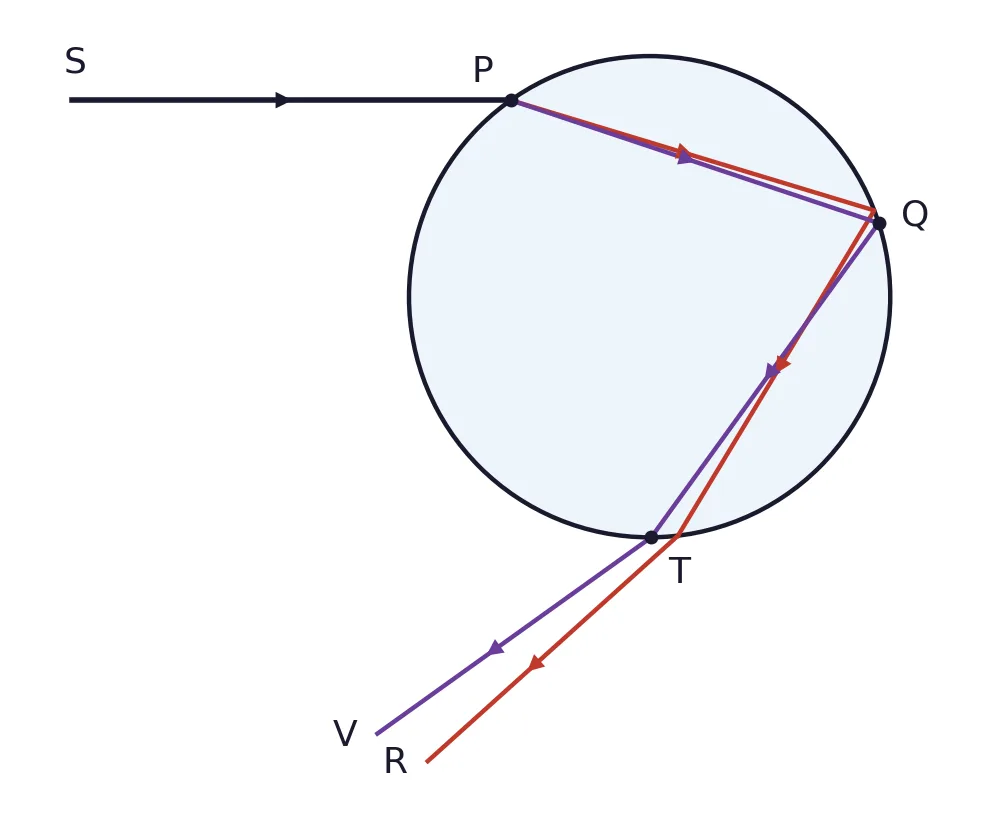
(ii) Draw a labelled diagram to show how one droplet forms the colours of a rainbow, and explain the three things that happen to the sunlight in it. (2 marks)
Answer.
Model answer:
The diagram is shown in the figure (S is sunlight, R red light, V violet light).
At P, sunlight is refracted as it enters the drop, and since each colour bends by a different amount, it splits into colours (dispersion).
At Q, the colours are reflected from the inside of the back surface of the drop (internal reflection).
At T, they are refracted again as they come out into air and travel towards Meenal. Light of different colours comes to her eye from drops at different heights, so she sees the colours as a band.
Marking scheme:
- Diagram: sunlight entering the drop, splitting into colours, reflected at the back and coming out, with red and violet labelled and arrows — 1 mark
- Refraction with dispersion on entering; internal reflection at the back surface; refraction again on leaving — 1 mark
(iii) Give one way in which the formation of a rainbow is like the formation of a spectrum by a glass prism, and one way in which it is different. (2 marks)
Answer.
- Alike: in both, white light is split into its colours by dispersion as it is refracted — 1 mark
- Different: in a drop the light is also reflected inside and comes back towards the side it came from; in a prism it passes through and leaves from the other side (accept: a drop is spherical and made of water) — 1 mark
OR
(B) Kiran can see distant hills clearly, but the print of a book held 25 cm from her eyes looks blurred. Her near point is found to be 40 cm.
(i) Name her defect of vision and give two possible causes of it. (1 mark)
Answer.
- Hypermetropia (long-sightedness) — 0.5 marks
- Causes: the focal length of the eye lens is too long; the eyeball has become too small (both needed) — 0.5 marks
(ii) Draw ray diagrams to show (I) where the image of the book held at 25 cm (N) is formed in her eye, and (II) how a suitable lens lets her read it. Mark her near point N′. (2 marks)
Answer.
Model answer:
The diagrams are shown in the figure.
(I) Without spectacles, light from the book at N comes to a focus behind the retina, so the print looks blurred.
(II) The convex lens L makes the rays from N spread out less, as if they came from N′, her near point at 40 cm. Her eye can focus light from N′, so the rays now meet on the retina.
Marking scheme:
- (I) Rays from N converge behind the retina — 1 mark
- (II) Convex lens in front of the eye; rays from N appear to come from N′ and meet on the retina; arrows and labels — 1 mark
(iii) Find the power of the spectacle lens she needs to read at 25 cm. (2 marks)
Answer.
- cm, cm: — 1 mark
- cm m; D (convex lens) — 1 mark
Question 12 (4 marks)
Rahul's eye doctor keeps a record of the spectacles she has prescribed for him over the years.
| Age of Rahul (years) | Power of spectacle lens |
|---|---|
| 10 | −0.8 D |
| 12 | −1.25 D |
| 14 | −2.0 D |
Rahul has always been able to read his books clearly without spectacles.
(a) Name Rahul's defect of vision. Is it getting better or worse? How can you tell from the table? (1 mark)
Answer.
- Myopia (near-sightedness) — 0.5 marks
- Worse: the power is becoming more negative, so he needs a stronger diverging lens each time — 0.5 marks
(b) By how much did his far point move between the ages of 10 and 14? (1 mark)
Answer.
- The lens focal length equals minus the far point: at 10, m, far point 1.25 m; at 14, m, far point 0.5 m — 0.5 marks
- It moved 0.75 m closer to his eyes — 0.5 marks
(c) At 14, Rahul borrows his cousin's spectacles of power −1.0 D. Up to what distance can he see clearly with them? (2 marks)
Answer.
- cm; the lens must form the image at his far point, cm: — 1 mark
- cm: he sees clearly only up to 1 m — 1 mark
OR
(c) At 14, Rahul's near point is 10 cm. With his −2.0 D spectacles on, what is the closest distance at which he can read a book clearly? (2 marks)
Answer.
- cm; the lens must form the image of the book at his near point, cm: — 1 mark
- cm: the closest reading distance is 12.5 cm — 1 mark
Question 13 (4 marks)
The eye works a little like a camera with automatic focus, with one big difference. In a camera the lens is moved forwards or backwards to focus. In the eye the distance between the eye lens and the retina stays fixed; take it as 2.5 cm (a simple model). To focus objects at different distances, the ciliary muscles change the curvature of the eye lens, and so its focal length. (Treat the eye lens as a single thin lens.)
(a) What is the focal length of the eye lens of an adult with normal eyesight when he looks at a distant star? Give a reason. (1 mark)
Answer.
- 2.5 cm — 0.5 marks
- Light from a distant star is parallel and meets at the focus; for a sharp image the focus must fall on the retina, 2.5 cm behind the lens — 0.5 marks
(b) Find the focal length of his eye lens when he reads a book held 25 cm away. (1 mark)
Answer.
- cm, cm; — 0.5 marks
- cm cm — 0.5 marks
(c) With age, the near point of this person moves out to 50 cm. What is now the shortest focal length his eye lens can have? Why has it changed? (2 marks)
Answer.
- , so cm cm — 1 mark
- The ciliary muscles weaken and the eye lens becomes less flexible, so it can no longer be made as thick (strongly curved) as before; its power of accommodation has decreased — 1 mark
OR
(c) Find the power of the eye lens when the person looks at the distant star and when he reads the book at 25 cm. By how much does the power change? Do the ciliary muscles contract or relax for the book? (2 marks)
Answer.
- Star: D; book: D; the power increases by 4 D — 1 mark
- They contract: the lens becomes thicker (more curved), so its power increases and its focal length decreases — 1 mark
Question 14 (5 marks)
Attempt either option (A) or (B).
(A) On a clear night at a hill station Tenzin notices that the stars twinkle. Next morning he watches the Sun rise over the hills.
(i) What is atmospheric refraction? Why does the air bend light at all? (1 mark)
Answer.
- Refraction of light by the Earth's atmosphere — 0.5 marks
- Layers of air at different temperatures and densities have different refractive indices, so light bends as it passes through them — 0.5 marks
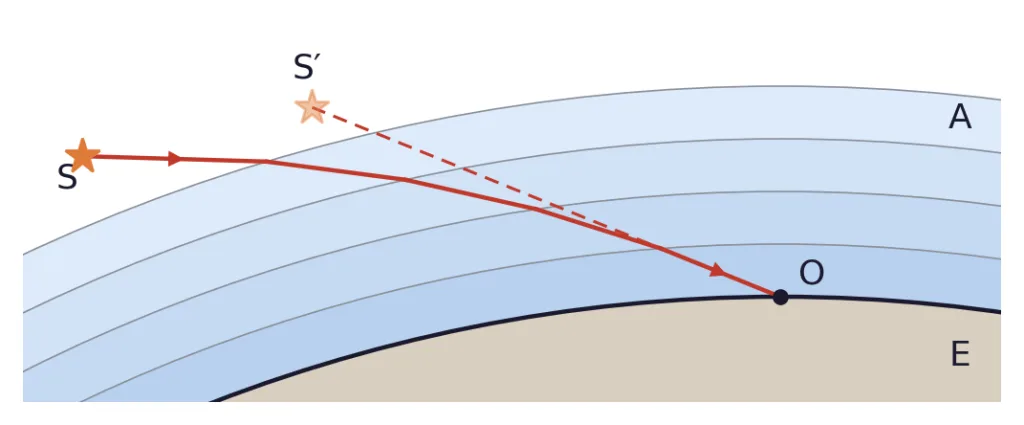
(ii) Draw a labelled diagram to show why a star seen near the horizon appears slightly higher than its actual position. (2 marks)
Answer.
Model answer:
The diagram is shown in the figure (S real star, S′ apparent position, O observer, A atmosphere, E Earth). The air gets denser towards the Earth, so starlight bends towards the normal again and again as it comes down. The observer's eye traces the light back along the direction in which it finally arrives, so the star is seen at S′, a little higher than S.
Marking scheme:
- Starlight entering denser and denser layers of air bends gradually towards the normal (curved path to the observer) — 1 mark
- The observer sees the star along the final direction of the ray, so the apparent position S′ is higher than the real position S; labels and arrows — 1 mark
(iii) Why does the Sun's disc look slightly flattened (oval) just as it rises? (1 mark)
Answer.
- Light from the lower edge passes through more (denser) air near the horizon and is lifted more than light from the upper edge, so the disc looks squeezed from top to bottom — 1 mark
(iv) Would the stars twinkle for an astronaut standing on the Moon? Give a reason. (1 mark)
Answer.
- No; the Moon has no atmosphere, so there are no moving air layers to keep changing the bending of starlight — 1 mark
OR
(B) Refraction and dispersion by a glass prism
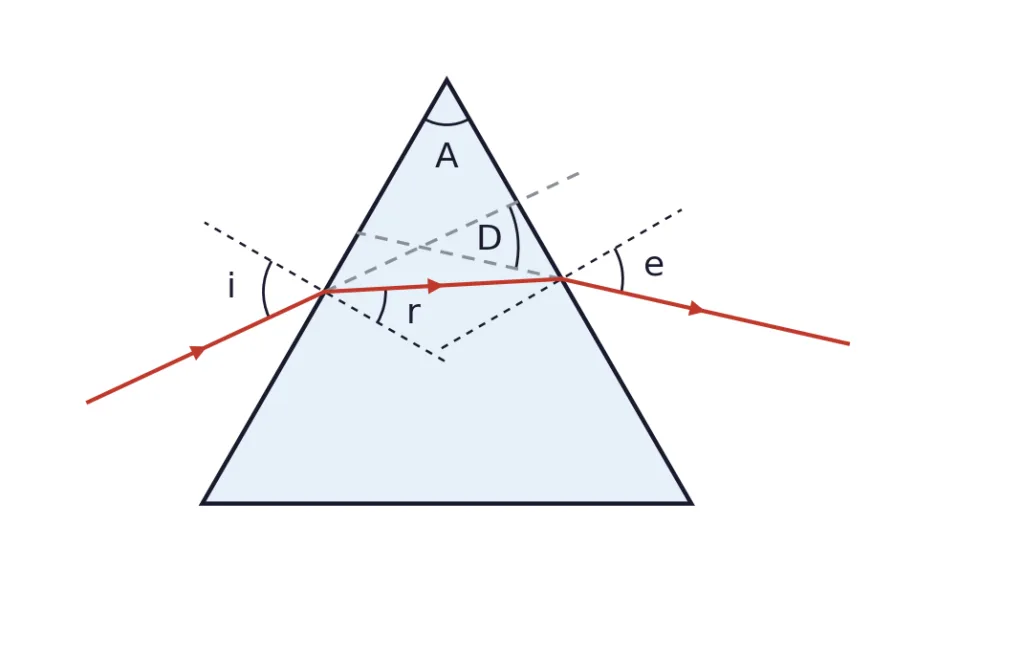
(i) A ray of light of a single colour falls obliquely on one face of a triangular glass prism. Draw its path through the prism and mark the angle of incidence i, the angle of refraction r, the angle of emergence e and the angle of deviation D. (2 marks)
Answer.
Model answer:
The diagram is shown in the figure (A is the angle of the prism). The ray bends towards the normal as it enters the glass and away from the normal as it leaves, and both times it turns towards the base. i is between the incident ray and the normal at the first face, r between the ray inside and the same normal, e between the emergent ray and the normal at the second face, and D between the incident ray produced forward and the emergent ray produced backward.
Marking scheme:
- Correct path: towards the normal at the first face and away from the normal at the second, the ray turning towards the base; normals drawn — 1 mark
- i, r, e marked between the rays and the normals, and D between the incident ray produced and the emergent ray produced backwards (all four marked correctly) — 1 mark
(ii) A narrow beam of white light is now used and forms a spectrum on a screen. Why does the band of colours become wider as the screen is moved farther from the prism? (1 mark)
Answer.
- After leaving the prism each colour travels in a slightly different direction, so the colours spread farther apart the longer they travel — 1 mark
(iii) A hollow prism is made of very thin glass sheets. Will it form a spectrum (a) when it is empty (filled with air), and (b) when it is filled with water? Give reasons. (2 marks)
Answer.
- Empty: no spectrum; each thin wall acts like a thin slab with parallel faces, and the air inside is the same as outside, so the light is hardly bent or split — 1 mark
- Filled with water: yes; the water forms a prism of a denser medium, and it bends different colours by different amounts — 1 mark