
Light – Reflection and Refraction
Light – Reflection and Refraction carried 4 to 11 marks in the 2026-27 sample paper and the board papers of 2025 and 2026. Together with the Human Eye it always makes up the 12 marks of Unit III. Expect an MCQ or a statement-type item on mirrors and lenses, often an Assertion-Reason (Snell's law, apparent depth), a 2-mark question on Snell's law or refractive index, a 3-mark lens or mirror numerical or ray diagram, and sometimes the case study (a telescope, 2026) or the 5-mark question (2025).
Where marks are usually lost:
- signs in the mirror and lens formulae: u is negative for a real object, and f is negative for a concave mirror and a concave lens;
- using for a mirror, where it is ;
- ray diagrams without arrows, or with rays that do not really pass through F or C;
- working out power with f in centimetres instead of metres.
Revise in 5 Minutes
Reflection: angle of incidence = angle of reflection. Plane mirror image: virtual, erect, same size, as far behind.
Spherical mirrors: pole P, centre of curvature C, principal focus F, ; f is negative for a concave mirror and positive for a convex mirror. Rays: parallel → through F (convex: as if from F); towards F → parallel; towards C → back on itself; at P → equal angle.
| Object | Concave mirror / convex lens image |
|---|---|
| at infinity | at F / ; real, inverted, point-sized |
| beyond C / | between F and C / and ; real, inverted, smaller |
| at C / | at C / ; real, inverted, same size |
| between C and F / and | beyond C / ; real, inverted, larger |
| at F / | at infinity; highly enlarged |
| inside F / between and O | behind the mirror / object's side; virtual, erect, larger |
Convex mirror: object at infinity → point image at F; any other object → between P and F; always virtual, erect, smaller. Concave lens: always virtual, erect, smaller, between and O.
Lens rays: parallel → through (concave: as if from ); through → parallel; through O → undeviated.
Uses: concave mirror: torch, headlight, shaving mirror, solar furnace; convex mirror: rear-view mirror.
Sign convention: distances from P or O; along the incident light +, against it −.
- Mirror: ,
- Lens: ,
- m negative: real, inverted; m positive: virtual, erect.
Refraction: (Snell); ; . Into a denser medium: towards the normal. Glass slab: e = i, ray shifted sideways.
Power: (f in metres), dioptre (D); convex +, concave −; lenses in contact: .
Common mistakes: m = +2 from a mirror means a concave mirror; kerosene is optically denser than water.
How to use this page: try each question on paper first, then read the answer. The marks against each step show what an examiner looks for. The 1-mark MCQs and Assertion-Reason questions are in the quiz at the end, together with questions that test how well you understand the chapter; every quiz answer comes with its explanation.
Short Answer Questions (2 and 3 Marks)
Question 1 (2 marks)
Sana wants to find the focal length of a concave mirror. She places a lighted lamp 60 cm in front of the mirror and moves a screen until the image of the lamp on it is sharp. The screen is then 15 cm from the mirror, so she writes "focal length = 15 cm".
(a) Why is her conclusion wrong?
(b) Use the mirror formula to find the correct focal length.
Answer.
Model answer:
(a) The image of an object forms at the principal focus only when the object is very far away, so that its rays reach the mirror almost parallel. The lamp is only 60 cm away, so its image forms a little beyond F. The 15 cm she measured is the image distance, not the focal length.
(b) cm, cm (the image is real, in front of the mirror).
cm. The focal length of the mirror is 12 cm.
Marking scheme:
- The image forms at the focus only when the object is very far away (rays almost parallel); a lamp at 60 cm is not far, so its image forms beyond F — 1 mark
- cm, cm; — 0.5 marks
- cm, so the focal length is 12 cm — 0.5 marks
Question 2 (3 marks)
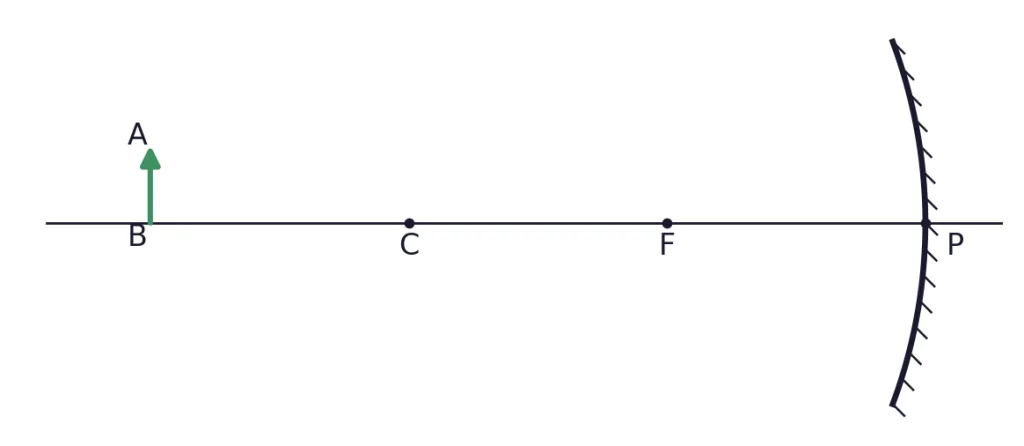
The figure shows an object AB in front of a concave mirror; P is the pole, F the principal focus and C the centre of curvature.
(a) Copy the figure and complete the ray diagram, using two rays from A, to locate the image A′B′.
(b) State the position, nature and size of the image.
Answer.
Model answer:
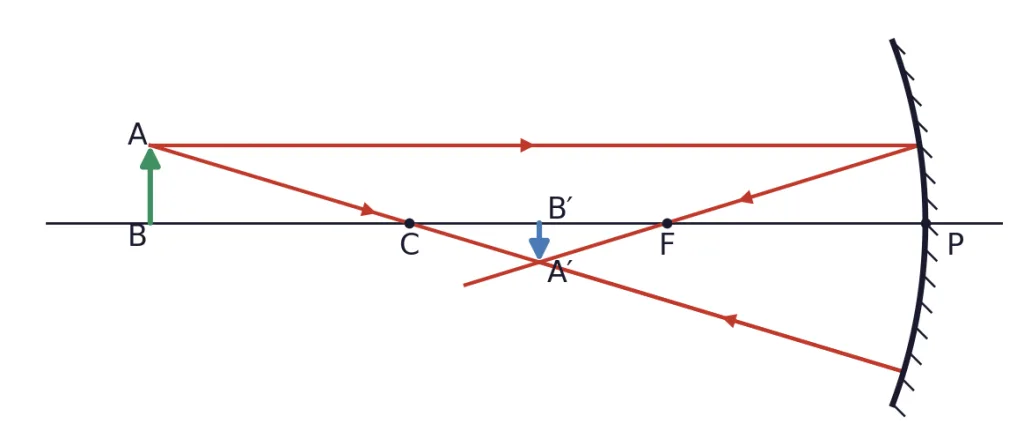
(a) The completed ray diagram is shown in the figure.
- Ray 1 from A goes parallel to the principal axis and, after reflection, passes through F.
- Ray 2 from A passes through C, meets the mirror along the normal and goes back along the same line.
- The two reflected rays meet at A′. The image A′B′ is drawn from there down to the axis.
(b) The image is formed between F and C. It is real, inverted and smaller than the object.
Marking scheme:
- A ray from A parallel to the principal axis, reflected through F — 0.5 marks
- A ray from A through C, reflected back along the same path (or a ray through F, reflected parallel to the axis) — 0.5 marks
- Arrows on the rays; the image A′B′ drawn inverted where the reflected rays meet — 1 mark
- Position: between F and C — 0.5 marks
- Real, inverted and diminished — 0.5 marks
Question 3 (2 marks)
A ray of light falls from air on two transparent slabs, X and Y, at the same angle of incidence, 45°. The angle of refraction is 28° in X and 32° in Y. (Take sin 45° = 0.71, sin 28° = 0.47, sin 32° = 0.53.)
(a) Which slab is optically denser? Give a reason.
(b) Find the refractive index of X with respect to Y.
Answer.
Model answer:
(a) X is optically denser. For the same angle of incidence the ray bends more towards the normal in X (28° against 32°), so X has the larger refractive index.
and
(b) The refractive index of X with respect to Y is
Marking scheme:
- X: for the same angle of incidence the ray bends more towards the normal in X (smaller angle of refraction), so X has the larger refractive index; accept and — 1 mark
- (accept 1.51/1.34 = 1.13) — 1 mark
Question 4 (3 marks)
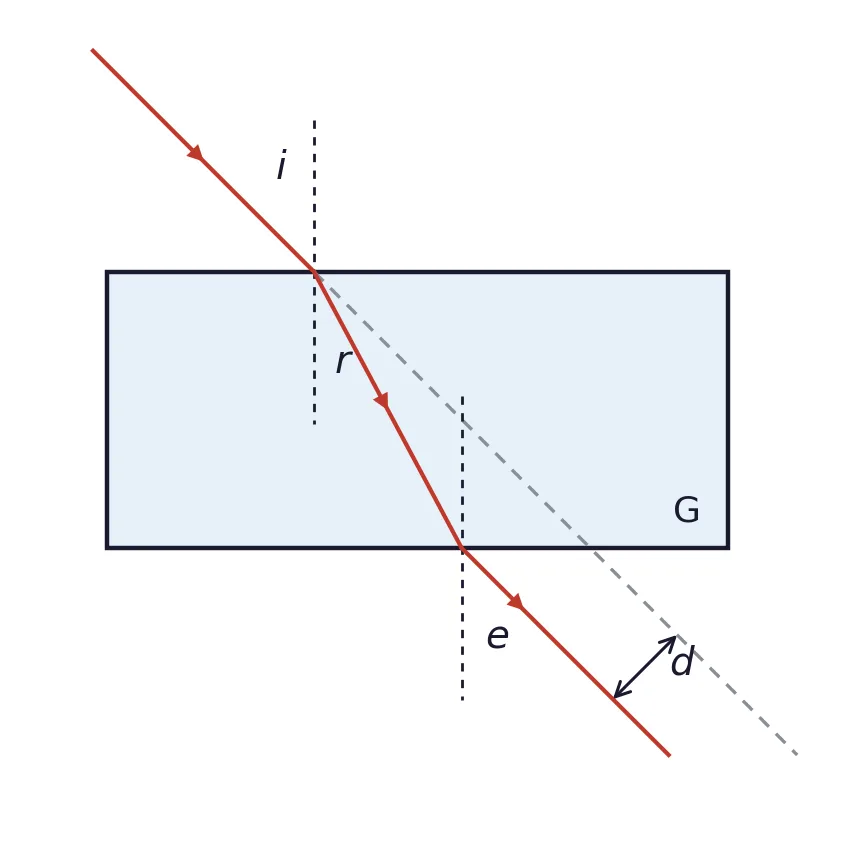
(a) Draw a labelled diagram to show the path of a ray of light that falls obliquely on one face of a rectangular glass slab and comes out of the opposite face. Mark the angle of incidence i, the angle of refraction r, the angle of emergence e and the lateral displacement d.
(b) Why is the emergent ray parallel to the incident ray?
(c) Ria repeats the activity with a slab of the same thickness made of a glass of higher refractive index, keeping the angle of incidence the same. How will the lateral displacement change?
Answer.
Model answer:
(a) The diagram is shown in the figure (G is the glass slab). The ray bends towards the normal as it enters the glass and away from the normal as it comes out. The dashed line is the incident ray produced; d is the perpendicular distance between it and the emergent ray.
(b) The two faces of the slab are parallel. The bending at the second face is equal and opposite to the bending at the first face, so the angle of emergence equals the angle of incidence and the emergent ray is parallel to the incident ray, only shifted sideways.
(c) The lateral displacement increases. In glass of higher refractive index the ray bends more towards the normal inside the slab, so it comes out farther to the side of the incident ray's line.
Marking scheme:
- Correct path: bends towards the normal on entering the slab and away from the normal on leaving it; normals drawn at both faces — 1 mark
- i, r, e and d marked correctly (d between the emergent ray and the incident ray produced) — 1 mark
- The two faces are parallel, so the bending at the second face is equal and opposite to that at the first; hence e = i — 0.5 marks
- d increases, because the ray bends more towards the normal inside the slab — 0.5 marks
Question 5 (3 marks)
Ritu photographs her friend, who is standing well beyond of the convex lens of her camera.
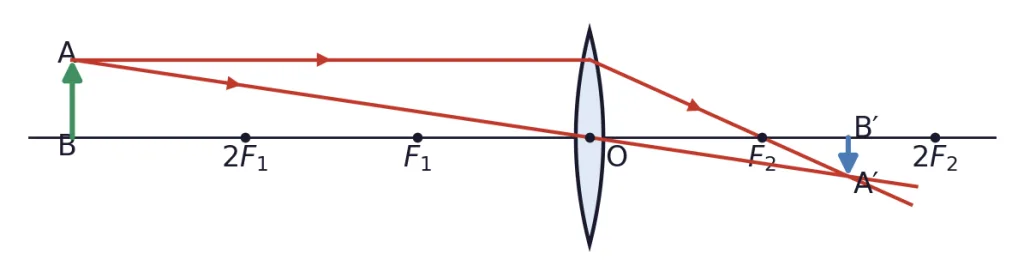
(a) Draw a ray diagram to show how the lens forms the image of an object placed beyond .
(b) State the position, size and nature of the image.
(c) How will the position and size of the image change if the object is moved to a point between and ?
Answer.
Model answer:
(a) The ray diagram is shown in the figure. The ray from A parallel to the principal axis passes through after refraction, and the ray through the optical centre O goes straight on. They meet at A′.
(b) The image is formed between and . It is smaller than the object, real and inverted.
(c) With the object between and , the image moves out beyond and becomes larger than the object. It is still real and inverted.
Marking scheme:
- Ray from the top of the object parallel to the principal axis, refracted through — 0.5 marks
- Ray through the optical centre O going straight on — 0.5 marks
- Arrows on the rays and the inverted image drawn where they meet — 0.5 marks
- Between and ; diminished; real and inverted — 1 mark
- The image moves beyond and becomes larger than the object — 0.5 marks
Question 6 (3 marks)
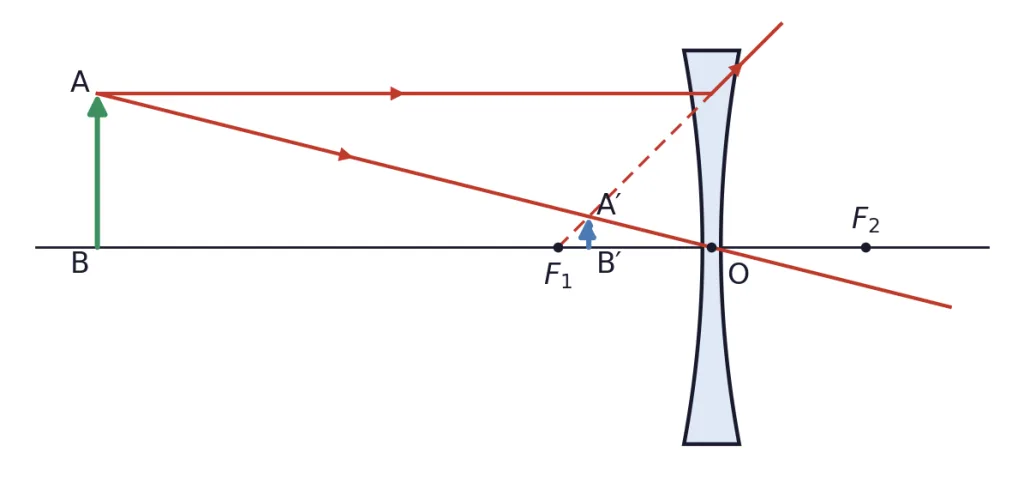
Riya's father fits a concave lens of power −4 D in the peephole of their front door. A cat 25 cm tall sits 1 m in front of the lens.
(a) Find the position of the image of the cat.
(b) Find the height of the image and state its nature.
(c) Draw a ray diagram to show how the image is formed.
Answer.
Model answer:
(a) m cm, and cm.
cm. The image is 20 cm from the lens, on the same side as the cat.
(b) , so cm.
The image is 5 cm tall, virtual, erect and diminished.
(c) The ray diagram is shown in the figure (drawn to a scale of 1 : 5). The ray parallel to the axis spreads out after the lens as if it came from (dashed line), and the ray through O goes straight. Produced backwards, they meet at A′.
Marking scheme:
- m cm; cm — 0.5 marks
- , so cm (20 cm from the lens, on the cat's side) — 0.5 marks
- ; cm — 0.5 marks
- Virtual, erect and diminished — 0.5 marks
- Ray diagram: parallel ray diverging as if from (dashed back to ), ray through O undeviated, image between and O — 1 mark
Question 7 (2 marks)
Ravi holds a convex lens A in front of a white wall and gets a sharp image of a distant building on the wall when the lens is 25 cm from it.
(a) Find the power of lens A.
(b) He now uses lens B, of power +2 D, in the same way. How far from the wall must he hold it?
Answer.
Model answer:
(a) Rays from a distant building are almost parallel, so its image forms at the focus. So cm m.
D
(b) The image of the building again forms at the focus. For lens B, m cm, so he must hold it 50 cm from the wall.
Marking scheme:
- The image of a distant object forms at the focus, so cm m; D — 1 mark
- The image again forms at the focus: m cm, so 50 cm from the wall — 1 mark
Question 8 (3 marks)
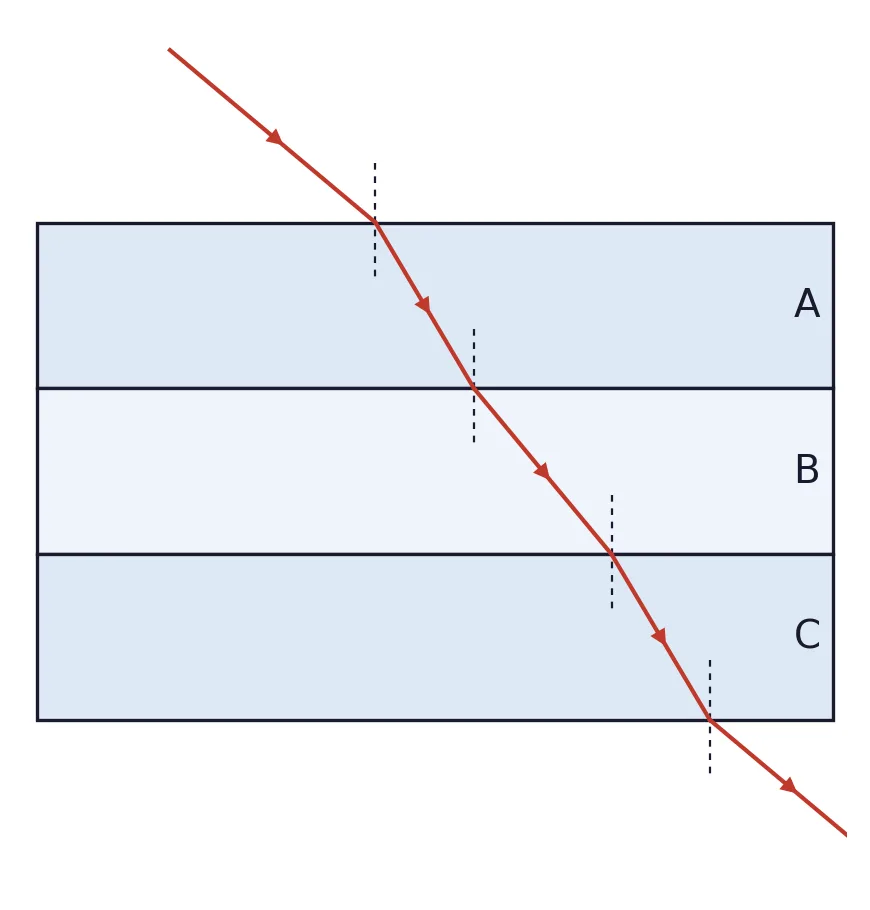
A ray of light in air falls obliquely on a stack of three transparent layers, A, B and C, with parallel faces, placed one on top of another. Their refractive indices are A: 1.5, B: 1.2 and C: 1.5. The ray passes through A, B and C and comes out into air below.
(a) Draw the path of the ray through the three layers, showing how it bends at each boundary.
(b) In which layer does the ray make the largest angle with the normal? Is the ray in C parallel to the ray in A? Give a reason.
Answer.
Model answer:
(a) The path is shown in the figure. Going from air into A the ray bends towards the normal. B is optically rarer than A, so the ray bends away from the normal. In C, which is denser than B, it bends towards the normal again, and on coming out into air it bends away and leaves parallel to the ray that fell on the stack.
(b) The ray makes the largest angle with the normal in B, the layer with the smallest refractive index. For a ray falling at 50°, the angle is about 31° in A, 40° in B and 31° in C.
Yes, the ray in C is parallel to the ray in A. A and C have the same refractive index and all the faces are parallel, so the bending at the B–C boundary exactly undoes the bending at the A–B boundary.
Marking scheme:
- Air to A: bends towards the normal; A to B: bends away from the normal (B is rarer) — 1 mark
- B to C: bends towards the normal; C to air: away from the normal, coming out parallel to the incident ray; normals and arrows drawn — 1 mark
- Largest angle in B, which has the smallest refractive index of the three layers — 0.5 marks
- Yes: A and C have the same refractive index and all the faces are parallel, so the ray bends back in C by as much as it bent in B — 0.5 marks
Question 9 (2 marks)
When a candle is placed 40 cm in front of a spherical mirror, a sharp, inverted image of the same size is formed on a screen placed beside the candle.
(a) Name the mirror and find its focal length.
(b) The candle is now moved to 20 cm from the mirror. Where should the screen be placed now to get a sharp image?
Answer.
Model answer:
(a) The mirror is concave, because only a concave mirror can form a real image that can be caught on a screen. A real, inverted image of the same size forms when the object is at the centre of curvature. So R = 40 cm and f = R/2 = 20 cm.
(b) At 20 cm the candle is at the principal focus. The reflected rays come out parallel and meet only at infinity, so there is no place where the screen will show a sharp image.
Marking scheme:
- Concave mirror (only it forms a real image on a screen) — 0.5 marks
- Same-size inverted image means the object is at C: R = 40 cm, so f = 20 cm — 0.5 marks
- The candle is now at F; the reflected rays are parallel and the image is at infinity, so no position of the screen gives a sharp image — 1 mark
Question 10 (3 marks)
The mirror fixed at a sharp bend on a hill road is a convex mirror.
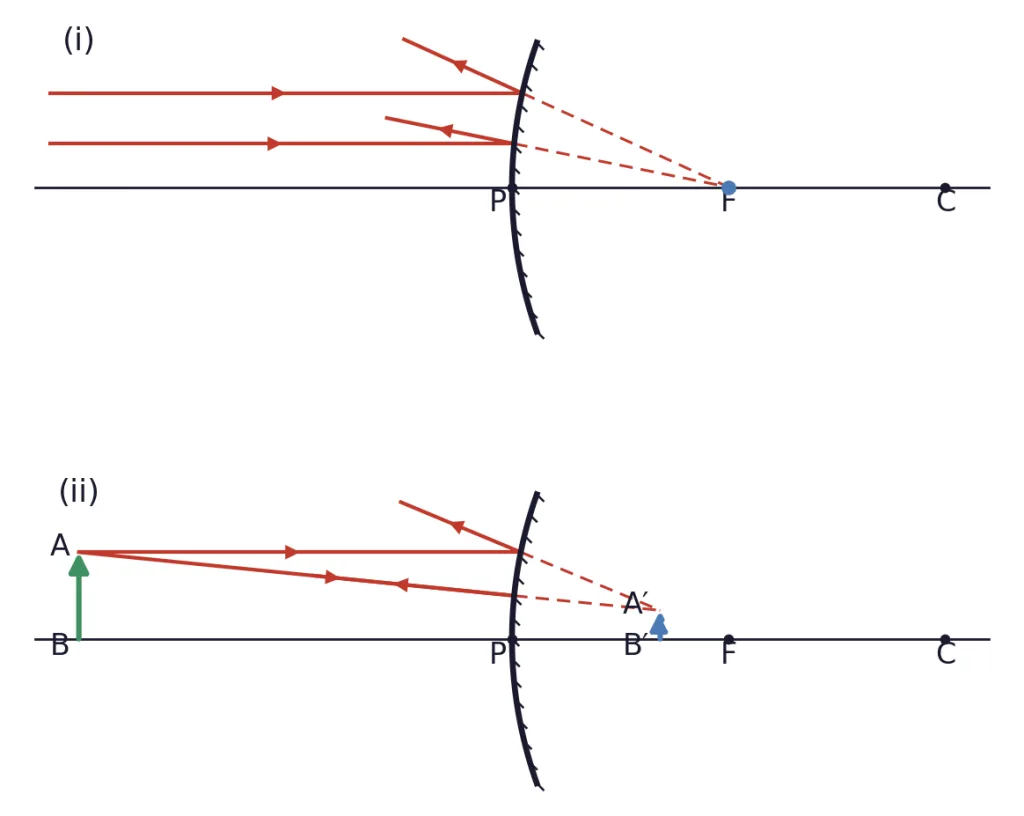
(a) Draw ray diagrams to show the image formed by a convex mirror of (i) a very distant object, and (ii) an object at a finite distance in front of it.
(b) A bus coming round the bend moves closer to the mirror. How do the position and size of its image change? Can the image ever form beyond the principal focus F? Give a reason.
Answer.
Model answer:
(a) The ray diagrams are shown in the figure.
(i) Rays from a very distant object arrive parallel to the axis. After reflection they spread out as if they came from F, so a point-sized, virtual, erect image forms at F behind the mirror.
(ii) For an object AB, the ray parallel to the axis is reflected as if it came from F, and the ray aimed at C comes back along itself. Produced behind the mirror, they meet at A′. The image lies between P and F and is virtual, erect and diminished.
(b) As the bus comes closer, its image moves from near F towards P and becomes larger, though always smaller than the bus. The image can never form beyond F. Even for an object at infinity the image is only at F, and for any nearer object it lies between P and F.
Marking scheme:
- (i) Parallel rays reflected so that they appear to spread out from F; image at F, virtual, erect, point-sized — 1 mark
- (ii) Ray parallel to the axis reflected as if from F, and ray aimed at C reflected back along itself; image between P and F, virtual, erect, diminished — 1 mark
- The image moves from near F towards P and grows larger, but stays smaller than the bus — 0.5 marks
- No: even a very distant object forms its image at F, and every nearer object forms it between P and F — 0.5 marks
Long Answer and Case-Based Questions
Question 11 (5 marks)
Attempt either option (A) or (B).
(A) Kabir places a small bulb in front of a concave mirror and gets a sharp image of it on a screen 30 cm from the mirror. The image is half as tall as the bulb.
(i) Find how far the bulb is from the mirror, and the focal length of the mirror. (1 mark)
Answer.
- Real image, half the size: with cm, so cm (60 cm from the mirror) — 0.5 marks
- , so cm (focal length 20 cm) — 0.5 marks
(ii) He then moves the bulb to 10 cm from the mirror. Find the position of the image and the magnification. Can he now get the image on the screen? Why? (2 marks)
Answer.
Model answer:
cm, cm.
, so cm.
The image is 20 cm behind the mirror. , so it is erect and twice as large.
He cannot get it on the screen. The bulb is now between P and F, the reflected rays spread out, and the image is virtual.
Marking scheme:
- , so cm: 20 cm behind the mirror — 1 mark
- (erect, twice the size) — 0.5 marks
- No: the image is virtual (behind the mirror); the reflected rays do not actually meet — 0.5 marks
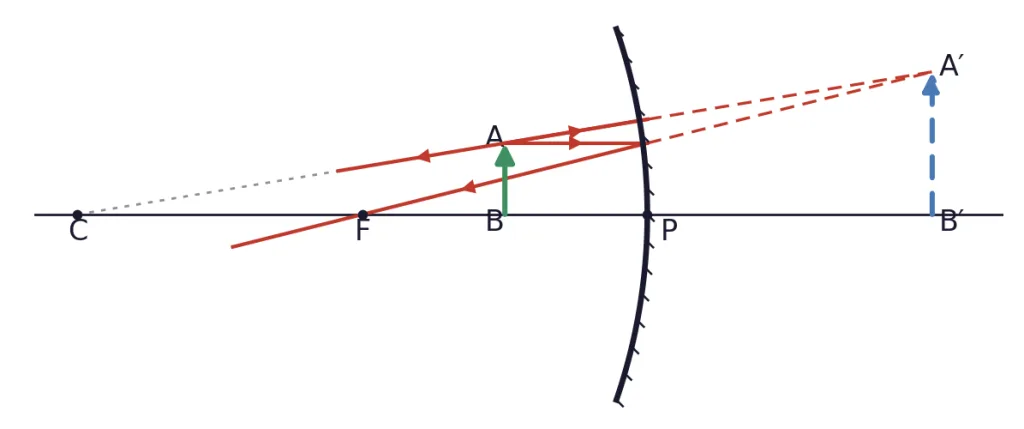
(iii) Draw a ray diagram for the second position of the bulb. (2 marks)
Answer.
- Ray parallel to the axis reflected through F, and a ray along the line from C reflected back along itself (or a ray from the direction of F reflected parallel) — 1 mark
- Reflected rays produced backwards (dashed) to meet behind the mirror; erect, enlarged virtual image; arrows on rays — 1 mark
OR
(B) Anjali fixes a candle and a screen 80 cm apart. She moves a convex lens between them until she gets a sharp image of the flame, three times as tall as the flame.
(i) Find the distances of the candle and the screen from the lens. (2 marks)
Answer.
Model answer:
The image is on a screen, so it is real and inverted: . So the screen is three times as far from the lens as the candle.
Let the candle be x cm from the lens. Then the screen is 3x cm from it, and x + 3x = 80, so x = 20.
cm and cm.
Marking scheme:
- The image is real (on a screen), so and (distance of the candle) — 0.5 marks
- Candle distance + screen distance = 80 cm, so 4 × (candle distance) = 80 cm — 0.5 marks
- cm — 0.5 marks
- cm — 0.5 marks
(ii) Find the focal length of the lens. (1 mark)
Answer.
- , so cm — 1 mark
(iii) Draw a ray diagram for this arrangement. (2 marks)
Answer.
- Object between and ; ray parallel to the axis refracted through , and ray through O undeviated — 1 mark
- Image beyond , inverted and enlarged; arrows on rays — 1 mark

Question 12 (4 marks)
In the physics laboratory, Megha fixes a convex lens on an optical bench. She places a lighted candle at different distances from the lens and each time moves a screen to get a sharp image of the flame. Her readings are:
| Reading | Distance of candle from lens (cm) | Distance of screen from lens (cm) |
|---|---|---|
| 1 | 60 | 30 |
| 2 | 40 | 40 |
| 3 | 30 | 60 |
| 4 | 25 | 100 |
| 5 | 15 | 60 |
Her teacher says that one of the readings cannot be correct.
(a) Which reading lets you write down the focal length straight away? What is the focal length? (1 mark)
Answer.
- Reading 2: candle and screen distances are equal only when the object is at (image at ) — 0.5 marks
- 2f = 40 cm, so f = 20 cm — 0.5 marks
(b) Which reading cannot be correct? Why? (1 mark)
Answer.
- Reading 5 — 0.5 marks
- 15 cm is less than f = 20 cm; with the object inside the focus the image is virtual, on the candle's side, and cannot form on a screen — 0.5 marks
(c) Find the magnification in reading 3 and describe the image. (2 marks)
Answer.
- cm, cm; — 1 mark
- Real, inverted and twice the size of the flame — 1 mark
OR
(c) Where must the screen be placed if the candle is kept 100 cm from the lens? How will the size of this image compare with the flame? (2 marks)
Answer.
- , so cm behind the lens — 1 mark
- : inverted and one-fourth the size of the flame — 1 mark
Question 13 (4 marks)
A jeweller in Jaipur checks whether a stone is a real diamond. He sends a thin beam of light from air into one face of the stone at an angle and measures the angles of incidence and refraction. For this stone, sin i = 0.84 and sin r = 0.35. He compares the result with this chart:
| Material | Refractive index |
|---|---|
| Crown glass | 1.52 |
| Quartz | 1.54 |
| Sapphire | 1.77 |
| Diamond | 2.42 |
(a) Why does the jeweller send the beam in at an angle, and not along the normal to the face? (1 mark)
Answer.
- Along the normal the angle of incidence and the angle of refraction are both zero for every material — 0.5 marks
- so the angles would tell him nothing about the refractive index; only an oblique ray bends by an amount that depends on the material — 0.5 marks
(b) Find the refractive index of the stone. Which material is it most likely to be? (1 mark)
Answer.
- — 0.5 marks
- Diamond (closest to 2.42) — 0.5 marks
(c) A cheap copy made of crown glass receives the beam at the same angle of incidence. Find sin r for the copy. In which of the two does the ray bend more? (2 marks)
Answer.
- — 1 mark
- In the diamond: its sin r (0.35) is smaller, so its angle of refraction is smaller and the ray bends more towards the normal — 1 mark
OR
(c) The jeweller now sends the beam into the same stone at a smaller angle, with sin i = 0.60. Find sin r. Does the ratio change? Give a reason. (2 marks)
Answer.
- — 1 mark
- No; the ratio stays 2.4: by Snell's law it is constant for a given pair of media, and only the angles change — 1 mark
Question 14 (5 marks)
Attempt either option (A) or (B).
(A) Refraction of light
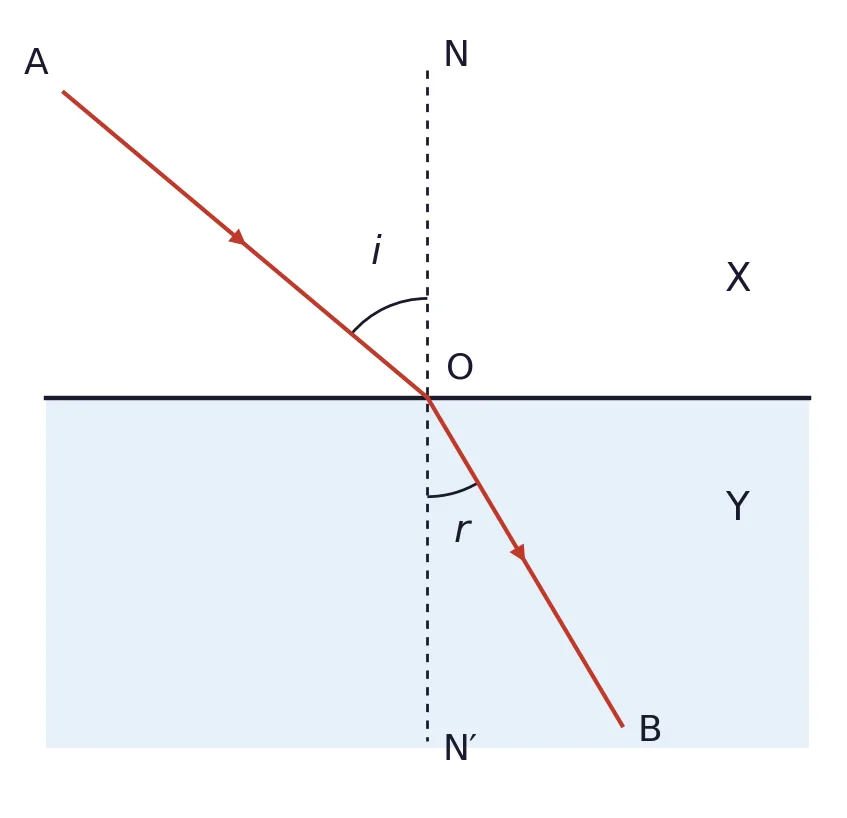
(i) A ray of light passes obliquely from air into a glass slab. Draw a labelled diagram showing the incident ray, the refracted ray, the normal, the angle of incidence and the angle of refraction. State the two laws of refraction. (2 marks)
Answer.
Model answer:
The diagram is shown in the figure: X is air, Y is glass, AO is the incident ray, OB the refracted ray and NN′ the normal at O.
- The incident ray, the refracted ray and the normal at the point of incidence all lie in the same plane.
- For light of a given colour and a given pair of media, the ratio of the sine of the angle of incidence to the sine of the angle of refraction is constant: constant. This is Snell's law.
Marking scheme:
- Diagram: ray bending towards the normal in glass, with incident ray, refracted ray, normal, i and r labelled — 1 mark
- First law: the incident ray, the refracted ray and the normal at the point of incidence all lie in the same plane — 0.5 marks
- Second law (Snell's law): for a given colour of light and a given pair of media, is constant — 0.5 marks
(ii) The refractive index of rock salt is 1.54 and that of ice is 1.31, both with respect to air. Find the refractive index of rock salt with respect to ice. (1 mark)
Answer.
- — 0.5 marks
- — 0.5 marks
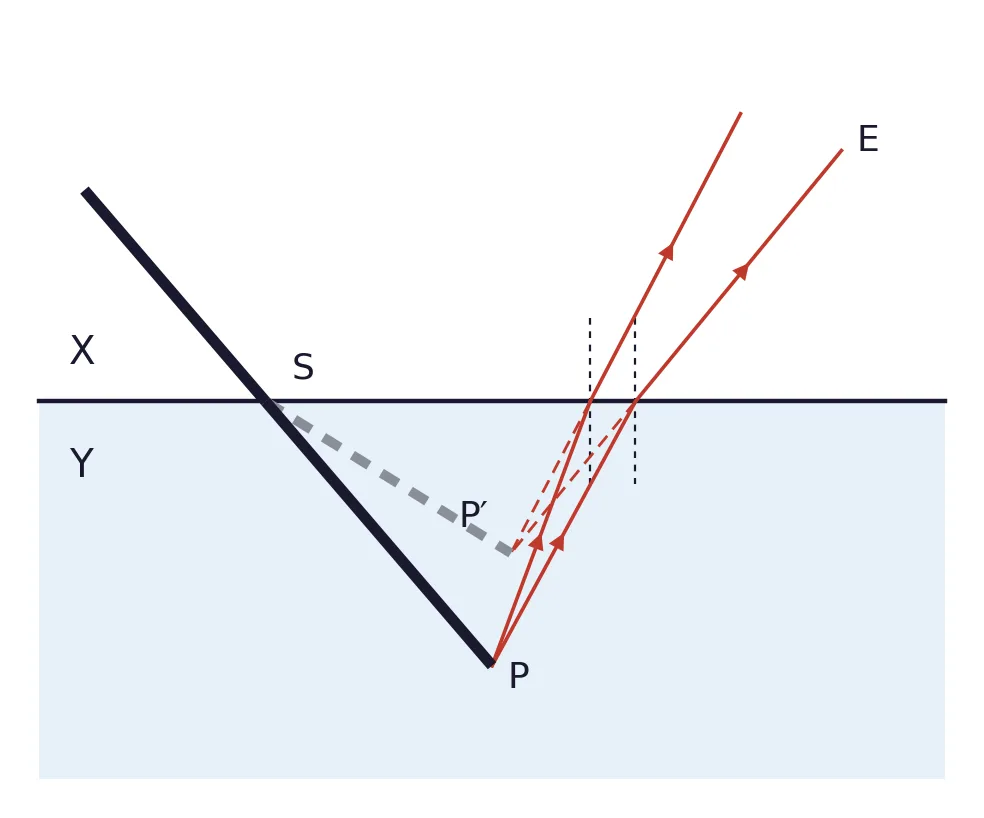
(iii) A pencil dipped slantwise in a glass of water looks bent at the water surface. Explain why, with the help of a ray diagram. (2 marks)
Answer.
Model answer:
The ray diagram is shown in the figure (X is air, Y is water, S is where the pencil enters the water, E is the eye).
Rays from the tip P of the pencil travel from water into air. At the surface they bend away from the normal, because water is optically denser than air. When these rays reach the eye, they seem to come from P′, a point above P. The same happens for every point of the dipped part, so it appears raised along SP′, and the pencil looks bent at the surface.
Marking scheme:
- Rays from the tip P under water pass into air and bend away from the normal at the surface — 1 mark
- To the eye these rays seem to come from P′, a point higher than P, so the dipped part looks raised and the pencil looks bent at the surface — 0.5 marks
- Ray diagram — 0.5 marks
OR
(B) Spherical mirrors
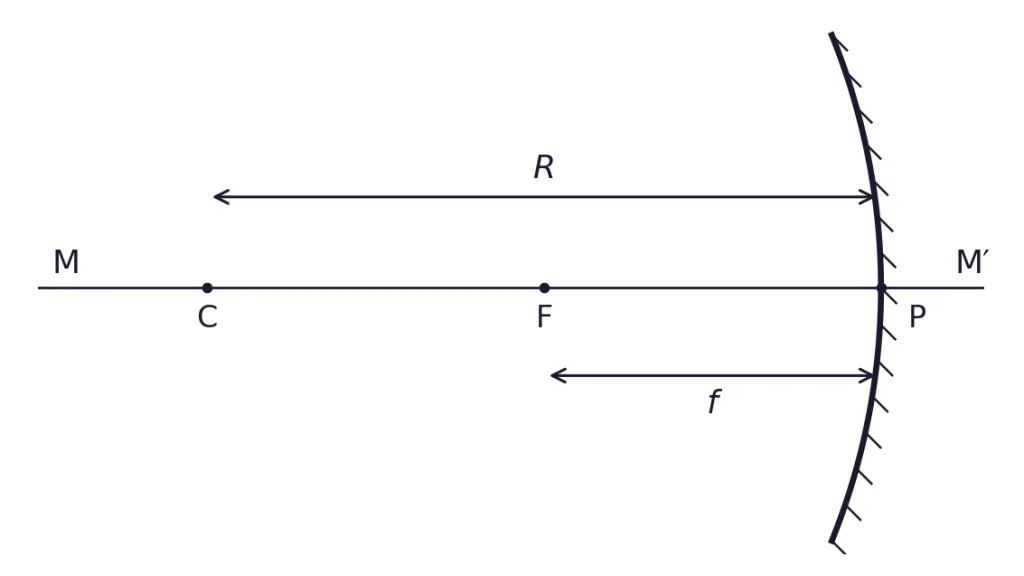
(i) Draw a concave mirror and mark on it the pole P, the principal focus F, the centre of curvature C and the principal axis. Define the principal focus and the radius of curvature of a concave mirror. (2 marks)
Answer.
Model answer:
The diagram is shown in the figure: MM′ is the principal axis, P the pole, F the principal focus and C the centre of curvature, with .
- Principal focus: the point on the principal axis where rays parallel to the axis actually meet after reflection from a concave mirror.
- Radius of curvature: the radius of the sphere of which the reflecting surface is a part. It is the distance PC.
Marking scheme:
- Diagram with P, F, C and the principal axis correctly marked (F midway between P and C) — 1 mark
- Principal focus: the point on the principal axis where rays parallel to the axis meet after reflection — 0.5 marks
- Radius of curvature: the radius of the sphere of which the mirror is a part (the distance PC) — 0.5 marks
(ii) What is meant by the aperture of a spherical mirror? (1 mark)
Answer.
- The diameter of the reflecting surface of the mirror (the width of the part that reflects light) — 1 mark
(iii) A concave mirror has a radius of curvature of 30 cm. It forms a sharp image of a small bulb on a wall 45 cm in front of the mirror. How far from the mirror is the bulb? Describe the image. (2 marks)
Answer.
- cm, cm — 0.5 marks
- , so cm — 1 mark
- : real, inverted, twice the size of the bulb — 0.5 marks