
Magnetic Effects of Electric Current
Magnetic Effects of Electric Current carried 4 to 7 marks in the 2026-27 sample paper and the board papers of 2025 and 2026. Expect an Assertion-Reason or a statement-type MCQ (field lines, the solenoid), a 2- or 3-mark question (right-hand thumb rule, electromagnet, Fleming's left-hand rule, fuse and earth wire), and in some years the Physics case-based question (a solenoid door lock in the sample paper, domestic circuits in 2025). This chapter has not had a 5-mark question. The electric motor, electromagnetic induction and the generator are not in the board exam.
Where marks are usually lost:
- field lines drawn without arrows, crossing each other, or evenly spaced where they should spread out;
- using the right-hand thumb rule where Fleming's left-hand rule is needed, or mixing up its fingers;
- showing the lines inside a magnet or solenoid going from N to S;
- writing that the earth wire and the fuse do the same job.
Revise in 5 Minutes
Field lines
- A compass needle's north end points along the field.
- Outside a magnet the lines go from N to S, inside from S to N: closed curves.
- They never cross (a compass cannot point two ways at once). Crowded lines mean a strong field. The tangent at a point gives the field direction.
Field due to a current
| Conductor | Pattern | Stronger with |
|---|---|---|
| Straight wire | concentric circles, spreading out | more current; nearer the wire |
| Circular loop | circles round each part; nearly straight at the centre | more current; more turns |
| Solenoid | like a bar magnet; parallel and uniform inside | more current; more turns; soft-iron core |
- Right-hand thumb rule: thumb along the current, curled fingers give the field.
- End of a coil or solenoid: current anticlockwise as you face it → N pole; clockwise → S pole.
- Electromagnet: soft-iron core in a solenoid; a magnet only while the current flows.
Force on a current in a field
- Largest when the current is at right angles to the field; zero when parallel.
- Fleming's left-hand rule: forefinger = field, middle finger = current, thumb = force (motion).
- Reversing the current or the field reverses the force.
AC and DC: DC flows one way (cell). AC reverses regularly; mains in India: 220 V, 50 Hz. AC can be sent far with little loss of energy.
Domestic circuits
- Live (red, 220 V), neutral (black), earth (green, joined to metal bodies).
- Appliances in parallel; fuse and switches in the live wire; 5 A circuit for bulbs and fans, 15 A for geyser, heater, air conditioner.
- Fuse melts on too much current; the earth wire keeps a metal body safe to touch.
- Short circuit: live touches neutral, resistance nearly zero. Overloading: too many appliances, or a voltage rise.
Traps: a charge at rest feels no magnetic force; for an electron beam, the current is opposite to the motion; fuse needed: , then the next higher rating.
How to use this page: try each question on paper first, then read the answer. The marks against each step show what an examiner looks for. The 1-mark MCQs and Assertion-Reason questions are in the quiz at the end, together with questions that test how well you understand the chapter; every quiz answer comes with its explanation.
Short Answer Questions (2 and 3 Marks)
Question 1 (3 marks)
The figure shows a solenoid wound on a cardboard tube and joined to a battery. The arrows show the direction of the current in the front part of each turn.
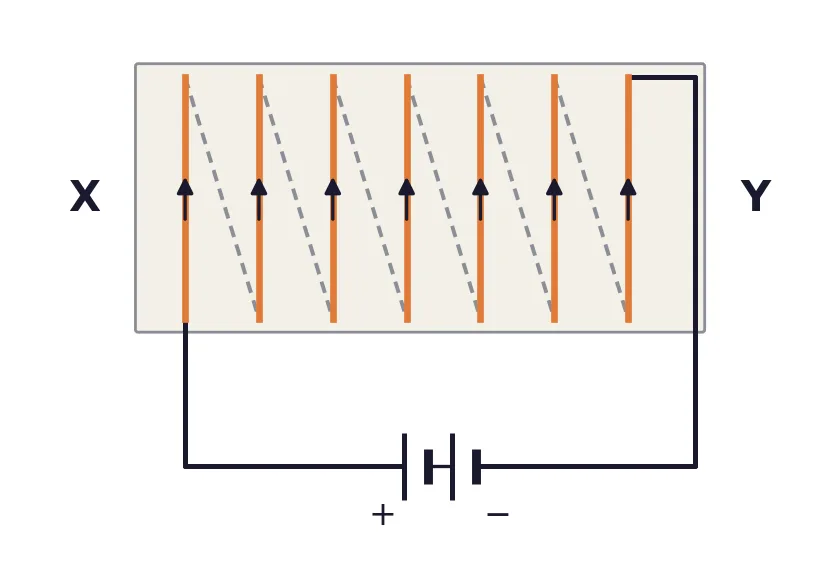
(a) Which end, X or Y, is the north pole of the solenoid? Explain how you found it. (1 mark)
Answer.
- X is the north pole (0.5); looking at end X, the current flows anticlockwise (or: curl the fingers of the right hand along the current and the thumb points towards X) (0.5) — 1 mark
(b) The north pole of a bar magnet is brought near end X. Will it be attracted or repelled? Why? (1 mark)
Answer.
- Repelled (0.5), because X is also a north pole and like poles repel (0.5) — 1 mark
(c) The solenoid, with its battery, is hung freely by a thread so that it can turn in a horizontal plane. Towards which direction will end X settle? What changes if the battery is turned round? (1 mark)
Answer.
- X, a north pole, settles pointing towards the geographic north (0.5); with the battery reversed the poles swap, so Y points north (0.5) — 1 mark
Question 2 (2 marks)
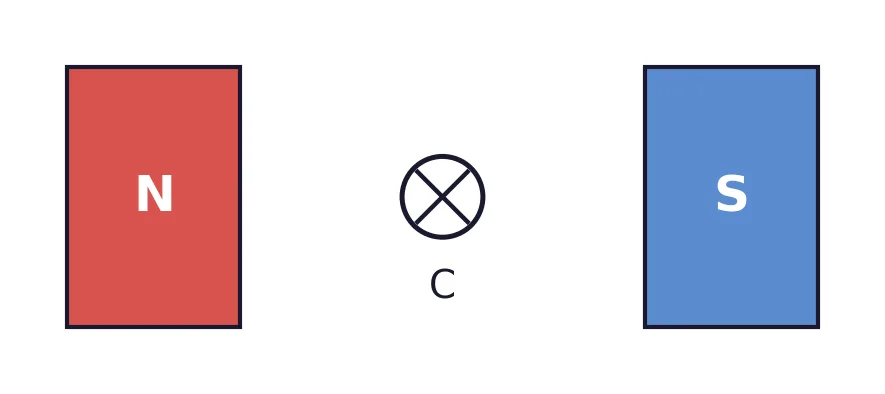
State Fleming's left-hand rule. The figure shows a straight conductor C, carrying a current into the page, placed between the poles N and S of a magnet. In which direction is C pushed? Which way would it be pushed if the poles N and S were swapped?
Answer.
- Stretch the thumb, forefinger and middle finger of the left hand at right angles to one another. If the forefinger points along the magnetic field and the middle finger along the current, the thumb gives the direction of the force (motion) on the conductor — 1 mark
- Field from N to S (left to right), current into the page: C is pushed downwards, towards the bottom of the page (0.5); with the poles swapped the field reverses, so C is pushed upwards (0.5) — 1 mark
Question 3 (2 marks)
Rekha's family has moved into an old house. The electrician finds that
(i) the insulation of a wire behind the refrigerator has cracked, and
(ii) the metal body of the washing machine is not joined to the earth wire.
For each problem, name the accident it could cause and one precaution that prevents it.
Answer.
- (i) The bare live and neutral wires may touch, causing a short circuit with sparks and a fire (or a shock if someone touches the bare wire) (0.5); replace the wire, or cover it with proper insulation, after switching off the mains (0.5) — 1 mark
- (ii) If a loose live wire touches the metal body, a person touching the machine gets a severe shock (0.5); join the body to the earth wire through a three-pin plug, so that such a current goes to the earth and the fuse blows (0.5) — 1 mark
Question 4 (2 marks)
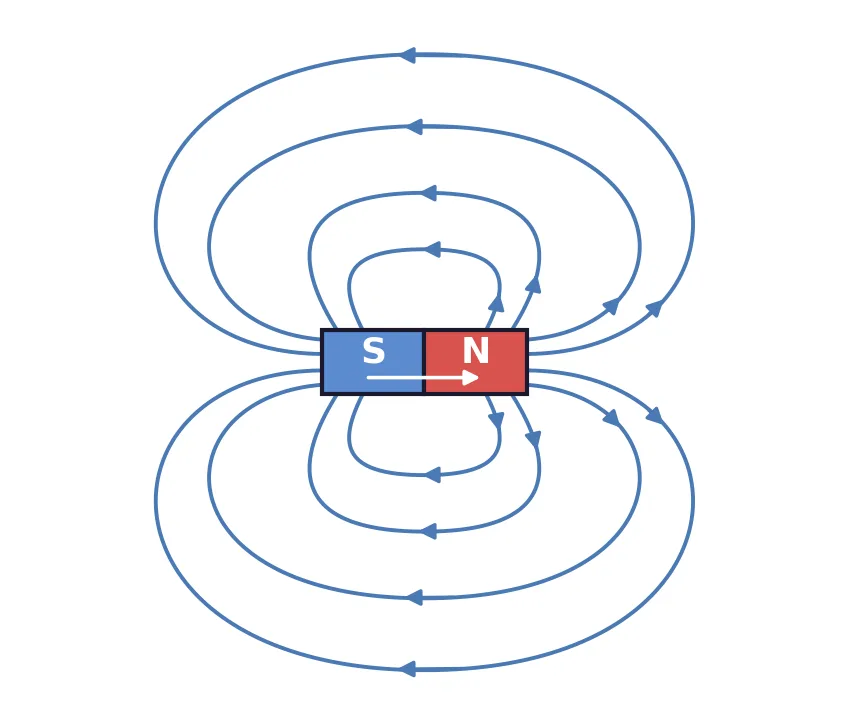
Draw the pattern of magnetic field lines around a bar magnet, showing their direction. A small compass is then placed just beside the middle of the magnet, level with its centre. Which way does the north end of the compass needle point?
Answer.
- Diagram: closed lines leaving the N pole and entering the S pole outside the magnet, with arrows, not crossing, crowded near the poles (see figure) — 1 mark
- Beside the middle, the field line runs parallel to the magnet from its N end towards its S end, so the needle lies parallel to the magnet with its north end pointing towards the magnet's south pole end — 1 mark
Question 5 (3 marks)
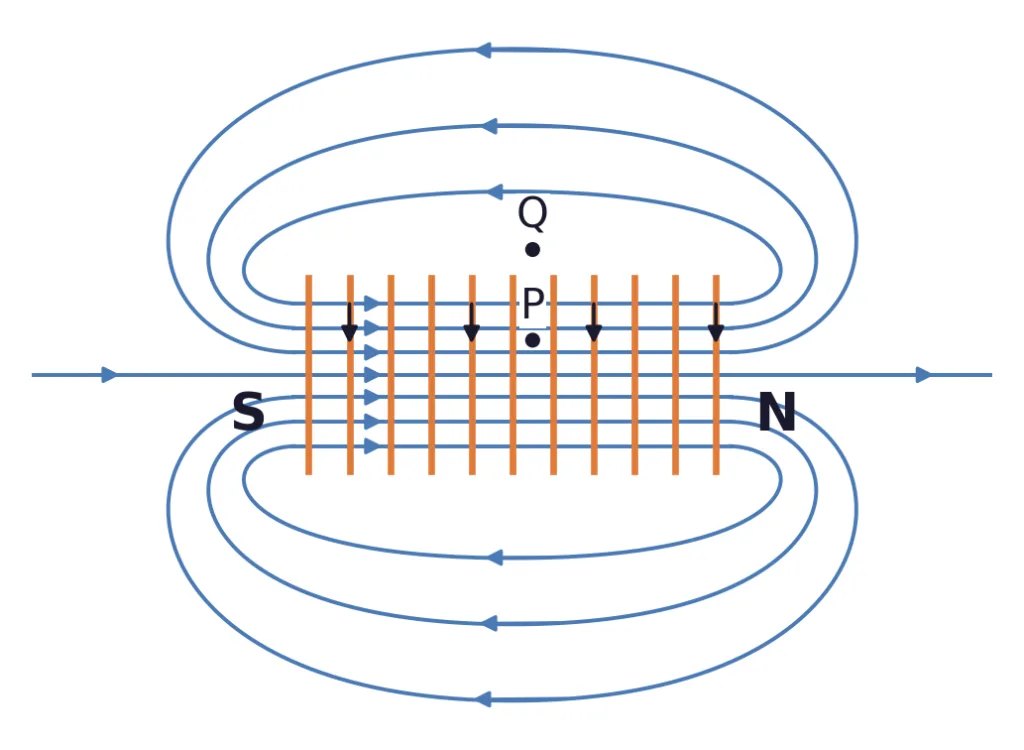
Draw the pattern of magnetic field lines in and around a current-carrying solenoid. Show the direction of the current in the turns, and mark the N and S poles so that they match it. Mark a point P inside the solenoid and a point Q just outside it, beside its middle. Which way does the north end of a compass needle point at P and at Q?
Answer.
- Pattern: parallel straight lines inside, closed curves outside like those of a bar magnet, with arrows going from N to S outside and S to N inside (see figure) — 1 mark
- Current direction matching the poles: seen from the N end the current flows anticlockwise, and from the S end clockwise (right-hand thumb rule) — 1 mark
- At P: along the axis, towards the N end (0.5); at Q: parallel to the axis, towards the S end (0.5) — 1 mark
Question 6 (2 marks)
The 5 A lighting circuit of a room has five 40 W tube lights and two 75 W fans, all working on 220 V. One evening a 1500 W room heater is also plugged into this circuit, and the fuse blows. The electrician replaces it with a 15 A fuse "so that it does not blow again".
(a) Show why the 5 A fuse blew. What danger does the 15 A fuse create?
(b) His assistant says, "The earth wire will protect the house anyway." Explain why the earth wire cannot do the job of the fuse.
Answer.
- (a) Total power W; A, more than 5 A, so the fuse melted (0.5) — 0.5 marks
- With a 15 A fuse, the thin wiring meant for 5 A can now carry about 8 A or more without the fuse blowing; it overheats and can start a fire — 0.5 marks
- (b) The earth wire carries current only when a live wire touches a metal body, and takes that current safely to the earth. It does nothing when too much current flows through the circuit wires in normal use; only the fuse breaks the circuit then — 1 mark
Question 7 (2 marks)
(a) How does an alternating current differ from a direct current? Name one source of each.
(b) State one advantage of alternating current over direct current.
Answer.
- (a) Direct current always flows in one direction, e.g. from a cell or battery; alternating current reverses its direction again and again at regular intervals, e.g. the mains supply at home (220 V, 50 Hz) (0.5 + 0.5) — 1 mark
- (b) Alternating current can be sent over long distances without much loss of energy (also accept: its voltage can easily be raised or lowered for sending and for use; it is what power stations produce, so it needs no change before it reaches homes) — 1 mark
Question 8 (2 marks)
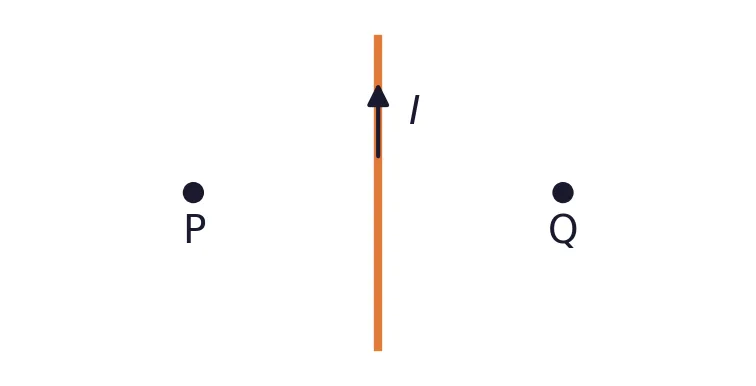
State the right-hand thumb rule. A long straight wire lies in the plane of the page and carries a current I upwards, as shown. What is the direction of the magnetic field at P and at Q?
Answer.
- Hold the current-carrying wire in the right hand with the thumb pointing along the current; the curled fingers show the direction of the magnetic field lines around the wire — 1 mark
- At P (left of the wire): out of the page, towards the reader; at Q (right): into the page (0.5 + 0.5) — 1 mark
Question 9 (3 marks)
Kiran makes an electromagnet by winding insulated copper wire on a rod and joining it to cells. She counts the steel pins it can lift in each set-up.
| Set-up | Turns | Cells in series | Rod | Pins lifted |
|---|---|---|---|---|
| 1 | 50 | 1 | soft iron | 6 |
| 2 | 100 | 1 | soft iron | 12 |
| 3 | 100 | 2 | soft iron | ? |
| 4 | 100 | 2 | wood | 1 |
(a) What does comparing set-ups 1 and 2 show? (1 mark)
Answer.
- With the same current, doubling the number of turns makes the electromagnet about twice as strong: the field increases with the number of turns — 1 mark
(b) Will set-up 3 lift more or fewer pins than set-up 2? Give a reason. (1 mark)
Answer.
- More (0.5); two cells in series drive a larger current through the same coil, and the field increases with the current (0.5) — 1 mark
(c) Set-up 4 has the same coil and cells as set-up 3, yet it lifts hardly any pins. Why? (1 mark)
Answer.
- A soft-iron rod gets strongly magnetised by the field of the coil and makes the magnet much stronger; wood is not magnetic, so only the weak field of the coil itself acts — 1 mark
Long Answer and Case-Based Questions
Question 10 (4 marks)
In a loudspeaker, a light coil of wire is fixed to the back of a paper cone. The coil sits in the narrow gap of a strong permanent magnet, where the magnetic field is at right angles to the wire of the coil. The music system sends an alternating current through the coil, and the cone moves in and out to make sound.
(a) Why does the coil experience a force when a current flows in it? (1 mark)
Answer.
- A current-carrying conductor placed in a magnetic field (at right angles to it) experiences a force — 1 mark
(b) Why does the cone move in and out, instead of being pushed one way only? (1 mark)
Answer.
- The alternating current keeps reversing its direction, and the direction of the force on the coil reverses whenever the current reverses — 1 mark
(c) Priya joins a 1.5 V cell across the coil of a small loudspeaker. The cone moves out once and stays out. When she turns the cell round, the cone moves in and stays in. Explain both observations. (2 marks)
Answer.
- The cell gives a steady direct current, so the force on the coil is steady and in one direction: the cone is pushed out once and held there — 1 mark
- Turning the cell round reverses the current, so the force on the coil reverses and the cone is pulled in — 1 mark
OR
(c) Priya fits the same coil and cone with a weaker permanent magnet of the same shape. What change will she notice in the sound, and why? What would happen instead if she only turned the original magnet round, so that its field is reversed? (2 marks)
Answer.
- The sound becomes softer (0.5): a weaker field gives a smaller force on the coil for the same current, so the cone moves less (0.5) — 1 mark
- With the field reversed, the force at every instant is reversed, but the current still keeps changing direction, so the cone vibrates just as before and the sound is the same (0.5 + 0.5) — 1 mark
Question 11 (4 marks)
The figure shows how an electrician has wired three lamps, P, Q and R, each rated 60 W, 220 V, to the mains in a room. L is the live wire, N is the neutral wire and F is the fuse. S1 and S2 are switches.
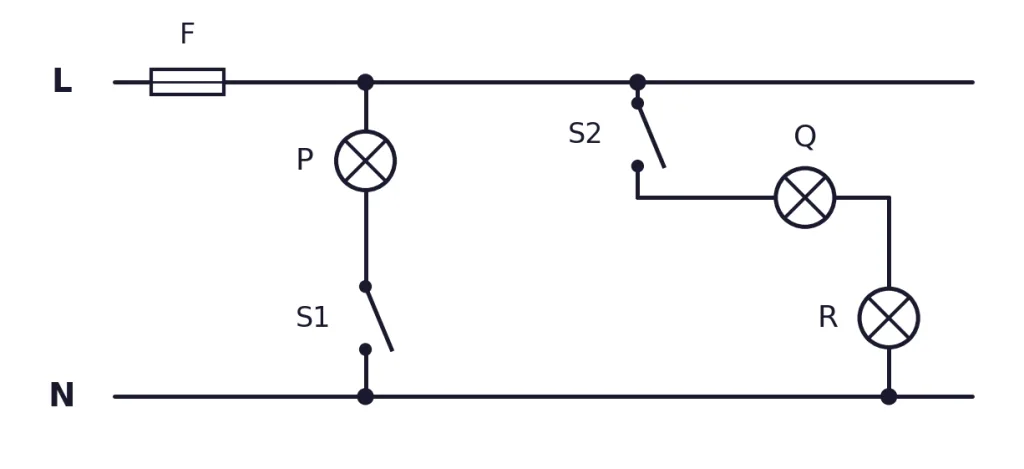
(a) When S1 is switched off, lamp P goes out. But when Rahul then touches the metal holder of lamp P to change the bulb, he gets a shock. Why? (1 mark)
Answer.
- S1 is on the neutral side of P, so even with S1 off the lamp holder stays joined to the live wire at 220 V; current passes through Rahul's body to the earth. A switch must be in the live wire — 1 mark
(b) When S2 is switched on, lamps Q and R glow very dimly. Why? (1 mark)
Answer.
- Q and R are joined in series, so the 220 V is shared and each lamp gets only about 110 V, much less than its rated voltage — 1 mark
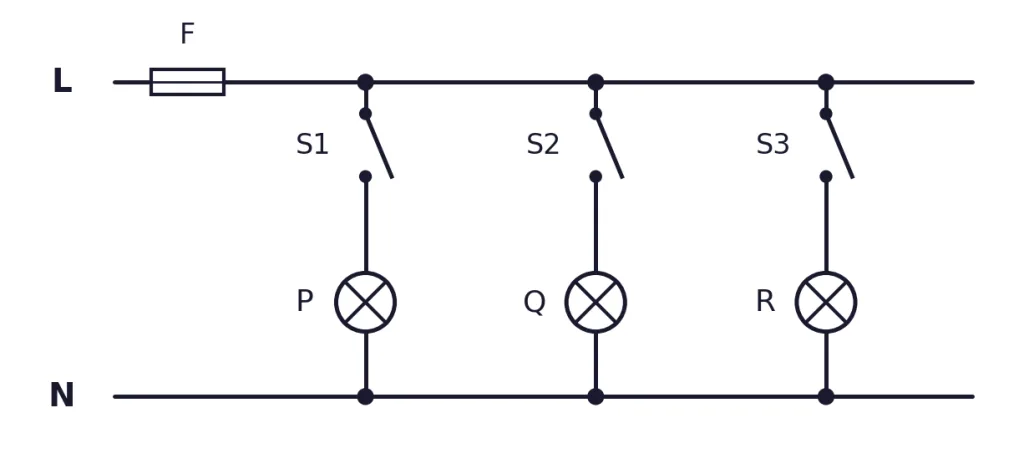
(c) Draw the correct way of wiring the three lamps, each with its own switch. (2 marks)
Answer.
- Each lamp joined in its own branch between L and N, that is, in parallel (see figure) — 1 mark
- Each switch placed between the live wire L and its lamp, with the fuse F in the live wire — 1 mark
OR
(c) Find the resistance of one lamp. What power does each of Q and R use as they are wired now, and what power would each use if wired correctly? (2 marks)
Answer.
- — 0.5 marks
- In series each gets 110 V: W each — 1 mark
- Wired correctly, each gets 220 V and uses its full 60 W — 0.5 marks
Question 12 (4 marks)
Students of a school in Pune use the magnetometer app on a phone to measure the magnetic field near a long straight wire carrying a steady current. They subtract the Earth's field from each reading. The app shows the field in microtesla (µT).
| Current (A) | Distance from the wire (cm) | Field (µT) |
|---|---|---|
| 2 | 2 | 20 |
| 2 | 4 | 10 |
| 2 | 8 | 5 |
| 6 | 4 | 30 |
(a) How does the field change with the distance from the wire? Use the readings to support your answer. (1 mark)
Answer.
- At 2 A, doubling the distance (2 → 4 → 8 cm) halves the field (20 → 10 → 5 µT): the field is inversely proportional to the distance — 1 mark
(b) How does the field depend on the current? Which readings show this? (1 mark)
Answer.
- At the same distance, 4 cm, making the current 3 times (2 A → 6 A) makes the field 3 times (10 → 30 µT): the field is proportional to the current — 1 mark
(c) Predict the field 2.5 cm from the wire when the current is 5 A. At what distance from the wire would a current of 4 A give a field of 16 µT? (2 marks)
Answer.
- Field ; from the first row, field µT, so at 5 A and 2.5 cm it is µT — 1 mark
- gives cm — 1 mark
OR
(c) Describe the shape of the graph of the field against the current at a fixed distance, and of the field against the distance at a fixed current. Use the readings to find the field 3 cm from the wire when the current is 4.5 A. (2 marks)
Answer.
- Field against current: a straight line through the origin; field against distance: a curve that falls, halving each time the distance doubles, and never reaching zero (0.5 + 0.5) — 1 mark
- Field µT — 1 mark
Question 13 (4 marks)
In an old physics laboratory in Shimla, Tenzin finds a large circular coil standing in a vertical plane, with a small compass at its centre. The coil has taps, so that 5, 10 or 20 of its turns can be used. His teacher turns the coil so that its plane lies along the north-south direction; the compass needle then lies in the plane of the coil. When a current is passed through the coil, the needle turns.
(a) Why is the plane of the coil set along the north-south direction? (1 mark)
Answer.
- The field at the centre of the coil is at right angles to its plane, that is, east-west; it then acts across the needle and turns it clearly (if the coil faced east-west, its field would be along the needle and would not turn it) — 1 mark
(b) With the same current, Tenzin changes from 5 turns to 20 turns. How does the field at the centre change? Why? (1 mark)
Answer.
- It becomes about 4 times as strong (0.5), because the field of each turn is in the same direction and they add up, so the field is proportional to the number of turns (0.5) — 1 mark
(c) Looking at the coil from its east side, Tenzin sees the current flowing anticlockwise. In which direction is the field at the centre, and which way does the north end of the needle turn? Name the rule you used. (2 marks)
Answer.
- The field at the centre points towards the viewer, that is, towards the east — 1 mark
- The north end of the needle turns from north towards the east (0.5); right-hand thumb rule (0.5) — 1 mark
OR
(c) Why do the magnetic field lines near the centre of the coil look almost like straight lines? Suggest one way, other than changing the number of turns, to make the needle turn through a larger angle. (2 marks)
Answer.
- Near the centre, the lines are parts of very large circles round each part of the wire, and every part of the coil gives a field in the same direction there, so the lines look straight — 1 mark
- Increase the current: add a rheostat set to a lower resistance, or use more cells — 1 mark