What Is a Sector?
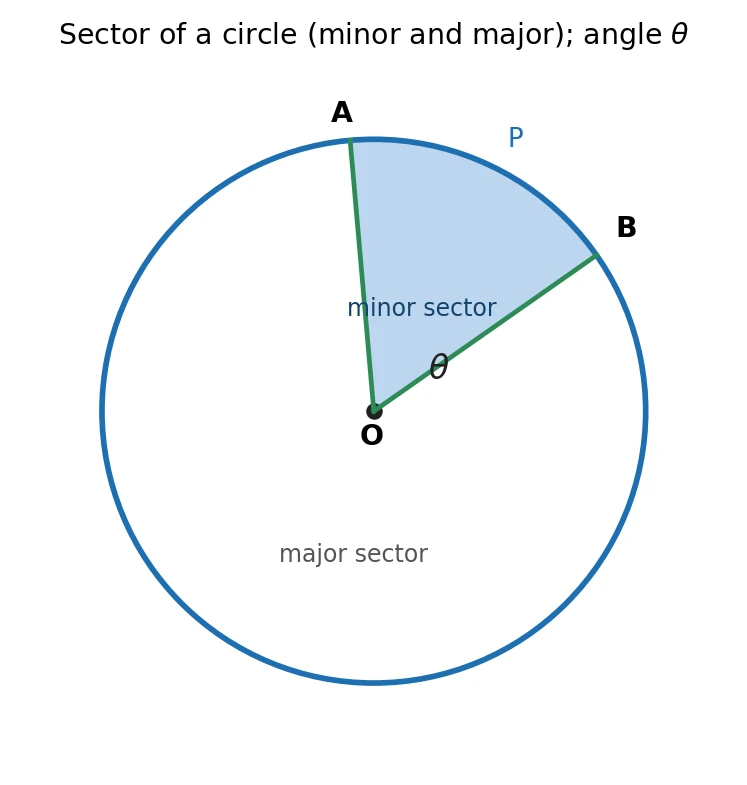
Cut a circular pizza from the centre with two straight cuts (two radii) — the slice you get is a sector. Formally, the region enclosed by two radii and the arc between them is a sector, and the angle between the two radii, θ, is the angle of the sector.
The two radii cut the circle into a smaller minor sector and a larger major sector. Unless a question says otherwise, "sector" means the minor sector. The angle of the major sector is 360∘−θ.
Area of a Sector — the Unitary Idea
A full circle is a sector of angle 360∘ with area πr2. So a sector is just a fraction of the circle — the fraction 360θ. Therefore
Area of a sector=360θ×πr2
where θ is the angle of the sector in degrees and r the radius.
Key Point: A sector's area is the fraction 360θ of the whole circle's area. A quadrant (θ=90∘) is 41πr2; a semicircle (θ=180∘) is 21πr2.
Length of the Arc
By exactly the same reasoning, the arc of the sector is the fraction 360θ of the whole circumference 2πr:
Length of arc=ℓ=360θ×2πr
A neat consequence links the two boxed formulas:
Area of sector=21ℓr,
i.e. half the arc length times the radius — handy when the arc length is already known.
Perimeter of a Sector
Do not confuse the arc with the perimeter. The perimeter (boundary) of a sector is the arc plus the two radii:
Perimeter of a sector=ℓ+2r=360θ×2πr+2r.
Key Point: Area uses πr2; arc length uses 2πr; perimeter of a sector adds the two straight radii (+2r) to the arc. Read the question carefully to see which one is asked.
Solved Examples
Example 1: Area of a sector
Find the area of a sector of a circle of radius 6 cm whose angle is 60∘. (π=722)
Solution:
- Area =360θπr2=36060×722×36.
- =61×722×36=722×6=7132≈18.86 cm2.
Final Answer: 7132≈18.86 cm2.
Takeaway: 36060=61 — reduce the fraction first.
Example 2: Length of an arc
In a circle of radius 21 cm, an arc subtends an angle of 60∘ at the centre. Find the length of the arc. (π=722)
Solution:
- ℓ=360θ×2πr=36060×2×722×21.
- =61×132=22 cm.
Final Answer: 22 cm.
Takeaway: Arc length uses 2πr, not πr2.
Example 3: Quadrant from circumference
Find the area of a quadrant of a circle whose circumference is 22 cm. (π=722)
Solution:
- 2πr=22⇒r=2×2222×7=27 cm.
- A quadrant is θ=90∘: area =41πr2=41×722×449=877=9.625 cm2.
Final Answer: 877=9.625 cm2.
Takeaway: Quadrant =41 of the circle.
Example 4: Perimeter of a sector
A sector of a circle of radius 7 cm has an angle of 90∘. Find its perimeter. (π=722)
Solution:
- Arc ℓ=36090×2×722×7=41×44=11 cm.
- Perimeter =ℓ+2r=11+14=25 cm.
Final Answer: 25 cm.
Takeaway: Perimeter of a sector = arc +2r — don't forget the two radii.
