What Is a Segment?

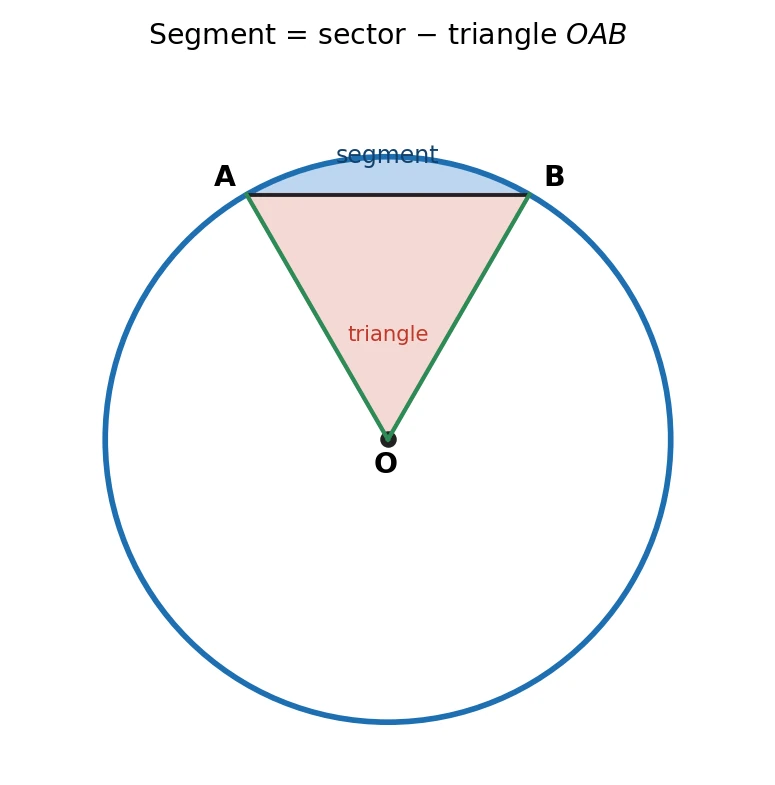
Draw a chord ABAB in a circle. The chord splits the circular region into two parts, each called a segment. The smaller piece (cut off by the chord, away from the centre) is the minor segment; the larger piece is the major segment. As with sectors, "segment" means the minor segment unless stated otherwise.

Notice the difference: a sector is bounded by two radii and an arc; a segment is bounded by a chord and an arc.

Area of a Segment = Sector - Triangle

Here is the key idea. The minor segment APBAPB and the triangle OABOAB together make up the sector OAPBOAPB. So the segment is what remains when we remove the triangle from the sector: Area of segment=Area of sectorArea of triangle OAB\boxed{\text{Area of segment} = \text{Area of sector} - \text{Area of triangle } OAB} =θ360πr2(area of OAB).= \frac{\theta}{360}\pi r^2 - (\text{area of }\triangle OAB).

The triangle OABOAB has two sides equal to the radius rr with the angle θ\theta between them, so a compact formula for its area is Area of OAB=12r2sinθ.\text{Area of }\triangle OAB = \frac{1}{2}r^2\sin\theta.

Key Point: Segment == sector - triangle. Get the sector from θ360πr2\dfrac{\theta}{360}\pi r^2 and the triangle from 12r2sinθ\dfrac12 r^2\sin\theta (or by dropping a perpendicular from OO to ABAB).

A circle with a chord AB; the shaded region between the chord and the minor arc is the minor segment, and the triangle OAB is shown, illustrating that the segment area equals the sector area minus the triangle area.

The Three Standard Angles

Most board problems use θ=90\theta = 90^\circ, 6060^\circ or 120120^\circ. Learn these shapes:

  • θ=90\theta = 90^\circ: triangle is right-angled, area =12r2=\tfrac12 r^2. Segment =πr24r22=r2 ⁣(π412)= \dfrac{\pi r^2}{4} - \dfrac{r^2}{2} = r^2\!\left(\dfrac{\pi}{4}-\dfrac12\right).
  • θ=60\theta = 60^\circ: triangle is equilateral, area =34r2=\dfrac{\sqrt3}{4}r^2. Segment =r2 ⁣(π634)= r^2\!\left(\dfrac{\pi}{6}-\dfrac{\sqrt3}{4}\right).
  • θ=120\theta = 120^\circ: triangle area =12r2sin120=34r2=\dfrac12 r^2\sin120^\circ = \dfrac{\sqrt3}{4}r^2. Segment =r2 ⁣(π334)= r^2\!\left(\dfrac{\pi}{3}-\dfrac{\sqrt3}{4}\right).

Major Segment (and Major Sector)

You rarely need a new formula for the major piece — just subtract the minor piece from the whole circle: Major segment=πr2minor segment,Major sector=πr2minor sector.\text{Major segment} = \pi r^2 - \text{minor segment}, \qquad \text{Major sector} = \pi r^2 - \text{minor sector}.

Key Point: Whole circle - minor part == major part. This is faster and safer than recomputing with the reflex angle.

Solved Examples

Example 1: Segment at 9090^\circ

A chord of a circle of radius 10 cm subtends a right angle at the centre. Find the area of the corresponding minor segment. (π=3.14)\left(\pi=3.14\right)

Solution:

  1. Sector =90360πr2=14×3.14×100=78.5= \dfrac{90}{360}\pi r^2 = \dfrac14\times 3.14\times 100 = 78.5 cm2^2.
  2. Triangle OABOAB (right-angled) =12×10×10=50= \dfrac12\times 10\times 10 = 50 cm2^2.
  3. Segment =78.550=28.5= 78.5 - 50 = 28.5 cm2^2.

Final Answer: 28.5 cm2^2.

Takeaway: At 9090^\circ the triangle is a simple right triangle, area 12r2\tfrac12 r^2.

Example 2: Segment at 120120^\circ

A chord of a circle of radius 21 cm subtends an angle of 120120^\circ at the centre. Find the area of the corresponding minor segment. (π=227, 3=1.73)\left(\pi=\dfrac{22}{7},\ \sqrt3 = 1.73\right)

Solution:

  1. Sector =120360×227×441=13×227×441=462= \dfrac{120}{360}\times\dfrac{22}{7}\times 441 = \dfrac13\times\dfrac{22}{7}\times 441 = 462 cm2^2.
  2. Triangle =12r2sin120=12×441×32=441×1.734190.7= \dfrac12 r^2\sin120^\circ = \dfrac12\times 441\times\dfrac{\sqrt3}{2} = \dfrac{441\times 1.73}{4} \approx 190.7 cm2^2.
  3. Segment =462190.7=271.3= 462 - 190.7 = 271.3 cm2^2.

Final Answer: 271.3\approx 271.3 cm2^2.

Takeaway: Triangle area =12r2sinθ=\tfrac12 r^2\sin\theta works for any angle.

Example 3: Minor and major segments at 6060^\circ

A chord of a circle of radius 15 cm subtends 6060^\circ at the centre. Find the areas of the minor and major segments. (π=3.14, 3=1.73)\left(\pi=3.14,\ \sqrt3=1.73\right)

Solution:

  1. Sector =60360×3.14×225=16×706.5=117.75= \dfrac{60}{360}\times 3.14\times 225 = \dfrac16\times 706.5 = 117.75 cm2^2.
  2. Triangle (equilateral) =34×225=1.73×225497.31= \dfrac{\sqrt3}{4}\times 225 = \dfrac{1.73\times 225}{4} \approx 97.31 cm2^2.
  3. Minor segment =117.7597.31=20.44= 117.75 - 97.31 = 20.44 cm2^2.
  4. Major segment =πr220.44=706.520.44=686.06= \pi r^2 - 20.44 = 706.5 - 20.44 = 686.06 cm2^2.

Final Answer: Minor 20.44\approx 20.44 cm2^2, major 686.06\approx 686.06 cm2^2.

Takeaway: Major segment == whole circle - minor segment.

Example 4: Which is bigger?

Without full calculation, state whether the minor segment or the triangle OABOAB is larger when θ=90\theta = 90^\circ and r=10r=10 cm.

Solution:

  1. Triangle =50= 50 cm2^2; minor segment =28.5= 28.5 cm2^2 (from Example 1).
  2. So the triangle is larger.

Final Answer: The triangle OABOAB (50 cm2^2) is larger than the minor segment (28.5 cm2^2).

Takeaway: For θ<180\theta<180^\circ the minor segment is always smaller than its triangle plus… always check by the sector-triangle split.