
The Circle — Circumference and Area
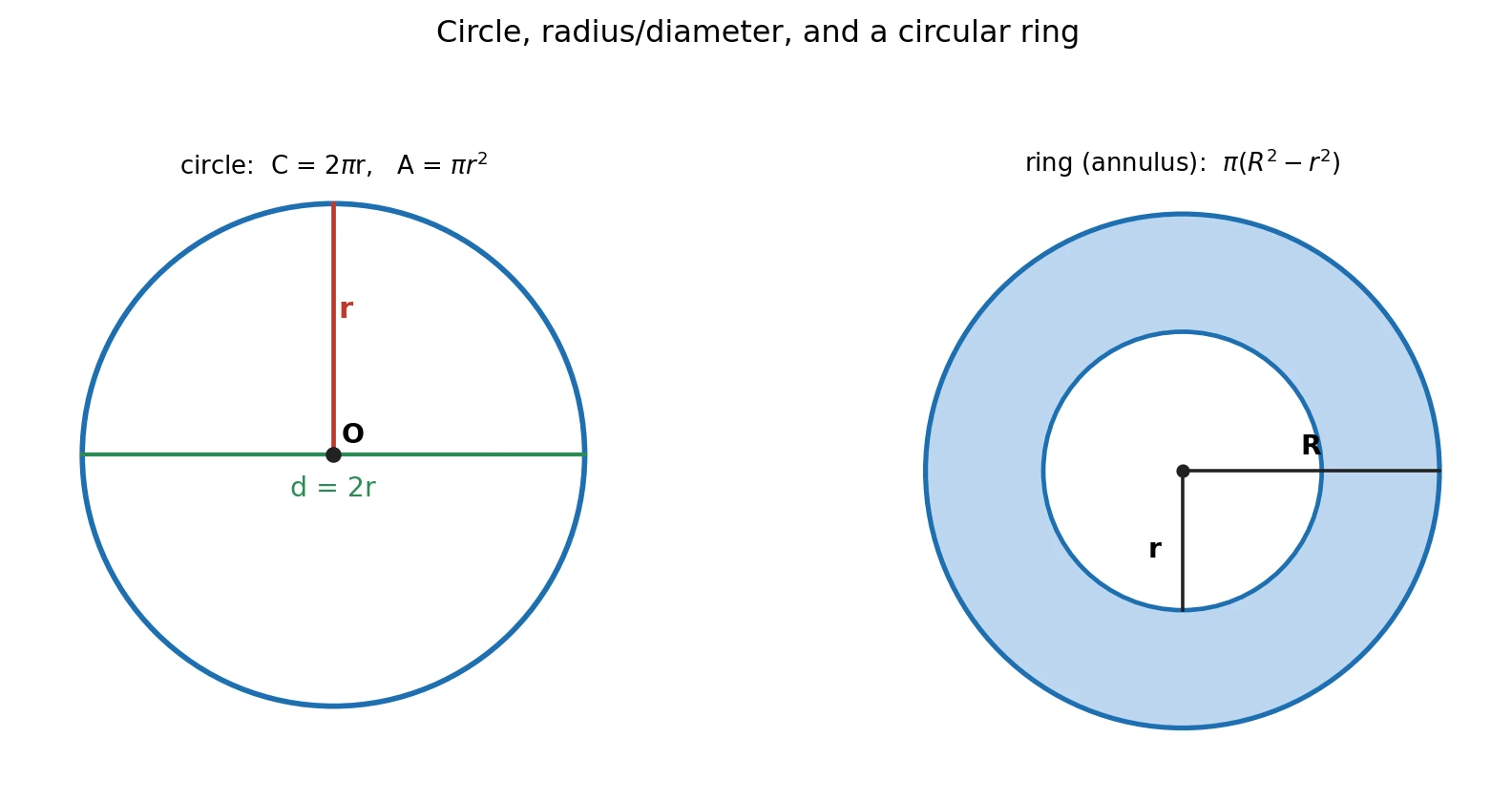
A circle of radius carries two basic measurements you have used since earlier classes.
- Circumference (the distance once around): , where is the diameter.
- Area (the region enclosed): .
Here (pi) is the constant ratio of any circle's circumference to its diameter. For calculations we use (or when a question asks for it).
Key Point: uses the radius once; uses it squared. Mixing these up is the most common slip in the whole chapter.
From Diameter, and Back Again
Often a problem gives the diameter or the circumference, not the radius. Convert first:
- Given : use .
- Given : use .
Worked idea
If the circumference is cm, then cm, so the area cm.
[Board Important] When two circles are compared, remember: the ratio of circumferences equals the ratio of radii, but the ratio of areas equals the ratio of the squares of the radii.
Area of a Circular Ring (Annulus)
A ring (or annulus) is the region between two concentric circles — think of a washer, a circular track, or a pipe's cross-section. If the outer radius is and the inner radius is , the ring's area is the big circle minus the small circle:
Key Point: — factorising often makes the arithmetic much easier.
A Rolling Wheel
When a wheel rolls without slipping, in one complete revolution it covers a distance equal to its circumference. So in revolutions it covers
Turned around: number of revolutions .
[Board Important] "How many revolutions does a wheel of radius make to cover metres?" is just — mind the units (convert everything to the same unit first).
Solved Examples
Example 1: Area from radius
Find the circumference and area of a circle of radius 7 cm.
Solution:
- cm.
- cm.
Final Answer: cm, cm.
Takeaway: With (or a multiple of 7), cancels neatly.
Example 2: Radius from circumference
The circumference of a circle is 88 cm. Find its area.
Solution:
- cm.
- cm.
Final Answer: 616 cm.
Takeaway: Find first, then square it for the area.
Example 3: Area of a ring
A circular path is 7 m wide and its inner radius is 21 m. Find the area of the path.
Solution:
- Inner m, outer m.
- Area m.
Final Answer: 1078 m.
Takeaway: Path/ring/track area ; outer radius inner width.
Example 4: Rolling wheel
A wheel of radius 35 cm makes 20 revolutions. What distance does it cover?
Solution:
- One revolution cm.
- Distance cm m.
Final Answer: 44 m.
Takeaway: Distance circumference.