
The One Big Idea: Add and Subtract
"Shaded region" problems look scary but use a single strategy: build the shaded area out of simple pieces you already know — circles, sectors, semicircles, squares, rectangles and triangles — and add or subtract them.
The whole skill is seeing the figure as a combination. Label each simple piece, write its area, then combine.
Circle Inside a Square (and Square Inside a Circle)
Largest circle in a square of side : the circle's diameter equals the side, so . The leftover (corners) area is
Largest square in a circle of radius : the square's diagonal is the diameter , so its area is . The leftover (four circular gaps) is .
Key Point: Inscribed circle in a square: diameter side. Inscribed square in a circle: diagonal diameter.
Quarter Circles at the Corners
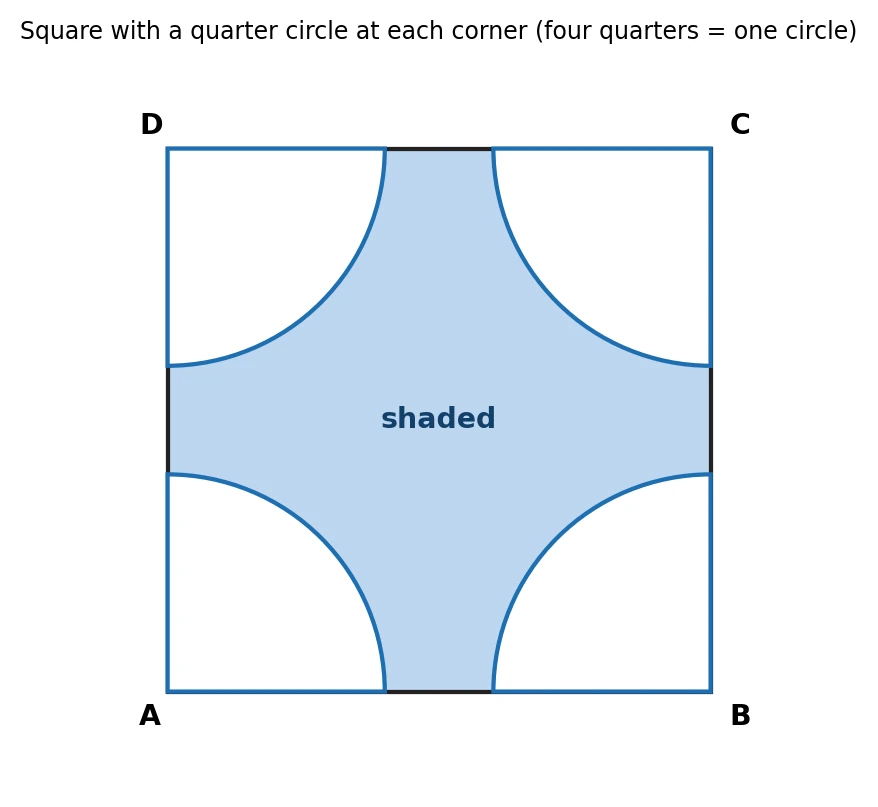
A favourite design: a square of side with a quarter circle drawn at each of the four corners, radius . The four quarter circles together make one full circle of radius . So provided the quarters do not overlap ().
Similarly, semicircles drawn on the sides of a square, or a design of overlapping circles, are handled by counting how many full circles/semicircles the pieces add up to.
Key Point: Four quarter circles of equal radius one full circle. Two semicircles of equal radius one full circle.
A Working Checklist
For any shaded-region problem:
- Identify the outer boundary (square, rectangle, circle, triangle).
- Spot the circular pieces (full circles, sectors, semicircles, quadrants) inside.
- Decide which areas are added and which are removed to leave the shaded part.
- Substitute or as told, and keep units (cm, m) consistent.
Key Point: Write the plan in words first ("big square circle small triangles"), then compute. Most mistakes are planning mistakes, not arithmetic.
Solved Examples
Example 1: Circle in a square
A circle is inscribed in a square of side 14 cm. Find the area between the square and the circle.
Solution:
- Circle diameter side ; circle area cm.
- Square area cm.
- Shaded cm.
Final Answer: 42 cm.
Takeaway: Inscribed circle .
Example 2: Quarter circles at corners
From each corner of a square of side 14 cm, a quarter circle of radius 7 cm is removed. Find the area of the remaining (shaded) region.
Solution:
- Four quarter circles of radius 7 one full circle cm.
- Square cm.
- Shaded cm.
Final Answer: 42 cm.
Takeaway: Four equal quarter circles combine into one circle.
Example 3: Square inside a circle
Find the area of the region between a circle of radius 7 cm and the largest square inscribed in it.
Solution:
- Square's diagonal , so square area cm.
- Circle area cm.
- Shaded cm.
Final Answer: 56 cm.
Takeaway: Inscribed square area .
Example 4: Two semicircles design
A rectangle is 14 cm by 7 cm with a semicircle drawn on each of the two shorter sides (diameter 7 cm), pointing outwards. Find the total area of the figure.
Solution:
- Rectangle cm.
- Two semicircles of diameter 7 (radius 3.5) make one full circle: cm.
- Total cm.
Final Answer: 136.5 cm.
Takeaway: Two equal semicircles one circle; here they are added to the rectangle.