
Chords and Concentric Circles
Concentric circles share the same centre. A classic result:
A chord of the larger of two concentric circles that touches the smaller circle is bisected at the point of contact.
Why? Let the chord of the bigger circle touch the smaller circle at . Then is a tangent to the smaller circle at , so (Theorem 10.1). But a perpendicular from the centre to a chord bisects the chord. Hence .
If the radii are (large) and (small), then each half of the chord is , so the full chord length is
[Board Important] For radii 5 cm and 3 cm, the chord cm.
The Relation
From an external point , tangents and touch a circle with centre . Then
Why? Let . Since , triangle is isosceles, so . Also (radius ⊥ tangent). Hence
So . This appears often as a 3-mark proof.
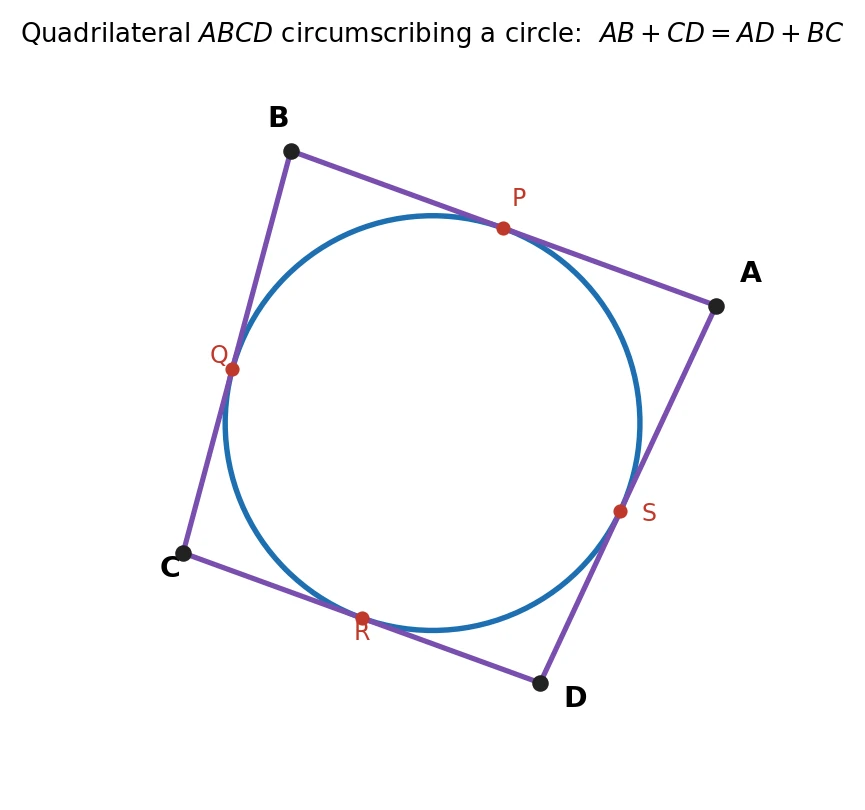
A Quadrilateral Circumscribing a Circle:
A quadrilateral is drawn so that all four sides touch a circle (the circle is inscribed in it). Let the circle touch at .
Using equal tangents from each vertex:
Add them up cleverly:
Result: In any quadrilateral circumscribing a circle, the sums of opposite sides are equal:
[Board Important] A parallelogram circumscribing a circle must be a rhombus: in a parallelogram and , and this result forces , i.e. all sides equal.
A Triangle Circumscribing a Circle (the Incircle)
When a circle is inscribed in a triangle (its incircle), each vertex sends two equal tangents to the circle. If the incircle touches at , then
These equal tangent lengths let you find unknown sides. Combined with the area relation Area (where is the inradius and the semi-perimeter), triangle-incircle problems are fully solvable.
Key Point: From each vertex, the two tangent segments to the incircle are equal — label them and set up equations.
Tangents at the Ends of a Diameter
The tangents drawn at the two ends of a diameter of a circle are parallel.
Why? Let be a diameter. The tangent at is perpendicular to radius , i.e. to the line ; the tangent at is perpendicular to , i.e. to the same line . Two lines perpendicular to the same line are parallel.
Another standard result: if and are two parallel tangents and a third tangent touches the circle at meeting them at and , then (using the angle-bisector property at and ).
Solved Examples
Example 1: Chord of concentric circles
Two concentric circles have radii 5 cm and 3 cm. Find the length of the chord of the larger circle that touches the smaller circle.
Solution:
- The chord touches the smaller circle, so the perpendicular from the centre (radius 3) bisects it.
- Half-chord cm.
- Full chord cm.
Final Answer: 8 cm.
Takeaway: Chord for concentric radii .
Example 2: Quadrilateral circumscribing a circle
A quadrilateral circumscribes a circle. If cm, cm and cm, find .
Solution:
- Opposite sides are equal in sum: .
- cm.
Final Answer: cm.
Takeaway: for any circumscribing quadrilateral.
Example 3: Triangle circumscribing a circle
A triangle is drawn to circumscribe a circle of radius 4 cm, and the point of contact divides into cm and cm. Find and .
Solution:
- Equal tangents: , , and let .
- Sides: , , ; semi-perimeter .
- Area . Also Area .
- Squaring: .
- cm, cm.
Final Answer: cm, cm.
Takeaway: Equal tangents + Area crack incircle problems.
Example 4: Parallelogram circumscribing a circle
Prove that a parallelogram that circumscribes a circle is a rhombus.
Solution:
- For a circumscribing quadrilateral : .
- In a parallelogram and . Substituting: , so .
- Adjacent sides equal in a parallelogram all sides equal rhombus.
Final Answer: It must be a rhombus.
Takeaway: Circumscribing + parallelogram forces all sides equal.
Example 5: Tangents at ends of a diameter
Prove that the tangents at the two ends of a diameter of a circle are parallel.
Solution:
- Let be a diameter. The tangent at is ; the tangent at is .
- But and lie along the same line .
- Both tangents are perpendicular to the same line , so they are parallel.
Final Answer: The two tangents are parallel.
Takeaway: Perpendiculars to the same line are parallel.