
A Quick Recap — and What Is New
You already know a circle from Class 9: it is the set of all points in a plane that are at a fixed distance (the radius) from a fixed point (the centre). You also met the words chord (a segment joining two points of the circle), arc (a part of the circle), segment and sector.
So what is new here? In this chapter we look closely at what happens when a line and a circle are drawn in the same plane. That single question leads us to one of the most useful ideas in geometry — the tangent — and to two short but powerful theorems that appear in the Board exam almost every year.
Key Point: This chapter is short (only two theorems), but it is very high-scoring. Master the two theorems and the length-of-tangent formula, and most questions fall quickly.
Three Positions of a Line and a Circle
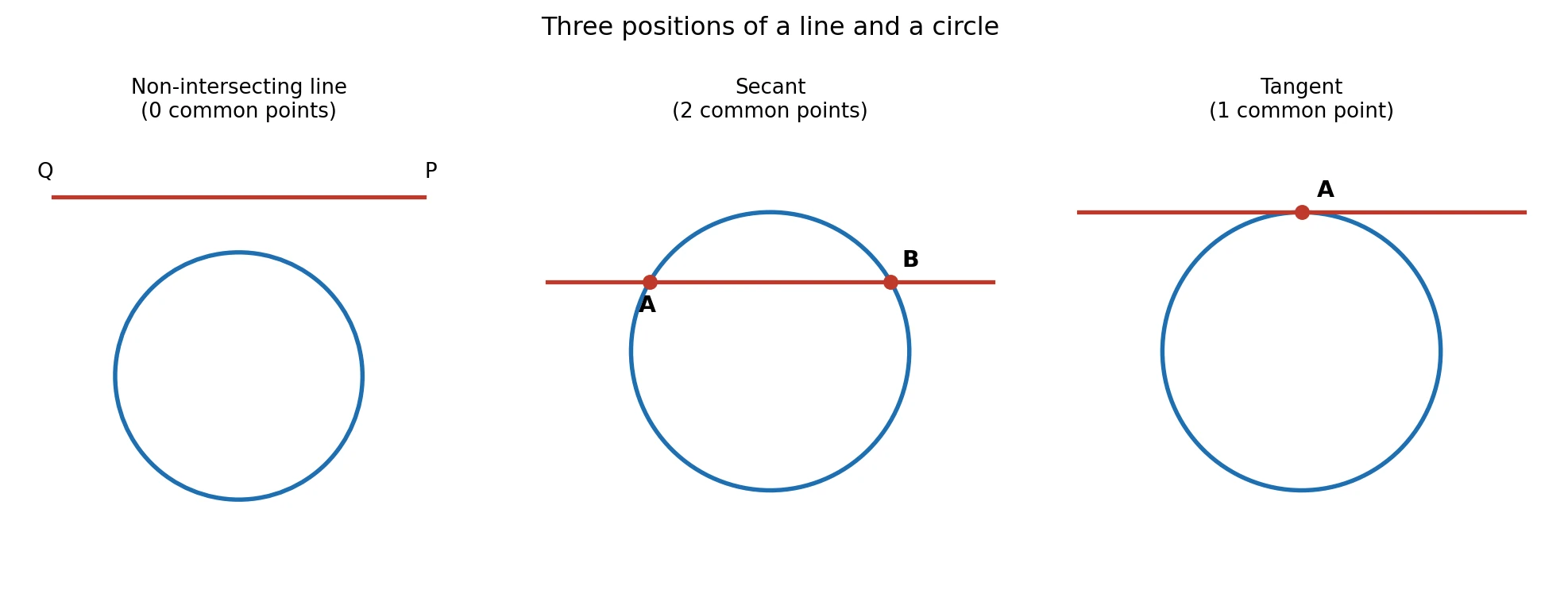
Take a circle and a line in the same plane. Exactly three things can happen — there is no fourth possibility.
1. Non-intersecting line. The line and the circle have no common point. The line misses the circle completely.
2. Secant. The line meets the circle at two distinct points and . Such a line is called a secant of the circle. (A chord is just the part of a secant that lies inside the circle.)
3. Tangent. The line meets the circle at exactly one point . Such a line is called a tangent to the circle, and is the point of contact.
| Position of the line | Common points with the circle |
|---|---|
| Non-intersecting line | 0 |
| Secant | 2 |
| Tangent | 1 |
The word tangent comes from the Latin tangere, meaning "to touch." A tangent touches the circle; a secant cuts it.
The Tangent Is a Special Secant
Here is a beautiful way to see a tangent. Start with a secant that cuts the circle at two points, and slide it (keeping it parallel) so that the two points come closer and closer together. At the instant the two points merge into one, the secant has become a tangent.
Key Point: A tangent to a circle is the limiting position of a secant when the two end points of its chord coincide.
Two consequences follow at once:
- At any given point of a circle there is exactly one tangent.
- For a given secant, there are at most two tangents parallel to it (one on each side).
[Board Important] A common 1-mark question asks "A tangent to a circle intersects it in how many points?" — the answer is one.
Tangents All Around You — and the Key Terms
Tangents are everywhere. The rope running off a pulley, or the ground under a moving bicycle wheel, behaves like a tangent to the circle. Look at a wheel rolling on a road: at every instant it touches the road at exactly one point, and — as we will prove in the next section — the spoke (radius) to that point stands at right angles to the road.
Let us fix the vocabulary we will use throughout the chapter:
- Point of contact: the single point where a tangent touches the circle.
- Length of the tangent (from an external point): the distance from the external point to the point of contact.
- Normal: the line through the point of contact perpendicular to the tangent — it always passes through the centre.
Key Point: "Touches" = tangent = one common point. "Cuts" = secant = two common points. Keep these words straight and half the theory questions answer themselves.
Solved Examples
Example 1: Naming the line
A line meets a circle at the two points and . What is this line called, and what is segment called?
Solution:
- A line meeting a circle at two points is a secant.
- The part of the secant inside the circle, the segment , is a chord.
Final Answer: The line is a secant; is a chord.
Takeaway: Secant = the whole line (2 points); chord = the segment between them.
Example 2: How many common points?
State the number of common points a tangent has with its circle, and the number a non-intersecting line has.
Solution:
- A tangent touches the circle at exactly one point (the point of contact).
- A non-intersecting line has no point in common with the circle.
Final Answer: Tangent — 1 point; non-intersecting line — 0 points.
Takeaway: 0, 1, 2 common points ↔ non-intersecting, tangent, secant.
Example 3: Parallel tangents
At most how many tangents to a circle can be drawn parallel to a given secant?
Solution:
- Sliding the secant towards the circle on each side, it becomes a tangent once on each side.
- So there are two such tangents, one on either side, and no more.
Final Answer: Two.
Takeaway: A circle has exactly two tangents parallel to any given direction (they are at the two ends of the diameter perpendicular to that direction).