
Theorem 10.1 — Statement
Look again at a wheel rolling on the ground: the spoke (radius) that reaches the point touching the road always stands straight up, at right angles to the road. That everyday observation is exactly our first theorem.
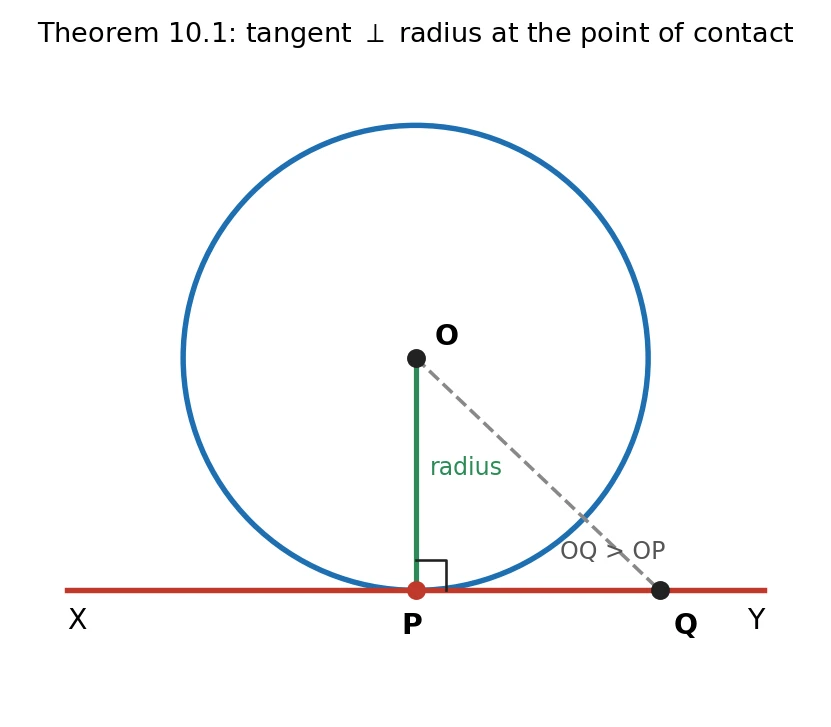
Theorem 10.1: The tangent at any point of a circle is perpendicular to the radius through the point of contact.
In symbols: if is the tangent at the point of a circle with centre , then
This is the single most-used fact in the whole chapter. Almost every circle problem begins with the words "radius ⊥ tangent.
Proof of Theorem 10.1
Given: A circle with centre and a tangent touching the circle at the point . To prove: .
Proof. Take any point on the tangent , other than , and join .
Since is a tangent, it meets the circle only at . So every other point of — including — lies outside the circle. (If were inside, the line would be a secant, not a tangent.)
Because is outside the circle,
This is true for every point on except itself. So among all the segments from to points of the line , the segment is the shortest.
But the shortest segment from a point to a line is the perpendicular from the point to the line. Therefore
Key Point: The proof idea is " is the shortest distance from to the line, and the shortest distance is the perpendicular."
Two Consequences You Will Use Constantly
1. Exactly one tangent at a point. Since the tangent at must be perpendicular to , and there is only one line through perpendicular to , there is one and only one tangent to a circle at any point on it.
2. The normal passes through the centre. The line through the point of contact, perpendicular to the tangent, is called the normal. Because the radius is already perpendicular to the tangent there, the normal is exactly the line — so the normal always passes through the centre.
[Board Important] "Prove that the perpendicular at the point of contact to a tangent passes through the centre" is a standard 2-mark question — it is just consequence 2 stated in reverse.
The Length of a Tangent — the Formula
This is the workhorse formula of the chapter. Suppose is a point outside a circle of centre and radius , and is a tangent from touching the circle at .
By Theorem 10.1, , so triangle is right-angled at . Let be the distance of the external point from the centre. By Pythagoras' theorem:
Therefore the length of the tangent is
where = distance from the external point to the centre and = radius.
Key Point: Radius, tangent length and centre-distance form a right triangle with the radius and tangent as the legs and the centre-to-point distance as the hypotenuse. So is always the largest of the three.
[Board Important] Any time a problem gives two of {radius, tangent length, distance to centre}, use to get the third.
Solved Examples
Example 1: Find the tangent length
A tangent at a point of a circle of radius 5 cm meets a line through the centre at a point so that cm. Find the length .
Solution:
- is a tangent and is the radius to the point of contact, so and triangle is right-angled at .
- By Pythagoras: , i.e. .
- , so cm.
Final Answer: cm.
Takeaway: Distance to centre is the hypotenuse; tangent length .
Example 2: Find the radius
From a point , the length of the tangent to a circle is 24 cm and the distance of from the centre is 25 cm. Find the radius.
Solution:
- Tangent radius, so with , tangent .
- .
- cm.
Final Answer: Radius cm.
Takeaway: is a Pythagorean triple — very common in this chapter.
Example 3: Distance to the centre
The length of a tangent from a point to a circle of radius 3 cm is 4 cm. How far is from the centre?
Solution:
- .
- cm.
Final Answer: is 5 cm from the centre.
Takeaway: triple again — radius and tangent are the legs, centre-distance the hypotenuse.
Example 4: The normal through the centre
A tangent touches a circle at . A student draws the perpendicular to the tangent at . Where must this perpendicular pass through?
Solution:
- By Theorem 10.1 the radius is perpendicular to the tangent at .
- Through there is only one line perpendicular to the tangent, and it is .
- Hence the perpendicular passes through the centre .
Final Answer: Through the centre .
Takeaway: The normal at the point of contact always passes through the centre.