Theorem 10.2 — Statement
We saw that two tangents can be drawn from an external point, and that they look equal. Now we prove it.
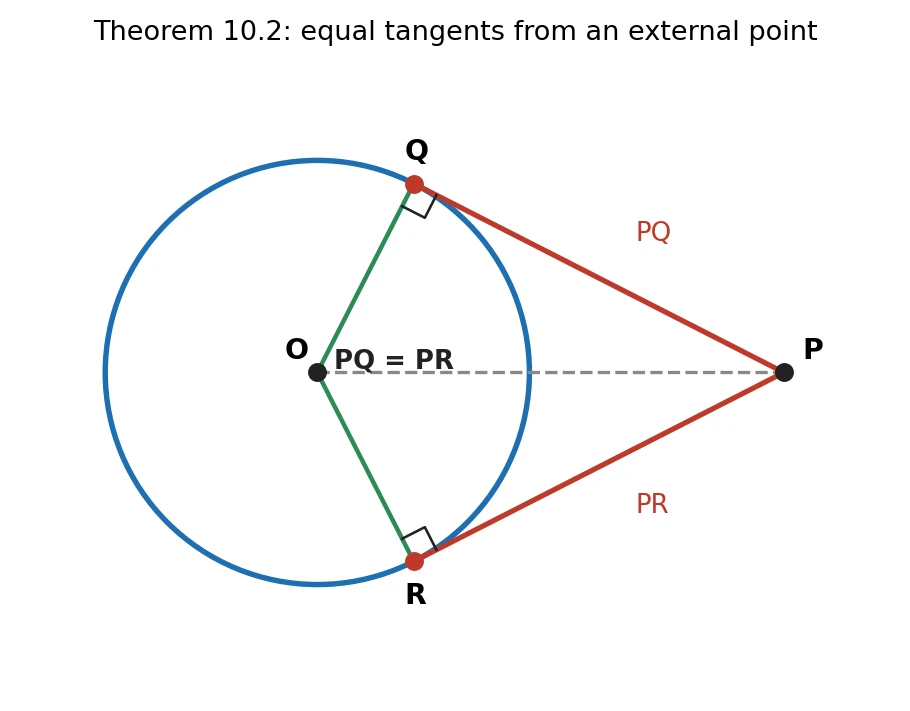
Theorem 10.2: The lengths of the two tangents drawn from an external point to a circle are equal.
If P is an external point and PQ, PR are the two tangents (touching the circle at Q and R), then
PQ=PR.
Proof of Theorem 10.2
Given: A circle with centre O, an external point P, and two tangents PQ and PR (points of contact Q and R).
To prove: PQ=PR.
Construction: Join OP, OQ and OR.
Proof. By Theorem 10.1, a tangent is perpendicular to the radius at the point of contact, so
∠OQP=∠ORP=90∘.
Now compare the right triangles OQP and ORP:
- OQ=OR (radii of the same circle),
- OP=OP (common hypotenuse),
- ∠OQP=∠ORP=90∘.
By the RHS congruence rule, △OQP≅△ORP.
Hence, by CPCT (corresponding parts of congruent triangles),
PQ=PR.■
A Second Proof, and the Angle-Bisector Property
Pythagoras version. In the right triangles, PQ2=OP2−OQ2 and PR2=OP2−OR2. Since OQ=OR, we get PQ2=PR2, so PQ=PR.
Angle-bisector property. The same congruence △OQP≅△ORP also gives
∠OPQ=∠OPRand∠QOP=∠ROP.
So OP bisects the angle ∠QPR between the two tangents, and also bisects the angle ∠QOR at the centre.
Key Point: The line joining the external point to the centre bisects both the angle between the tangents and the angle between the radii to the points of contact.
A Very Useful Angle Relation
Look at the quadrilateral OQPR (centre O, contacts Q, R, external point P). Its angles at Q and R are each 90∘. Since the angles of a quadrilateral add up to 360∘,
∠QOR+∠QPR=360∘−90∘−90∘=180∘.
Result: The angle between the two tangents from an external point and the angle subtended by the line joining the points of contact at the centre are supplementary:
∠QPR+∠QOR=180∘.
[Board Important] So if ∠POQ=110∘, then ∠PTQ=180∘−110∘=70∘; if the tangents meet at 80∘, then ∠ at the centre =100∘, and each ∠OPA=21(180∘−80∘)=50∘.
Solved Examples
Example 1: Angle between tangents
Two tangents TP and TQ are drawn to a circle with centre O from an external point T, and ∠POQ=110∘. Find ∠PTQ.
Solution:
- ∠PTQ and ∠POQ are supplementary: ∠PTQ+∠POQ=180∘.
- ∠PTQ=180∘−110∘=70∘.
Final Answer: ∠PTQ=70∘.
Takeaway: Angle between tangents + angle at centre =180∘.
Example 2: Find the angle at the centre
Tangents PA and PB from a point P to a circle with centre O are inclined to each other at 80∘. Find ∠POA.
Solution:
- ∠AOB=180∘−∠APB=180∘−80∘=100∘.
- OP bisects ∠AOB, so ∠POA=21(100∘)=50∘.
Final Answer: ∠POA=50∘.
Takeaway: OP bisects the central angle; half of (180∘−angle between tangents).
Example 3: Isosceles set-up
From an external point T, tangents TP and TQ touch a circle at P and Q. If ∠PTQ=60∘, find ∠TPQ.
Solution:
- TP=TQ (equal tangents), so triangle TPQ is isosceles with ∠TPQ=∠TQP.
- Angle sum: ∠TPQ+∠TQP+60∘=180∘⇒2∠TPQ=120∘.
- ∠TPQ=60∘.
Final Answer: ∠TPQ=60∘ (the triangle is in fact equilateral).
Takeaway: Equal tangents make triangle TPQ isosceles — use the base angles.
