
The Distance Formula
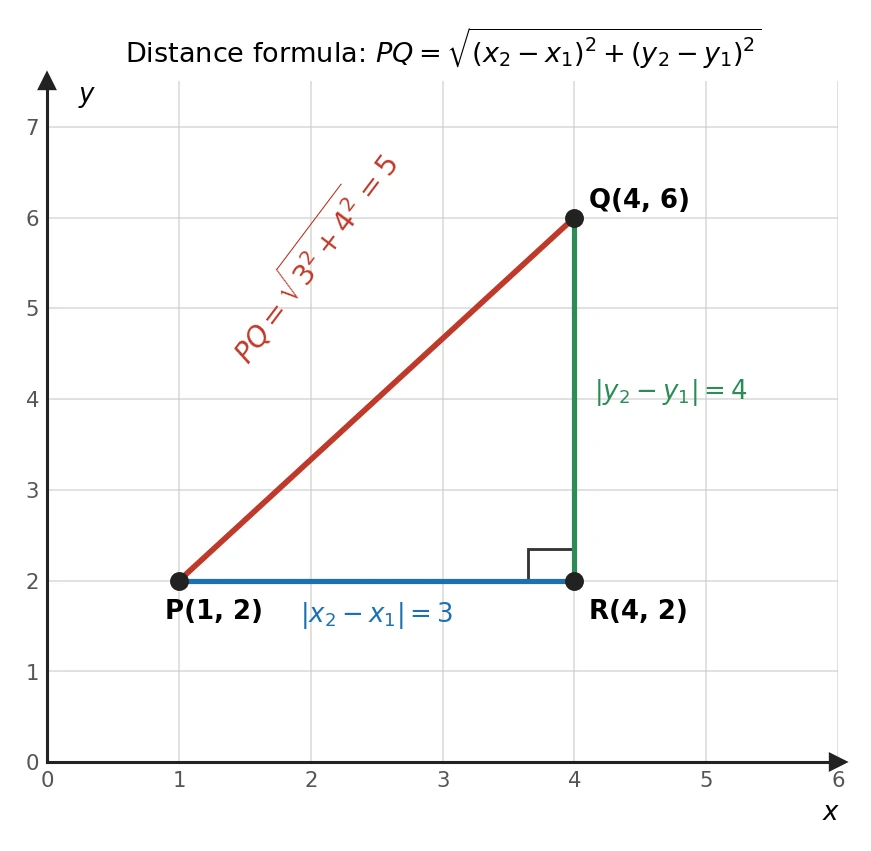
How far apart are two points and ? Drop perpendiculars to form a right triangle: the horizontal leg is and the vertical leg is . By the Pythagoras theorem, the distance is the hypotenuse:
Key Point: It does not matter which point you call first — squaring removes any sign issue. So .
[Board Important] This formula is the heart of the chapter. Write it down first, then substitute carefully — most marks here are for correct substitution.
Distance from the Origin
The distance of a point from the origin is a special case with :
Think of it this way: it's just the distance formula with the origin as the second point.
Key Point: — memorise this shortcut; it appears in many 1-mark questions.
[Board Important] For example, the distance of from the origin is .
Using Distance to Identify Shapes
Distances let us classify triangles and quadrilaterals:
- Equilateral triangle: all three sides equal.
- Isosceles triangle: exactly two sides equal.
- Right triangle: the three sides satisfy the Pythagoras relation .
- Square: all four sides equal AND the two diagonals equal.
- Rhombus: all four sides equal, but diagonals unequal.
- Rectangle: opposite sides equal AND diagonals equal.
- Parallelogram: opposite sides equal (diagonals generally unequal).
Key Point: To name a quadrilateral, compute all four sides and both diagonals, then compare.
[Board Important] A frequent 3-mark question: 'Show that the points … form a square/rhombus/right triangle.' Always justify with the side and diagonal lengths.
Collinearity Using Distances
Three points , , are collinear (lie on one straight line) if the longest distance equals the sum of the other two — for example .
This is because the only way to travel from to through with no detour is along a straight line.
Key Point: Collinear ⇒ one distance = sum of the other two. (We'll see a faster area-based test in Section 4.)
[JEE Tip] The distance method for collinearity is reliable but slow; the zero-area test is quicker for three given points.
Solved Examples
Example 1: Basic distance
Find the distance between and .
Solution:
- .
- .
Final Answer: units.
Takeaway: shows up constantly — recognise Pythagorean triples.
Example 2: Distance from origin
Find the distance of from the origin.
Solution:
- .
- .
Final Answer: 10 units.
Takeaway: Use directly.
Example 3: Find an unknown coordinate
The distance between and is 10. Find .
Solution:
- .
- .
- or .
Final Answer: or .
Takeaway: Square both sides; expect two answers from .
Example 4: Point equidistant from two points
Find a point on the x-axis equidistant from and .
Solution:
- Let the point be .
- : .
- .
- .
Final Answer: .
Takeaway: Equidistant ⇒ set squared distances equal; the terms cancel.
Example 5: Isosceles triangle
Show that , , form an isosceles triangle.
Solution:
- .
- .
- .
- .
Final Answer: Isosceles (two equal sides).
Takeaway: Two equal sides ⇒ isosceles.
Example 6: Right triangle test
Do , , form a right triangle?
Solution:
- , , .
- Check: .
Final Answer: Yes, right-angled at .
Takeaway: Verify the Pythagoras relation with the longest side as hypotenuse.
Example 7: Collinearity by distances
Are , , collinear?
Solution:
- ; ; .
- .
Final Answer: Yes, collinear.
Takeaway: If one distance equals the sum of the other two, the points are collinear.
Example 8: Equilateral triangle
Show that , , form an equilateral triangle.
Solution:
- .
- .
- .
- All sides equal 4.
Final Answer: Equilateral (all sides 4).
Takeaway: All three sides equal ⇒ equilateral.
Example 9: Equidistant point on y-axis
Find a point on the y-axis equidistant from and .
Solution:
- Let . Then .
- .
- .
- .
Final Answer: .
Takeaway: A point on the y-axis has ; set squared distances equal.
Example 10: Radius of a circle
The centre of a circle is and a point on it is . Find the radius.
Solution:
- Radius = distance from centre to the point.
- .
Final Answer: Radius units.
Takeaway: The radius is just the distance from the centre to any point on the circle.