
The Cartesian Plane
Let's break this down. To locate a point on a flat surface, we use two number lines that cross each other at right angles. This setup is the Cartesian plane (named after René Descartes).
- The horizontal number line is the x-axis.
- The vertical number line is the y-axis.
- The point where they cross is the origin, written , with coordinates .
Every point in the plane is described by an ordered pair :
- (the abscissa) tells you how far to move left/right from the origin,
- (the ordinate) tells you how far to move up/down.
Key Point: The order matters — and are different points. Always read as 'x first, then y'.
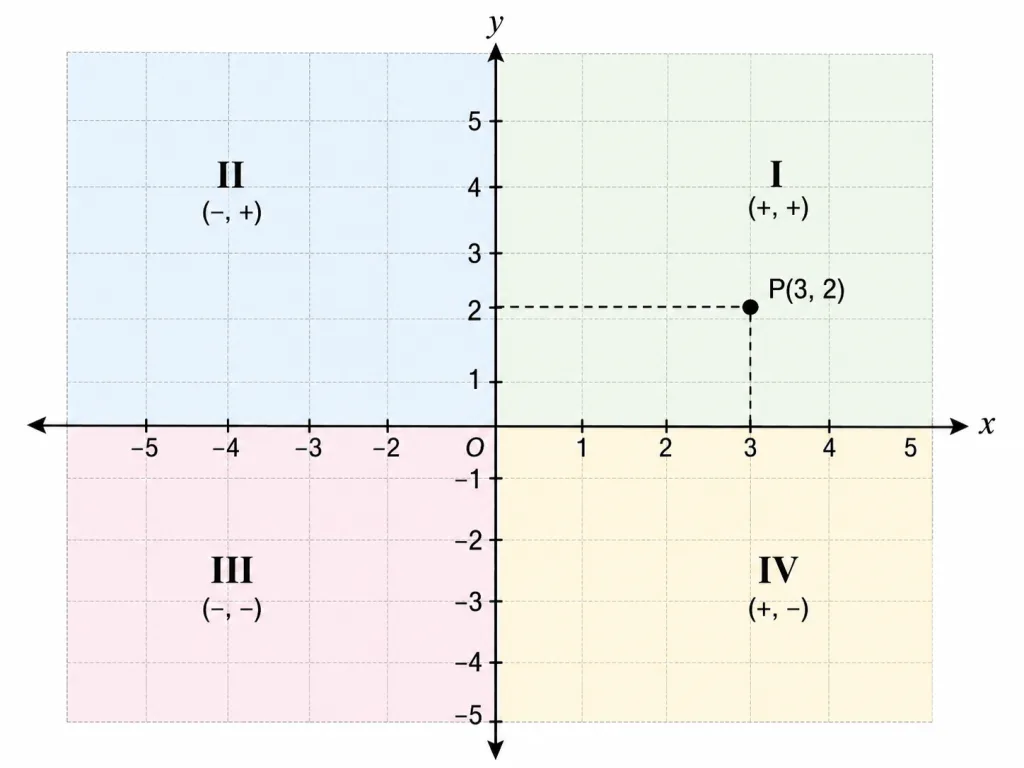
The Four Quadrants
The two axes divide the plane into four regions called quadrants, numbered I to IV going anticlockwise from the top-right.
| Quadrant | x sign | y sign | Example |
|---|---|---|---|
| I | + | + | |
| II | − | + | |
| III | − | − | |
| IV | + | − |
Key Point: Remember the sign pattern by going anticlockwise: .
[Board Important] A point's quadrant is decided entirely by the signs of its coordinates. A 1-mark question often asks 'In which quadrant does lie?' — answer: Quadrant II.
Points on the Axes
Points lying exactly on an axis are special cases:
- A point on the x-axis has the form — its y-coordinate is 0.
- A point on the y-axis has the form — its x-coordinate is 0.
- The origin lies on both axes.
Think of it this way: if you don't move up or down at all, you stay on the x-axis; if you don't move left or right, you stay on the y-axis.
Key Point: On the x-axis, ; on the y-axis, . Points on the axes do not belong to any quadrant.
[Board Important] 'The point lies on which axis?' — the y-axis, because .
Why Coordinate Geometry Matters
Coordinate geometry (also called analytic geometry) lets us study geometric shapes using algebra. Once points become number pairs, we can:
- find the distance between two points,
- find a point that divides a segment in a given ratio,
- find the area of a triangle from its vertices,
- check whether points are collinear (lie on one line).
All of these reduce to plugging coordinates into formulas — that's what makes this chapter high-scoring.
Key Point: The whole chapter is formula-driven. Master four formulas — distance, section, midpoint, and area — and you can solve almost every question.
[JEE/NEET Tip] Coordinate geometry is the foundation for straight lines, circles, and conics in Class 11 — a strong grip here pays off later.
Solved Examples
Example 1: Identify the quadrant
In which quadrant does the point lie?
Solution:
- x-coordinate is negative, y-coordinate is positive.
- Sign pattern ⇒ Quadrant II.
Final Answer: Quadrant II.
Takeaway: The quadrant depends only on the signs of the coordinates.
Example 2: Point on an axis
Where does the point lie?
Solution:
- The y-coordinate is 0.
- A point with lies on the x-axis.
Final Answer: On the x-axis.
Takeaway: ⇒ x-axis; ⇒ y-axis.
Example 3: Order matters
Are and the same point?
Solution:
- means , .
- means , .
- Different coordinates ⇒ different points.
Final Answer: No, they are different points.
Takeaway: An ordered pair is read x first, then y — order cannot be swapped.
Example 4: Reading coordinates
A point is 5 units to the left of the y-axis and 3 units below the x-axis. Write its coordinates.
Solution:
- Left of y-axis ⇒ negative x: .
- Below x-axis ⇒ negative y: .
Final Answer: (Quadrant III).
Takeaway: Left/down are negative; right/up are positive.
Example 5: Origin distance idea
What are the coordinates of the origin, and what is its special property?
Solution:
- The origin is .
- It lies on both the x-axis and the y-axis, where the two axes meet.
Final Answer: ; it lies on both axes.
Takeaway: The origin is the reference point for all coordinates.
Example 6: Sign reasoning
If a point has and , in which quadrant is it?
Solution:
- (right), (down).
- Sign pattern ⇒ Quadrant IV.
Final Answer: Quadrant IV.
Takeaway: is the bottom-right region.
Example 7: Points with equal coordinates
Where do all points of the form with lie?
Solution:
- Both coordinates positive ⇒ Quadrant I.
- They lie on the line (the diagonal through the origin).
Final Answer: In Quadrant I, on the line .
Takeaway: Points with equal coordinates lie on the line .
Example 8: Distance along an axis
How far apart are the points and ?
Solution:
- Both lie on the y-axis ().
- Distance along the y-axis units.
Final Answer: 5 units.
Takeaway: For points on the same axis, just subtract the differing coordinate.
Example 9: Mirror image in x-axis
What is the reflection of in the x-axis?
Solution:
- Reflecting in the x-axis keeps the same and changes the sign of .
- .
Final Answer: .
Takeaway: Reflection in the x-axis: .
Example 10: Mirror image in y-axis
What is the reflection of in the y-axis?
Solution:
- Reflecting in the y-axis keeps the same and changes the sign of .
- .
Final Answer: .
Takeaway: Reflection in the y-axis: .