
The Section Formula (Internal Division)
Suppose a point divides the line segment joining and internally in the ratio (so ). Then
Key Point: The ratio number nearest to a point multiplies the far coordinate: (next to in ) multiplies , and multiplies . Memorise the pattern .
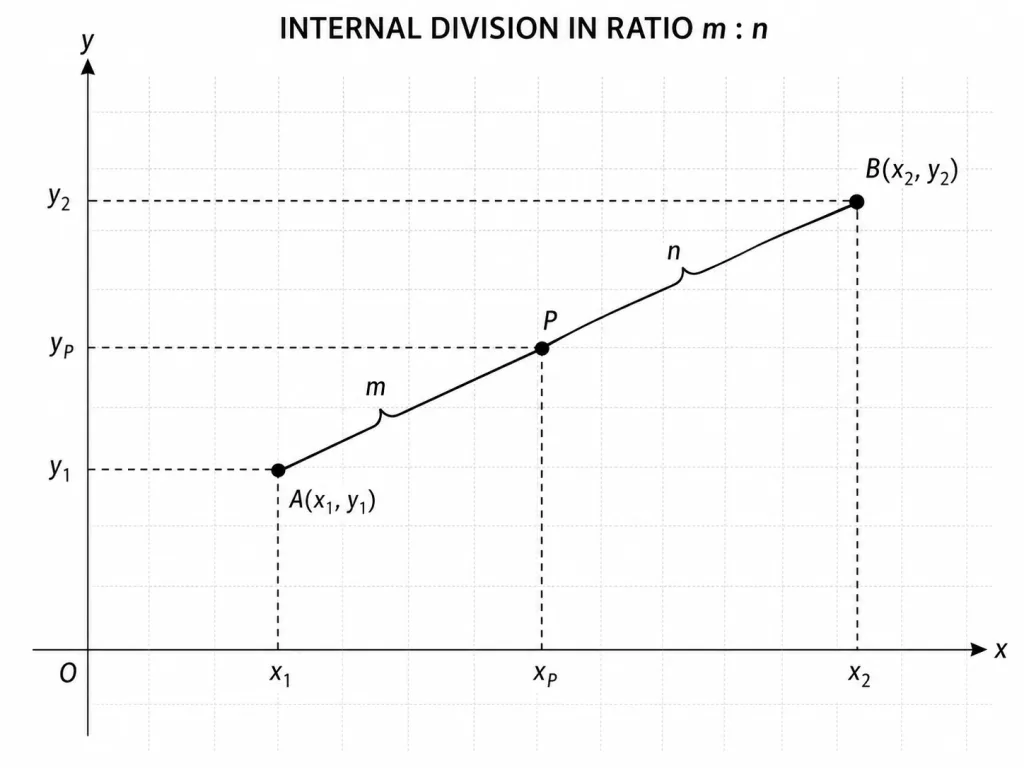
[Board Important] Write the ratio as in the same order as the segment to , then substitute carefully.
The Midpoint Formula
The midpoint of and is the special case :
Think of it this way: the midpoint is just the average of the two x-coordinates and the average of the two y-coordinates.
Key Point: Midpoint = average of coordinates. This is one of the most-used formulas in the whole chapter.
[Board Important] The diagonals of a parallelogram bisect each other — so their midpoints coincide. This fact solves many 'find the fourth vertex' problems.
Finding the Ratio of Division
If we know that a point lies on segment but not the ratio, let the ratio be and use the section formula on one coordinate:
Solve for . A positive means internal division.
This is exactly how we find the ratio in which the x-axis () or y-axis () divides a segment: set the relevant coordinate to 0 and solve for .
Key Point: Use to reduce two unknowns () to one (). Then a positive confirms internal division.
[JEE Tip] A negative would indicate external division — outside the scope of the Class 10 board syllabus but useful to recognise.
Points of Trisection
The two points of trisection of a segment divide it into three equal parts. The point closer to divides in the ratio , and the point closer to in the ratio .
Apply the section formula with these ratios to get both points.
Key Point: Trisection points use ratios and — a very common board question.
[Board Important] Don't confuse trisection (three equal parts, two interior points) with bisection (two equal parts, one midpoint).
Solved Examples
Example 1: Midpoint
Find the midpoint of and .
Solution:
- .
Final Answer: .
Takeaway: Midpoint is the average of the coordinates.
Example 2: Section formula
Find the point dividing and internally in the ratio .
Solution:
- .
- .
Final Answer: .
Takeaway: multiplies 's coordinates; multiplies 's.
Example 3: Ratio in which x-axis divides
In what ratio does the x-axis divide the segment joining and ?
Solution:
- Let the ratio be ; on the x-axis .
- .
- Ratio (positive ⇒ internal).
Final Answer: .
Takeaway: Set and solve for to find where the x-axis cuts the segment.
Example 4: Fourth vertex of a parallelogram
Three vertices of a parallelogram are , , . Find .
Solution:
- Diagonals bisect each other ⇒ midpoint of = midpoint of .
- Midpoint of .
- Let : and .
- , .
Final Answer: .
Takeaway: Equate diagonal midpoints to find a missing vertex.
Example 5: Points of trisection
Find the points of trisection of the segment joining and .
Solution:
- Point (): .
- Point (): .
Final Answer: and .
Takeaway: Trisection uses ratios and .
Example 6: Midpoint given, find endpoint
The midpoint of and is . Find .
Solution:
- .
- .
Final Answer: .
Takeaway: Use the midpoint equations to back out a missing endpoint.
Example 7: Ratio by y-axis
In what ratio does the y-axis divide the segment joining and ?
Solution:
- On the y-axis ; let ratio .
- .
- Ratio .
Final Answer: .
Takeaway: y-axis ⇒ set and solve for .
Example 8: Verify a midpoint
Is the midpoint of and ?
Solution:
- Midpoint .
Final Answer: Yes, is the midpoint.
Takeaway: Opposite points about the origin have the origin as midpoint.
Example 9: Section with given ratio 3:1
Find the point dividing and in the ratio .
Solution:
- .
- .
Final Answer: .
Takeaway: Substitute the ratio directly; fractional answers are fine.
Example 10: Centre of a diameter
The endpoints of a diameter of a circle are and . Find the centre.
Solution:
- The centre is the midpoint of the diameter.
- .
Final Answer: .
Takeaway: The centre of a circle is the midpoint of any diameter.