
Setting Up Depression Problems
When the observer is up high (on a tower, cliff, or building) and looks down at an object, the angle below the horizontal is the angle of depression.
The key move: the horizontal at the observer's eye is parallel to the ground, so the angle of depression equals the alternate angle at the object — which is the angle of elevation looking back up. Drop the angle to the object's foot, and you have a clean right triangle.
Key Point: Depression angle (at the top) = elevation angle (at the bottom). Always transfer it to the bottom so it sits inside the triangle.
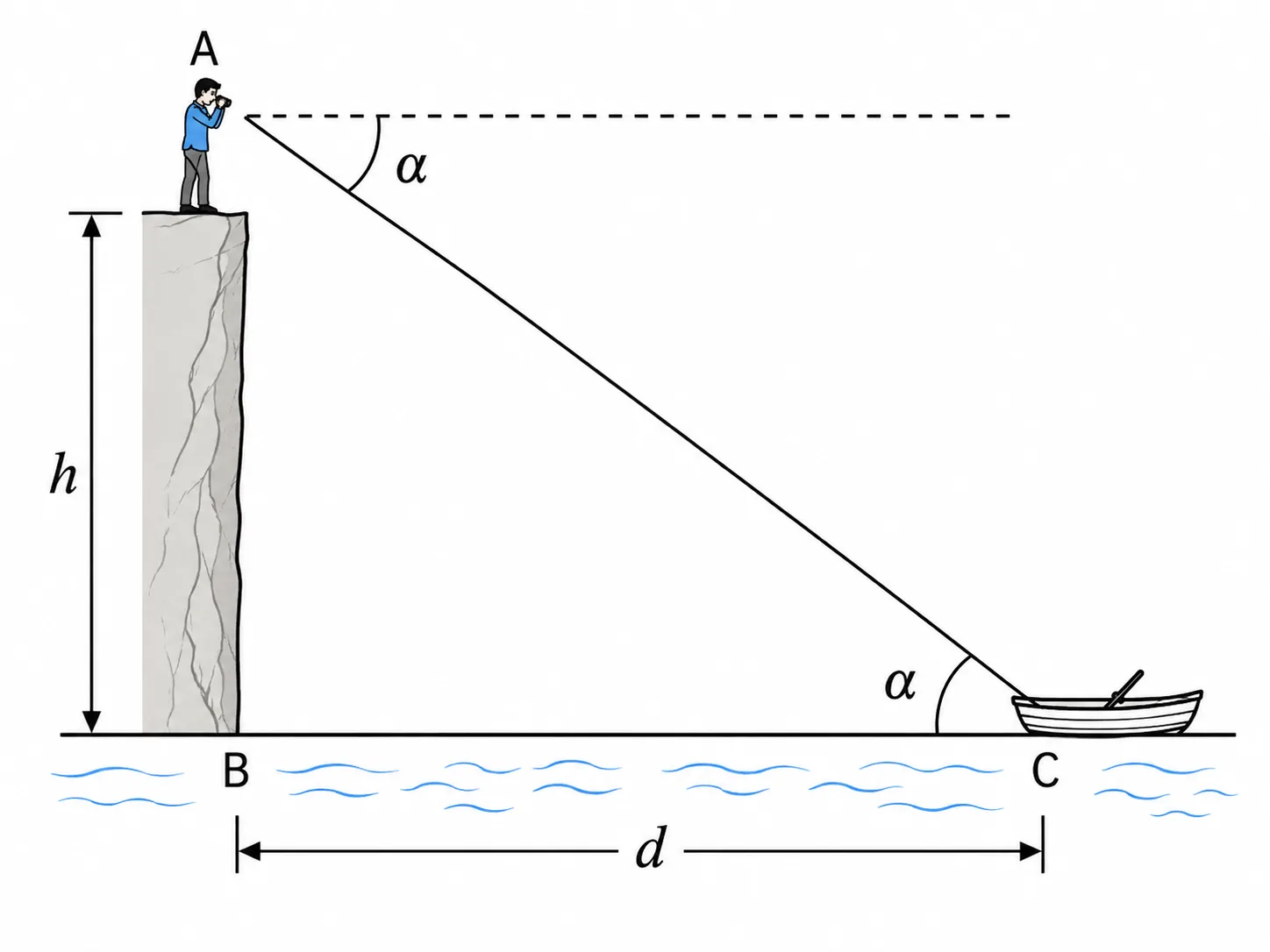
[Board Important] A frequent mistake is to use the depression angle as if it were inside the triangle at the top vertex. Move it to the alternate position at the bottom.
The Basic Depression Equation
For an observer at height looking down at an object on the ground at horizontal distance , with depression : This is identical to the elevation equation, because the depression equals the elevation at the object.
Key Point: — same as elevation.
[JEE/NEET Tip] Whenever you see 'angle of depression', mentally replace it with 'angle of elevation from the object' and proceed.
Objects Moving Towards or Away
Many depression problems involve an object (a car, a boat) moving. Two depression angles at two times give two triangles; the difference of horizontal distances is the distance the object moved.
If time is given, speed .
Key Point: Two depressions ⇒ two horizontal distances; their difference is the distance travelled.
[Board Important] As an object approaches the base, the angle of depression increases (the line of sight steepens).
Observer Height Matters
If the problem mentions the observer is at a window or eye level above the ground, be careful whether the height in is the full structure height or only the part above the object's level.
For a tower-top observer and a ground object, is the full tower height. For two objects at the same level, the height cancels in ratios.
Key Point: Identify exactly which vertical distance the depression triangle uses before substituting.
[Board Important] Draw the horizontal line at the observer's eye every time — it shows which angle is alternate to which.
Solved Examples
Example 1: Distance from depression
From the top of a 60 m tower, the angle of depression of a car is 30°. How far is the car from the foot?
Solution:
- .
Final Answer: m.
Takeaway: Depression behaves exactly like elevation.
Example 2: Find the height
From a cliff, the depression of a boat 40 m from the foot is 45°. Find the cliff's height.
Solution:
- m.
Final Answer: 40 m.
Takeaway: At 45° depression, height equals distance.
Example 3: Two ships
From the top of a 100 m lighthouse, the depressions of two ships in line are 30° and 45°. Find the distance between them.
Solution:
- Nearer: .
- Farther: .
- Distance .
Final Answer: m.
Takeaway: Larger depression ⇒ nearer object.
Example 4: Approaching car and speed
From a 150 m tower, the depression of a car changes from 30° to 60° in 3 seconds. Find the speed.
Solution:
- Far: . Near: .
- Distance m.
- Speed m/s.
Final Answer: m/s.
Takeaway: Distance moved ÷ time = speed.
Example 5: Depression both equal
From the top of a building, the depressions of the top and bottom of a lamp post are 30° and 45°. Hint: this needs the building height and the horizontal distance. If the building is 20 m tall, set up the equations.
Solution:
- For the lamp post bottom (on the ground): .
- For the lamp post top (height ): the vertical drop to it is , so .
- .
Final Answer: m, lamp post height m.
Takeaway: Different depression angles to top and bottom give the object's height.
Example 6: Cliff and boat moving away
From a 50 m cliff, a boat's depression decreases from 45° to 30° as it sails away. How far did it move?
Solution:
- Near (45°): . Far (30°): .
- Distance .
Final Answer: m.
Takeaway: Moving away ⇒ depression decreases.
Example 7: Height needed for a depression
A guard wants the depression of a gate 30 m away to be 60°. How tall must the watchtower be?
Solution:
- .
Final Answer: m.
Takeaway: Height .
Example 8: Aeroplane depression
An aeroplane at height 1500 m observes two boats in line at depressions 45° and 30°. Find the distance between the boats.
Solution:
- Near: . Far: .
- Distance .
Final Answer: m.
Takeaway: Same template, larger numbers.
Example 9: Window depression
From a window 10 m above the ground, the depression of the foot of a tree is 30°. How far is the tree?
Solution:
- .
Final Answer: m.
Takeaway: The window height is the vertical side of the depression triangle.
Example 10: Equal-distance check
From the top of a 45 m tower, the depression of a point is 45°. Verify the point is 45 m from the foot.
Solution:
- m.
Final Answer: 45 m — verified.
Takeaway: A 45° angle always makes the two legs equal.