
Combining Elevation and Depression
The richest problems mix both angles. A classic: from a point you see the top of a building at an elevation and its bottom (or a window) at a depression — or you stand on one building and measure the top and bottom of another.
Each angle gives one right triangle; they usually share the horizontal distance. Add or subtract the two vertical pieces to get the total height.
Key Point: Elevation + depression from the same spot share the horizontal distance. Total height = (part above eye) + (part below eye).
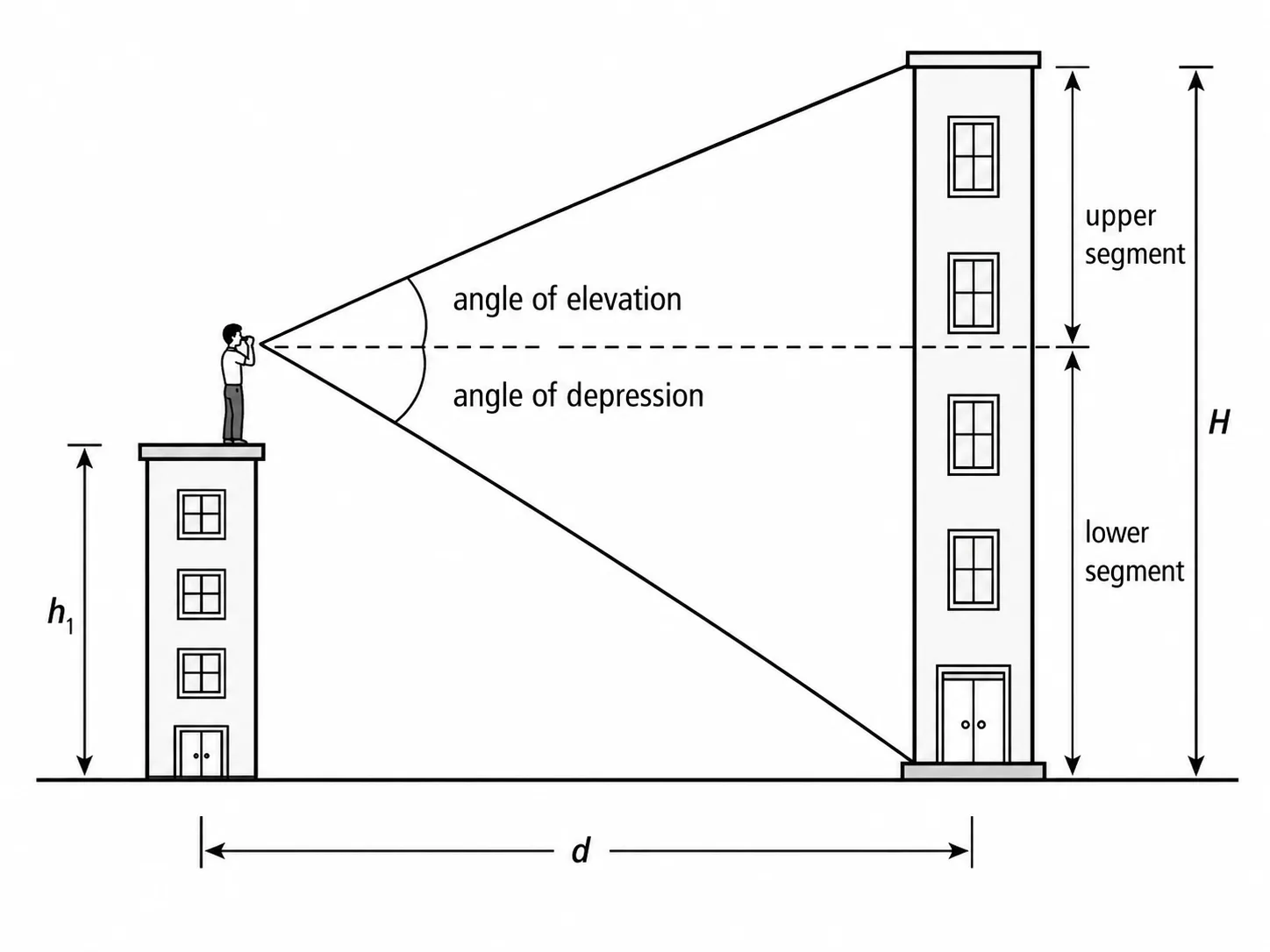
[Board Important] The horizontal distance is the common link. Find it from the easier triangle first, then use it in the other.
Two Buildings / Cliff and Object
If you stand on top of a building of height and look at another building across a distance :
- Depression of its foot : the vertical drop is , so .
- Elevation of its top : the rise above your eye is some , so .
- The other building's total height is .
Key Point: Your own building height appears as the depression's vertical side; the extra rise comes from the elevation.
[JEE/NEET Tip] Solve the depression equation first (it usually contains the known height), get , then plug into the elevation equation.
Rivers, Balloons and Aeroplanes
Real-life set-ups are dressed-up versions of the same triangles:
- River width: elevation of a tree/tower on the far bank gives the horizontal distance across.
- Balloon / aeroplane: height stays constant while horizontal distance changes — a two-triangle problem.
- Two banks of a river: observer between or on one side, leading to elevations on both sides.
Key Point: Strip away the story and find the right triangle(s); the physics is always height vs horizontal distance.
[Board Important] Always convert the words into a labelled figure; the marking scheme rewards the correct diagram and the correct ratio.
Choosing the Right Ratio Quickly
A fast checklist once your triangle is drawn:
- Know vertical & horizontal, want the angle ⇒ .
- Know the angle & horizontal, want vertical ⇒ vertical horizontal .
- Know the angle & slant, want vertical ⇒ vertical slant .
- Know the angle & vertical, want horizontal ⇒ horizontal vertical .
Key Point: Match the two sides (one known, one wanted) to the ratio that uses exactly those two.
[Board Important] Don't introduce the hypotenuse unless the problem gives or asks for a slant length — most height/distance problems stay with .
Solved Examples
Example 1: Elevation and depression together
From the top of a 7 m building, the angle of elevation of the top of a cable tower is 60° and the angle of depression of its foot is 45°. Find the height of the tower.
Solution:
- Depression of foot 45°: m.
- Elevation of top 60°: rise above eye , .
- Tower height .
Final Answer: m.
Takeaway: Depression gives ; elevation gives the rise; add the building height.
Example 2: Two buildings
From the top of a 20 m building, the angle of depression of the foot of another building is 30° and the elevation of its top is 45°. Find the second building's height.
Solution:
- .
- .
- Height .
Final Answer: m.
Takeaway: Total height = own height + extra rise above eye level.
Example 3: River width
A tree 15 m tall stands on the far bank of a river. From the near bank its top has elevation 30°. Find the river's width.
Solution:
- .
Final Answer: m.
Takeaway: Width is the horizontal distance from the elevation triangle.
Example 4: Balloon between observations
A balloon at constant height is seen at elevation 60° from a point; after moving the observer 30 m away (directly), the elevation is 30°. Find the balloon's height.
Solution:
- Near: .
- Far: .
- .
Final Answer: m.
Takeaway: Constant-height balloon ⇒ two-triangle problem.
Example 5: Tower on a building
A vertical tower stands on a 50 m building. From a point on the ground, the elevation of the bottom of the tower (building top) is 45° and of the top of the tower is 60°. Find the tower's height.
Solution:
- .
- .
- .
Final Answer: m.
Takeaway: Use the lower angle to fix , then the upper angle for the total height.
Example 6: Aeroplane height
The angle of elevation of an aeroplane from a point on the ground is 60°. After 15 seconds of horizontal flight, the elevation drops to 30°. If the plane flies at a constant height of m, find its speed.
Solution:
- Near: .
- Far: .
- Distance m in 15 s.
- Speed m/s.
Final Answer: 200 m/s.
Takeaway: Constant-height flight is a two-triangle problem; speed = distance ÷ time.
Example 7: Both banks of a river
From a point between two poles on opposite banks, the elevations of their tops are 60° and 30°. The poles are equal in height and the banks are 40 m apart. Find and the point's position.
Solution:
- Let the point be from the first pole, from the second. , .
- and . So .
- .
Final Answer: m; the point is 10 m from the first pole.
Takeaway: Equate the two expressions for to locate the point.
Example 8: Shadow lengthens
The shadow of a tower is m longer when the sun's elevation is 30° than when it is 60°. Find the tower's height.
Solution:
- At 30°: shadow . At 60°: shadow .
- .
Final Answer: m.
Takeaway: Lower sun ⇒ longer shadow; the difference gives the height.
Example 9: Two boats, depression
From the top of a m tower, the depressions of two boats due east are 30° and 60°. Find the distance between them.
Solution:
- Near (60°): . Far (30°): .
- Distance m.
Final Answer: 80 m.
Takeaway: The height is chosen so the answers are whole numbers.
Example 10: Pole on a building, depression
From the foot of a tower, the elevation of the top of a building is 30°; from the foot of the building, the elevation of the top of the tower is 60°. If the building is 10 m tall, find the tower's height.
Solution:
- Let be the distance between feet, tower height .
- From tower foot: .
- From building foot: .
Final Answer: Tower height m.
Takeaway: Two cross elevations share the same horizontal distance .