
Why This Chapter Exists
In the last chapter we learned the six trigonometric ratios. Here we put them to work: measuring heights and distances that are hard or impossible to measure directly — the height of a tower, the width of a river, the distance to a ship.
The trick is always the same: model the situation as a right-angled triangle, identify which sides and angle you know, and use , or to find the unknown.
Key Point: Every height-and-distance problem becomes a right triangle. Your first job is always to draw and label that triangle.
[Board Important] A clear, labelled diagram earns marks on its own and prevents most mistakes. Always draw one.
Line of Sight and the Horizontal
When you look at an object, the straight line from your eye to the object is the line of sight. The horizontal is the level line through your eye (parallel to the ground).
The angle between the line of sight and the horizontal is what we measure.
Key Point: All angles in this chapter are measured from the horizontal, not from the vertical.
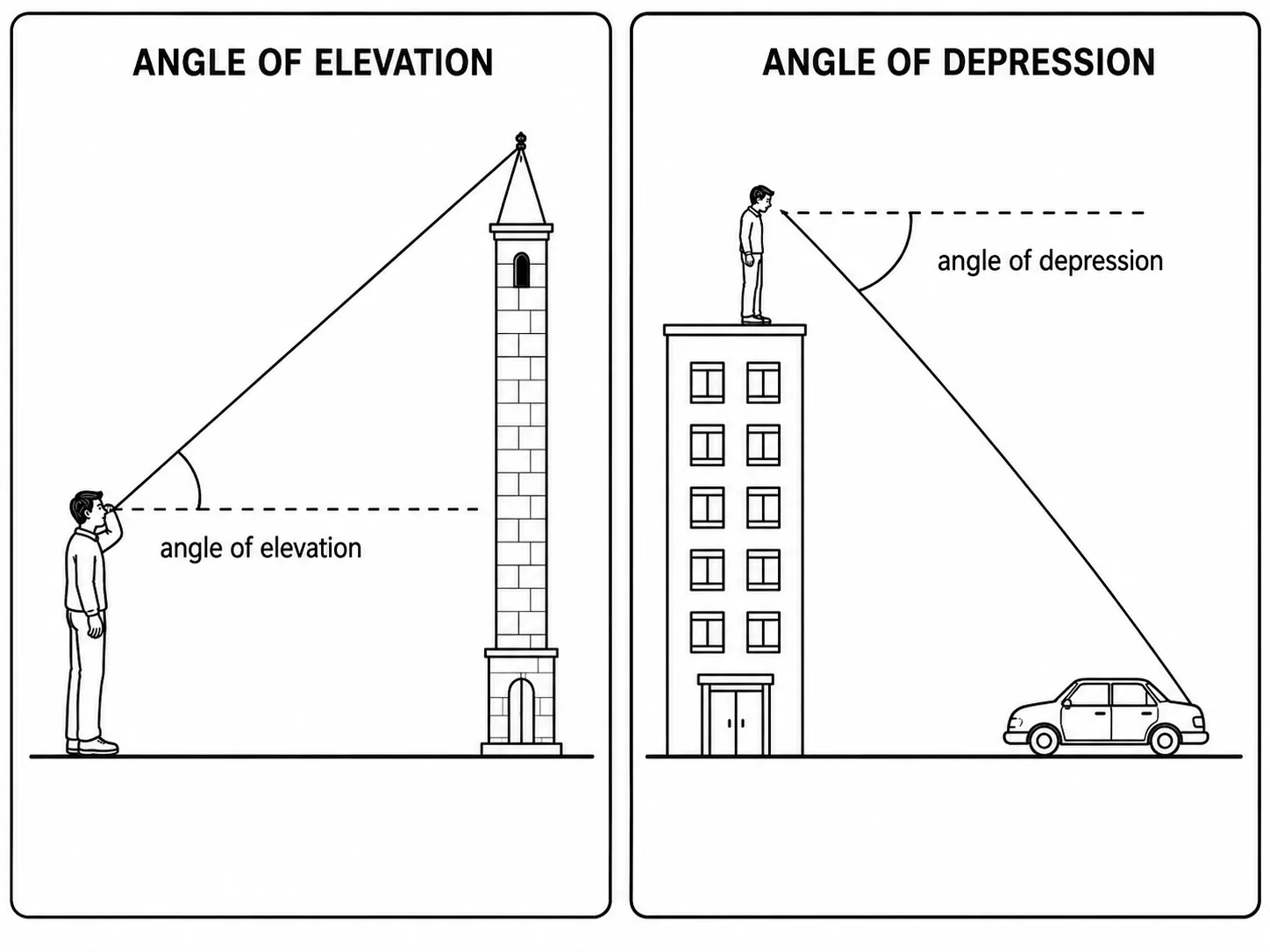
[Board Important] The horizontal is your reference line. The object is above it (elevation) or below it (depression).
Angle of Elevation
When the object is above the horizontal — you tilt your eyes up to see it — the angle between the line of sight and the horizontal is the angle of elevation.
Example: looking up at the top of a tower from a point on the ground.
Key Point: Angle of elevation = the upward angle from the horizontal to the line of sight. As the object gets higher (or you get closer), the elevation increases.
[JEE/NEET Tip] In a right triangle modelling elevation, .
Angle of Depression
When the object is below the horizontal — you tilt your eyes down to see it — the angle between the line of sight and the horizontal is the angle of depression.
Example: standing on a cliff and looking down at a boat.
A crucial fact: the angle of depression from the observer equals the angle of elevation from the object, because they are alternate angles between the two horizontal (parallel) lines.
Key Point: Angle of depression (looking down) = angle of elevation (looking back up), by alternate angles. Use this to put the angle inside your triangle.
[Board Important] A very common slip is to place the depression angle at the wrong vertex. Move it to the alternate position at the object's foot, where it sits inside the triangle.
Solved Examples
Example 1: Identify the angle
A person on the ground looks up at the top of a building. Is the angle of elevation or depression involved?
Solution:
- The object (top) is above the horizontal, and the person looks up.
- So it is an angle of elevation.
Final Answer: Angle of elevation.
Takeaway: Looking up ⇒ elevation; looking down ⇒ depression.
Example 2: Depression equals elevation
From the top of a tower, the angle of depression of a car is 40°. What is the angle of elevation of the tower's top from the car?
Solution:
- Depression from tower = elevation from car (alternate angles).
- So the elevation is also 40°.
Final Answer: 40°.
Takeaway: Depression and the matching elevation are equal.
Example 3: Set up the ratio
A tower of height stands on level ground. From a point metres away, the angle of elevation of the top is . Write the relation between , , .
Solution:
- The right triangle has opposite , adjacent .
- .
Final Answer: .
Takeaway: Height over horizontal distance is the tangent of the elevation.
Example 4: Which ratio?
You know the angle of elevation and the length of the line of sight (the slant), and want the height. Which ratio do you use?
Solution:
- Height is opposite the angle; the slant is the hypotenuse.
- Opposite/Hypotenuse , so height .
Final Answer: Use .
Takeaway: Pick the ratio that links the side you know with the side you want.
Example 5: Draw and label
A ladder leans against a wall, making 60° with the ground. The foot is 2 m from the wall. Which side is known and which ratio finds the ladder's length?
Solution:
- The 2 m is adjacent to the 60° angle; the ladder is the hypotenuse.
- Adjacent/Hypotenuse , so ladder .
Final Answer: Use ; ladder m.
Takeaway: Adjacent known + hypotenuse wanted ⇒ cosine.
Example 6: Effect of distance on elevation
As you walk towards the base of a tower, does the angle of elevation of the top increase or decrease?
Solution:
- ; as decreases, increases.
- So increases.
Final Answer: It increases.
Takeaway: Closer to the object ⇒ larger angle of elevation.
Example 7: Depression to a triangle
From the top of a 30 m cliff, the angle of depression of a boat is 30°. Set up the equation for the boat's distance from the foot of the cliff.
Solution:
- The depression 30° equals the elevation at the boat.
- .
Final Answer: m.
Takeaway: Bring the depression angle down to the object to form .
Example 8: Elevation 45° special case
If the angle of elevation of a tower's top is 45° from a point on the ground, how does the height compare to the distance?
Solution:
- .
- So .
Final Answer: Height equals the horizontal distance.
Takeaway: At 45°, height and base distance are equal.
Example 9: Reading the diagram
An observer's eye is 1.5 m above the ground. Why might a problem add or subtract this 1.5 m?
Solution:
- The triangle's height is measured from the eye level, not the ground.
- To get the object's height above the ground, add the eye height (1.5 m) to the triangle's vertical side.
Final Answer: Add the observer's height to the triangle height when the question asks for height above ground.
Takeaway: Mind the observer's eye level when it is given.
Example 10: Choose elevation or depression
A bird sits on a wire. A cat on the ground looks up at it; a person on a balcony above looks down at it. Name the two angles.
Solution:
- Cat looks up ⇒ angle of elevation.
- Person looks down ⇒ angle of depression.
Final Answer: Elevation (cat) and depression (person).
Takeaway: The same object can be seen by elevation from below and depression from above.