
When Two Triangles Appear
Harder problems give two angles — for example, the elevation of a tower's top measured from two different points, or before and after walking some distance. Each angle gives one right triangle, and the two triangles share the common height (or some common side).
The method:
- Let the unknown height be and an unknown distance be .
- Write one equation from each triangle.
- Solve the two equations together (usually by substitution or subtraction).
Key Point: Two angles ⇒ two equations. The shared side (height) links them.
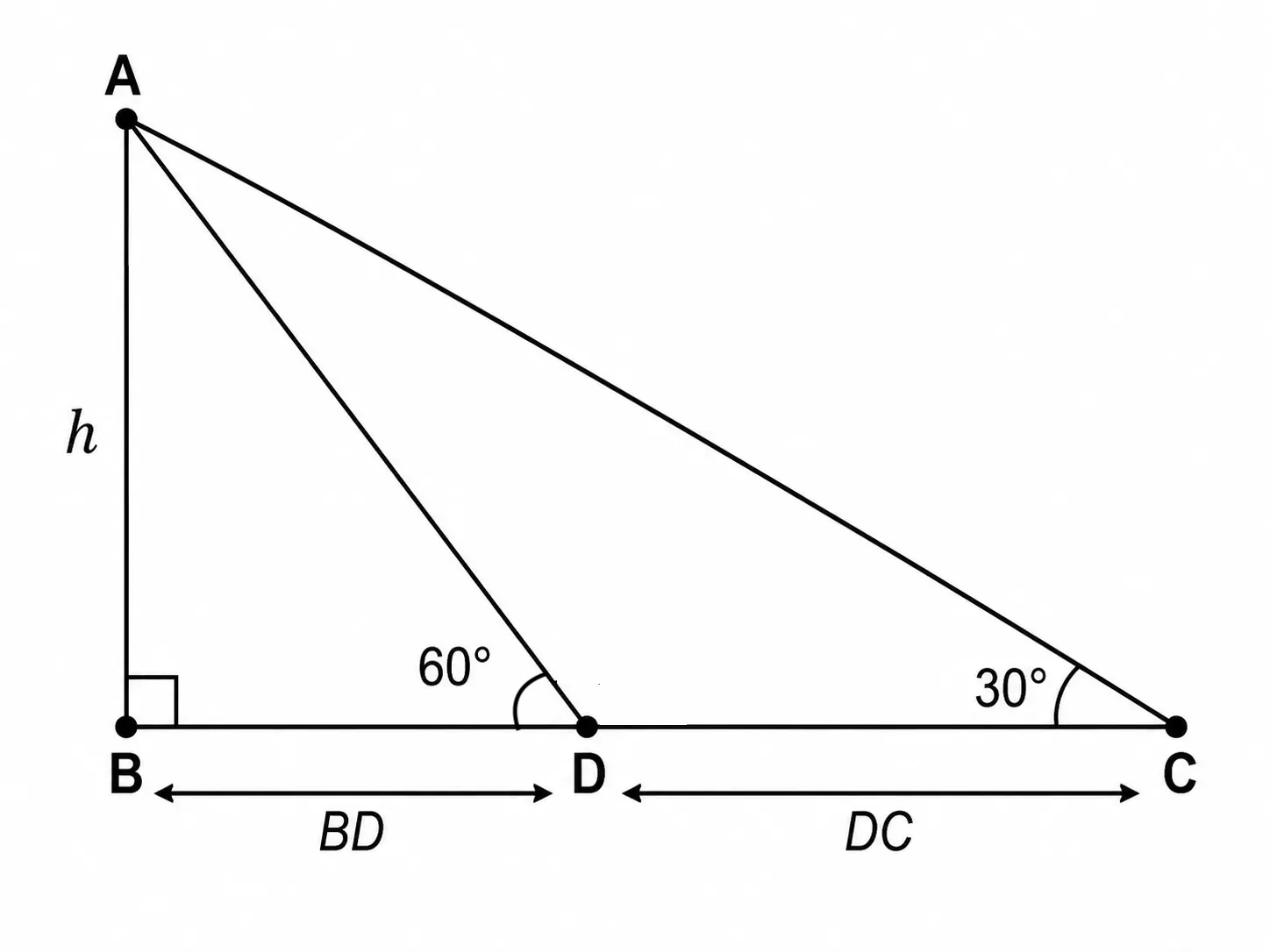
[Board Important] Mark the common height as a single letter; it is what makes the two equations solvable together.
The Two-Point Elevation Set-Up
Suppose a tower of height is observed from two points on the same straight line on the ground. From the farther point the elevation is the smaller angle; from the nearer point it is the larger angle.
If the nearer point is at distance from the foot and the points are apart, then:
Key Point: Both equations contain . Express from each and set them equal, or subtract to eliminate .
[JEE/NEET Tip] The nearer point always has the larger angle of elevation — a quick sanity check on your set-up.
Solving the Pair
A standard trick: from get , substitute into the second equation, and solve for . The distance between the two points is usually the given data.
For the common 30°–60° pair this gives clean answers because and , whose ratio is 3.
Key Point: Substitute one equation into the other to remove , leaving a single equation in .
[Board Important] Keep surds exact through the algebra; rationalise denominators at the end.
Object Moving Between Observations
Some problems describe a moving object (a car, a boat, a balloon) seen at one angle, then a different angle after it travels a distance. This is the same two-triangle idea: the two positions give two triangles sharing the observer's height.
Key Point: 'Before and after moving' is just two triangles with a common vertical side — set up two equations as before.
[Board Important] The distance travelled equals the difference of the two horizontal distances; that difference is often what the question asks for.
Solved Examples
Example 1: Classic 30°–60° tower
The angles of elevation of the top of a tower from two points 40 m apart on level ground are 30° and 60°. Find the height of the tower.
Solution:
- Let height , nearer point at distance . .
- .
- .
- .
Final Answer: m.
Takeaway: Express from the larger angle, substitute into the smaller-angle equation.
Example 2: Find both height and distance
From the previous example, also find the distance of the nearer point from the foot.
Solution:
- m.
Final Answer: 20 m.
Takeaway: Once is known, back-substitute for .
Example 3: 45°–60° pair
The elevation of a tower's top from a point is 45°; moving 20 m closer it becomes 60°. Find the height.
Solution:
- Nearer distance : .
- .
- .
- .
Final Answer: m.
Takeaway: Rationalise the denominator using its conjugate.
Example 4: Tower and given height
The angles of elevation of the top of a 100 m tower from two points in line with its foot are 45° and 30°. Find the distance between the two points.
Solution:
- Nearer point: .
- Farther point: .
- Distance .
Final Answer: m.
Takeaway: With the height known, compute each distance directly, then subtract.
Example 5: Moving car (depression)
From the top of a 75 m lighthouse, the angles of depression of two ships in line with its foot are 30° and 45°. Find the distance between the ships.
Solution:
- Depressions equal elevations from the ships. Nearer ship: .
- Farther ship: .
- Distance .
Final Answer: m.
Takeaway: Depression problems convert to the same elevation equations.
Example 6: Find distance moved
A man observes the elevation of a tower's top as 30°. Walking 50 m towards it, the elevation becomes 45°. Find the tower's height.
Solution:
- Nearer (after walking): .
- Farther: .
- .
Final Answer: m.
Takeaway: Walking towards the tower increases the elevation; the larger angle is the nearer one.
Example 7: Two towers, same line
Two points are 60 m apart. The elevation of a tower's top from them is 60° (near) and 30° (far). Find the height.
Solution:
- (near); (far).
- .
Final Answer: m.
Takeaway: The 30°–60° pair gives .
Example 8: Height of a hill
From two points 100 m apart in line with the base of a hill, the elevations of the summit are 45° and 30°. Find the height of the hill.
Solution:
- Near: (since ). Far: .
- .
Final Answer: m.
Takeaway: Same template as the moving-observer problem.
Example 9: Building between two points
The elevation of the top of a building from two points on opposite sides, 80 m apart, are 30° and 60°. Find the height (the building is between the points).
Solution:
- Let foot split the 80 m into and . , .
- , . Add: .
- .
Final Answer: m.
Takeaway: On opposite sides, the two base distances ADD to the total separation.
Example 10: Find the speed
From a 60 m cliff, the depression of a boat changes from 30° to 60° in 2 minutes as it approaches. Find the distance it travelled and its speed.
Solution:
- Far: . Near: .
- Distance m.
- Speed m/min.
Final Answer: m in 2 min; speed m/min.
Takeaway: Distance travelled = difference of horizontal distances; speed = distance ÷ time.