
Circulatory Pathways
Think of the circulatory system as the delivery network of the body. There are two main designs in the animal kingdom:
A. Open Circulatory System (The "Bathtub" Method)
- Mechanism: The heart pumps blood out, but instead of staying in pipes (vessels), it pours into open spaces called sinuses. The body tissues soak directly in this blood.
- Pressure: Low, because fluid isn't confined.
- Who has it? Arthropods (like insects) and Molluscs (like snails).
B. Closed Circulatory System (The "Plumbing" Method)
- Mechanism: Blood never leaves the network of closed blood vessels (arteries, veins, capillaries). It circulates continuously.
- Advantage: The body can precisely regulate where blood goes and how fast it flows.
- Who has it? Annelids (earthworms) and Chordates (including humans).
Evolution of the Vertebrate Heart
As animals became more complex, their hearts evolved to separate oxygen-rich blood from oxygen-poor blood.
| Group | Chambers | Circulation Type | Key Feature |
|---|---|---|---|
| Fishes | 2 (1 Atrium, 1 Ventricle) | Single Circulation | Heart pumps deoxygenated blood to gills for oxygenation. |
| Amphibians & Reptiles | 3 (2 Atria, 1 Ventricle) | Incomplete Double Circulation | Oxygenated and deoxygenated blood mix in the single ventricle. |
| Crocodiles (Exception) | 4 | Double Circulation | Unlike other reptiles, crocodiles have a fully 4-chambered heart. |
| Birds & Mammals | 4 (2 Atria, 2 Ventricles) | Double Circulation | Strict separation of blood. Left side = Oxygenated; Right side = Deoxygenated. |
Human Heart Anatomy
Location & Origin:
- It sits in the thoracic cavity (chest), between the lungs, tilting slightly left.
- It originates from the Mesoderm germ layer.
- Protection: It is wrapped in a double-layered bag called the Pericardium. The space between layers is filled with pericardial fluid to reduce friction (shock absorber).
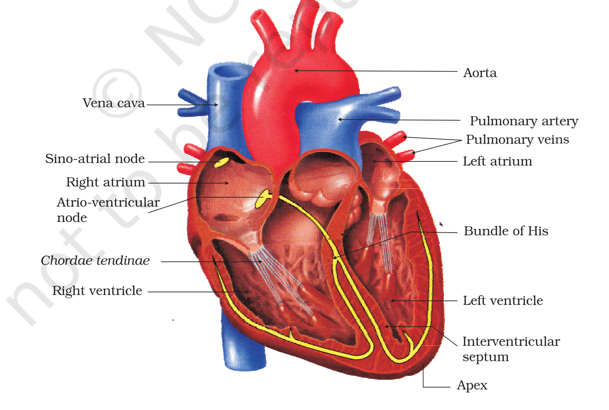
The Four Chambers:
- Atria (Top): Receiving chambers. Thin walls. Separated by the Inter-atrial septum.
- Ventricles (Bottom): Pumping chambers. Thick walls (to pump blood out). Separated by the Inter-ventricular septum.
The Valves (One-Way Doors): Valves prevent backflow. Blood must flow: Atria Ventricles Arteries.
- Tricuspid Valve: Between Right Atrium & Right Ventricle. (Has 3 flaps).
- Bicuspid (Mitral) Valve: Between Left Atrium & Left Ventricle. (Has 2 flaps).
- Semilunar Valves: Guard the exits to the large arteries (Pulmonary Artery & Aorta).
The Conducting System (The Heart's Wiring)
The heart doesn't wait for the brain to tell it to beat; it is Auto-excitable. Special muscle fibers called Nodal Tissue generate and spread electricity.
The Pathway of the Impulse:
Sino-atrial Node (SAN):
- Role: The Pacemaker. It starts the beat.
- Location: Top right of Right Atrium.
- Speed: Fires 70–75 times/min (your heart rate).
(Signal travels to)
Atrio-ventricular Node (AVN):
- Location: Bottom left of Right Atrium.
- Role: Catches the signal and passes it to the ventricles.
Bundle of His (AV Bundle):
- Passes through the septum and splits into Right and Left branches.
Purkinje Fibres:
- Tiny fibers that spread the signal through the Ventricular muscles, causing them to contract.
Circulatory Pathways and Human Heart
- "Try to be Right": The Tricuspid valve is on the Right side. (So, Bicuspid must be on the Left).
- Chamber Evolution:
- Fish = 2 (Simple)
- Frog/Lizard = 3 (Mixing)
- Croc/Bird/Human = 4 (Perfect separation)
- The Electrical Path: SAN AVN Bundle Purkinje.
- (Think: Sstart At Node… then down to the muscles).
- SAN Stats: Remember 70-75. That's the normal heart rate because the SAN sets the pace.
💡 Questions and Answers
Q1: Distinguish between the tricuspid and bicuspid (mitral) valves.
Answer: Tricuspid valve has 3 flaps and is found between the right atrium and right ventricle. Bicuspid (mitral) valve has 2 flaps and is between the left atrium and left ventricle. Both stop backflow into atria.
Key Points:
- Tricuspid = Right side = 3 cusps (RA→RV)
- Bicuspid/Mitral = Left side = 2 cusps (LA→LV)
Q2: Why is the SAN called the natural pacemaker?
Answer: Because SAN produces the highest number of electrical impulses (about 70–75 per minute), so it sets the heartbeat rate for the whole heart.
Key Points:
- SAN fires fastest
- Controls heart rhythm
Q3: What type of circulatory system do arthropods have?
Answer: Arthropods have an open circulatory system, where the blood (haemolymph) flows into open sinuses and bathes organs.
Key Points:
- Open system = sinuses
- Example: insects
Q4: How many chambers does a crocodile heart have?
Answer: Crocodile has a four-chambered heart, even though it is a reptile.
Key Points:
- Crocodile = reptile exception = 4 chambers
Q5: What is the function of the pericardium?
Answer: Pericardium is a protective covering of the heart. The pericardial fluid inside reduces friction when the heart beats.
Key Points:
- Protection
- Friction reduction via fluid