
Regulation of Cardiac Activity - Why the Heart Is Myogenic
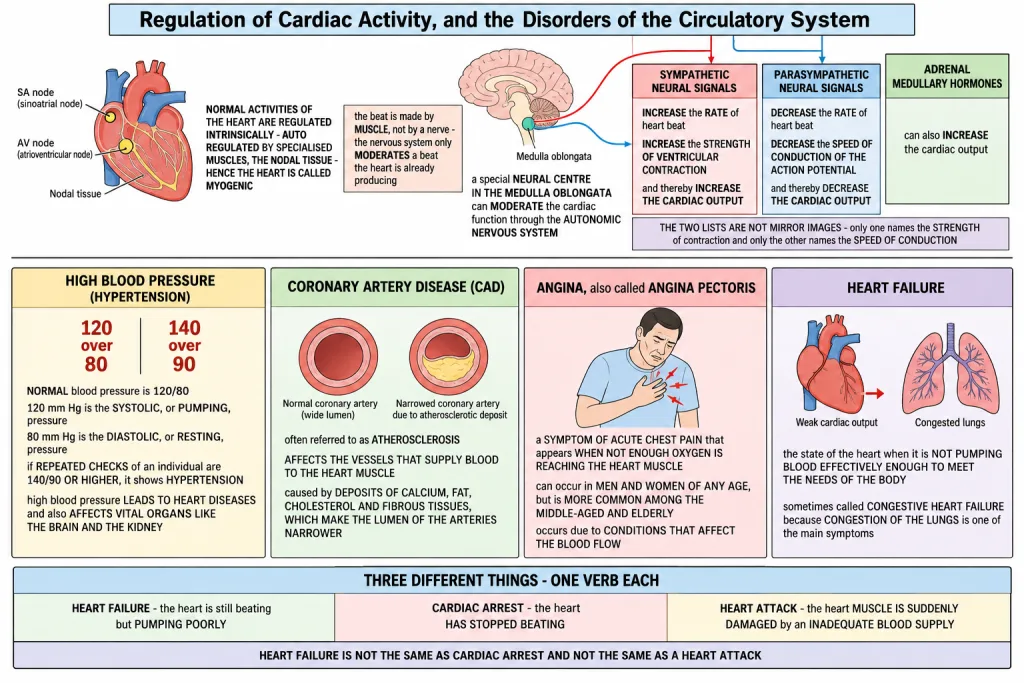
Normal activities of the heart are regulated INTRINSICALLY, that is, they are auto regulated by specialised muscles - the nodal tissue - and hence the heart is called MYOGENIC.
Read that sentence twice, because it settles the whole section. The beat is made by muscle, not by a nerve. The nervous system is present and it does matter, but it only moderates a beat the heart is already producing on its own.
A special neural centre in the MEDULLA OBLONGATA can moderate the cardiac function through the AUTONOMIC NERVOUS SYSTEM (ANS). That centre works through the two arms of the ANS, and the two arms pull in opposite directions.
| Sympathetic neural signals | Parasympathetic neural signals |
|---|---|
| increase the rate of heart beat | decrease the rate of heart beat |
| increase the strength of ventricular contraction | decrease the speed of conduction of the action potential |
| and thereby increase the cardiac output | and thereby decrease the cardiac output |
And one more input from outside the nervous system: adrenal medullary hormones can also increase the cardiac output.
[NEET Important] The two lists are NOT mirror images, and a question can turn on exactly that. The parasympathetic effect includes slowing the SPEED OF CONDUCTION of the action potential, which the sympathetic list does not mention at all; the sympathetic list instead names the strength of ventricular contraction. Learn each side by its own three items rather than assuming one is the opposite of the other. The other certain item is the medulla oblongata as the neural centre - not the cerebrum, not the cerebellum.
Disorders of the Circulatory System - Hypertension and CAD
HIGH BLOOD PRESSURE (HYPERTENSION) is the term for blood pressure that is higher than normal, which is 120/80.
In that measurement, 120 mm Hg is the SYSTOLIC, or pumping, pressure and 80 mm Hg is the DIASTOLIC, or resting, pressure. The reading is always written systolic over diastolic, so the larger number always comes first.
- If repeated checks of an individual's blood pressure are 140/90 or higher, it shows hypertension.
- High blood pressure leads to heart diseases and also affects vital organs like the brain and the kidney.
Note the word repeated. One high reading is not a diagnosis; the chapter specifies repeated checks.
CORONARY ARTERY DISEASE (CAD), often referred to as ATHEROSCLEROSIS, affects the vessels that supply blood to the heart muscle. It is caused by deposits of CALCIUM, FAT, CHOLESTEROL AND FIBROUS TISSUES, which make the lumen of the arteries narrower.
[NEET Important] Two numbers and one four-item list carry this block. The numbers are 120/80 normal and 140/90 or higher on repeated checks for hypertension; the trap is reversing systolic 120 and diastolic 80. The list is calcium, fat, cholesterol and fibrous tissues for CAD, and atherosclerosis is the other name for CAD - not for angina and not for heart failure.
Angina and Heart Failure
ANGINA, also called angina pectoris, is a symptom of acute chest pain that appears when not enough oxygen is reaching the heart muscle.
- Angina can occur in men and women of any age, but it is more common among the middle-aged and elderly.
- It occurs due to conditions that affect the blood flow.
HEART FAILURE is the state of the heart when it is not pumping blood effectively enough to meet the needs of the body. It is sometimes called congestive heart failure because congestion of the lungs is one of the main symptoms of this disease.
Now the line that is examined more than any other in this section. Heart failure is NOT the same as cardiac arrest and NOT the same as a heart attack. Three different things, three different definitions:
| Condition | What it actually is |
|---|---|
| Heart failure | the heart is not pumping blood effectively enough to meet the needs of the body; also called congestive heart failure because congestion of the lungs is one of the main symptoms |
| Cardiac arrest | the heart stops beating |
| Heart attack | the heart muscle is suddenly damaged by an inadequate blood supply |
In heart failure the heart is still beating but beating inadequately. In cardiac arrest it has stopped. In a heart attack the muscle itself is damaged. Keep those three verbs apart - pumping poorly, stopped, damaged - and the question answers itself.
[NEET Important] The three-way distinction between heart failure, cardiac arrest and heart attack is the most examined line of the disorders section, and the options are always the other two definitions. The second item is angina pectoris = acute chest pain when not enough oxygen reaches the heart muscle, with the qualifier any age but more common among the middle-aged and elderly - a statement that angina occurs only in the elderly is false.
Quick Recap
- Normal activities of the heart are regulated intrinsically - auto regulated by specialised muscles, the nodal tissue - hence the heart is called MYOGENIC.
- A special neural centre in the medulla oblongata can moderate the cardiac function through the autonomic nervous system (ANS).
- Sympathetic neural signals increase the rate of heart beat, the strength of ventricular contraction, and thereby the cardiac output.
- Parasympathetic neural signals decrease the rate of heart beat, the speed of conduction of the action potential, and thereby the cardiac output.
- Adrenal medullary hormones can also increase the cardiac output.
- Hypertension is blood pressure higher than normal, which is 120/80; 120 mm Hg is the systolic or pumping pressure and 80 mm Hg is the diastolic or resting pressure; repeated checks of 140/90 or higher show hypertension; it leads to heart diseases and also affects vital organs like the brain and the kidney.
- Coronary Artery Disease (CAD), often referred to as atherosclerosis, affects the vessels that supply blood to the heart muscle, and is caused by deposits of calcium, fat, cholesterol and fibrous tissues, which make the lumen of the arteries narrower.
- Angina, also called angina pectoris, is a symptom of acute chest pain that appears when not enough oxygen is reaching the heart muscle; it can occur in men and women of any age but is more common among the middle-aged and elderly; it occurs due to conditions that affect the blood flow.
- Heart failure is the state of the heart when it is not pumping blood effectively enough to meet the needs of the body, sometimes called congestive heart failure because congestion of the lungs is one of the main symptoms.
- Heart failure is not the same as cardiac arrest (when the heart stops beating) or a heart attack (when the heart muscle is suddenly damaged by an inadequate blood supply).
Solved Examples
Question 1
Q. Why do we call our heart myogenic? This is one of the chapter-end exercises.
Answer. Because the heart beat originates in the heart muscle itself and not in a nerve.
- The nodal tissue is a specialised cardiac musculature that is autoexcitable - it is able to generate action potentials without any external stimuli.
- The SAN generates the action potentials that set the rhythm, which is why it is called the pacemaker.
- So the normal activities of the heart are regulated intrinsically, that is, auto regulated by specialised muscles (nodal tissue) - and a heart regulated by its own muscle is called myogenic.
The nervous system does not start the beat; it only moderates it. A special neural centre in the medulla oblongata can moderate the cardiac function through the autonomic nervous system, speeding the heart up or slowing it down, but the beat it is adjusting is one the heart is already producing on its own.
Contrast this with a neurogenic heart, as in many arthropods, where the beat originates in a nerve ganglion outside the cardiac muscle and the muscle only follows that command.
Question 2
Q. Which tissue auto regulates the normal activities of the heart?
Answer. The nodal tissue - specialised muscles of the heart. Because the regulation is intrinsic, the heart is called myogenic.
Question 3
Q. Name the neural centre that can moderate cardiac function and the system it works through.
Answer. A special neural centre in the medulla oblongata, acting through the autonomic nervous system (ANS).
Question 4
Q. What do sympathetic neural signals do to the heart?
Answer. They increase the rate of heart beat, increase the strength of ventricular contraction, and thereby increase the cardiac output.
Question 5
Q. What do parasympathetic neural signals do to the heart?
Answer. They decrease the rate of heart beat, decrease the speed of conduction of the action potential, and thereby decrease the cardiac output.
Question 6
Q. Apart from nerves, what else can increase the cardiac output?
Answer. Adrenal medullary hormones.
Question 7
Q. What is hypertension, and what is normal blood pressure?
Answer. Hypertension is the term for blood pressure that is higher than normal, and normal is 120/80. If repeated checks of an individual's blood pressure are 140/90 or higher, it shows hypertension.
Question 8
Q. In a reading of 120/80, what does each number stand for?
Answer. 120 mm Hg is the systolic, or pumping, pressure and 80 mm Hg is the diastolic, or resting, pressure.
Question 9
Q. Why is hypertension dangerous?
Answer. High blood pressure leads to heart diseases and also affects vital organs like the brain and the kidney.
Question 10
Q. What is Coronary Artery Disease, and what causes it?
Answer. Coronary Artery Disease, often referred to as atherosclerosis, affects the vessels that supply blood to the heart muscle. It is caused by deposits of calcium, fat, cholesterol and fibrous tissues, which make the lumen of the arteries narrower.
Question 11
Q. What is angina, and who does it affect?
Answer. Angina, also called angina pectoris, is a symptom of acute chest pain that appears when not enough oxygen is reaching the heart muscle. It can occur in men and women of any age, but it is more common among the middle-aged and elderly. It occurs due to conditions that affect the blood flow.
Question 12
Q. Define heart failure and explain why it is also called congestive heart failure.
Answer. Heart failure is the state of the heart when it is not pumping blood effectively enough to meet the needs of the body. It is sometimes called congestive heart failure because congestion of the lungs is one of the main symptoms of this disease.
Question 13
Q. Distinguish between heart failure, cardiac arrest and a heart attack.
Answer. They are three different conditions, and the chapter is explicit that heart failure is not the same as either of the other two.
| Condition | What it is |
|---|---|
| Heart failure | the heart is not pumping blood effectively enough to meet the needs of the body |
| Cardiac arrest | the heart stops beating |
| Heart attack | the heart muscle is suddenly damaged by an inadequate blood supply |
In short - in heart failure the heart pumps poorly, in cardiac arrest it has stopped, and in a heart attack the muscle itself is damaged.
Question 14
Q. A person's heart rate rises sharply before a race, though no signal has changed inside the heart. What is happening?
Answer. The neural centre in the medulla oblongata is moderating the heart through the sympathetic arm of the autonomic nervous system, which increases the rate of heart beat and the strength of ventricular contraction, and thereby the cardiac output. Adrenal medullary hormones can also increase the cardiac output at the same time. The beat itself is still being generated by the nodal tissue - the nerves and hormones are only adjusting it.