
The Blood Vessels and Their Three Layers
The blood flows strictly by a fixed route through blood vessels - the arteries and veins. Nothing in the circulation wanders. Every drop follows the same named path in the same order, which is why most of this section is simply that path learnt correctly.
Basically, each artery and vein consists of three layers. Learn them named from the inside out, because that is exactly how the question is set.
| Layer | Position | What it is made of |
|---|---|---|
| Tunica intima | innermost | an inner lining of squamous endothelium |
| Tunica media | middle | a middle layer of smooth muscle and elastic fibres |
| Tunica externa | outermost | an external layer of fibrous connective tissue with collagen fibres |
The tunica media is comparatively THIN in the veins. That one difference is the whole artery-versus-vein comparison in this chapter, and the reason behind it is simple: a vein carries blood at low pressure and so does not need the thick muscular coat that an artery must have to withstand the pressure of blood driven out of the heart.
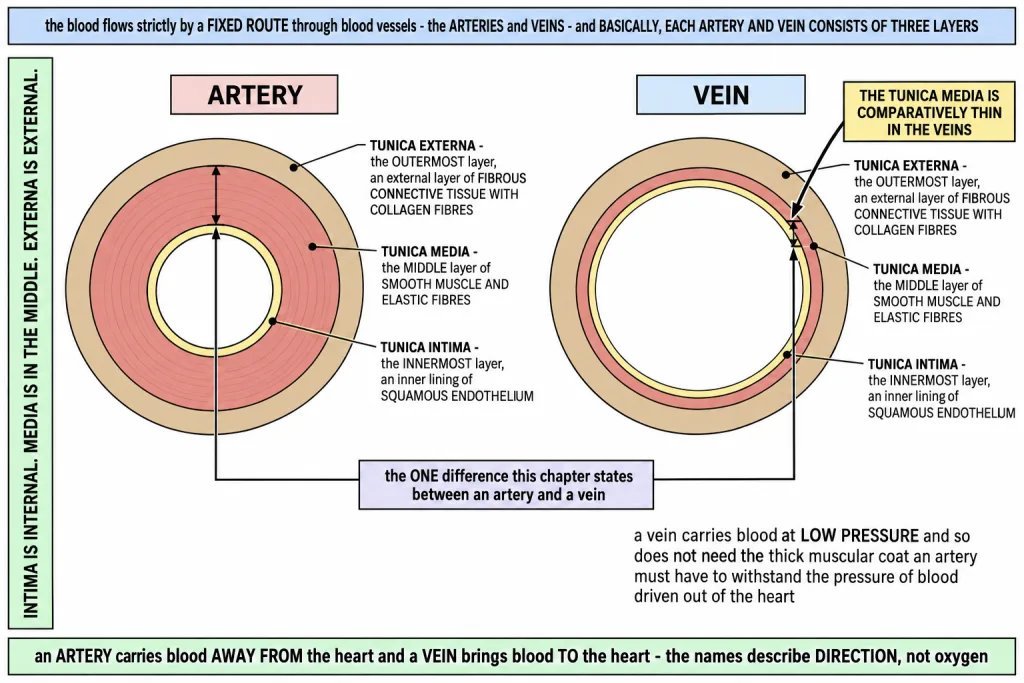
[NEET Important] This is a pure address question - layer name to layer content, and the order inside out. The standard error is swapping tunica intima and tunica externa; remember intima is internal and externa is external, with media in the middle. The second guaranteed item is "the tunica media is thin in the veins" - the layer that differs is named in the question stem, so the answer is the vein, not the artery.
Double Circulation - the Two Circuits
As mentioned earlier, the blood pumped by the RIGHT ventricle enters the PULMONARY ARTERY, whereas the LEFT ventricle pumps blood into the AORTA. Those two sentences start the two circuits, and everything else follows from them.
Pulmonary circulation. The deoxygenated blood pumped into the pulmonary artery is passed on to the lungs, from where the oxygenated blood is carried by the PULMONARY VEINS into the LEFT ATRIUM. That pathway - right ventricle to pulmonary artery to lungs to pulmonary veins to left atrium - constitutes the pulmonary circulation.
Systemic circulation. The oxygenated blood entering the aorta is carried by a network of arteries, arterioles and capillaries to the tissues, from where the deoxygenated blood is collected by a system of venules, veins and vena cava and emptied into the RIGHT ATRIUM. This is the systemic circulation. And it has a stated purpose: the systemic circulation provides nutrients, oxygen and other essential substances to the tissues and takes carbon dioxide and other harmful substances away for elimination.
| Pulmonary circulation | Systemic circulation | |
|---|---|---|
| Starts at | the right ventricle | the left ventricle |
| Leaves by | the pulmonary artery | the aorta |
| Blood leaving the heart | deoxygenated | oxygenated |
| Goes to | the lungs | the tissues, through arteries, arterioles and capillaries |
| Returns by | the pulmonary veins | venules, veins and vena cava |
| Ends at | the left atrium | the right atrium |
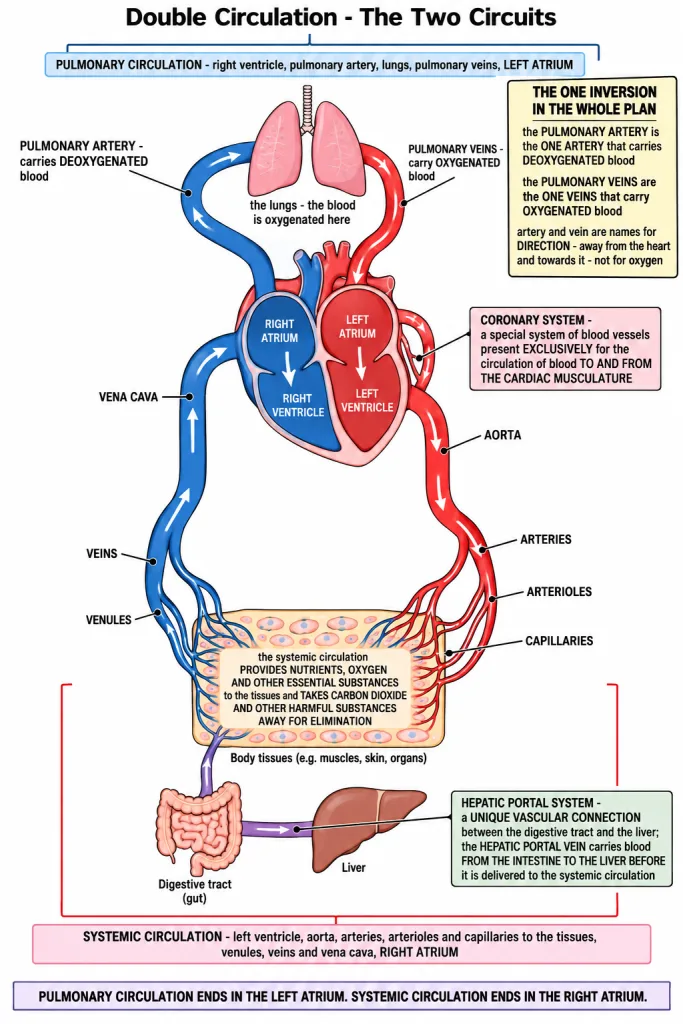
Now the trap the chapter sets every year. The pulmonary artery is the ONE artery that carries deoxygenated blood, and the pulmonary veins are the ONE veins that carry oxygenated blood. The rule you were taught - arteries carry oxygenated blood, veins carry deoxygenated blood - is a rule about direction, not about oxygen. An artery is a vessel that carries blood AWAY from the heart and a vein is one that brings blood TO the heart, and in the pulmonary circuit that puts the oxygen on the opposite side from usual.
[NEET Important] "Which artery carries deoxygenated blood?" and "which vein carries oxygenated blood?" are the two most repeated items from this section, and the answers are the pulmonary artery and the pulmonary veins. The other certain item is the destination of each circuit: pulmonary circulation ends in the LEFT atrium, systemic circulation ends in the RIGHT atrium - swap those two and the whole answer is gone.
Two Special Routes - the Hepatic Portal and Coronary Systems
Beyond the two main circuits the chapter names two special vascular arrangements, and both are one-line answers.
The hepatic portal system. A unique vascular connection exists between the digestive tract and the liver, called the hepatic portal system. The hepatic portal vein carries blood from the intestine to the liver BEFORE it is delivered to the systemic circulation. The word to hold on to is before - blood absorbed from the intestine does not go straight into general circulation; it is routed through the liver first.
The coronary system. A special coronary system of blood vessels is present in our body exclusively for the circulation of blood to and from the cardiac musculature. The heart is full of blood at every moment, but that blood inside the chambers does not feed the heart wall; the cardiac muscle has its own dedicated supply, and that is the coronary system.
[NEET Important] The hepatic portal vein runs from the INTESTINE to the LIVER, not from the liver to the heart - that is the standard reversal in the options. And "exclusively for the cardiac musculature" is the phrase that identifies the coronary system; a question naming any other organ is naming the wrong system.
Quick Recap
- The blood flows strictly by a fixed route through blood vessels - the arteries and veins.
- Each artery and vein has three layers, inside out: tunica intima (an inner lining of squamous endothelium), tunica media (a middle layer of smooth muscle and elastic fibres) and tunica externa (an external layer of fibrous connective tissue with collagen fibres).
- The tunica media is comparatively thin in the veins, because a vein carries blood at low pressure and needs no thick muscular coat.
- The blood pumped by the right ventricle enters the pulmonary artery; the left ventricle pumps blood into the aorta.
- Pulmonary circulation: deoxygenated blood in the pulmonary artery goes to the lungs, and the oxygenated blood is carried by the pulmonary veins into the LEFT ATRIUM.
- Systemic circulation: oxygenated blood entering the aorta is carried by arteries, arterioles and capillaries to the tissues, and the deoxygenated blood is collected by venules, veins and vena cava and emptied into the RIGHT ATRIUM.
- The systemic circulation provides nutrients, oxygen and other essential substances to the tissues and takes carbon dioxide and other harmful substances away for elimination.
- The pulmonary artery is the one artery carrying deoxygenated blood; the pulmonary veins are the one veins carrying oxygenated blood.
- The hepatic portal system is a unique vascular connection between the digestive tract and the liver; the hepatic portal vein carries blood from the intestine to the liver before it is delivered to the systemic circulation.
- A special coronary system of blood vessels serves exclusively the circulation of blood to and from the cardiac musculature.
Solved Examples
Question 1
Q. Name the three layers of an artery or a vein, from the inside out, and say what each is made of.
Answer.
- Tunica intima - an inner lining of squamous endothelium.
- Tunica media - a middle layer of smooth muscle and elastic fibres.
- Tunica externa - an external layer of fibrous connective tissue with collagen fibres.
Question 2
Q. Which layer is comparatively thin in the veins, and why does that make sense?
Answer. The tunica media. It is thin because a vein carries blood at low pressure, so it does not need the thick muscular and elastic coat that an artery needs to take the pressure of blood pushed out of the heart.
Question 3
Q. What is meant by double circulation? What is its significance? This is one of the chapter-end exercises.
Answer. Double circulation means that blood passes through the heart TWICE in one complete circuit of the body. In our body it is made of two separate circuits.
The pulmonary circulation. The blood pumped by the right ventricle enters the pulmonary artery. This deoxygenated blood is passed on to the lungs, from where the oxygenated blood is carried by the pulmonary veins into the left atrium.
The systemic circulation. The left ventricle pumps blood into the aorta. The oxygenated blood entering the aorta is carried by a network of arteries, arterioles and capillaries to the tissues, from where the deoxygenated blood is collected by a system of venules, veins and vena cava and emptied into the right atrium. The systemic circulation provides nutrients, oxygen and other essential substances to the tissues and takes carbon dioxide and other harmful substances away for elimination.
Its significance:
- Oxygenated and deoxygenated blood are kept completely separate, so fully oxygenated blood reaches the tissues and no mixing dilutes the supply.
- The two circuits can run at different pressures - the systemic circulation at high pressure so that blood reaches the whole body, and the pulmonary circulation at low pressure, which suits the delicate lungs.
- This efficient supply supports the high metabolic rate of birds and mammals, which need a large and steady delivery of oxygen.
Question 4
Q. Trace the pulmonary circulation in order.
Answer. Right ventricle to the pulmonary artery to the lungs to the pulmonary veins to the left atrium. The blood leaving the heart in this circuit is deoxygenated and the blood returning is oxygenated.
Question 5
Q. Trace the systemic circulation in order.
Answer. Left ventricle to the aorta, then by a network of arteries, arterioles and capillaries to the tissues, and back by a system of venules, veins and vena cava, which empties into the right atrium.
Question 6
Q. What does the systemic circulation do for the body?
Answer. It provides nutrients, oxygen and other essential substances to the tissues, and takes carbon dioxide and other harmful substances away for elimination.
Question 7
Q. Which artery carries deoxygenated blood, and which veins carry oxygenated blood?
Answer. The pulmonary artery carries deoxygenated blood - from the right ventricle to the lungs. The pulmonary veins carry oxygenated blood - from the lungs to the left atrium. They are the exceptions to the usual pattern, because an artery is defined as a vessel carrying blood AWAY from the heart and a vein as one carrying blood TO the heart - the definition is about direction, not about oxygen.
Question 8
Q. Where does the blood pumped by each ventricle go?
Answer. The blood pumped by the right ventricle enters the pulmonary artery, and the left ventricle pumps blood into the aorta.
Question 9
Q. Which chamber does each circuit end in?
Answer. The pulmonary circulation ends in the LEFT ATRIUM and the systemic circulation ends in the RIGHT ATRIUM.
Question 10
Q. What is the hepatic portal system?
Answer. A unique vascular connection between the digestive tract and the liver. Its hepatic portal vein carries blood from the intestine to the liver before that blood is delivered to the systemic circulation.
Question 11
Q. What is the significance of routing intestinal blood through the liver first?
Answer. Because the hepatic portal vein delivers blood from the intestine to the liver BEFORE it reaches the systemic circulation, everything absorbed from the gut passes through the liver first. The liver therefore gets to handle the absorbed material before it is sent on to the rest of the body.
Question 12
Q. What is the coronary system, and why is it needed when the heart is already full of blood?
Answer. A special coronary system of blood vessels present in our body exclusively for the circulation of blood to and from the cardiac musculature. It is needed because the blood passing through the chambers does not supply the heart wall itself - the cardiac muscle needs its own dedicated set of vessels, and the coronary system is that set.
Question 13
Q. Name the vessels of the systemic circuit in the order blood meets them after leaving the aorta.
Answer. Arteries, then arterioles, then capillaries at the tissues, then back through venules, then veins, then the vena cava into the right atrium.