
Same Syllabus. A Different Exam.
The Important Questions and Answers section worked this chapter the way a written paper does - describe the cycle, explain the cascade, compare the two fluids. NEET does not ask you to describe anything here. It names one structure, one number or one order, gives four options, and you have about half a minute.
The marking is +4 for a correct answer and -1 for a wrong one. In a written answer, writing "the mitral valve is on one side and the tricuspid on the other" still earns something. Here, putting the tricuspid on the left is worth -1, which is five marks behind someone who left it blank.
This chapter is almost pure recall, and it is the densest address problem in Class 11 Biology. Two grids carry nearly all of it - a name to a number, and a structure to its one line. Both are below. Nothing here has to be derived except two small arithmetic steps, the 0.8-second cycle and the 5-litre cardiac output.
Where students lose marks is the left-right swaps and the inactive-active swaps. They have their own block.
The Four Shapes This Chapter Is Asked In
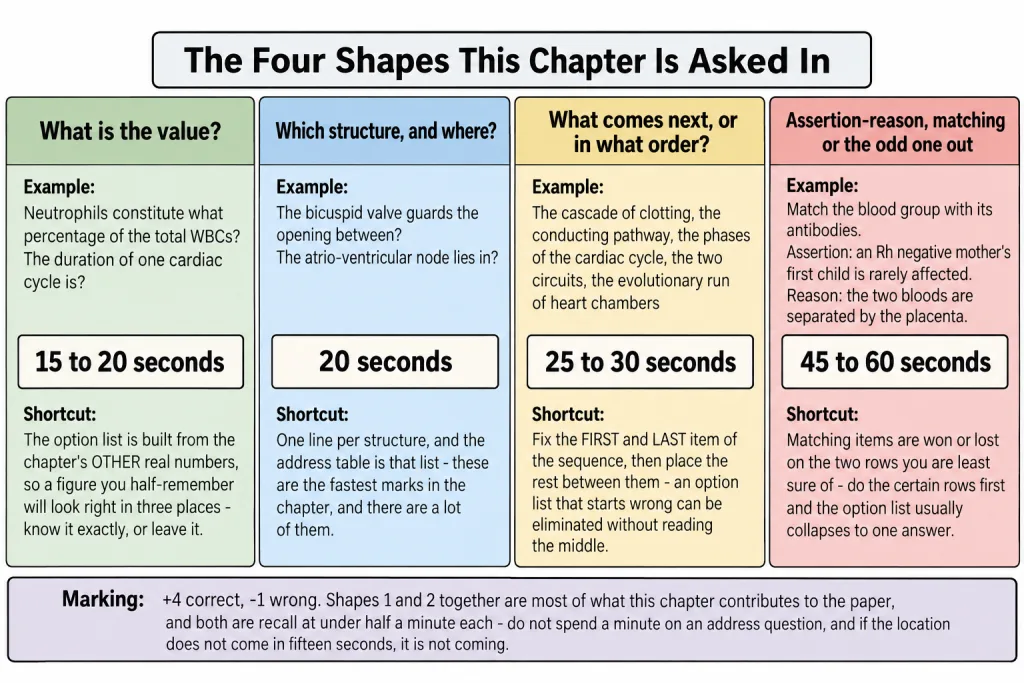
Shape 1 - What is the value? "Neutrophils constitute what percentage of the total WBCs?" "The duration of one cardiac cycle is?" Budget 15 to 20 seconds. The shortcut: the option list is built from the chapter's OTHER real numbers, so a figure you half-remember will look right in three places. Know it exactly, or leave it.
Shape 2 - Which structure, and where? "The bicuspid valve guards the opening between?" "The atrio-ventricular node lies in?" Budget 20 seconds. The shortcut: one line per structure, and the address table below is that list. These are the fastest marks in the chapter, and there are a lot of them.
Shape 3 - What comes next, or in what order? The cascade of clotting, the conducting pathway, the phases of the cardiac cycle, the two circuits, the evolutionary run of heart chambers. Budget 25 to 30 seconds. The shortcut: fix the FIRST and LAST item of the sequence, then place the rest between them. An option list that starts wrong can be eliminated without reading the middle.
Shape 4 - Assertion-reason, matching or the odd one out. "Match the blood group with its antibodies." "Assertion: an Rh negative mother's first child is rarely affected. Reason: the two bloods are separated by the placenta." Budget 45 to 60 seconds. The shortcut: matching items are won or lost on the two rows you are least sure of - do the certain rows first and the option list usually collapses to one answer.
[NEET Important] Shapes 1 and 2 together are most of what this chapter contributes to the paper, and both are recall at under half a minute. Do not spend a minute on an address question. If the location does not come in fifteen seconds, it is not coming.
Every Number in the Chapter
Learn these as a block, because the wrong options are drawn from this same block.
Blood
- Plasma is nearly 55 per cent of blood; formed elements are nearly 45 per cent.
- Plasma is 90-92 per cent water and 6-8 per cent proteins.
- RBC count: 5 million to 5.5 million per cubic millimetre.
- Haemoglobin: 12-16 grams in every 100 mL of blood.
- RBC life span: 120 days.
- WBC count: 6000-8000 per cubic millimetre.
- Platelet count: 1,50,000 to 3,50,000 per cubic millimetre.
- Nearly 80 per cent of humans are Rh positive.
The five white cells, in descending order of abundance
| Cell | Share | Job |
|---|---|---|
| Neutrophil | 60-65 per cent | phagocytic |
| Lymphocyte | 20-25 per cent | immune responses; B and T |
| Monocyte | 6-8 per cent | phagocytic |
| Eosinophil | 2-3 per cent | resists infection, allergy |
| Basophil | 0.5-1 per cent | histamine, serotonin, heparin |
The heart
- SAN generates 70-75 action potentials per minute - the maximum of any part of the nodal system.
- The heart beats 70-75 times a minute, average 72.
- One cardiac cycle lasts 0.8 seconds - because 60 divided by 72 is 0.8.
- Atrial systole increases the flow into the ventricles by about 30 per cent.
- Stroke volume: approximately 70 mL per ventricle per cycle.
- Cardiac output = stroke volume x heart rate, averaging 5000 mL, or 5 litres, per minute.
- Normal blood pressure 120/80; 140/90 or higher on repeated checks is hypertension.
The chambers
- Fishes 2. Amphibians and reptiles 3, EXCEPT crocodiles. Crocodiles, birds and mammals 4.
[NEET Important] Three counts, three magnitudes: RBCs in millions, platelets in lakhs, WBCs in thousands. Getting the magnitude right eliminates two options before you have thought about the digits.
One Structure, One Line
Every Shape 2 question is one row of this table.
| Structure | Its one line |
|---|---|
| Plasma | the fluid matrix, 55 per cent of blood |
| Serum | plasma without the clotting factors |
| Spleen | the graveyard of RBCs |
| Megakaryocytes | bone-marrow cells that shed platelets |
| Thrombin | the enzyme that turns fibrinogen into fibrin |
| Thrombokinase | the enzyme complex needed to turn prothrombin into thrombin |
| Calcium ions | play a very important role in clotting |
| Lacteals | in the intestinal villi; fats are absorbed through lymph here |
| Pericardium | double walled membranous bag holding pericardial fluid |
| Inter-atrial septum | thin, muscular; between the atria |
| Inter-ventricular septum | thick-walled; between the ventricles |
| Atrio-ventricular septum | thick fibrous tissue; between atrium and ventricle |
| Tricuspid valve | RIGHT atrium to RIGHT ventricle; three cusps |
| Bicuspid or mitral valve | LEFT atrium to LEFT ventricle |
| Semilunar valves | ventricles into the pulmonary artery and the aorta |
| SAN | right upper corner of the RIGHT atrium; the pacemaker |
| AVN | lower left corner of the RIGHT atrium, near the atrio-ventricular septum |
| AV bundle (bundle of His) | from the AVN through the atrio-ventricular septum to the top of the inter-ventricular septum |
| Purkinje fibres | minute fibres through the ventricular musculature |
| Tunica intima | inner lining of squamous endothelium |
| Tunica media | smooth muscle and elastic fibres; thin in veins |
| Tunica externa | fibrous connective tissue with collagen fibres |
| Pulmonary artery | the one artery carrying deoxygenated blood |
| Pulmonary veins | the one veins carrying oxygenated blood |
| Hepatic portal vein | intestine to liver, before the systemic circulation |
| Coronary system | vessels exclusively for the cardiac musculature |
| Medulla oblongata | the neural centre that moderates cardiac function through the ANS |
| P wave | depolarisation of the ATRIA |
| QRS complex | depolarisation of the VENTRICLES; marks the beginning of systole |
| T wave | repolarisation of the ventricles; its end marks the end of systole |
| Lub | closure of the tricuspid and bicuspid valves |
| Dub | closure of the semilunar valves |
[NEET Important] Both nodes are in the RIGHT atrium. Students place the AVN in the left atrium because its address says "lower left corner" - but that is the lower left corner of the right atrium. Read the whole address.
The Negatives, and the Pairs That Get Swapped
The negatives
- AB group has NO antibodies in the plasma. O group has NO antigens on the RBCs. That is exactly why AB is the universal recipient and O the universal donor.
- The Rh antigens of the foetus do NOT get exposed to the mother's blood in the FIRST pregnancy - the placenta separates the two. The trouble starts at the delivery of the first child.
- Eosinophils are NOT phagocytic. The phagocytes are neutrophils and monocytes.
- Platelets are NOT whole cells - they are cell fragments from megakaryocytes.
- Lymph has NO red blood cells and NO platelets - only specialised lymphocytes.
- Crocodiles are NOT 3-chambered. They sit with the birds and mammals at four.
- The atrio-ventricular septum does NOT conduct - it is fibrous, which is why the AVN and AV bundle are the ONLY electrical route from atria to ventricles.
- There is NO ECG wave for atrial repolarisation - it is buried inside the QRS complex.
- Heart failure is NOT cardiac arrest and NOT a heart attack. Three different things, and the chapter says so in as many words.
The pairs
| If the question says | The answer is | The trap option is |
|---|---|---|
| guards the right atrio-ventricular opening | tricuspid valve | bicuspid, which is on the left |
| right upper corner of the right atrium | SAN | AVN, which is the lower left corner of the same atrium |
| the first heart sound, lub | closure of the tricuspid and bicuspid valves | the semilunar valves, which make dub |
| atrial depolarisation | P wave | T wave, which is ventricular repolarisation |
| the inactive plasma protein | fibrinogen, and prothrombin | fibrin and thrombin, which are the active products |
| universal donor | O | AB, which is the universal recipient |
| carries deoxygenated blood but is an artery | pulmonary artery | pulmonary veins, which carry oxygenated blood |
| most abundant WBC | neutrophil, 60-65 per cent | lymphocyte, 20-25 per cent, which is second |
| increases heart rate and cardiac output | sympathetic signals | parasympathetic, which decreases both |
| plasma without the clotting factors | serum | plasma, which is blood without the formed elements |
[NEET Important] A left-right question is never about biology, only about whether you read the whole phrase. Slow down for one second on any stem containing "right", "left", "first" or "second".
Solved Examples at NEET Pace
Each item names the shortcut it uses, because the shortcut is the thing worth carrying into the exam hall.
Question 1
Q. Which valve guards the opening between the left atrium and the left ventricle?
Answer. The bicuspid, or mitral, valve. Shortcut: bi- and left both have two letters; tri- and right do not. Any device works as long as you fix the pair once - tricuspid right, bicuspid left.
Question 2
Q. Where exactly is the atrio-ventricular node?
Answer. In the lower left corner of the RIGHT atrium, close to the atrio-ventricular septum. Shortcut: both nodes live in the right atrium. The words "lower left" describe a corner, not a chamber.
Question 3
Q. A person's blood shows no antigen on the RBCs and both anti-A and anti-B in the plasma. What group is it, and who can receive from them?
Answer. Group O, and anyone - they are the universal donor. Shortcut: the antibody you carry is against the antigen you lack. No antigens means both antibodies, which means O can give to all but receive only from O.
Question 4
Q. Which is the least abundant white blood cell, and what does it secrete?
Answer. The basophil, 0.5-1 per cent, secreting histamine, serotonin and heparin. Shortcut: the rarest cell has the longest list of products - that pairing is asked more often than the percentage itself.
Question 5
Q. Platelets number how many per cubic millimetre, and what are they made from?
Answer. 1,50,000 to 3,50,000, and they are cell fragments from megakaryocytes. Shortcut: RBCs in millions, platelets in lakhs, WBCs in thousands. Fix the magnitude and the digits follow.
Question 6
Q. Name the enzyme that converts fibrinogen to fibrin, and the one that is needed to make it.
Answer. Thrombin converts fibrinogen to fibrin; thrombokinase, an enzyme complex, is needed to convert prothrombin into thrombin. Shortcut: read the cascade backwards from the clot - fibrin, so thrombin, so prothrombin, so thrombokinase.
Question 7
Q. Fats are absorbed where, and by which fluid?
Answer. In the lacteals of the intestinal villi, through lymph. Shortcut: lacteal is the only word in this chapter that belongs to the intestine, so any stem naming the villi has one answer.
Question 8
Q. In which vertebrates is the heart 3-chambered, and who is the exception?
Answer. Amphibians and reptiles, except crocodiles, which have four chambers. Shortcut: the exception is always the crocodile. A question that lists reptiles without excluding it is testing that parenthesis.
Question 9
Q. During joint diastole, which valves are open and which are closed?
Answer. The tricuspid and bicuspid valves are OPEN; the semilunar valves are CLOSED. Shortcut: blood is filling the ventricles, so the doors from the atria are open and the exits are shut. Reason from where the blood is going rather than memorising the state.
Question 10
Q. How long is one cardiac cycle, and where does the figure come from?
Answer. 0.8 seconds, because the heart beats 72 times a minute and 60 divided by 72 is 0.8. Shortcut: the duration is derived, not memorised - if you know 72 you can rebuild it in five seconds.
Question 11
Q. Define cardiac output and give its normal value.
Answer. The volume of blood pumped out by EACH ventricle per minute, equal to stroke volume multiplied by heart rate, averaging 5000 mL or 5 litres. Shortcut: 70 mL times 72 beats is about 5040 mL, which the chapter rounds to 5 litres. The words "each ventricle" are the mark - it is not the total from both.
Question 12
Q. The second heart sound is associated with the closure of which valves?
Answer. The semilunar valves. Shortcut: lub comes first and closes the first pair of doors, the tricuspid and bicuspid; dub comes second and closes the exits. The order of the sounds is the order of the valves.
Question 13
Q. Which ECG wave marks the beginning of systole, and which marks its end?
Answer. The QRS complex marks the beginning - contraction starts shortly after Q - and the end of the T wave marks the end of systole. Shortcut: systole runs from Q to the end of T. The P wave is before all of it, and it belongs to the atria.
Question 14
Q. Parasympathetic signals to the heart do what?
Answer. They decrease the rate of heart beat, the speed of conduction of the action potential, and thereby the cardiac output. Shortcut: the parasympathetic list has one item the sympathetic list does not - speed of conduction. If an option mentions conduction speed, it is the parasympathetic side.
A Drill Before You Move On
Decide each one before you read the verdict. Aim for 20 to 25 seconds per question.
- Plasma makes up nearly 45 per cent of blood. - False. Plasma is 55, formed elements 45.
- Serum is plasma without the formed elements. - False. Serum is plasma without the CLOTTING FACTORS.
- Basophils are the most abundant white blood cells. - False. Neutrophils are, at 60-65 per cent. Basophils are the least, at 0.5-1.
- AB group individuals are universal recipients. - True, because they have no antibodies in the plasma.
- The tricuspid valve guards the left atrio-ventricular opening. - False. Right.
- The SAN generates more action potentials per minute than any other part of the nodal system. - True, at 70-75 per minute, which is why it is the pacemaker.
- One cardiac cycle lasts 0.8 seconds. - True.
- The first heart sound is caused by the closure of the semilunar valves. - False. Semilunar closure is dub, the second sound.
- The T wave represents depolarisation of the ventricles. - False. REPOLARISATION. The QRS is the depolarisation.
- The pulmonary artery carries oxygenated blood. - False. Deoxygenated - it is the exception that proves artery does not mean oxygenated.
- Cardiac output is the blood pumped by both ventricles together per minute. - False. By EACH ventricle.
- Heart failure and cardiac arrest are the same thing. - False. Cardiac arrest is the heart stopping; heart failure is the heart not pumping effectively enough.