
Open and Closed Circulation
The circulatory patterns are of two types - OPEN or CLOSED. Every animal you meet in this chapter belongs to one of the two, and the whole difference is whether the blood ever leaves its vessels.
OPEN circulatory system - present in ARTHROPODS AND MOLLUSCS. In it, blood pumped by the heart passes through large vessels into open spaces or body cavities called SINUSES. The blood leaves the vessels, bathes the organs directly and then drains back to the heart.
CLOSED circulatory system - present in ANNELIDS AND CHORDATES. In it, the blood pumped by the heart is always circulated through a closed network of blood vessels. The blood never leaves its tubes; it reaches the tissues through the walls of the finest vessels.
And the chapter gives one reason for preferring the closed plan: this pattern is considered to be more advantageous as the flow of fluid can be more precisely regulated. That is the whole answer whenever a question asks which system is better and why - the advantage is precise regulation of flow, not greater speed and not a larger volume of blood.
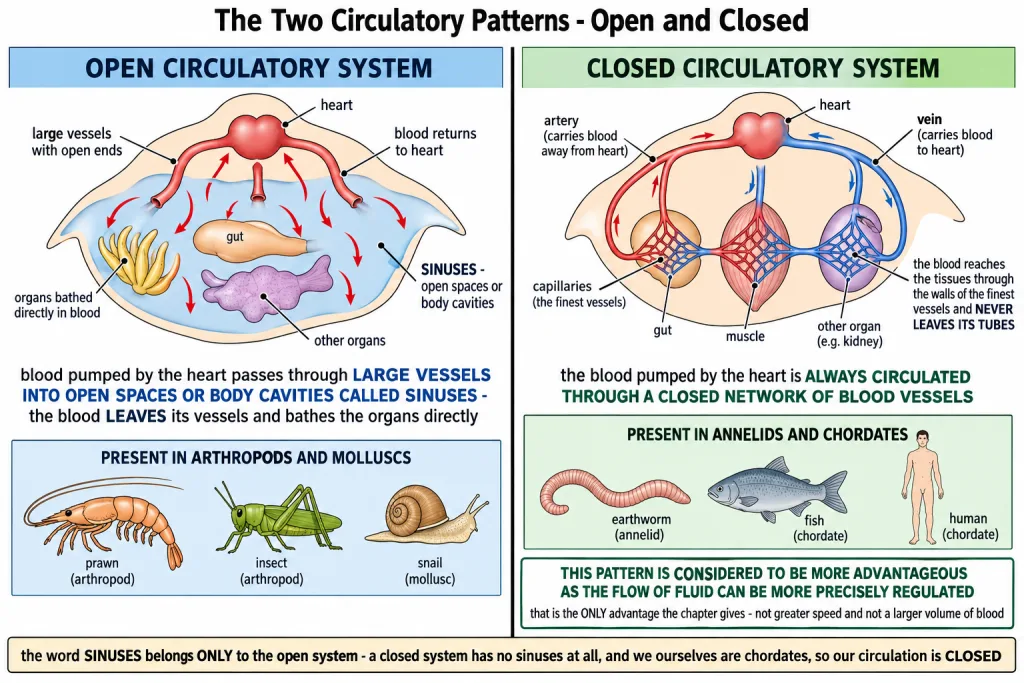
[NEET Important] The address to fix is arthropods and molluscs OPEN, annelids and chordates CLOSED, and the swapped animal list is the standard wrong option. The word SINUSES belongs only to the open system - a closed system has no sinuses at all. We ourselves are chordates, so our circulation is closed.
The Vertebrate Heart, Chamber by Chamber
All vertebrates possess a muscular chambered heart. What changes from group to group is the number of chambers - and the number of chambers decides the pattern of circulation, which is why the two are nearly always asked together. Learn them as one table.
| Group | Chambers | Circulation |
|---|---|---|
| Fishes | 2-chambered - an atrium and a ventricle | single circulation |
| Amphibians and reptiles (EXCEPT crocodiles) | 3-chambered - two atria and a single ventricle | incomplete double circulation |
| Crocodiles, birds and mammals | 4-chambered - two atria and two ventricles | double circulation |
Read the bracket in the middle row as a mark on its own. The chapter writes amphibians and the reptiles (EXCEPT crocodiles), which means the crocodile is a reptile with a 4-chambered heart and sits in the bottom row with the birds and mammals rather than with the lizards and snakes it is classified beside. Any question that names the crocodile is testing that one exception.
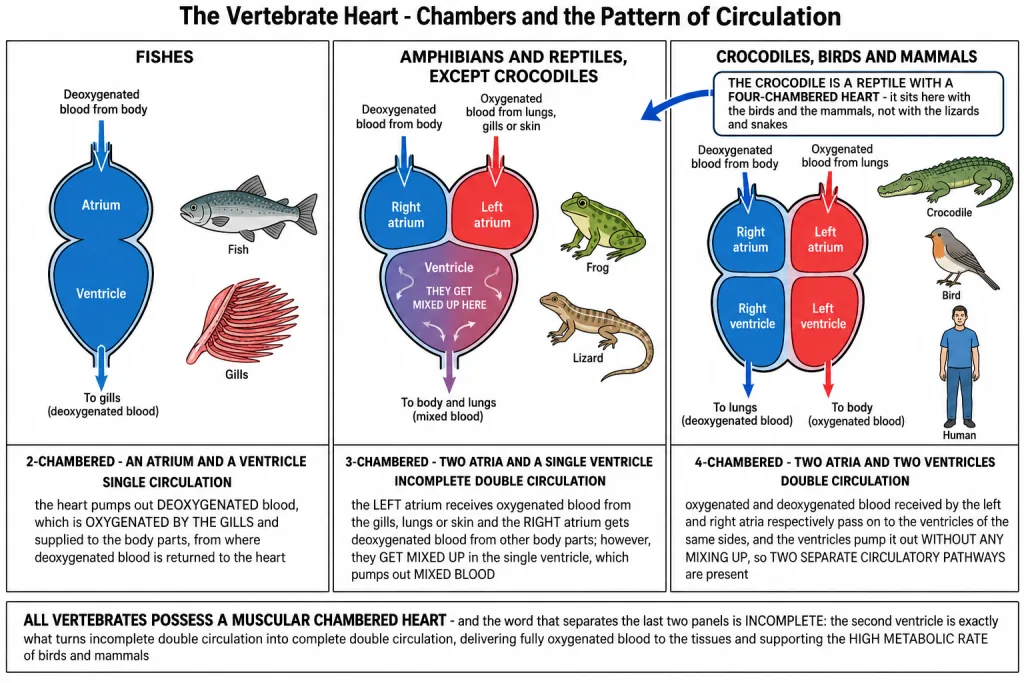
Two more habits worth building from the table. Count the atria and the ventricles separately - a 3-chambered heart is two atria and ONE ventricle, never one atrium and two ventricles. And the row you are given decides the row you must produce: given "single circulation", answer "fishes, 2-chambered"; given "4-chambered", answer "crocodiles, birds and mammals, double circulation".
[NEET Important] The crocodile is the single most examined animal in this table. The other favourite is the trap of calling the amphibian heart "one atrium and two ventricles" - it is two atria and a single ventricle.
Single, Incomplete Double and Double Circulation
Fishes - SINGLE CIRCULATION. The heart pumps out DEOXYGENATED blood, which is oxygenated by the gills and supplied to the body parts, from where deoxygenated blood is returned to the heart. Note what that means: a fish heart handles only deoxygenated blood, and the blood passes through the heart once in one complete round of the body.
Amphibians and reptiles - INCOMPLETE DOUBLE CIRCULATION. The left atrium receives oxygenated blood from the gills, lungs or skin and the right atrium gets deoxygenated blood from other body parts; however, they GET MIXED UP in the single ventricle, which pumps out mixed blood. The two atria do their job perfectly; it is the single ventricle that undoes it.
Birds and mammals - DOUBLE CIRCULATION. Oxygenated and deoxygenated blood received by the left and right atria respectively pass on to the ventricles of the same sides, and the ventricles pump it out WITHOUT ANY MIXING UP, so two separate circulatory pathways are present.
The word that separates the last two is INCOMPLETE. Both the frog and the human keep the two kinds of blood apart in the atria; only the bird and the mammal keep them apart after that as well, because there are two ventricles instead of one. So the presence of a second ventricle is exactly what turns incomplete double circulation into complete double circulation.
Why it is worth having. Complete separation means fully oxygenated blood reaches the tissues, which is what supports the high metabolic rate of a bird or a mammal - animals that keep their body temperature up and stay active cannot afford to send half-oxygenated blood to their muscles.
[NEET Important] Single, incomplete double and double are the three named answers, and each is glued to its own group. Fish - single. Amphibian and reptile - incomplete double. Bird and mammal - double. The distractor is always "double circulation in the frog", which is wrong by the one word incomplete.
Quick Recap
- The circulatory patterns are of two types - open or closed.
- Open circulatory system: arthropods and molluscs. Blood pumped by the heart passes through large vessels into open spaces or body cavities called SINUSES.
- Closed circulatory system: annelids and chordates. Blood pumped by the heart is always circulated through a closed network of blood vessels.
- The closed pattern is more advantageous because the flow of fluid can be more precisely regulated.
- All vertebrates possess a muscular chambered heart.
- Fishes: 2-chambered - an atrium and a ventricle - single circulation.
- Amphibians and reptiles (except crocodiles): 3-chambered - two atria and a single ventricle - incomplete double circulation.
- Crocodiles, birds and mammals: 4-chambered - two atria and two ventricles - double circulation.
- In fishes the heart pumps out deoxygenated blood, oxygenated by the gills and supplied to the body parts, from where deoxygenated blood returns to the heart.
- In amphibians and reptiles the left atrium receives oxygenated blood from the gills, lungs or skin and the right atrium deoxygenated blood from the body, but they get mixed up in the single ventricle, which pumps out mixed blood.
- In birds and mammals the ventricles pump the blood out without any mixing up, so two separate circulatory pathways are present.
- Complete separation delivers fully oxygenated blood to the tissues and supports the high metabolic rate of birds and mammals.
Solved Examples
Question 1
Q. How many types of circulatory pattern are there, and what are they called?
Answer. Two - OPEN and CLOSED.
Question 2
Q. Which animals have an open circulatory system, and what happens to the blood in it?
Answer. Arthropods and molluscs. In them, blood pumped by the heart passes through large vessels into open spaces or body cavities called sinuses, so the blood leaves the vessels and bathes the organs directly.
Question 3
Q. What are sinuses, and in which system are they found?
Answer. Sinuses are the open spaces or body cavities into which blood is emptied in an OPEN circulatory system. They are found only in the open system - arthropods and molluscs.
Question 4
Q. Which animals have a closed circulatory system?
Answer. Annelids and chordates. In them the blood pumped by the heart is always circulated through a closed network of blood vessels. Human beings are chordates, so our own circulation is closed.
Question 5
Q. Write the differences between Open and Closed system of circulation. This is one of the chapter-end exercises.
Answer.
| Feature | Open circulatory system | Closed circulatory system |
|---|---|---|
| Where the blood goes | Blood pumped by the heart passes through large vessels into open spaces or body cavities - it leaves the vessels and bathes the organs directly | Blood pumped by the heart is always circulated through a closed network of blood vessels - it never leaves the vessels |
| Sinuses | Present - the open spaces are called sinuses | Absent - there are no open spaces in the path of blood |
| Animals | Arthropods and molluscs | Annelids and chordates |
| Regulation of flow | Flow cannot be regulated precisely, since the blood spreads through open cavities | The flow of fluid can be more precisely regulated, which is why this pattern is considered more advantageous |
Question 6
Q. Why is the closed system of circulation considered to be more advantageous?
Answer. Because the flow of fluid can be more precisely regulated. The blood stays inside a closed network of blood vessels, so how much goes to each organ can be controlled; in an open system the blood spills into sinuses and no such control is possible.
Question 7
Q. Give the number of heart chambers in fishes, in amphibians and reptiles, and in crocodiles, birds and mammals.
Answer. All vertebrates possess a muscular chambered heart, and the counts are:
| Group | Chambers |
|---|---|
| Fishes | 2 - an atrium and a ventricle |
| Amphibians and reptiles (except crocodiles) | 3 - two atria and a single ventricle |
| Crocodiles, birds and mammals | 4 - two atria and two ventricles |
Question 8
Q. Which reptile has a four chambered heart, and why is that worth remembering?
Answer. The crocodile. The chapter says amphibians and the reptiles except crocodiles have a 3-chambered heart, so the crocodile is the reptile that breaks the rule and carries two atria and two ventricles like a bird or a mammal. Questions on this table are usually built around exactly that exception.
Question 9
Q. What is single circulation? In which animals does it occur?
Answer. In fishes. The heart pumps out deoxygenated blood, which is oxygenated by the gills and supplied to the body parts, from where deoxygenated blood is returned to the heart. The blood therefore passes through the heart only once in one complete round of the body, and the fish heart handles only deoxygenated blood.
Question 10
Q. What is incomplete double circulation, and in which animals is it found?
Answer. In amphibians and reptiles. The left atrium receives oxygenated blood from the gills, lungs or skin and the right atrium gets deoxygenated blood from other body parts; however, they get mixed up in the single ventricle, which pumps out mixed blood. It is called incomplete because the separation made by the two atria is lost in the single ventricle.
Question 11
Q. What is double circulation, and which animals have it?
Answer. Birds and mammals have it. Oxygenated and deoxygenated blood received by the left and right atria respectively pass on to the ventricles of the same sides, and the ventricles pump it out without any mixing up, so two separate circulatory pathways are present.
Question 12
Q. Why does a frog have incomplete double circulation while a bird has complete double circulation?
Answer. Because of the number of ventricles. Both animals separate the two kinds of blood in the atria, but the frog has a single ventricle in which the oxygenated and deoxygenated blood get mixed up, so mixed blood is pumped out. The bird has two ventricles, so the blood of each side stays on its own side and is pumped out without any mixing up.
Question 13
Q. What does the complete separation of the two kinds of blood buy a bird or a mammal?
Answer. Fully oxygenated blood reaches the tissues. Nothing is diluted with returning deoxygenated blood, so the tissues get the most oxygen the lungs can supply, and that is what supports the high metabolic rate of a bird or a mammal - the constant body temperature and the sustained activity both depend on it.
Question 14
Q. Describe the evolutionary change in the pattern of heart among the vertebrates. This is one of the chapter-end exercises.
Answer. All vertebrates possess a muscular chambered heart, and the change across the groups is a steady move towards keeping oxygenated and deoxygenated blood apart.
Fishes - a 2-chambered heart, an atrium and a ventricle. The heart pumps out deoxygenated blood, which is oxygenated by the gills and supplied to the body parts, from where deoxygenated blood is returned to the heart. This is single circulation - the blood passes through the heart once per circuit, and the heart handles only deoxygenated blood.
Amphibians and reptiles, except crocodiles - a 3-chambered heart, two atria and a single ventricle. A second atrium appears, so the left atrium receives oxygenated blood from the gills, lungs or skin and the right atrium gets deoxygenated blood from other body parts. However, they get mixed up in the single ventricle, which pumps out mixed blood. This is incomplete double circulation - the separation begins, but it is undone by the one ventricle. What it buys the animal is a second circuit through the lungs or skin, so blood can be sent to a breathing surface and back to the heart before going to the body.
Crocodiles, birds and mammals - a 4-chambered heart, two atria and two ventricles. The ventricle divides too. Oxygenated and deoxygenated blood received by the left and right atria respectively pass on to the ventricles of the same sides, and the ventricles pump it out without any mixing up, so two separate circulatory pathways are present - double circulation.
What the last change buys the animal: complete separation means fully oxygenated blood reaches the tissues and supports the high metabolic rate of a bird or a mammal. It also lets the two circuits work at different pressures, since each has a ventricle of its own.
The line to end on: 2-chambered and single, then 3-chambered and incomplete double, then 4-chambered and double - and the crocodile is the reptile that has already arrived at the last stage.