
Blood Is a Connective Tissue
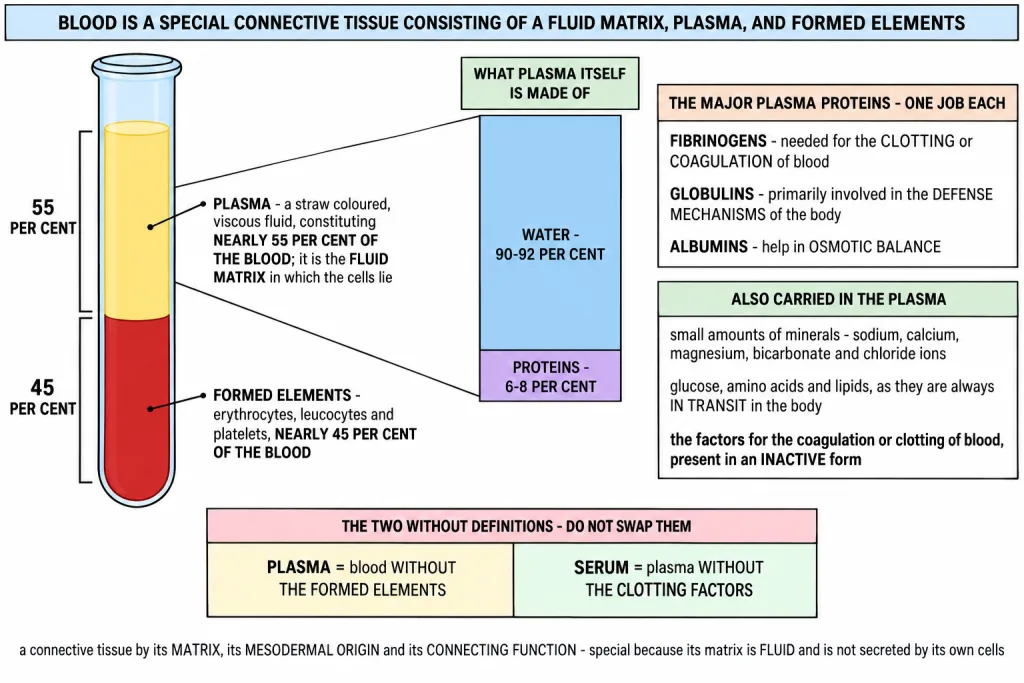
Blood is a special connective tissue consisting of a fluid matrix, plasma, and formed elements.
That one sentence is two exam answers at once, so take it apart.
Why is blood a connective tissue? Because it has the defining architecture of one - cells scattered in an abundant extracellular matrix. In bone the matrix is hard, in cartilage it is firm, and in blood the matrix is fluid. Add the other two reasons and the answer is complete:
- It has a matrix, plasma, in which the cells lie separated from one another - they are not packed together as in an epithelium.
- It is mesodermal in origin, like every other connective tissue.
- It connects and serves the whole body, carrying nutrients, gases, hormones and wastes between distant organs.
The word "special" in the definition is doing work too. Blood is a connective tissue whose matrix is not secreted by its own cells and is fluid rather than solid, which is why the chapter calls it a special connective tissue rather than an ordinary one.
[NEET Important] "Why do we consider blood a connective tissue?" is one of the chapter-end exercises, and the marks are for matrix, mesodermal origin and the connecting function - not for a description of what blood carries. Lead with the matrix.
Plasma - the Fluid Matrix
Plasma is a straw coloured, viscous fluid constituting nearly 55 per cent of the blood.
Its own composition, in the chapter's numbers:
| Component | Share of plasma |
|---|---|
| Water | 90-92 per cent |
| Proteins | 6-8 per cent |
The major proteins are fibrinogen, globulins and albumins, and each has one job that gets asked on its own:
- Fibrinogens are needed for the clotting or coagulation of blood.
- Globulins are primarily involved in the defense mechanisms of the body.
- Albumins help in osmotic balance.
Plasma also contains small amounts of minerals - , , , , and others. Glucose, amino acids and lipids are also present in the plasma, as they are always in transit in the body.
Factors for the coagulation or clotting of blood are also present in the plasma in an INACTIVE form. That word matters - the clotting machinery is carried everywhere, switched off, and is turned on only at an injury.
And that gives the chapter's neatest definition: plasma without the clotting factors is called SERUM.
[NEET Important] Three protein jobs, three words: fibrinogen clots, globulin defends, albumin balances. The other guaranteed item is serum = plasma minus clotting factors - not "plasma minus cells", which is what plasma already is.
The Two Halves of Blood
Plasma is nearly 55 per cent of blood and the formed elements are nearly 45 per cent. Learn the pair together; a question that gives you one is checking whether you can produce the other.
And keep the two "without" definitions apart, because they are the standard swap:
| Term | What it is |
|---|---|
| Plasma | the fluid matrix - blood without the formed elements |
| Serum | plasma without the clotting factors |
The importance of the plasma proteins is a chapter-end exercise in itself, and the full answer runs wider than the three names:
- Fibrinogen makes clotting possible, so a wound seals instead of bleeding on.
- Globulins carry out defense, so the body can answer infection.
- Albumins maintain osmotic balance, holding water in the vessels; without them fluid leaks into the tissues.
- Together the proteins also make plasma viscous, which helps maintain blood pressure, and act as a buffer holding the blood's pH steady.
[NEET Important] 55 and 45 are the two percentages of this section, and 90-92 and 6-8 are the two inside plasma. All four are asked directly, and the wrong options in a NEET item are drawn from the other three.
Quick Recap
- Blood is a special connective tissue consisting of a fluid matrix, plasma, and formed elements.
- It counts as connective tissue because of its matrix, its mesodermal origin and its connecting function.
- Plasma is a straw coloured, viscous fluid, nearly 55 per cent of the blood; formed elements are nearly 45 per cent.
- Plasma is 90-92 per cent water and 6-8 per cent proteins.
- Major plasma proteins: fibrinogen (clotting), globulins (defense), albumins (osmotic balance).
- Plasma carries minerals such as sodium, calcium, magnesium, bicarbonate and chloride ions, and glucose, amino acids and lipids in transit.
- Clotting factors are present in plasma in an inactive form.
- Serum = plasma without the clotting factors.
Solved Examples
Question 1
Q. Define blood in the chapter's own words.
Answer. Blood is a special connective tissue consisting of a fluid matrix, plasma, and formed elements.
Question 2
Q. Why do we consider blood as a connective tissue? This is one of the chapter-end exercises.
Answer. Because it has everything a connective tissue is defined by.
- It has an extracellular MATRIX in which its cells lie separated from one another - and in blood that matrix, plasma, is fluid instead of solid.
- It is mesodermal in origin, like all connective tissues.
- It performs the connecting and transporting function of a connective tissue, linking distant organs by carrying nutrients, respiratory gases, hormones and wastes between them.
It is called a special connective tissue because its matrix is fluid and is not secreted by its own cells.
Question 3
Q. What is plasma, and what fraction of blood is it?
Answer. A straw coloured, viscous fluid that makes up nearly 55 per cent of the blood. It is the fluid matrix in which the formed elements are suspended.
Question 4
Q. Give the composition of plasma by percentage.
Answer. 90-92 per cent water and 6-8 per cent proteins, with small amounts of minerals and glucose, amino acids and lipids in transit.
Question 5
Q. Name the major plasma proteins and give one function of each.
Answer.
- Fibrinogen - needed for the clotting or coagulation of blood.
- Globulins - primarily involved in the defense mechanisms of the body.
- Albumins - help in osmotic balance.
Question 6
Q. What is the importance of plasma proteins? This is one of the chapter-end exercises.
Answer. Each of the three named proteins carries a job the body cannot do without.
- Fibrinogen is needed for coagulation. Without it a wound would keep bleeding, because fibrinogen is the inactive form that is converted into the fibrin threads of a clot.
- Globulins are primarily involved in the defense mechanisms of the body - they act against infection.
- Albumins help in osmotic balance. They hold water inside the blood vessels; if they fall, fluid moves out into the tissues.
Beyond the three, the plasma proteins together make the plasma viscous, which helps maintain blood pressure, and act as buffers that keep the pH of blood steady.
Question 7
Q. Which minerals does plasma carry?
Answer. Small amounts of sodium, calcium, magnesium, bicarbonate and chloride ions - , , , and - among others.
Question 8
Q. Why are glucose, amino acids and lipids found in plasma?
Answer. Because they are always in transit in the body. Plasma is the medium that carries them from where they are absorbed or made to where they are used or stored.
Question 9
Q. In what state are the clotting factors carried in plasma, and why does that matter?
Answer. In an inactive form. It matters because the clotting machinery travels everywhere in the body but must switch on only at the site of an injury - if the factors were active in circulation, blood would clot inside intact vessels.
Question 10
Q. What is serum, and how does it differ from plasma?
Answer. Serum is plasma without the clotting factors. Plasma is the whole fluid matrix, clotting factors included; remove those factors and what is left is serum.
Question 11
Q. A sample of blood is separated. What are the two fractions and what share does each hold?
Answer. Plasma, nearly 55 per cent, and the formed elements, nearly 45 per cent.
Question 12
Q. A patient's albumin level falls sharply. What would you expect to happen, and why?
Answer. Fluid would move out of the blood vessels into the tissue spaces, because albumins help in osmotic balance and it is largely they that hold water inside the vessels. Losing them lowers the pull that keeps fluid in the blood.