
Clotting - What It Is and What It Is For
When you cut a finger the wound does not bleed on for ever; the blood stops flowing after some time. That is because blood exhibits coagulation or clotting in response to an injury or trauma.
This is a mechanism to prevent excessive loss of blood from the body. That single line is the whole answer to "why does blood clot", and it is worth writing exactly as the chapter gives it.
What forms at the site of the cut is a clot, also called a coagulum.
| The clot | The chapter's description |
|---|---|
| What it looks like | a dark reddish brown scum at the site of the cut or injury |
| What it is made of | mainly a network of threads called FIBRINS |
| What is caught in it | dead and damaged formed elements of blood, trapped in the network |
So a clot is not a lump of cells - it is a mesh of fibrin threads with cells caught in it. The colour comes from the trapped red cells, not from the threads.
[NEET Important] "Dark reddish brown scum", "network of threads called fibrins" and "dead and damaged formed elements" are the three phrases the answer is marked on. The common slip is to name fibrinogen as the material of the clot - fibrinogen is the inactive form dissolved in the plasma; the threads in the clot are FIBRIN.
The Cascade, in Order
The whole of this section is one ordered chain, and the order is the answer. Read it once backwards, the way the chapter writes it, and then forwards, the way it actually happens.
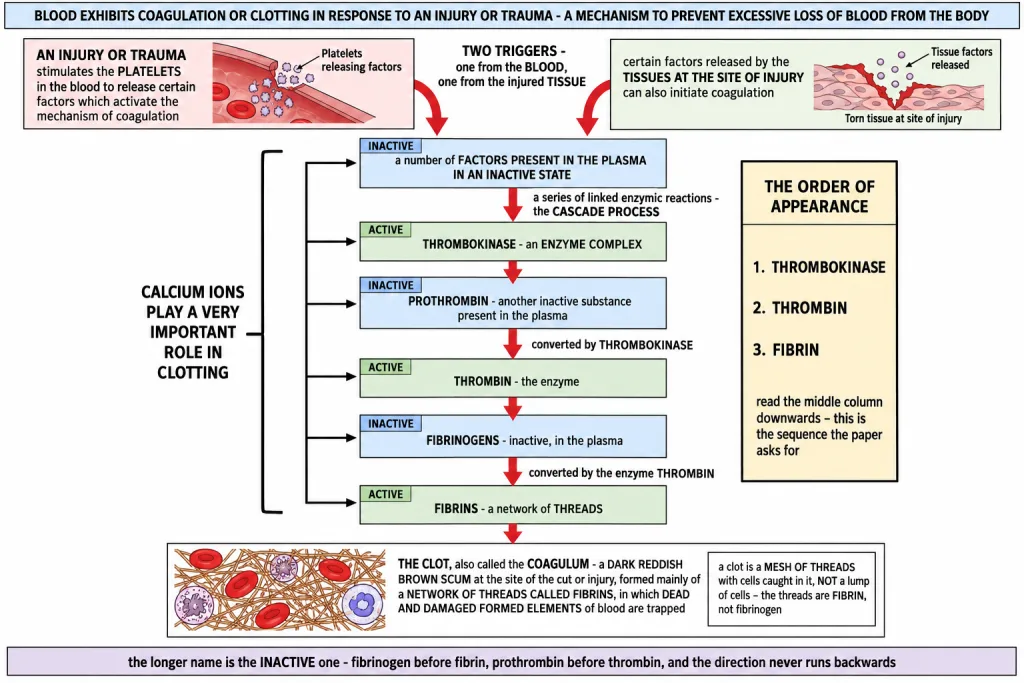
As the chapter states it, working back from the clot:
- Fibrins are formed by the conversion of inactive FIBRINOGENS in the plasma by the enzyme THROMBIN.
- Thrombins, in turn, are formed from another inactive substance present in the plasma called PROTHROMBIN.
- An enzyme complex, THROMBOKINASE, is required for that reaction.
- This complex is formed by a series of linked enzymic reactions - a CASCADE PROCESS - involving a number of factors present in the plasma in an inactive state.
Now read it forwards, in the order the events actually occur. This is the form most often asked.
- The cascade process builds the enzyme complex THROMBOKINASE from a number of factors present in the plasma in an inactive state.
- Thrombokinase converts the inactive PROTHROMBIN of the plasma into the enzyme THROMBIN.
- Thrombin converts the inactive FIBRINOGENS of the plasma into FIBRIN threads.
- The fibrin threads form a network, trapping the dead and damaged formed elements - and that is the clot.
Each step is an inactive substance turned into its active product, so the pairs are worth setting out on their own:
| Inactive form, present in plasma | Active product | Converted by |
|---|---|---|
| The clotting factors of the cascade | THROMBOKINASE (enzyme complex) | a series of linked enzymic reactions - the cascade process |
| PROTHROMBIN | THROMBIN (the enzyme) | thrombokinase |
| FIBRINOGEN | FIBRIN (the threads of the clot) | thrombin |
[NEET Important] Read the middle column down: thrombokinase, thrombin, fibrin. That is the order of appearance, and NEET asks it as a sequence item just as often as it asks a single conversion. Note also that all three starting materials are already in the plasma, in an inactive state - the body carries the whole machinery switched off and turns it on only at an injury.
What Starts It, and the Part Played by Calcium
The cascade does not run on its own. Two triggers can set it going, and the chapter names both.
- An injury or a trauma stimulates the platelets in the blood to release certain factors which activate the mechanism of coagulation.
- Certain factors released by the tissues at the site of injury can also initiate coagulation.
So one trigger comes from the blood - the platelets - and the other from the injured tissue itself. Learn them as a pair; an item that names one is usually checking whether you can name the other.
Calcium ions play a very important role in clotting. That is a one-mark question on its own, and the chapter gives it its own sentence, so give it its own line in your answer too. Calcium, written , is the mineral without which the cascade cannot proceed.
Putting the section together in one flow:
injury or trauma -> platelets release factors, and the injured tissues release factors -> the cascade builds thrombokinase -> prothrombin becomes thrombin -> fibrinogen becomes fibrin -> the fibrin network traps the formed elements -> the clot.
[NEET Important] The three examinable lines here are the platelet trigger, the tissue trigger and the calcium line, and calcium is the one asked most. Do not confuse the platelets with the clot itself - the platelets release the factors that start coagulation; they are not the threads of the clot. And the ion is calcium, not sodium or potassium.
[NEET Important] The pairs that get swapped: fibrinogen is the inactive form and fibrin the active threads; prothrombin is inactive and thrombin is the enzyme; thrombokinase is the enzyme complex that starts the conversion. The commonest error in this whole section is to reverse an inactive form with its active product - fibrin for fibrinogen, or thrombin for prothrombin. The rule is short: the longer name is the inactive one.
Quick Recap
- Blood exhibits coagulation or clotting in response to an injury or trauma.
- This is a mechanism to prevent excessive loss of blood from the body.
- The clot or coagulum is a dark reddish brown scum formed mainly of a network of threads called FIBRINS, in which dead and damaged formed elements of blood are trapped.
- Fibrins are formed by the conversion of inactive FIBRINOGENS in the plasma by the enzyme THROMBIN.
- Thrombins in turn are formed from another inactive substance present in the plasma called PROTHROMBIN.
- An enzyme complex, THROMBOKINASE, is required for that reaction.
- Thrombokinase is formed by a series of linked enzymic reactions - a CASCADE PROCESS - involving a number of factors present in the plasma in an inactive state.
- The order of events forwards: thrombokinase, then prothrombin to thrombin, then fibrinogen to fibrin.
- The inactive to active pairs: fibrinogen to fibrin, prothrombin to thrombin.
- An injury or trauma stimulates the platelets in the blood to release certain factors which activate the mechanism of coagulation.
- Certain factors released by the tissues at the site of injury can also initiate coagulation.
- Calcium ions play a very important role in clotting.
Solved Examples
Question 1
Q. When does blood clot, and what is the purpose of clotting?
Answer. Blood exhibits coagulation or clotting in response to an injury or trauma. It is a mechanism to prevent excessive loss of blood from the body.
Question 2
Q. Describe the clot as the chapter describes it.
Answer. The clot or coagulum is a dark reddish brown scum seen at the site of a cut. It is formed mainly of a network of threads called fibrins, in which dead and damaged formed elements of blood are trapped.
Question 3
Q. What are fibrins, and how are they formed?
Answer. Fibrins are the threads that make up the network of the clot. They are formed by the conversion of inactive fibrinogens present in the plasma, by the enzyme thrombin.
Question 4
Q. How is thrombin formed?
Answer. From prothrombin, which is another inactive substance present in the plasma. An enzyme complex called thrombokinase is required for this reaction.
Question 5
Q. What is thrombokinase, and how is it formed?
Answer. Thrombokinase is an enzyme complex required for the conversion of prothrombin into thrombin. It is formed by a series of linked enzymic reactions - a cascade process - involving a number of factors present in the plasma in an inactive state.
Question 6
Q. Write the clotting cascade in the order in which the events actually occur.
Answer.
- The cascade process, a series of linked enzymic reactions among plasma factors that are present in an inactive state, forms the enzyme complex THROMBOKINASE.
- Thrombokinase converts the inactive PROTHROMBIN of the plasma into the enzyme THROMBIN.
- Thrombin converts the inactive FIBRINOGEN of the plasma into FIBRIN threads.
- The fibrin threads form a network in which dead and damaged formed elements are trapped - the clot.
Question 7
Q. Give the inactive form and the active product for each step of clotting.
Answer.
| Inactive form in plasma | Active product |
|---|---|
| The clotting factors of the cascade | thrombokinase |
| Prothrombin | thrombin |
| Fibrinogen | fibrin |
Question 8
Q. What starts the mechanism of coagulation?
Answer. Two things.
- An injury or a trauma stimulates the platelets in the blood to release certain factors which activate the mechanism of coagulation.
- Certain factors released by the tissues at the site of injury can also initiate coagulation.
Question 9
Q. What role do calcium ions play in clotting?
Answer. Calcium ions play a very important role in clotting. Without them the cascade of reactions cannot proceed, so no clot is formed.
Question 10
Q. In what state are the clotting factors present in the plasma, and why does that matter?
Answer. In an inactive state. It matters because the whole clotting machinery travels in the circulation all the time; keeping the factors inactive means blood clots only where there is an injury, and not inside intact vessels.
Question 11
Q. Distinguish between fibrinogen and fibrin.
Answer. Fibrinogen is the inactive plasma protein; fibrin is the active product - the network of threads that forms the clot. Fibrinogen is converted into fibrin by the enzyme thrombin.
Question 12
Q. Distinguish between prothrombin and thrombin.
Answer. Prothrombin is an inactive substance present in the plasma. Thrombin is the enzyme formed from it, and thrombin is what converts fibrinogen into fibrin. The conversion of prothrombin into thrombin needs the enzyme complex thrombokinase.
Question 13
Q. A person's blood takes far longer than normal to clot after a cut, although the platelet count is normal. Suggest what could be wrong.
Answer. Something in the cascade is missing or short. It could be a shortage of one of the plasma factors that build the enzyme complex thrombokinase, or a shortage of prothrombin or fibrinogen in the plasma, or too little calcium, since calcium ions play a very important role in clotting. With any of these, fibrin threads form slowly or not at all, so the clot is delayed even though the platelets are present in normal numbers.