
The Three Formed Elements
Erythrocytes, leucocytes and platelets are collectively called the formed elements, and they constitute nearly 45 per cent of the blood.
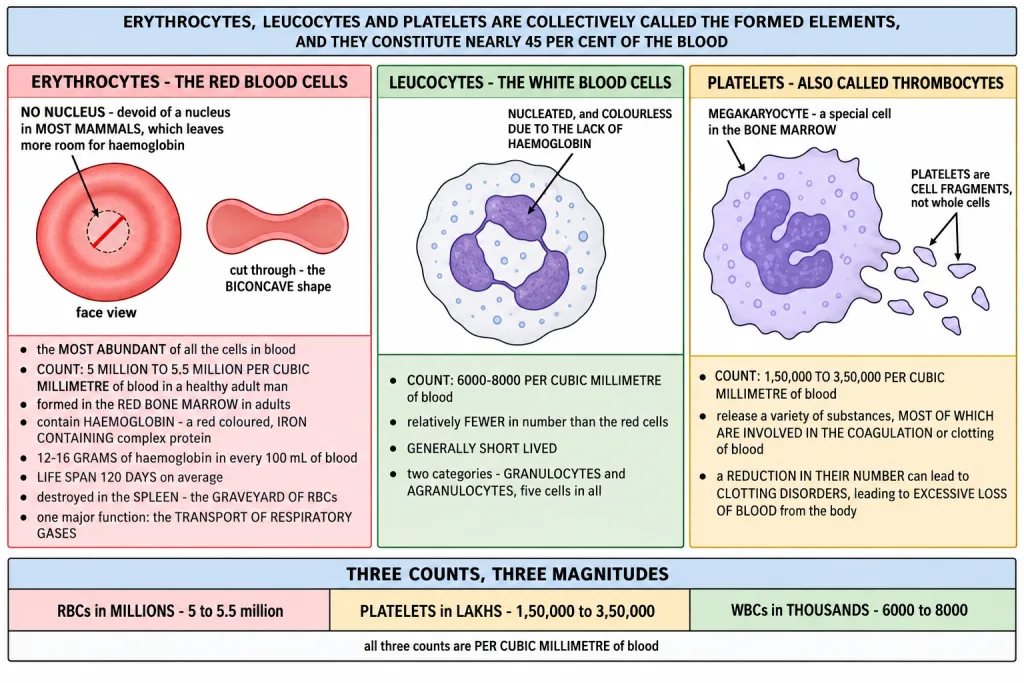
Erythrocytes are red blood cells, leucocytes are white blood cells, and platelets are also called thrombocytes. Every question in this section is about one of those three, so fix which is which before anything else.
Erythrocytes - the Red Blood Cells
RBCs are the most abundant of all the cells in blood. Here is everything the chapter says about them, and every line of it is examinable.
| Feature | The fact |
|---|---|
| Count | 5 million to 5.5 million per cubic millimetre of blood in a healthy adult man |
| Where formed | the red bone marrow, in adults |
| Nucleus | absent in most mammals |
| Shape | biconcave |
| Pigment | haemoglobin - a red coloured, iron containing complex protein |
| Haemoglobin content | 12-16 grams in every 100 mL of blood |
| Life span | 120 days on average |
| Where destroyed | the spleen, called the graveyard of RBCs |
Read the two qualifiers carefully. "Most mammals", not all - the chapter does not claim every mammal. And "in the adults" for the red bone marrow - the site of formation changes with age, and the chapter is specifically describing the adult.
The shape and the missing nucleus are the same idea from two directions. Losing the nucleus leaves more room for haemoglobin, and the biconcave disc gives a larger surface for its size - both changes make the cell a better carrier of respiratory gases, which is its one major function: the transport of respiratory gases.
[NEET Important] The three numbers here are 5 to 5.5 million, 12-16 grams per 100 mL, and 120 days, and NEET builds its wrong options out of the other two. Do not confuse 12-16 grams of haemoglobin per 100 mL with 12-16 breaths per minute from the previous chapter - the figures are identical and the two chapters sit next to each other.
Leucocytes - the White Blood Cells
Leucocytes are colourless due to the lack of haemoglobin. They are nucleated, and they are relatively fewer in number, averaging 6000-8000 per cubic millimetre of blood. Leucocytes are generally short lived.
Note the two contrasts with the RBC straight away: the RBC has no nucleus and the WBC has one, and the RBC has haemoglobin and the WBC does not.
There are two main categories.
- Granulocytes: neutrophils, eosinophils and basophils.
- Agranulocytes: lymphocytes and monocytes.
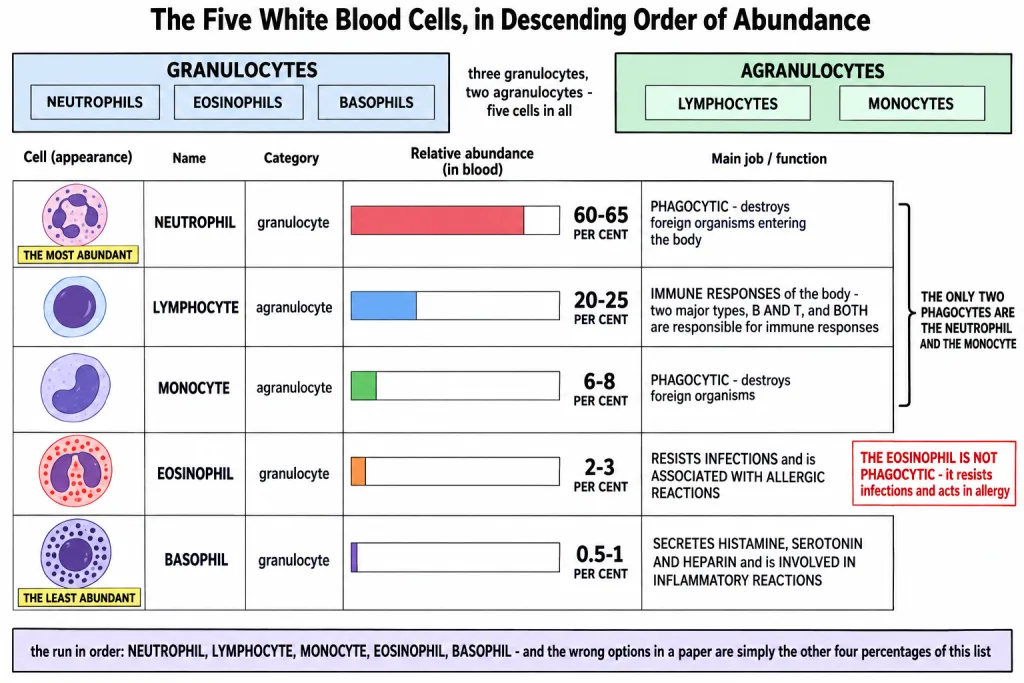
And then the five cells themselves, with their percentages and their jobs.
| Cell | Category | Share of total WBCs | What it does |
|---|---|---|---|
| Neutrophil | granulocyte | 60-65 per cent - the most abundant | phagocytic - destroys foreign organisms entering the body |
| Lymphocyte | agranulocyte | 20-25 per cent | immune responses; two major types, B and T |
| Monocyte | agranulocyte | 6-8 per cent | phagocytic - destroys foreign organisms |
| Eosinophil | granulocyte | 2-3 per cent | resists infections; associated with allergic reactions |
| Basophil | granulocyte | 0.5-1 per cent - the least abundant | secretes histamine, serotonin and heparin; involved in inflammatory reactions |
The order in that table is the order of abundance, and it is worth memorising as a descending run: neutrophil, lymphocyte, monocyte, eosinophil, basophil. Neutrophils are the most abundant and basophils are the least - the chapter says both in as many words.
Two of the five are phagocytic: neutrophils and monocytes. Nobody else in the list eats anything.
[NEET Important] The single most asked fact here is that basophils secrete histamine, serotonin and heparin. The second is neutrophils most abundant, basophils least. The classic wrong answer pairs eosinophils with phagocytosis - eosinophils resist infections and act in allergy, but the phagocytes are neutrophils and monocytes.
Platelets - the Thrombocytes
Platelets, also called thrombocytes, are CELL FRAGMENTS produced from megakaryocytes, special cells in the bone marrow.
"Cell fragments" is the phrase to keep. A platelet is not a whole cell, which is why it is grouped with the formed elements rather than counted as a third kind of blood cell.
- Blood normally contains 1,50,000 to 3,50,000 platelets per cubic millimetre.
- Platelets can release a variety of substances, most of which are involved in the coagulation or clotting of blood.
- A reduction in their number can lead to clotting disorders, which will lead to excessive loss of blood from the body.
So the one major function of a platelet is coagulation - that is the answer the chapter-end exercise wants, in one word.
[NEET Important] Platelet count is the number most often misremembered in this chapter, because it is written in the Indian style. One and a half lakh to three and a half lakh per cubic millimetre. Compare it with 6000-8000 for WBCs and 5 to 5.5 million for RBCs, and the three counts fall into an order you can hold: RBC in millions, platelets in lakhs, WBC in thousands.
Quick Recap
- Erythrocytes, leucocytes and platelets are the formed elements, together nearly 45 per cent of the blood.
- RBCs are the most abundant cells in blood: 5 to 5.5 million per cubic millimetre, formed in the red bone marrow in adults, devoid of a nucleus in most mammals, biconcave, carrying haemoglobin - a red coloured, iron containing complex protein.
- 12-16 grams of haemoglobin in every 100 mL of blood. Life span 120 days. Destroyed in the spleen, the graveyard of RBCs.
- WBCs are colourless because they lack haemoglobin, are nucleated, average 6000-8000 per cubic millimetre, and are generally short lived.
- Granulocytes: neutrophils, eosinophils, basophils. Agranulocytes: lymphocytes, monocytes.
- Neutrophils 60-65 per cent (most abundant), lymphocytes 20-25, monocytes 6-8, eosinophils 2-3, basophils 0.5-1 (least abundant).
- Neutrophils and monocytes are phagocytic. Basophils secrete histamine, serotonin and heparin and act in inflammatory reactions. Eosinophils resist infections and are associated with allergic reactions. Lymphocytes are B and T, and both are responsible for immune responses.
- Platelets are cell fragments from megakaryocytes, 1,50,000 to 3,50,000 per cubic millimetre, releasing substances involved in coagulation; a fall in their number causes clotting disorders and excessive blood loss.
Solved Examples
Question 1
Q. Name the components of the formed elements in the blood and mention one major function of each of them. This is one of the chapter-end exercises.
Answer. The formed elements are erythrocytes, leucocytes and platelets, together nearly 45 per cent of the blood.
| Formed element | One major function |
|---|---|
| Erythrocytes (RBCs) | transport of respiratory gases, carried out by the haemoglobin they contain |
| Leucocytes (WBCs) | defence of the body - neutrophils and monocytes destroy foreign organisms by phagocytosis, and lymphocytes are responsible for immune responses |
| Platelets (thrombocytes) | coagulation of blood - they release substances that clot blood and stop excessive bleeding |
Question 2
Q. How many RBCs does a healthy adult man have per cubic millimetre of blood?
Answer. 5 million to 5.5 million.
Question 3
Q. Where are RBCs formed in an adult, and where are they destroyed?
Answer. Formed in the red bone marrow, and destroyed in the spleen, which is called the graveyard of RBCs.
Question 4
Q. Describe the structure of a mammalian RBC.
Answer. Devoid of a nucleus in most mammals and biconcave in shape. It carries haemoglobin, a red coloured, iron containing complex protein, which is where its colour and its name come from.
Question 5
Q. How much haemoglobin does a healthy individual have, and what is its role?
Answer. 12-16 grams in every 100 mL of blood. These molecules play a significant role in the transport of respiratory gases.
Question 6
Q. What is the average life span of an RBC?
Answer. 120 days.
Question 7
Q. Why are leucocytes colourless, and how else do they differ from RBCs?
Answer. They are colourless due to the lack of haemoglobin. They are also nucleated, where a mammalian RBC is not, and they are far fewer - 6000-8000 per cubic millimetre against 5 to 5.5 million. They are also generally short lived.
Question 8
Q. Classify the white blood cells into their two main categories.
Answer. Granulocytes - neutrophils, eosinophils and basophils. Agranulocytes - lymphocytes and monocytes.
Question 9
Q. Which WBC is the most abundant and which the least, and what are their percentages?
Answer. Neutrophils are the most abundant at 60-65 per cent of the total WBCs, and basophils are the least at 0.5-1 per cent.
Question 10
Q. Which white blood cells are phagocytic?
Answer. Neutrophils and monocytes. They destroy foreign organisms entering the body.
Question 11
Q. What do basophils secrete, and what are they involved in?
Answer. They secrete histamine, serotonin and heparin, and they are involved in inflammatory reactions.
Question 12
Q. What is the role of eosinophils?
Answer. They resist infections and are also associated with allergic reactions. Note that they are not phagocytic - that is the job of neutrophils and monocytes.
Question 13
Q. Name the two types of lymphocyte and say what they do.
Answer. B and T forms. Both B and T lymphocytes are responsible for the immune responses of the body.
Question 14
Q. What are platelets, where do they come from, and how many are there?
Answer. Cell fragments produced from megakaryocytes, which are special cells in the bone marrow. Blood normally contains 1,50,000 to 3,50,000 platelets per cubic millimetre.
Question 15
Q. What happens if the platelet count falls?
Answer. Clotting disorders develop, and these lead to excessive loss of blood from the body. Platelets release the substances involved in the coagulation of blood, so fewer platelets means a weaker clot.