
Tissue Fluid - How It Is Formed
As the blood passes through the capillaries in tissues, some water along with many small water soluble substances moves out into the spaces between the cells of the tissues, LEAVING THE LARGER PROTEINS AND MOST OF THE FORMED ELEMENTS IN THE BLOOD VESSELS.
This fluid released out is called the interstitial fluid or TISSUE FLUID.
Read the sentence as a filter, because that is what it describes.
| Moves out of the capillary | Stays behind in the blood vessel |
|---|---|
| water | the larger proteins |
| many small water soluble substances | most of the formed elements |
It has the same mineral distribution as that in plasma - the same , , , and , in the same proportions. What tissue fluid lacks compared with plasma is the large protein, not the minerals.
And then the line that explains why this fluid exists at all: exchange of nutrients, gases and so on between the blood and the cells ALWAYS occurs through this fluid. Never directly between the blood and the cell. The blood does not touch a body cell; it fills the tissue spaces with fluid, and the cell trades with the fluid.
[NEET Important] The examinable words are "leaving the larger proteins and most of the formed elements", "same mineral distribution as plasma" and "always occurs through this fluid". The trap is the option that says exchange happens directly across the capillary wall into the cell - it does not; it always goes through the tissue fluid.
The Lymphatic System and Lymph
An elaborate network of vessels called the LYMPHATIC SYSTEM collects this fluid and drains it back to the major veins. The fluid present in the lymphatic system is called LYMPH.
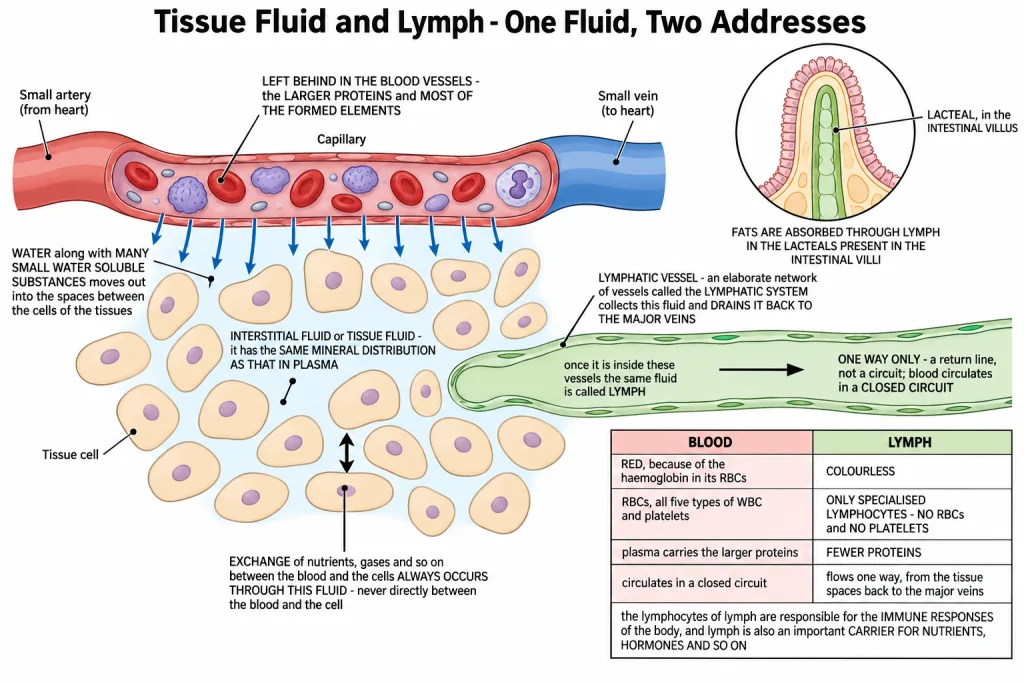
So tissue fluid and lymph are the same fluid at two addresses. In the tissue spaces it is tissue fluid or interstitial fluid; once it is inside the lymphatic vessels it is lymph. That is the whole distinction, and it is asked exactly that way.
What lymph is and what it does:
- Lymph is a colourless fluid - it has no haemoglobin containing RBCs, which is why it has no red colour.
- It contains specialised LYMPHOCYTES, which are responsible for the immune responses of the body.
- Lymph is also an important carrier for nutrients, hormones and so on.
- Fats are absorbed through lymph in the LACTEALS present in the intestinal villi.
That last line is the single most asked sentence of the section. Fat absorption - lymph - lacteals - intestinal villi. Learn the four words as one chain: the lacteals are the lymph vessels sitting inside the villi of the small intestine, and it is through them that fats enter the body.
And note the direction of flow. Blood circulates in a closed circuit, going out and coming back. Lymph moves one way only - from the tissue spaces, through the lymphatic vessels, back into the major veins. It is a return line, not a circuit.
[NEET Important] Lacteals, villi, fats is the guaranteed item, and the distractors are always other absorbing structures - alveoli, glomeruli, Bowman's capsule. The second item is lymphocytes for immune responses. Do not answer "leucocytes" - the chapter says specialised lymphocytes.
Lymph Set Against Blood
Both are fluid connective tissues, both carry things, and the chapter asks you to separate them. Here is the comparison in the form the answer is marked in.
| Feature | Blood | Lymph |
|---|---|---|
| Colour | red, because of the haemoglobin in its RBCs | colourless |
| Cells present | RBCs, all five types of WBC and platelets | only specialised lymphocytes; no RBCs and no platelets |
| Proteins | plasma carries the larger proteins - fibrinogen, globulins, albumins | fewer proteins, since the larger proteins are left behind in the blood vessels |
| What it carries | respiratory gases, nutrients, hormones and wastes | nutrients and hormones, and especially fats absorbed in the lacteals |
| Direction of flow | circulates in a closed circuit | flows one way, from the tissue spaces back to the major veins |
| Function | transport and defence | returns tissue fluid, absorbs fats, and carries out immune responses |
Three of those rows are really the same fact seen three times. The capillary wall lets water and small solutes out but holds back the large proteins and the formed elements. So lymph has no RBCs (hence colourless), fewer proteins, and only the lymphocytes, which get in by their own movement rather than by leaking out.
[NEET Important] Colour, cells and fat absorption are the three rows that carry the marks. The classic error is to say lymph has no cells at all - it has specialised lymphocytes; what it lacks is RBCs and platelets.
Quick Recap
- As blood passes through the capillaries in tissues, some water along with many small water soluble substances moves out into the spaces between the cells, leaving the larger proteins and most of the formed elements in the blood vessels.
- This fluid released out is called the interstitial fluid or TISSUE FLUID.
- It has the same mineral distribution as that in plasma.
- Exchange of nutrients, gases and so on between the blood and the cells ALWAYS occurs through this fluid.
- An elaborate network of vessels called the LYMPHATIC SYSTEM collects this fluid and drains it back to the major veins.
- The fluid present in the lymphatic system is called LYMPH.
- Lymph is a colourless fluid containing specialised LYMPHOCYTES, which are responsible for the immune responses of the body.
- Lymph is also an important carrier for nutrients, hormones and so on.
- Fats are absorbed through lymph in the LACTEALS present in the intestinal villi.
- Blood is red and carries RBCs, all five WBCs and platelets; lymph is colourless and carries only specialised lymphocytes.
- Blood circulates in a closed circuit; lymph flows one way, from the tissue spaces back to the major veins.
Solved Examples
Question 1
Q. How is tissue fluid formed?
Answer. As blood passes through the capillaries in the tissues, some water along with many small water soluble substances moves out into the spaces between the cells of the tissues, leaving the larger proteins and most of the formed elements in the blood vessels. This fluid released out is called the interstitial fluid or tissue fluid.
Question 2
Q. What does tissue fluid leave behind in the blood vessels?
Answer. The larger proteins and most of the formed elements. Only water and small water soluble substances move out.
Question 3
Q. How does the mineral content of tissue fluid compare with that of plasma?
Answer. It has the same mineral distribution as that in plasma. The difference between the two fluids is in the proteins, not in the minerals.
Question 4
Q. How do nutrients and gases pass between the blood and the body cells?
Answer. Always through the tissue fluid. Exchange of nutrients, gases and so on between the blood and the cells always occurs through this fluid - never directly between the blood and the cell.
Question 5
Q. What is the lymphatic system, and what does it do?
Answer. An elaborate network of vessels that collects the tissue fluid and drains it back to the major veins. The fluid present in the lymphatic system is called lymph.
Question 6
Q. What is lymph? Describe it.
Answer. Lymph is the fluid present in the lymphatic system. It is a colourless fluid containing specialised lymphocytes, which are responsible for the immune responses of the body. It is also an important carrier for nutrients, hormones and so on.
Question 7
Q. How are fats absorbed?
Answer. Fats are absorbed through lymph, in the lacteals present in the intestinal villi. The lacteals are the lymph vessels inside the villi of the small intestine, and fats enter the body through them rather than through the blood capillaries.
Question 8
Q. Which cells does lymph contain, and what do they do?
Answer. Specialised lymphocytes. They are responsible for the immune responses of the body.
Question 9
Q. Why is lymph colourless while blood is red?
Answer. Because lymph has no RBCs, and it is the haemoglobin inside the RBCs that makes blood red. When the fluid leaves the capillary, most of the formed elements stay behind in the blood vessels.
Question 10
Q. What is the difference between lymph and blood? This is one of the chapter-end exercises.
Answer.
| Feature | Blood | Lymph |
|---|---|---|
| Colour | Red, because of the haemoglobin present in its RBCs | Colourless |
| Cells present | RBCs, all five types of WBC - neutrophils, eosinophils, basophils, lymphocytes and monocytes - and platelets | Only specialised lymphocytes; no RBCs and no platelets |
| Proteins | Plasma carries the larger proteins - fibrinogen, globulins and albumins | Fewer proteins, because the larger proteins are left behind in the blood vessels when the fluid moves out |
| What it carries | Respiratory gases, nutrients, hormones and wastes | Nutrients and hormones, and especially fats absorbed in the lacteals of the intestinal villi |
| Direction of flow | Circulates in a closed circuit, out from the heart and back to it | Flows one way only, from the tissue spaces back to the major veins |
| Function | Transport of gases, nutrients, hormones and wastes, and defence of the body | Returns the tissue fluid to the blood, absorbs fats, and carries out the immune responses of the body |
Question 11
Q. Tissue fluid and lymph are described as the same fluid. What then is the difference between the two names?
Answer. The place it is in. In the spaces between the cells of the tissues it is called interstitial fluid or tissue fluid. Once the lymphatic system has collected it, the same fluid is called lymph.
Question 12
Q. A patient's lymphatic drainage from one leg is blocked. What would you expect, and why?
Answer. Fluid would collect in the tissue spaces of that leg and it would swell. Water and small solutes keep moving out of the capillaries into the tissue spaces all the time, and it is the lymphatic system that collects this fluid and drains it back to the major veins. If that return line is blocked, the tissue fluid has nowhere to go and builds up.
Question 13
Q. Why must fats be absorbed by lymph rather than straight into the blood capillaries of the villi?
Answer. The chapter's statement of fact is that fats are absorbed through lymph in the lacteals present in the intestinal villi. The lacteals are lymph vessels, and the fat taken up by them travels in the lymph until the lymphatic system drains it back into the major veins - so the fat still reaches the blood in the end, but by the lymphatic route.