
ABO Grouping - Two Antigens and Two Antibodies
The blood of human beings differs in certain aspects though it appears to be similar. Various types of grouping of blood have been done, and two such groupings - the ABO and the Rh - are widely used all over the world.
ABO grouping is based on the presence or absence of two surface ANTIGENS on the RBCs, namely A and B.
- An ANTIGEN is a chemical that can induce an immune response. In ABO grouping the antigens sit on the surface of the RBCs.
- The plasma of different individuals contains two natural ANTIBODIES. An ANTIBODY is a protein produced in response to an antigen. These are in the plasma, not on the cell.
Fix the address before anything else: the antigen is ON the red cell, the antibody is IN the plasma. Almost every wrong answer in this section comes from swapping those two.
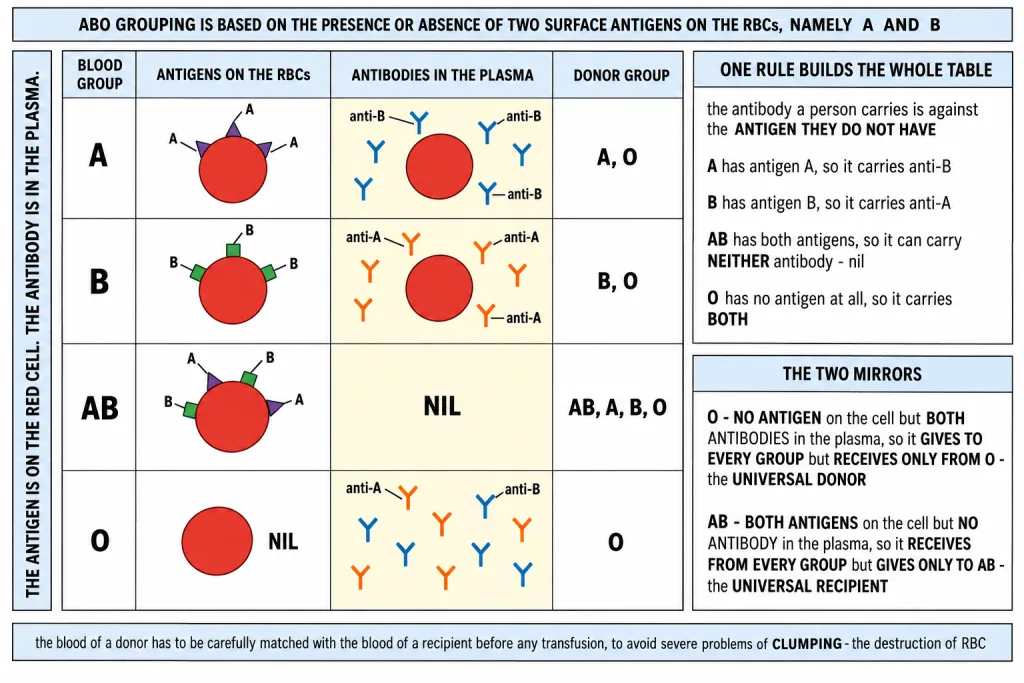
Table 15.1 - Blood Groups and Donor Compatibility
| Blood group | Antigens on RBCs | Antibodies in plasma | Donor's group |
|---|---|---|---|
| A | A | anti-B | A, O |
| B | B | anti-A | B, O |
| AB | A, B | nil | AB, A, B, O |
| O | nil | anti-A, anti-B | O |
During blood transfusion, any blood cannot be used. The blood of a donor has to be carefully matched with the blood of a recipient before any transfusion, to avoid severe problems of CLUMPING (destruction of RBC).
[NEET Important] Table 15.1 is asked one cell at a time. The item gives you a group and asks for its antigen, its antibody or its donors, and the wrong options are the other rows of the same table. The one row students lose marks on is AB - antigens A and B, antibody nil. Reading "nil" in the antigen column instead of the antibody column turns AB into O.
Reading the Table - Universal Donors and Universal Recipients
One rule generates the whole of Table 15.1: the antibody a person carries is against the antigen they do NOT have. If your own cells carried the matching antigen, your own antibody would destroy them - so the body only makes the antibody it can safely carry.
- Group A has antigen A, so it cannot carry anti-A; it carries anti-B.
- Group B has antigen B, so it carries anti-A.
- Group AB has both antigens A and B, so it can carry neither antibody - nil.
- Group O has no antigen at all, so it carries both - anti-A and anti-B.
That is why O has both antibodies and AB has none, and it is the fastest way to rebuild the table in an exam hall if you forget a row.
The donor column now follows from the recipient's antibodies. A transfusion is safe when the recipient's plasma carries no antibody against the donor cell's antigen.
- Group O blood can be donated to persons with any other blood group, so O group individuals are called UNIVERSAL DONORS. O cells carry no A or B antigen, so no recipient's antibody has anything to attack.
- Persons with AB group can accept blood from AB as well as all the other groups, so they are called UNIVERSAL RECIPIENTS. AB plasma carries no antibody, so no donor cell gets attacked.
And the two roles are exact mirrors of each other, which is the pairing NEET tests:
| Group | Can donate to | Can receive from | Why |
|---|---|---|---|
| O | every group - the universal donor | O only | no antigen on the cell, but both antibodies in the plasma |
| AB | AB only | every group - the universal recipient | both antigens on the cell, but no antibody in the plasma |
So O gives to everyone but receives only from O, while AB receives from everyone but gives only to AB. A is safe with A and O; B is safe with B and O.
[NEET Important] The trap is to say the universal donor can also receive from anybody. It cannot - O plasma carries anti-A and anti-B and would clump A, B or AB cells at once. Learn the pair as one sentence: O gives to all, AB takes from all.
Rh Grouping
Another antigen, the Rh antigen, similar to one present in Rhesus monkeys - hence the name Rh - is also observed on the surface of the RBCs of nearly 80 PER CENT of humans.
- Individuals who have this antigen are called Rh positive.
- Individuals in whom this antigen is absent are called Rh negative.
An Rh negative person, if exposed to Rh positive blood, will form specific antibodies against the Rh antigens. Therefore the Rh group should also be matched before transfusions, exactly as the ABO group is.
Note how the Rh antibody differs from the ABO antibodies. The anti-A and anti-B antibodies of ABO grouping are natural - they are already present in the plasma. The anti-Rh antibody is not; it is formed only after an Rh negative person is exposed to Rh positive blood. That single difference is what makes the first exposure harmless and the second dangerous.
[NEET Important] Nearly 80 per cent is the figure, and the wrong options are always the other percentages of this chapter - 45, 55, 60-65. Also remember Rh positive means the antigen is PRESENT; students routinely read "negative" as "no antibody" instead of "no antigen".
Erythroblastosis Foetalis - the Sequence
A special case of Rh incompatibility is observed between the Rh negative blood of a pregnant mother and the Rh positive blood of the foetus. This is asked as a sequence, so learn it as one, in order.
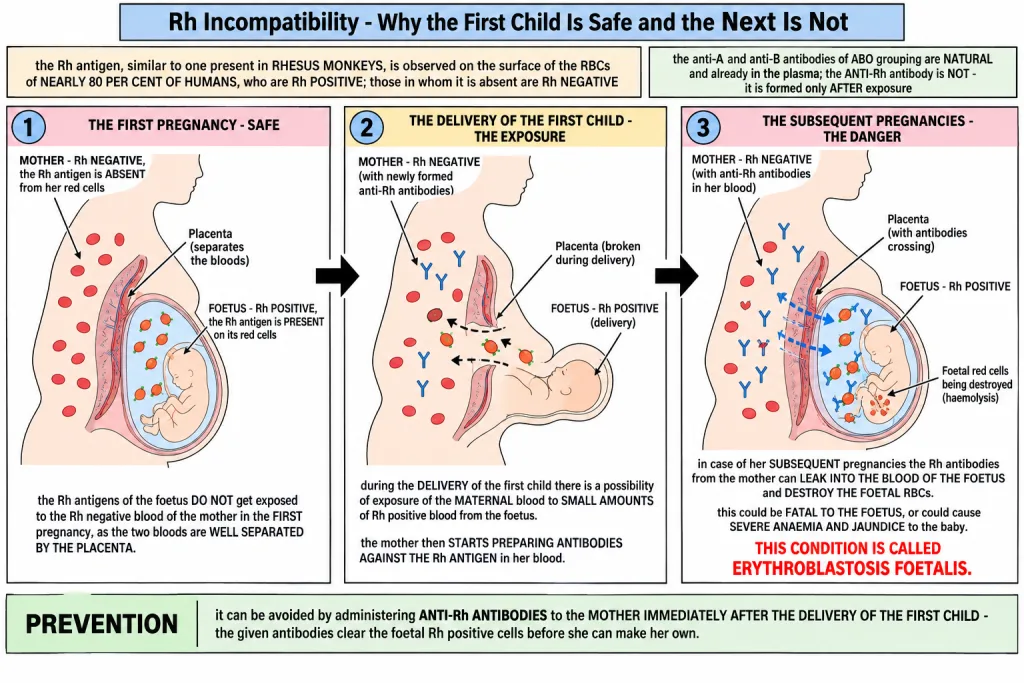
- The Rh antigens of the foetus do not get exposed to the Rh negative blood of the mother in the FIRST pregnancy, as the two bloods are well separated by the placenta.
- However, during the delivery of the first child, there is a possibility of exposure of the maternal blood to small amounts of Rh positive blood from the foetus.
- The mother then starts preparing antibodies against the Rh antigen in her blood.
- In case of her subsequent pregnancies, the Rh antibodies from the mother can leak into the blood of the foetus and destroy the foetal RBCs.
- This could be fatal to the foetus, or could cause severe anaemia and jaundice to the baby.
- This condition is called ERYTHROBLASTOSIS FOETALIS.
It can be avoided by administering anti-Rh antibodies to the mother immediately after the delivery of the first child. Those given antibodies mop up the foetal Rh positive cells before the mother's own immune system can respond, so she never makes her own anti-Rh antibodies and the next pregnancy is safe.
Two things decide the whole story, and both are worth saying out loud:
| The condition | What it must be |
|---|---|
| Mother | Rh negative |
| Foetus | Rh positive |
| Which pregnancy is safe | the first - the placenta keeps the two bloods separate |
| When exposure happens | during the delivery of the first child |
| Which pregnancy is at risk | the subsequent ones |
| Prevention | anti-Rh antibodies given to the mother immediately after the first delivery |
[NEET Important] The order is the answer. The two errors that cost marks are putting the danger in the first pregnancy and reversing the parents - it is an Rh NEGATIVE mother carrying an Rh POSITIVE foetus, never the other way round. The prevention line is also asked on its own: anti-Rh antibodies to the MOTHER, immediately AFTER the delivery of the FIRST child.
Quick Recap
- Two groupings, the ABO and the Rh, are widely used all over the world.
- ABO grouping is based on the presence or absence of two surface antigens on the RBCs, namely A and B.
- An antigen is a chemical that can induce an immune response; an antibody is a protein produced in response to an antigen.
- Antigens are on the RBCs; antibodies are in the plasma.
- Group A: antigen A, antibody anti-B, donors A, O.
- Group B: antigen B, antibody anti-A, donors B, O.
- Group AB: antigens A, B, antibodies nil, donors AB, A, B, O.
- Group O: antigens nil, antibodies anti-A, anti-B, donor O only.
- The antibody a person carries is against the antigen they do not have - so O has both and AB has none.
- O group individuals are UNIVERSAL DONORS; AB group individuals are UNIVERSAL RECIPIENTS.
- O gives to everyone but receives only from O; AB receives from everyone but gives only to AB.
- Blood of a donor must be carefully matched with the blood of the recipient to avoid clumping, that is destruction of RBC.
- The Rh antigen, similar to one in Rhesus monkeys, is present on the RBCs of nearly 80 per cent of humans - they are Rh positive; the rest are Rh negative.
- An Rh negative person exposed to Rh positive blood forms specific antibodies against the Rh antigens, so the Rh group must also be matched before transfusion.
- Erythroblastosis foetalis: Rh negative mother, Rh positive foetus; first pregnancy safe because the placenta separates the two bloods; exposure at the delivery of the first child; mother makes anti-Rh antibodies; in subsequent pregnancies these leak into the foetus and destroy foetal RBCs; fatal to the foetus, or severe anaemia and jaundice to the baby.
- Prevention: anti-Rh antibodies given to the mother immediately after the delivery of the first child.
Solved Examples
Question 1
Q. Which two groupings of blood are widely used all over the world?
Answer. The ABO grouping and the Rh grouping.
Question 2
Q. What is ABO grouping based on?
Answer. On the presence or absence of two surface antigens on the RBCs, namely A and B.
Question 3
Q. Define an antigen and an antibody as the chapter does.
Answer.
- An antigen is a chemical that can induce an immune response. In ABO grouping the antigens are on the surface of the RBCs.
- An antibody is a protein produced in response to an antigen. The two natural antibodies of ABO grouping are in the plasma.
Question 4
Q. Reproduce the table of blood groups, their antigens, their antibodies and their donor groups.
Answer.
| Blood group | Antigens on RBCs | Antibodies in plasma | Donor's group |
|---|---|---|---|
| A | A | anti-B | A, O |
| B | B | anti-A | B, O |
| AB | A, B | nil | AB, A, B, O |
| O | nil | anti-A, anti-B | O |
Question 5
Q. Why does a person of group O carry both anti-A and anti-B antibodies, while a person of group AB carries none?
Answer. Because the antibody a person carries is always against the antigen they do NOT have.
- Group O has neither the A antigen nor the B antigen, so it can safely carry both anti-A and anti-B.
- Group AB has both the A and the B antigen, so it can carry neither antibody - either one would destroy its own red cells.
Question 6
Q. Why is group O called the universal donor?
Answer. Because group O blood can be donated to persons with any other blood group. O red cells carry no A or B antigen, so no recipient's antibody has anything to attack.
But note the limit: an O person can receive blood only from O, because O plasma carries both anti-A and anti-B and would clump A, B or AB cells.
Question 7
Q. Why is group AB called the universal recipient?
Answer. Because persons with AB group can accept blood from AB as well as from all the other groups. AB plasma contains no antibody at all, so no donor's red cells get attacked.
Again, note the limit: an AB person can donate only to AB, because AB cells carry both the A and the B antigens.
Question 8
Q. Why must the blood of a donor be carefully matched with that of a recipient before a transfusion?
Answer. Because any blood cannot be used. A mismatch causes severe problems of clumping, that is the destruction of RBC, when the recipient's antibodies meet the matching antigen on the donor's red cells.
Question 9
Q. From which groups can a person of blood group B safely receive blood, and why?
Answer. From B and from O. B plasma carries anti-A, so it will clump any cell carrying the A antigen - which rules out A and AB. B cells carry only the B antigen and O cells carry none, so both are safe.
Question 10
Q. What is the Rh antigen, and what share of humans carry it?
Answer. An antigen on the surface of the RBCs, similar to one present in Rhesus monkeys - hence the name Rh. It is observed in nearly 80 per cent of humans, who are called Rh positive; those in whom it is absent are Rh negative.
Question 11
Q. Why should the Rh group also be matched before a transfusion?
Answer. Because an Rh negative person, if exposed to Rh positive blood, will form specific antibodies against the Rh antigens. Those antibodies would attack Rh positive cells in any later transfusion.
Question 12
Q. Explain erythroblastosis foetalis in full.
Answer. It is a special case of Rh incompatibility between the Rh negative blood of a pregnant mother and the Rh positive blood of the foetus. The story runs in order.
- In the first pregnancy the Rh antigens of the foetus do not get exposed to the mother's blood, as the two bloods are well separated by the placenta.
- During the delivery of the first child there is a possibility of exposure of the maternal blood to small amounts of Rh positive blood from the foetus.
- The mother then starts preparing antibodies against the Rh antigen in her blood.
- In her subsequent pregnancies the Rh antibodies from the mother can leak into the blood of the foetus and destroy the foetal RBCs.
- This could be fatal to the foetus, or could cause severe anaemia and jaundice to the baby.
This condition is called erythroblastosis foetalis.
Question 13
Q. How can erythroblastosis foetalis be avoided?
Answer. By administering anti-Rh antibodies to the mother immediately after the delivery of the first child. The given antibodies remove the foetal Rh positive cells before the mother's own immune system can react, so she never makes her own anti-Rh antibodies and the next pregnancy is not at risk.
Question 14
Q. An Rh negative woman is expecting her second child, who is Rh positive. Her first child was also Rh positive. What is the risk, and could it have been prevented?
Answer. The risk is erythroblastosis foetalis. At the first delivery her blood was probably exposed to Rh positive foetal blood and she began making anti-Rh antibodies. In this second pregnancy those antibodies can leak into the foetus and destroy its RBCs, which could be fatal to the foetus or cause severe anaemia and jaundice to the baby.
Yes - it could have been prevented by giving her anti-Rh antibodies immediately after the delivery of her first child.