
Same Syllabus. A Different Exam.
The Solved Examples section worked this chapter the way a written paper does - describe the stage, list its events, compare the two divisions. NEET does not ask you to describe anything. It gives you one event and four stage names, and you have about half a minute to pick.
The marking is +4 for a correct answer and -1 for a wrong one. In a written answer, getting three of the four events of telophase still earns most of the marks. Here, a half-remembered stage is worth -1, which is five marks behind the person who skipped it.
This chapter is worth more preparation time than its length suggests. It is short, entirely factual, and asked every single year, and almost every question reduces to one of two things: which stage is this, or what are N and C here.
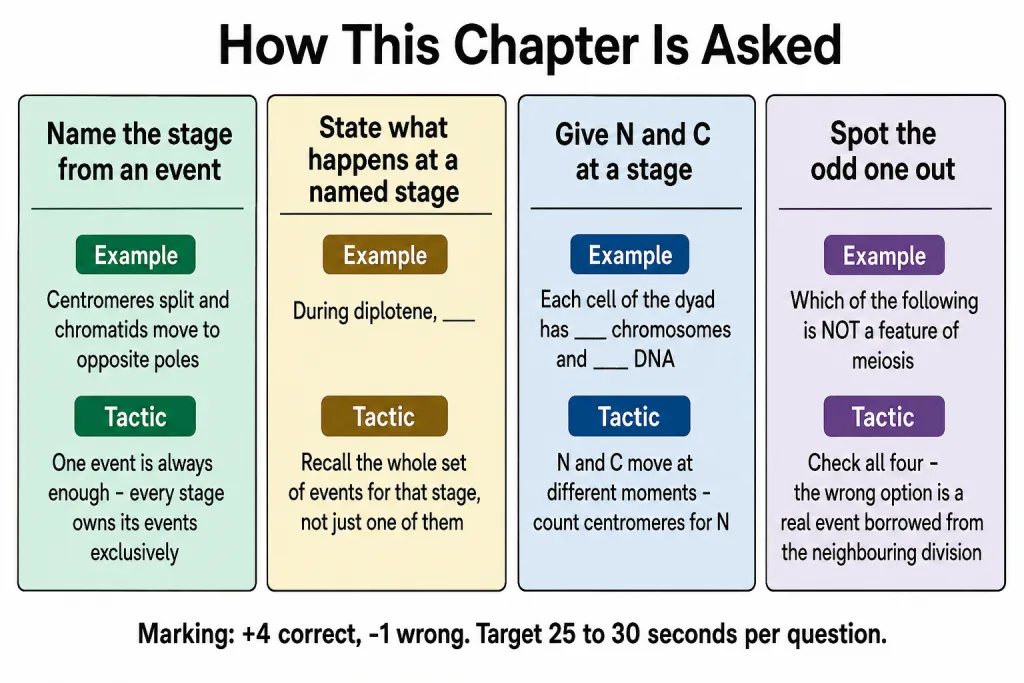
The Four Shapes This Chapter Is Asked In
Shape 1 - Name the stage from an event. "Centromeres split and chromatids move to opposite poles." You are given one event, and one event is always enough - every stage in this chapter owns its events exclusively. Answer and move on.
Shape 2 - State what happens at a named stage. The reverse direction. "During diplotene, _." These are harder only because you must recall several events instead of recognising one.
Shape 3 - Give N and C at a stage. "A cell at has _." Two numbers, and they move at different moments, which is the whole difficulty. The table below settles every one of these.
Shape 4 - The odd one out, or the incorrect statement. "Which of the following is NOT a feature of meiosis?" You must check all four, so budget the extra time. The wrong option is almost always a real event borrowed from the neighbouring division - a mitotic event listed under meiosis, or a meiosis I event listed under meiosis II.
One Event, One Stage
This is the table that answers Shape 1 and Shape 2 questions. Read it down to learn a stage and across to identify one.
| The event | The stage that owns it |
|---|---|
| DNA replicates; centriole duplicates in animal cells | S phase |
| Proteins synthesised in preparation for mitosis | phase |
| Cell exits the cycle but stays metabolically active | , entered from |
| Condensation of chromosomal material begins | Prophase |
| Centrosome starts moving to opposite poles; asters appear | Prophase |
| Golgi, ER, nucleolus and nuclear envelope disappear | End of prophase |
| Nuclear envelope completely disintegrates | Start of metaphase |
| Chromosome morphology is most easily studied | Metaphase |
| Spindle fibres attach to kinetochores | Metaphase |
| Chromosomes align on the metaphase plate at the equator | Metaphase |
| Centromeres split; chromatids separate | Anaphase |
| Centromere leads, arms trail behind | Anaphase |
| Chromosomes decondense and lose their identity | Telophase |
| Nuclear envelope reforms; nucleolus, golgi and ER reform | Telophase |
| Furrow appears in the plasma membrane | Cytokinesis, animal cell |
| Cell-plate forms in the centre and grows outward | Cytokinesis, plant cell |
| Chromosomes first become visible | Leptotene |
| Synapsis; synaptonemal complex forms; bivalent appears | Zygotene |
| Recombination nodules; crossing over; recombinase acts | Pachytene |
| Synaptonemal complex dissolves; chiasmata appear | Diplotene |
| Terminalisation of chiasmata; nuclear envelope breaks down | Diakinesis |
| Bivalents align on the equatorial plate | Metaphase I |
| Homologous chromosomes separate, sister chromatids stay together | Anaphase I |
| Dyad of cells formed; nuclear membrane and nucleolus reappear | Telophase I |
| No DNA replication; short-lived gap between the two divisions | Interkinesis |
| Sister chromatids finally separate | Anaphase II |
| Tetrad of four haploid cells formed | Telophase II |
The rule that saves the most marks here: when a question says chromatids separate, ask which division. In mitosis and in meiosis II, sister chromatids separate. In anaphase I they do not - homologous chromosomes separate while sister chromatids remain associated at their centromeres. That one sentence is the most-asked fact in the chapter.
The Numbers, and the Negatives
The N and C table
Start from a cell that is , at .
| Stage | N | C | Why |
|---|---|---|---|
| Starting point | |||
| After S | DNA doubles; chromosome count does not | ||
| , prophase, metaphase | Nothing has separated yet | ||
| Mitotic anaphase | Centromeres split, so each chromatid counts as a chromosome | ||
| After mitotic cytokinesis | Back to the parent - equational | ||
| Prophase I to metaphase I | Still one cell, nothing separated | ||
| After telophase I - the dyad | Homologues separated - reductional | ||
| Interkinesis, prophase II, metaphase II | No DNA replication here | ||
| Anaphase II | Centromeres split within each cell | ||
| After telophase II - the tetrad | Four haploid cells |
Every other number
- Human cell in culture - about 24 hours. Yeast - about 90 minutes.
- Cell division proper - about one hour. Interphase - more than 95 per cent of the cycle.
- Karyokinesis - four stages. Prophase I - five sub-stages.
- Meiosis - two divisions, one DNA replication, four haploid cells.
- Telophase I gives a dyad (two cells); telophase II gives a tetrad (four cells).
The lists the "which is NOT" questions come from
- Missing at the end of prophase: golgi complex, endoplasmic reticulum, nucleolus, nuclear envelope.
- Reforming at telophase: nucleolus, golgi complex, ER, plus the nuclear envelope.
- The five sub-stages of prophase I: leptotene, zygotene, pachytene, diplotene, diakinesis.
- Significance of mitosis: growth of multicellular organisms, restoring the nucleo-cytoplasmic ratio, cell repair and replacement, continuous growth of plants through the meristems.
- Significance of meiosis: conserving the chromosome number of the species across generations, and increasing genetic variability, which matters for evolution.
The pairs that get swapped
- Anaphase - centromeres split. Anaphase I - they do not.
- Meiosis I is reductional; meiosis II is equational and resembles a normal mitosis.
- Synapsis at zygotene; crossing over at pachytene; chiasmata at diplotene; terminalisation at diakinesis.
- Dyad after telophase I; tetrad after telophase II - and tetrad is also the word for a bivalent at pachytene, which is a deliberate ambiguity in the source.
- Plant cytokinesis builds outward from the centre; animal cytokinesis furrows inward from the edge.
- The centriole duplicates in S phase, not in prophase.
- Cells enter from , and are metabolically active but not proliferating.
Solved Examples at NEET Pace
Each item names the shortcut it uses, because the shortcut is the thing worth carrying into the exam hall.
Question 1
Q. Homologous chromosomes separate while sister chromatids remain associated at their centromeres. This describes (a) anaphase of mitosis (b) anaphase I of meiosis (c) anaphase II of meiosis (d) metaphase I
Answer. (b) anaphase I of meiosis. Shortcut - "chromatids stay together" occurs at exactly one stage in the whole chapter. In anaphase of mitosis and in anaphase II, the centromere splits and sister chromatids separate. Anaphase I is the one stage where the centromere does not split - the homologous chromosomes are what move apart. This is why meiosis I is the reductional division.
Question 2
Q. A cell has chromosomes and DNA. It could be at (a) (b) (c) after telophase I (d) after telophase II
Answer. (b) . Shortcut - read C first, then N. means S phase has happened, which rules out (, ). means nothing has separated yet, which rules out the dyad after telophase I (, ) and the tetrad after telophase II (, ). Only - and prophase and metaphase, which are not offered - fit both.
Question 3
Q. Crossing over between non-sister chromatids of homologous chromosomes occurs during (a) leptotene (b) zygotene (c) pachytene (d) diplotene
Answer. (c) pachytene. Shortcut - walk the five sub-stages in order and attach one event to each. Leptotene - chromosomes become visible. Zygotene - synapsis, synaptonemal complex, bivalent. Pachytene - recombination nodules and crossing over, by the enzyme recombinase. Diplotene - synaptonemal complex dissolves, chiasmata appear. Diakinesis - terminalisation of chiasmata. Say the five in order every time and any question of this shape maps onto one of them.
Question 4
Q. Which of the following is NOT seen in a cell at the end of prophase of mitosis? (a) asters (b) spindle fibres (c) compact mitotic chromosomes (d) nucleolus
Answer. (d) nucleolus. Shortcut - recall the four that vanish, then look for the intruder. Cells at the end of prophase do not show golgi complexes, endoplasmic reticulum, nucleolus and the nuclear envelope. The other three options are all things prophase builds - the centrosomes have moved to the poles, each radiating asters, and the two asters together with spindle fibres form the mitotic apparatus.
Question 5
Q. The stage at which the morphology of chromosomes is most easily studied is (a) prophase (b) metaphase (c) anaphase (d) telophase
Answer. (b) metaphase. Shortcut - the answer is not the stage where chromosomes first appear, but the one where condensation is finished. By metaphase, condensation of chromosomes is completed and they can be observed clearly under the microscope. Prophase is where condensation only begins, which is why it is the tempting wrong answer.
Question 6
Q. The centriole duplicates during (a) prophase (b) phase (c) S phase (d) phase
Answer. (c) S phase. Shortcut - S phase copies everything that needs copying, not just DNA. In animal cells, during the S phase, DNA replication begins in the nucleus and the centriole duplicates in the cytoplasm. In prophase the centrosome only begins to move towards opposite poles - moving is not duplicating, and that distinction is the trap.
Question 7
Q. Cytokinesis in a plant cell differs from that in an animal cell in that (a) it begins at the periphery and moves inward (b) it forms a cell-plate that grows from the centre outward (c) it does not divide the cytoplasm (d) it occurs before karyokinesis
Answer. (b) it forms a cell-plate that grows from the centre outward. Shortcut - the wall is inextensible, so the plant cell cannot pinch; it must build. Plant cells are enclosed by a relatively inextensible cell wall, so wall formation starts in the centre of the cell and grows outward to meet the existing lateral walls, beginning with the cell-plate, which represents the middle lamella. An animal cell does the opposite - a furrow appears in the plasma membrane, deepens, and joins in the centre.
Question 8
Q. A multinucleate condition arising because karyokinesis is not followed by cytokinesis is called (a) a dyad (b) a tetrad (c) a syncytium (d) a bivalent
Answer. (c) a syncytium. Shortcut - nuclei divided but the cell did not. In some organisms karyokinesis is not followed by cytokinesis, as a result of which a multinucleate condition arises leading to the formation of a syncytium - the standard example is the liquid endosperm in coconut. The other three options are all real terms from this chapter, which is what makes them good distractors.
Question 9
Q. During interkinesis (a) DNA replicates again (b) crossing over occurs (c) there is no replication of DNA (d) the chromosome number doubles
Answer. (c) there is no replication of DNA. Shortcut - meiosis has two divisions but only one DNA replication; this is where the second one would have gone. The stage between the two meiotic divisions is called interkinesis and is generally short lived. There is no replication of DNA during interkinesis. This is exactly why the tetrad cells end at , rather than , .
Question 10
Q. Cells that stop dividing enter the quiescent stage by exiting (a) (b) S phase (c) (d) M phase
Answer. (a) . Shortcut - a cell can only step off the track before it has committed to copying its DNA. Cells that do not divide further exit the phase to enter an inactive stage called the quiescent stage, . Remember also that these cells remain metabolically active but no longer proliferate - "inactive" refers to division only.
Question 11
Q. Meiosis II is described as resembling a normal mitosis because in it (a) homologous chromosomes pair (b) crossing over occurs (c) sister chromatids separate and the chromosome number is not reduced (d) the chromosome number is halved
Answer. (c) sister chromatids separate and the chromosome number is not reduced. Shortcut - reduction has already happened; meiosis II is only cleaning up. Meiosis I is the reductional division - it takes the cell from , to , . Meiosis II then behaves like mitosis: the centromere splits, sister chromatids move apart, and each daughter cell keeps the same chromosome number as the cell that entered, ending at , .
Question 12
Q. The complex formed by a pair of synapsed homologous chromosomes is called a (a) chiasma (b) bivalent (c) recombination nodule (d) synaptonemal complex
Answer. (b) bivalent. Shortcut - four names appear in two sentences of zygotene and pachytene; separate them by what each one IS. Synapsis is the process of pairing. The synaptonemal complex is the structure that forms during synapsis. The bivalent, also called a tetrad, is the pair of synapsed homologous chromosomes itself. The recombination nodule is the site at which crossing over occurs, at pachytene, and the chiasma is the X-shaped structure left behind, seen from diplotene.
A Drill Before You Move On
Decide each one before you read the verdict. Aim for 25 to 30 seconds per question.
Mark yourself honestly. A wrong answer here is worth -1 in the hall, so treat "I think it is B" as a skip, not an answer, and go back to the event table for that row.