
What the Cell Cycle Is
Cell division is a very important process in all living organisms. But a cell does not simply split. During the division of a cell, DNA replication and cell growth also take place, and all these processes have to take place in a coordinated way to ensure correct division and formation of progeny cells containing intact genomes.
The cell cycle is the sequence of events by which a cell duplicates its genome, synthesises the other constituents of the cell and eventually divides into two daughter cells.
Two details in that definition carry marks on their own:
- Cell growth, in terms of cytoplasmic increase, is a continuous process, but DNA synthesis occurs only during one specific stage in the cell cycle.
- The replicated chromosomes are then distributed to daughter nuclei by a complex series of events during cell division, and these events are themselves under genetic control.
How long it takes. A typical eukaryotic cell cycle is illustrated by human cells in culture, which divide once in approximately every 24 hours. But this duration can vary from organism to organism and also from cell type to cell type - yeast, for example, can progress through the cell cycle in only about 90 minutes.
[NEET Important] Two numbers here are asked as bare facts: about 24 hours for a human cell in culture, and about 90 minutes for yeast. And learn the definition as a three-part sentence - duplicates its genome, synthesises the other constituents, divides into two daughter cells - because questions are built by dropping one of the three.
The Two Basic Phases
The cell cycle is divided into two basic phases: interphase and M phase (mitosis phase).
- The M phase represents the phase when the actual cell division or mitosis occurs.
- The interphase represents the phase between two successive M phases.
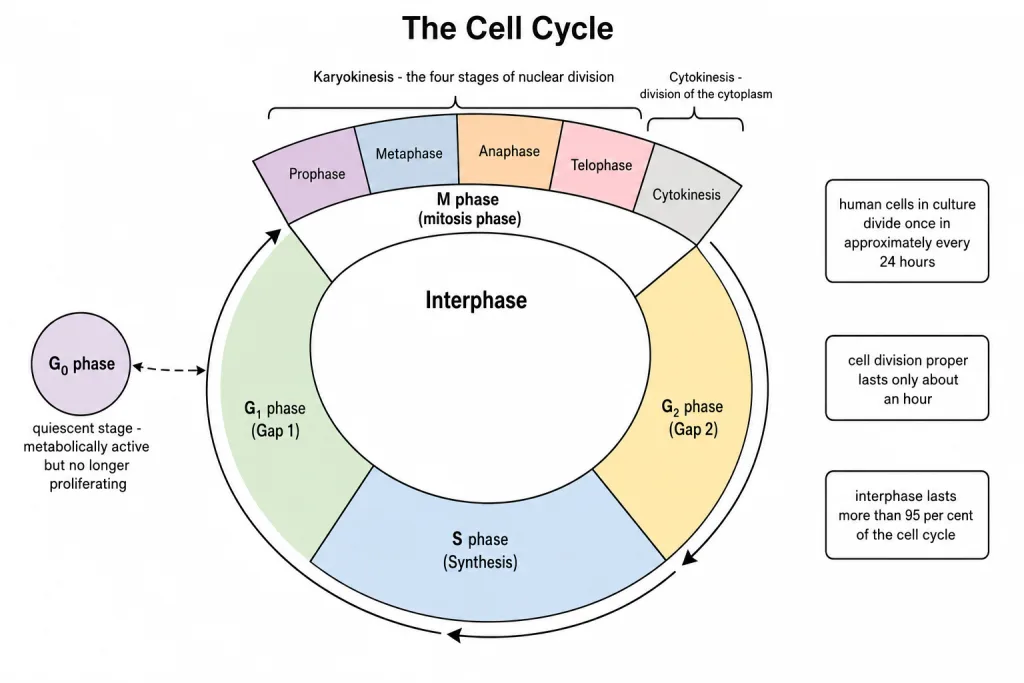
The split of time is lopsided, and this is the most-asked fact in the section. In the 24 hour average duration of the cell cycle of a human cell, cell division proper lasts for only about an hour. The interphase lasts more than 95 per cent of the duration of cell cycle.
What happens in M phase. The M phase starts with the nuclear division, corresponding to the separation of daughter chromosomes - karyokinesis - and usually ends with division of the cytoplasm - cytokinesis.
What happens in interphase. The interphase, though called the resting phase, is the time during which the cell is preparing for division by undergoing both cell growth and DNA replication in an orderly manner.
[NEET Important] The phrase "though called the resting phase" is doing real work. Interphase is not a rest - it is the busiest part of the cycle, and any option that calls it inactive is wrong. Pair that with more than 95 per cent of the cycle and only about an hour of division and you have answered three questions with one fact.
Inside Interphase - , S and
The interphase is divided into three further phases: phase (Gap 1), S phase (Synthesis) and phase (Gap 2).
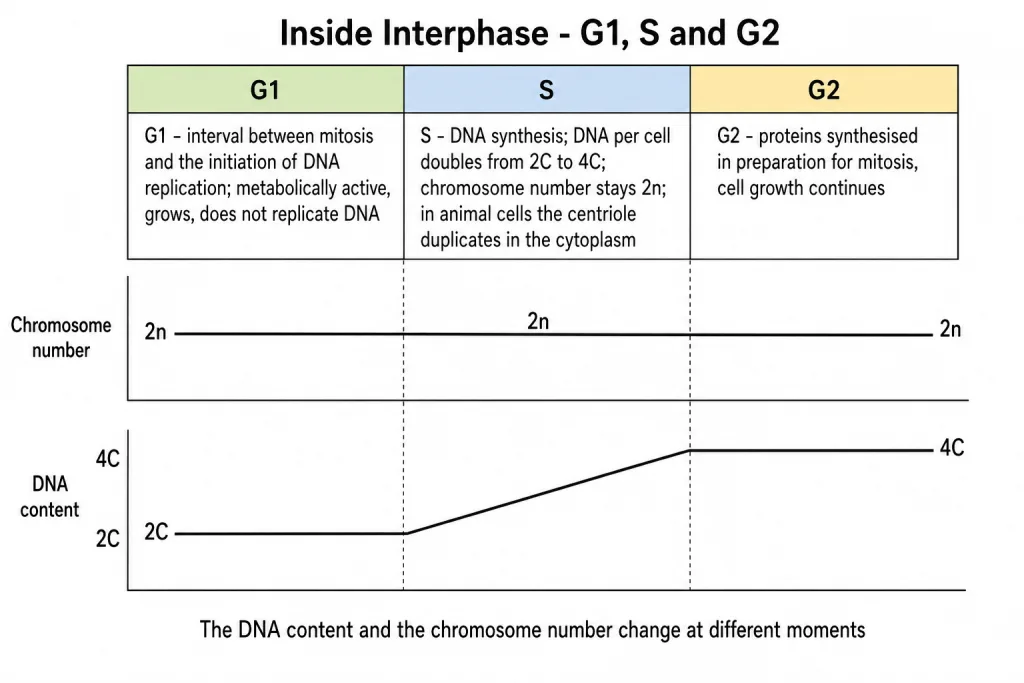
phase corresponds to the interval between mitosis and initiation of DNA replication. During it the cell is metabolically active and continuously grows but does not replicate its DNA.
S phase, or synthesis phase, marks the period during which DNA synthesis or replication takes place. Two things happen here, and only one of them is what students expect:
- The amount of DNA per cell doubles. If the initial amount of DNA is denoted as then it increases to .
- There is no increase in the chromosome number. If the cell had a diploid or number of chromosomes at , even after S phase the number of chromosomes remains the same, that is .
In animal cells, during the S phase, DNA replication begins in the nucleus, and the centriole duplicates in the cytoplasm.
phase - proteins are synthesised in preparation for mitosis while cell growth continues.
| Phase | What happens | Chromosome number | DNA content |
|---|---|---|---|
| Metabolically active, grows, no DNA replication | |||
| S | DNA synthesis; centriole duplicates in animal cells | to | |
| Proteins synthesised for mitosis; growth continues |
[NEET Important] This is the single most valuable idea in the chapter: S phase doubles the DNA but not the chromosome number. The cell goes from , to , - each chromosome now has two chromatids instead of one, which is a change in structure, not in count. Every "what is N and C at this stage" question rests on it.
The Phase
Not every cell keeps cycling.
Some cells in adult animals do not appear to exhibit division - heart cells, for example. Many other cells divide only occasionally, as needed to replace cells that have been lost because of injury or cell death.
These cells that do not divide further exit the phase to enter an inactive stage called the quiescent stage, or , of the cell cycle.
Cells in this stage remain metabolically active but no longer proliferate unless called on to do so depending on the requirement of the organism.
Who divides by mitosis. In animals, mitotic cell division is only seen in the diploid somatic cells. There are a few exceptions where haploid cells divide by mitosis - for example, male honey bees. Against this, plants can show mitotic divisions in both haploid and diploid cells.
[NEET Important] Read the definition carefully. The cell is inactive with respect to division but still metabolically active - those are two different things, and the wrong option always merges them into "metabolically inactive". Note also the exit point: cells leave from , not from and not from M phase.
Quick Recap
- The cell cycle is the sequence of events by which a cell duplicates its genome, synthesises the other constituents of the cell and eventually divides into two daughter cells.
- Cell growth is continuous, but DNA synthesis occurs only during one specific stage.
- The distribution of replicated chromosomes to daughter nuclei is under genetic control.
- Human cells in culture divide once in approximately every 24 hours; yeast in about 90 minutes.
- Two basic phases - interphase and M phase.
- M phase - the actual cell division. Interphase - the phase between two successive M phases.
- Cell division proper lasts about an hour; interphase is more than 95 per cent of the cycle.
- M phase starts with karyokinesis, the separation of daughter chromosomes, and usually ends with cytokinesis, the division of the cytoplasm.
- Interphase, though called the resting phase, is when the cell prepares for division by cell growth and DNA replication.
- - between mitosis and the initiation of DNA replication; metabolically active, grows, does not replicate DNA.
- S - DNA synthesis; DNA per cell doubles from to , but chromosome number stays . In animal cells the centriole duplicates in the cytoplasm during S.
- - proteins synthesised in preparation for mitosis; cell growth continues.
- , the quiescent stage - cells exit , remain metabolically active but no longer proliferate; example heart cells.
- In animals mitosis is seen only in diploid somatic cells, except in cases such as male honey bees; plants show mitosis in both haploid and diploid cells.
Solved Examples
Question 1
Q. Define the cell cycle.
Answer. It is the sequence of events by which a cell duplicates its genome, synthesises the other constituents of the cell and eventually divides into two daughter cells.
Question 2
Q. What is the average cell cycle span for a mammalian cell? This is one of the chapter-end exercises.
Answer. Approximately 24 hours. A typical eukaryotic cell cycle is illustrated by human cells in culture, which divide once in approximately every 24 hours.
Two points are worth adding, because they are what the question is really testing. First, this duration can vary from organism to organism and also from cell type to cell type - yeast, for example, can progress through the cell cycle in only about 90 minutes. Second, the 24 hours is not evenly split: cell division proper lasts for only about an hour, and interphase lasts more than 95 per cent of the duration of the cell cycle.
Question 3
Q. How long does a yeast cell take to go through its cell cycle?
Answer. About 90 minutes.
Question 4
Q. Name the two basic phases of the cell cycle and say what each is.
Answer. Interphase and M phase. The M phase is the phase when the actual cell division or mitosis occurs, and the interphase is the phase between two successive M phases.
Question 5
Q. Distinguish cytokinesis from karyokinesis. This is one of the chapter-end exercises.
Answer. They are the two halves of M phase, and they happen in that order.
Karyokinesis is the division of the nucleus - the separation of daughter chromosomes. The M phase starts with it. It is itself divided into the four stages prophase, metaphase, anaphase and telophase, and it ends with two daughter nuclei inside one cell.
Cytokinesis is the division of the cytoplasm. The M phase usually ends with it, and it is what actually divides the cell into two daughter cells. In an animal cell it happens by a furrow appearing in the plasma membrane, which deepens and joins in the centre; in a plant cell it happens by cell-plate formation starting in the centre and growing outward.
The word "usually" matters. In some organisms karyokinesis is not followed by cytokinesis, and the result is a multinucleate condition called a syncytium - for example the liquid endosperm in coconut.
Question 6
Q. Why is interphase called the resting phase, and is the name accurate?
Answer. It is called that because no visible division is going on. The name is misleading. Interphase is the time during which the cell is preparing for division by undergoing both cell growth and DNA replication in an orderly manner, and it takes up more than 95 per cent of the cell cycle.
Question 7
Q. Describe the events taking place during interphase. This is one of the chapter-end exercises.
Answer. Interphase is the phase between two successive M phases, and although it is called the resting phase, it is when the cell prepares for division by cell growth and DNA replication in an orderly manner. It lasts more than 95 per cent of the cell cycle. It has three sub-phases.
phase (Gap 1). This is the interval between mitosis and the initiation of DNA replication. The cell is metabolically active and continuously grows, but it does not replicate its DNA.
S phase (Synthesis). This is the period during which DNA synthesis or replication takes place. The amount of DNA per cell doubles - from to - but there is no increase in the chromosome number: a cell that had chromosomes at still has after S phase. In animal cells, DNA replication begins in the nucleus while the centriole duplicates in the cytoplasm.
phase (Gap 2). Proteins are synthesised in preparation for mitosis, while cell growth continues.
Question 8
Q. What happens to the DNA content and the chromosome number during S phase?
Answer. The DNA content doubles, from to . The chromosome number does not change - a cell is still after S phase. Each chromosome simply now has two chromatids instead of one.
Question 9
Q. What duplicates in the cytoplasm of an animal cell during S phase?
Answer. The centriole. DNA replication begins in the nucleus and the centriole duplicates in the cytoplasm.
Question 10
Q. What is (quiescent phase) of the cell cycle? This is one of the chapter-end exercises.
Answer. It is an inactive stage that cells enter when they stop dividing.
Some cells in adult animals do not appear to exhibit division at all - heart cells are the standard example - and many other cells divide only occasionally, as needed to replace cells that have been lost because of injury or cell death. These cells that do not divide further exit the phase to enter an inactive stage called the quiescent stage, , of the cell cycle.
The part students get wrong: cells in remain metabolically active. They are inactive only with respect to division, and they no longer proliferate unless called on to do so depending on the requirement of the organism.
Question 11
Q. From which phase does a cell exit to enter ?
Answer. From .
Question 12
Q. In animals, which cells divide by mitosis, and what is the exception?
Answer. In animals, mitotic cell division is only seen in the diploid somatic cells. The exception is that a few haploid cells divide by mitosis - for example, male honey bees. Plants, by contrast, show mitotic divisions in both haploid and diploid cells.
Question 13
Q. Why must cell division, DNA replication and cell growth be coordinated?
Answer. To ensure correct division and the formation of progeny cells containing intact genomes. If the three ran out of step, a daughter cell could end up without a complete copy of the genome.