
Metaphase I
Prophase I has ended with diakinesis, and by then the nucleolus has disappeared, the nuclear envelope has broken down and the meiotic spindle has been assembled to prepare the homologous chromosomes for separation. The cell now enters the second stage of the first meiotic division.
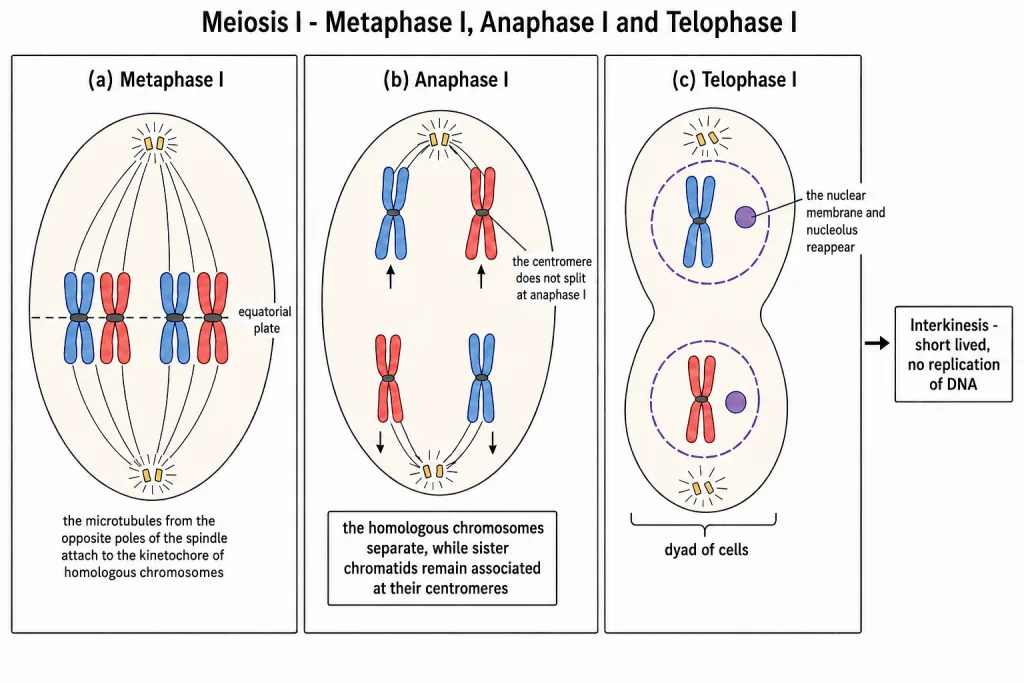
Metaphase I: the bivalent chromosomes align on the equatorial plate.
The microtubules from the opposite poles of the spindle attach to the kinetochore of homologous chromosomes.
Read that against mitotic metaphase, because the unit lying on the plate is not the same thing.
| Metaphase of mitosis | Metaphase I of meiosis | |
|---|---|---|
| What lies on the equator | Individual chromosomes, each of two sister chromatids | Bivalents, that is pairs of homologous chromosomes |
| What the spindle fibres attach to | The kinetochores of the two sister chromatids of one chromosome | The kinetochore of homologous chromosomes |
| Which way the attachment faces | One chromatid to one pole, its sister to the opposite pole | One whole homologue to one pole, its partner to the opposite pole |
[NEET Important] The examiner tests whether you know what is being pulled apart. At metaphase I the spindle has hold of two homologous chromosomes facing opposite poles, not two sister chromatids of one chromosome. The wrong option always says "sister chromatids" - that description belongs to metaphase of mitosis and to metaphase II.
Anaphase I - the Single Most Examined Fact in the Chapter
Anaphase I: the homologous chromosomes separate, while sister chromatids remain associated at their centromeres.
That one sentence carries two separate facts, and questions are built by keeping one and swapping the other.
- What separates: the homologous chromosomes - the two members of each bivalent are pulled apart and go to opposite poles.
- What does not separate: the sister chromatids, which remain associated at their centromeres. The centromere does not split at anaphase I. Each chromosome therefore travels to the pole still made of two chromatids.
Because whole homologues are separated, each pole receives half the chromosome number of the parent cell. This is the moment at which the chromosome number is halved, and it is why meiosis I is the reductional division.
| Anaphase of mitosis | Anaphase I of meiosis | |
|---|---|---|
| What splits | The centromere of each chromosome splits | The centromere does not split |
| What separates | Sister chromatids separate | Homologous chromosomes separate |
| What moves to each pole | Daughter chromatids, now referred to as daughter chromosomes, each with a single chromatid | Whole chromosomes, each still made of two chromatids held at the centromere |
| Chromosome number reaching each pole | The same as the parent cell, | Half that of the parent cell, |
| Type of division | Equational | Reductional |
| Preceded by pairing? | No pairing of homologues | Yes - the bivalents formed at zygotene |
[NEET Important] If you learn one line from this chapter, learn this one: in anaphase I the homologous chromosomes separate while the sister chromatids remain associated at their centromeres. The standard distractor is "centromeres split and chromatids separate" - true of anaphase of mitosis and anaphase II, false of anaphase I. Note also what does not differ: in both cases chromosomes move towards opposite poles, and in both the kinetochores are attached to spindle fibres.
Telophase I and the Dyad
Telophase I: the nuclear membrane and nucleolus reappear, cytokinesis follows, and this is called a dyad of cells.
So the first meiotic division ends with two cells, and the name for that pair is worth fixing now, because the second division ends with a different name.
- Telophase I gives a dyad - two cells.
- Telophase II gives a tetrad - four cells.
The chromosomes do not fully unwind. Although in many cases the chromosomes do undergo some dispersion, they do not reach the extremely extended state of the interphase nucleus. They loosen a little, but they stay far more compact than chromatin in a true interphase nucleus - which makes sense, because the cell is about to divide again almost at once.
[NEET Important] Two traps sit in this short paragraph. First the counting word: dyad after telophase I, tetrad after telophase II - options swap them freely. Second the state of the chromosomes: they show some dispersion but do not reach the extremely extended state of the interphase nucleus, so an option saying the chromosomes return to the fully extended interphase condition is wrong.
Interkinesis
The stage between the two meiotic divisions is called interkinesis, and it is generally short lived.
There is no replication of DNA during interkinesis.
That single negative is the whole point of the stage, and it is what makes meiosis work. Meiosis involves two sequential cycles of nuclear and cell division but only a single cycle of DNA replication, which happened back in S phase before meiosis I began. If DNA replicated again during interkinesis, the second division would not reduce the DNA content and the gametes would be wrong.
Interkinesis is followed by prophase II, a much simpler prophase than prophase I.
Do not confuse interkinesis with interphase. Interphase has , S and and includes DNA replication in S phase. Interkinesis has no S phase and no DNA replication at all, and it is generally short lived.
[NEET Important] "There is no replication of DNA during interkinesis" is asked directly, and it is also the hidden step in every N-and-C question about meiosis. Remember the pairing: two divisions, one round of DNA replication. The distractor to reject is any option that gives interkinesis an S phase or calls it a long resting stage.
Quick Recap
- Metaphase I - the bivalent chromosomes align on the equatorial plate.
- The microtubules from the opposite poles of the spindle attach to the kinetochore of homologous chromosomes.
- In mitotic metaphase the spindle attaches to the kinetochores of the two sister chromatids of one chromosome; in metaphase I it attaches to homologous chromosomes.
- Anaphase I - the homologous chromosomes separate, while sister chromatids remain associated at their centromeres.
- The centromere does not split at anaphase I, so each chromosome reaches the pole still made of two chromatids.
- Each pole receives half the chromosome number of the parent cell - this is why meiosis I is reductional.
- In anaphase of mitosis, by contrast, centromeres split and chromatids separate, and each pole receives the parent chromosome number.
- Telophase I - the nuclear membrane and nucleolus reappear, cytokinesis follows, and this is called a dyad of cells.
- Although in many cases the chromosomes do undergo some dispersion, they do not reach the extremely extended state of the interphase nucleus.
- Telophase I gives a dyad (two cells); telophase II gives a tetrad (four cells).
- Interkinesis is the stage between the two meiotic divisions and is generally short lived.
- There is no replication of DNA during interkinesis.
- Meiosis has two sequential cycles of nuclear and cell division but only a single cycle of DNA replication.
- Interkinesis is followed by prophase II, a much simpler prophase than prophase I.
Solved Examples
Question 1
Q. What aligns on the equatorial plate at metaphase I?
Answer. The bivalent chromosomes. A bivalent is a pair of synapsed homologous chromosomes, so what lies on the plate is a pair, not a single chromosome.
Question 2
Q. At metaphase I, what do the microtubules from the opposite poles of the spindle attach to?
Answer. The kinetochore of homologous chromosomes. One homologue of each pair is held by fibres from one pole and its partner by fibres from the opposite pole.
Question 3
Q. Distinguish anaphase of mitosis from anaphase I of meiosis. This is one of the chapter-end exercises.
Answer. The difference is what the cell pulls apart.
In anaphase of mitosis, each chromosome arranged at the metaphase plate is split simultaneously: the centromeres split and the chromatids separate, and the two daughter chromatids, now referred to as daughter chromosomes, migrate towards the two opposite poles. Each pole therefore receives chromosomes made of a single chromatid, and the number reaching each pole is the same as the parent cell had, . This is why mitosis is equational.
In anaphase I of meiosis, the homologous chromosomes separate, while sister chromatids remain associated at their centromeres. The centromere does not split. Each pole therefore receives whole chromosomes, each still made of two chromatids, and the number reaching each pole is half that of the parent cell, . This is why meiosis I is reductional.
A compact way to hold it:
| Anaphase of mitosis | Anaphase I of meiosis | |
|---|---|---|
| Centromere | Splits | Does not split |
| What separates | Sister chromatids | Homologous chromosomes |
| Chromatids per chromosome moving to a pole | One | Two |
| Chromosome number at each pole | ||
| Nature of division | Equational | Reductional |
What is the same in both: chromosomes move towards opposite poles, and they do so through spindle fibres attached at kinetochores.
Question 4
Q. In anaphase I, what happens to the sister chromatids?
Answer. They remain associated at their centromeres. They do not separate at this stage - they separate only in anaphase II.
Question 5
Q. Why is meiosis I called the reductional division?
Answer. Because the chromosome number is halved during it. At anaphase I the homologous chromosomes separate, so each pole receives half the chromosome number of the parent cell. A cell gives two cells that are each .
Question 6
Q. Describe telophase I.
Answer. The nuclear membrane and nucleolus reappear, and cytokinesis follows. The result is two cells, and this is called a dyad of cells. Although in many cases the chromosomes do undergo some dispersion, they do not reach the extremely extended state of the interphase nucleus.
Question 7
Q. What is meant by a dyad of cells?
Answer. The pair of cells produced at the end of telophase I, that is at the end of meiosis I. Compare it with the tetrad, the four cells produced at the end of telophase II.
Question 8
Q. How condensed are the chromosomes at the end of telophase I, and why does it matter?
Answer. They undergo some dispersion but do not reach the extremely extended state of the interphase nucleus. It matters because the cell is about to divide again almost immediately - meiosis II is initiated immediately after cytokinesis, usually before the chromosomes have fully elongated.
Question 9
Q. What is interkinesis?
Answer. The stage between the two meiotic divisions. It is generally short lived, and there is no replication of DNA during interkinesis. It is followed by prophase II.
Question 10
Q. Does DNA replicate during interkinesis, and what follows from the answer?
Answer. No. There is no replication of DNA during interkinesis.
This is what allows meiosis to do its job. Meiosis involves two sequential cycles of nuclear and cell division but only a single cycle of DNA replication, and that single round happened in S phase before meiosis I. Because no DNA is added back in between, the second division halves the DNA content per cell and the gametes end up correct.
Question 11
Q. How does interkinesis differ from interphase?
Answer. Interphase has three sub-phases, , S and , and DNA replication takes place in its S phase. Interkinesis has no DNA replication at all and is generally short lived. Interphase prepares a cell to divide from the beginning; interkinesis is only the gap between two divisions that are already under way.
Question 12
Q. Which stage of cell division is characterised by centromeres splitting and chromatids separating - and does this happen in anaphase I?
Answer. Anaphase of mitosis, and also anaphase II of meiosis. It does not happen in anaphase I, where the homologous chromosomes separate while the sister chromatids remain associated at their centromeres.
Question 13
Q. A cell with 20 chromosomes completes meiosis I. How many chromosomes does each cell of the dyad contain, and how many chromatids does each of those chromosomes have?
Answer. Each cell of the dyad has 10 chromosomes, because anaphase I separates homologous chromosomes and each pole receives half the chromosome number of the parent cell. Each of those 10 chromosomes still has two chromatids, because the centromere did not split at anaphase I.