
Why Meiosis Exists
The production of offspring by sexual reproduction includes the fusion of two gametes, each with a complete haploid set of chromosomes. That single sentence forces a problem on the organism. If two gametes fuse, and each gamete carried the full diploid set, the chromosome number would double in every generation.
Gametes are formed from specialised diploid cells. So somewhere between the diploid parent cell and the gamete, the chromosome number has to be cut in half.
This specialised kind of cell division that reduces the chromosome number by half results in the production of haploid daughter cells. This kind of division is called meiosis. A cell enters, and cells come out.
Meiosis ensures the production of the haploid phase in the life cycle of sexually reproducing organisms, whereas fertilisation restores the diploid phase. The two processes are a matched pair - meiosis halves, fertilisation doubles back - and between them they keep the chromosome number of a species constant generation after generation.
We come across meiosis during gametogenesis in plants and animals. This leads to the formation of haploid gametes.
[NEET Important] Keep the two jobs opposite each other in your memory: meiosis produces the haploid phase, fertilisation restores the diploid phase. Learn the definition with its two halves intact - reduces the chromosome number by half and results in haploid daughter cells - and remember that the cells meiosis starts from are specialised diploid cells, not haploid ones.
The Four Key Features, and the Phases of Meiosis
The key features of meiosis are as follows:
- Meiosis involves two sequential cycles of nuclear and cell division called meiosis I and meiosis II, but only a single cycle of DNA replication.
- Meiosis I is initiated after the parental chromosomes have replicated to produce identical sister chromatids at the S phase.
- Meiosis involves pairing of homologous chromosomes and recombination between non-sister chromatids of homologous chromosomes.
- Four haploid cells are formed at the end of meiosis II.
Feature 1 is the arithmetic of the whole process. The DNA is copied once but the cell divides twice, and that is exactly why one cell ends up as four cells rather than two.
Feature 3 has a word in it that is tested on its own. Recombination is between non-sister chromatids - that is, between chromatids belonging to the two different homologous chromosomes. Two sister chromatids are identical copies, so exchanging material between them would achieve nothing.
Meiotic events can be grouped under the following phases:
| Meiosis I | Meiosis II |
|---|---|
| Prophase I | Prophase II |
| Metaphase I | Metaphase II |
| Anaphase I | Anaphase II |
| Telophase I | Telophase II |
[NEET Important] The most valuable single line in this section is two sequential cycles of nuclear and cell division but only a single cycle of DNA replication. The distractor always offers two rounds of replication. Add to it four haploid cells at the end of meiosis II and recombination between non-sister chromatids, and you have covered the three ways this list is usually set.
Prophase I - Leptotene, Zygotene and Pachytene
Prophase of the first meiotic division is typically longer and more complex when compared to prophase of mitosis. It has been further subdivided into the following five phases based on chromosomal behaviour: leptotene, zygotene, pachytene, diplotene and diakinesis.
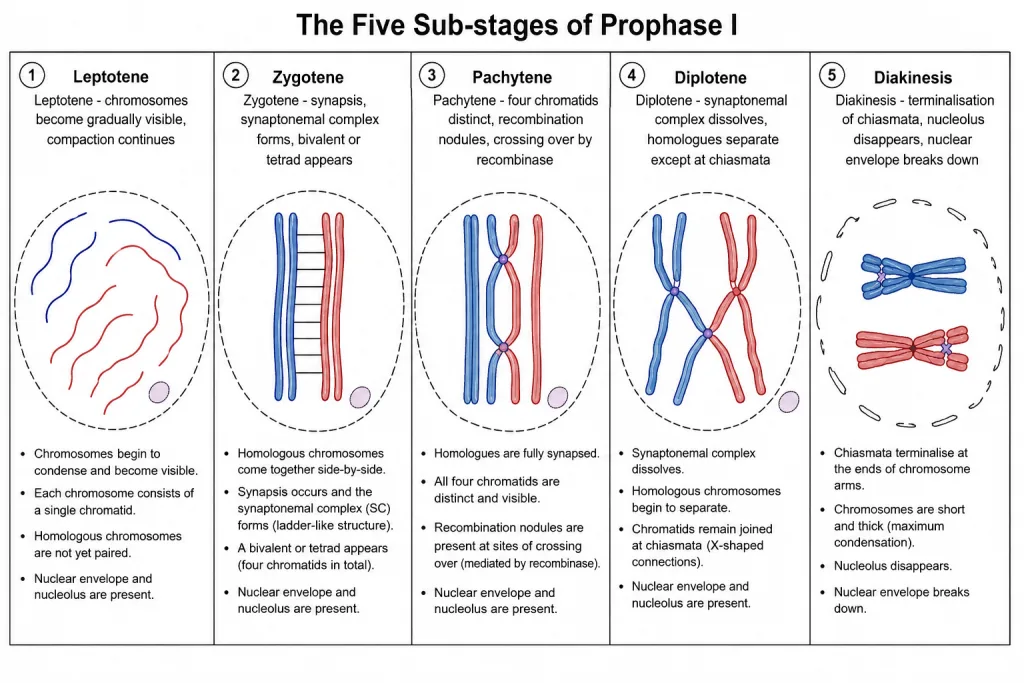
Leptotene. During the leptotene stage the chromosomes become gradually visible under the light microscope. The compaction of chromosomes continues throughout leptotene. Nothing has paired yet; the chromosomes are simply becoming visible as they compact.
Zygotene. During this stage, chromosomes start pairing together, and this process of association is called synapsis. Such paired chromosomes are called homologous chromosomes. Electron micrographs of this stage indicate that chromosome synapsis is accompanied by the formation of a complex structure called the synaptonemal complex. The complex formed by a pair of synapsed homologous chromosomes is called a bivalent or a tetrad. These are more clearly visible at the next stage.
Pachytene. The first two stages of prophase I are relatively short-lived compared to the next stage, that is pachytene.
- During this stage, the four chromatids of each bivalent chromosome become distinct and clearly appear as tetrads.
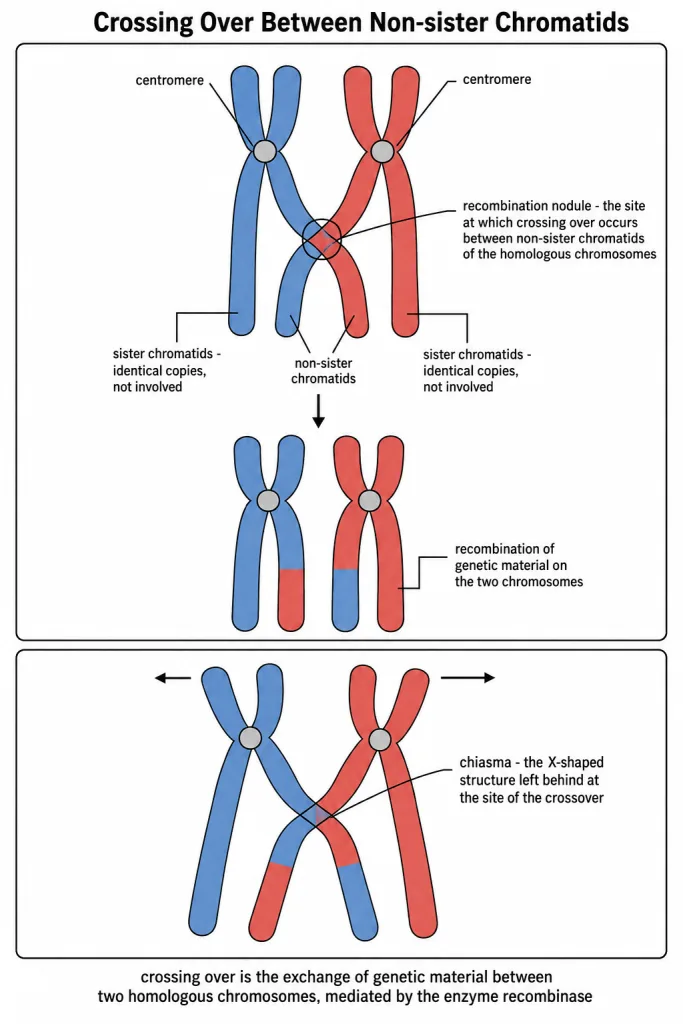
- This stage is characterised by the appearance of recombination nodules, the sites at which crossing over occurs between non-sister chromatids of the homologous chromosomes.
- Crossing over is the exchange of genetic material between two homologous chromosomes.
- Crossing over is also an enzyme-mediated process, and the enzyme involved is called recombinase.
- Crossing over leads to recombination of genetic material on the two chromosomes.
- Recombination between homologous chromosomes is completed by the end of pachytene, leaving the chromosomes linked at the sites of crossing over.
[NEET Important] These three stages give three separate one-line answers, and mixing them up is the commonest mistake in the chapter. Chromosomes become visible - leptotene. Pairing, that is synapsis, and the synaptonemal complex - zygotene. Recombination nodules and crossing over - pachytene. Two more single facts get asked directly: the enzyme is recombinase, and a pair of synapsed homologous chromosomes is a bivalent or a tetrad.
Prophase I - Diplotene and Diakinesis
Diplotene. The beginning of diplotene is recognised by the dissolution of the synaptonemal complex and the tendency of the recombined homologous chromosomes of the bivalents to separate from each other except at the sites of crossovers. These X-shaped structures are called chiasmata.
Read that carefully: the homologues are trying to move apart and succeeding everywhere except where they exchanged material. The points where they stay stuck together are the chiasmata, and each one is the visible evidence of a crossover that happened back in pachytene.
In oocytes of some vertebrates, diplotene can last for months or years. It is the longest stage of prophase I by a very wide margin.
Diakinesis. The final stage of meiotic prophase I is diakinesis. This is marked by terminalisation of chiasmata.
- During this phase the chromosomes are fully condensed and the meiotic spindle is assembled to prepare the homologous chromosomes for separation.
- By the end of diakinesis the nucleolus disappears and the nuclear envelope also breaks down.
- Diakinesis represents transition to metaphase.
[NEET Important] Two terms are set against each other here, and they are one stage apart. Chiasmata appear at diplotene; terminalisation of chiasmata happens at diakinesis. Note also that the nucleolus disappears and the nuclear envelope breaks down by the end of diakinesis - in mitosis these had already gone by the end of prophase, so in meiosis the equivalent event is pushed right to the end of prophase I. And diplotene lasting months or years in the oocytes of some vertebrates is asked as a bare fact.
Quick Recap
- The production of offspring by sexual reproduction includes the fusion of two gametes, each with a complete haploid set of chromosomes.
- Gametes are formed from specialised diploid cells.
- Meiosis is the specialised kind of cell division that reduces the chromosome number by half and results in the production of haploid daughter cells.
- Meiosis ensures the production of the haploid phase in the life cycle of sexually reproducing organisms, whereas fertilisation restores the diploid phase.
- Meiosis is met with during gametogenesis in plants and animals, leading to the formation of haploid gametes.
- Key feature 1: meiosis involves two sequential cycles of nuclear and cell division called meiosis I and meiosis II, but only a single cycle of DNA replication.
- Key feature 2: meiosis I is initiated after the parental chromosomes have replicated to produce identical sister chromatids at the S phase.
- Key feature 3: meiosis involves pairing of homologous chromosomes and recombination between non-sister chromatids of homologous chromosomes.
- Key feature 4: four haploid cells are formed at the end of meiosis II.
- Meiosis I - prophase I, metaphase I, anaphase I, telophase I. Meiosis II - prophase II, metaphase II, anaphase II, telophase II.
- Prophase I is typically longer and more complex than prophase of mitosis, and is subdivided into leptotene, zygotene, pachytene, diplotene and diakinesis on the basis of chromosomal behaviour.
- Leptotene - chromosomes become gradually visible under the light microscope; compaction continues throughout.
- Zygotene - chromosomes start pairing, a process called synapsis; paired chromosomes are homologous chromosomes; synapsis is accompanied by the synaptonemal complex; the complex of a pair of synapsed homologous chromosomes is a bivalent or a tetrad.
- Pachytene - the four chromatids of each bivalent become distinct and appear as tetrads; recombination nodules appear, the sites at which crossing over occurs between non-sister chromatids.
- Crossing over is the exchange of genetic material between two homologous chromosomes, is enzyme-mediated, and the enzyme involved is recombinase.
- Recombination is completed by the end of pachytene, leaving the chromosomes linked at the sites of crossing over.
- Diplotene - the synaptonemal complex dissolves and the recombined homologues separate except at the sites of crossovers; these X-shaped structures are chiasmata.
- In oocytes of some vertebrates, diplotene can last for months or years.
- Diakinesis - marked by terminalisation of chiasmata; chromosomes fully condensed; meiotic spindle assembled; nucleolus disappears and nuclear envelope breaks down; represents transition to metaphase.
Solved Examples
Question 1
Q. What does the production of offspring by sexual reproduction involve, in terms of chromosomes?
Answer. The fusion of two gametes, each with a complete haploid set of chromosomes. The gametes themselves are formed from specialised diploid cells.
Question 2
Q. Define meiosis.
Answer. It is the specialised kind of cell division that reduces the chromosome number by half and results in the production of haploid daughter cells. A cell gives cells.
Question 3
Q. What does meiosis ensure in the life cycle of a sexually reproducing organism, and what balances it?
Answer. Meiosis ensures the production of the haploid phase in the life cycle of sexually reproducing organisms, whereas fertilisation restores the diploid phase. Between them the chromosome number of the species is held constant from one generation to the next. Meiosis is met with during gametogenesis in plants and animals, leading to the formation of haploid gametes.
Question 4
Q. State the four key features of meiosis.
Answer.
- Meiosis involves two sequential cycles of nuclear and cell division called meiosis I and meiosis II, but only a single cycle of DNA replication.
- Meiosis I is initiated after the parental chromosomes have replicated to produce identical sister chromatids at the S phase.
- Meiosis involves pairing of homologous chromosomes and recombination between non-sister chromatids of homologous chromosomes.
- Four haploid cells are formed at the end of meiosis II.
Question 5
Q. Name the phases of meiosis I and meiosis II.
Answer. Meiosis I - prophase I, metaphase I, anaphase I and telophase I. Meiosis II - prophase II, metaphase II, anaphase II and telophase II.
Question 6
Q. How does prophase I compare with the prophase of mitosis, and what are its sub-stages?
Answer. Prophase of the first meiotic division is typically longer and more complex when compared to prophase of mitosis. It has been further subdivided into five phases based on chromosomal behaviour: leptotene, zygotene, pachytene, diplotene and diakinesis.
Question 7
Q. What happens during leptotene?
Answer. The chromosomes become gradually visible under the light microscope, and compaction of the chromosomes continues throughout leptotene.
Question 8
Q. What is synapsis, and what structure accompanies it?
Answer. During zygotene, chromosomes start pairing together, and this process of association is called synapsis. Such paired chromosomes are called homologous chromosomes. Chromosome synapsis is accompanied by the formation of a complex structure called the synaptonemal complex.
Question 9
Q. Describe what happens during pachytene.
Answer. Pachytene is much longer than the first two stages of prophase I, which are relatively short-lived.
The four chromatids of each bivalent chromosome become distinct and clearly appear as tetrads. The stage is characterised by the appearance of recombination nodules, the sites at which crossing over occurs between non-sister chromatids of the homologous chromosomes. Recombination between homologous chromosomes is completed by the end of pachytene, leaving the chromosomes linked at the sites of crossing over.
Question 10
Q. What is crossing over, and which enzyme carries it out?
Answer. Crossing over is the exchange of genetic material between two homologous chromosomes. It is an enzyme-mediated process, and the enzyme involved is called recombinase. Crossing over leads to recombination of genetic material on the two chromosomes.
Question 11
Q. Describe the following: (a) synapsis (b) bivalent (c) chiasmata. Draw a diagram to illustrate your answer. This is one of the chapter-end exercises.
Answer. All three belong to prophase I of meiosis, and they come one after the other, so it helps to answer them in order.
(a) Synapsis. This is the event of zygotene. Chromosomes start pairing together, and this process of association is called synapsis. Such paired chromosomes are called homologous chromosomes. Chromosome synapsis is accompanied by the formation of a complex structure called the synaptonemal complex, which holds the two partners together along their length.
(b) Bivalent. The complex formed by a pair of synapsed homologous chromosomes is called a bivalent or a tetrad. The two names describe the same thing counted two ways: two chromosomes, hence bivalent, made of four chromatids, hence tetrad. The four chromatids of each bivalent become distinct and clearly appear as tetrads during pachytene.
(c) Chiasmata. These belong to diplotene. The beginning of diplotene is recognised by the dissolution of the synaptonemal complex and the tendency of the recombined homologous chromosomes of the bivalents to separate from each other except at the sites of crossovers. These X-shaped structures are called chiasmata. Each chiasma is therefore the visible mark of a crossover that took place in pachytene.
What your diagram must carry. Draw one bivalent - that is, two homologous chromosomes lying side by side, each already made of two sister chromatids, so four chromatids in all. Then label, in this order:
- Homologous chromosomes - the two partner chromosomes, drawn as a pair.
- Sister chromatids - the two identical threads of one chromosome, joined at their centromere.
- Centromere - marked on each of the two chromosomes.
- Synapsis - an arrow or bracket showing the two homologues paired along their length.
- Synaptonemal complex - the structure drawn between the two paired homologues.
- Bivalent or tetrad - a bracket around the whole four-chromatid group.
- Chiasma - the X-shaped crossing point between two non-sister chromatids, drawn where the homologues remain attached after the rest of them has separated. Label the plural as chiasmata if you draw more than one.
- Non-sister chromatids - the two chromatids actually involved in the X, one from each homologue.
The single most common mistake in this diagram is drawing the X between sister chromatids. Crossing over, and therefore the chiasma, is always between non-sister chromatids of homologous chromosomes.
Question 12
Q. What marks the beginning of diplotene, and how long can this stage last?
Answer. The dissolution of the synaptonemal complex and the tendency of the recombined homologous chromosomes of the bivalents to separate from each other except at the sites of crossovers, where the X-shaped chiasmata hold them together. In oocytes of some vertebrates, diplotene can last for months or years.
Question 13
Q. Describe diakinesis.
Answer. Diakinesis is the final stage of meiotic prophase I, and it is marked by terminalisation of chiasmata. During this phase the chromosomes are fully condensed and the meiotic spindle is assembled to prepare the homologous chromosomes for separation. By the end of diakinesis the nucleolus disappears and the nuclear envelope also breaks down. Diakinesis represents transition to metaphase.
Question 14
Q. Name the stage of cell cycle at which the following event occurs: Pairing between homologous chromosomes takes place. This is one of the chapter-end exercises.
Answer. Zygotene, the second sub-stage of prophase I of meiosis I.
During this stage, chromosomes start pairing together, and this process of association is called synapsis. Such paired chromosomes are called homologous chromosomes, and the pairing is accompanied by the formation of the synaptonemal complex. The complex formed by a pair of synapsed homologous chromosomes is called a bivalent or a tetrad.
Question 15
Q. Name the stage of cell cycle at which the following event occurs: Crossing over between homologous chromosomes takes place. This is one of the chapter-end exercises.
Answer. Pachytene, the third sub-stage of prophase I of meiosis I.
This stage is characterised by the appearance of recombination nodules, the sites at which crossing over occurs between non-sister chromatids of the homologous chromosomes. Crossing over is the exchange of genetic material between two homologous chromosomes, it is enzyme-mediated, and the enzyme involved is recombinase. Recombination between homologous chromosomes is completed by the end of pachytene, leaving the chromosomes linked at the sites of crossing over.
Do not confuse this with zygotene, which is only when the homologues pair. Pairing is zygotene; crossing over is pachytene.