
N and C - Two Counts That Move at Different Moments
Students lose more marks on this than on anything else in the chapter, and the reason is almost always the same: N and C are treated as one thing when they are two.
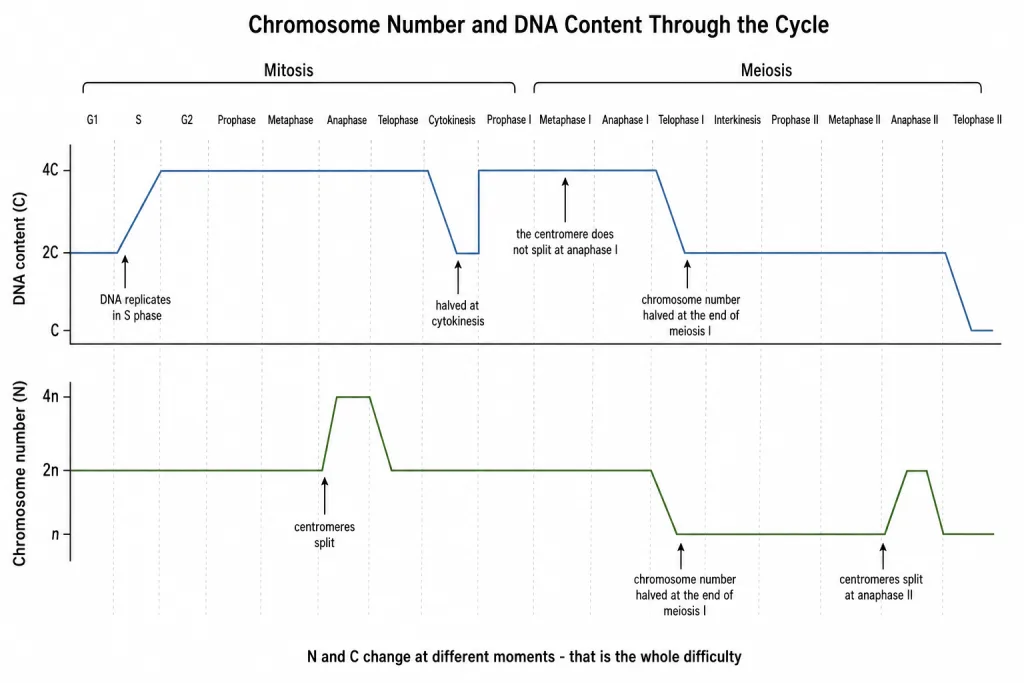
- N is the number of chromosomes per cell. It is a count of separate chromosomes, and a chromosome counts as one whether it is made of one chromatid or two. Write it as for a diploid cell and for a haploid one.
- C is the amount of DNA per cell. Write the DNA of one unreplicated haploid set as , so a diploid cell before replication is , and after replication .
The two change at different moments, and each has its own trigger.
| Parameter | What makes it change | Where that happens |
|---|---|---|
| C, the DNA content | DNA replication doubles it; cell division halves it | Doubled in S phase; halved at each cytokinesis |
| N, the chromosome number | Splitting of centromeres raises it; separation of chromosomes into two cells lowers it | Raised at anaphase of mitosis and anaphase II; lowered at every cytokinesis, and halved at the end of meiosis I |
A worked reading of one line. In S phase the DNA content goes from to , but the chromosome number stays . Nothing new was counted, because each chromosome simply now has two chromatids instead of one. The count of centromeres did not change - and that is the practical rule: count centromeres, and you are counting chromosomes.
[NEET Important] Learn the trigger, not the table. C changes only when DNA is made or a cell divides. N changes only when centromeres split or chromosomes are parcelled into separate cells. Every wrong option in this topic comes from assuming that doubling the DNA doubles the chromosome number - it does not.
Through Mitosis, Step by Step
Take a cell that is , at and follow it round.
phase. The cell is metabolically active and grows but does not replicate its DNA, so it stays at , . This is the reference state.
S phase. DNA synthesis takes place and the amount of DNA per cell doubles from to . There is no increase in the chromosome number - a cell that had a diploid or number of chromosomes at still has after S phase. Each chromosome is now made of two sister chromatids attached at the centromere.
phase. Proteins are synthesised in preparation for mitosis and cell growth continues. Neither count moves: , .
Prophase. Chromosomal material condenses to form compact mitotic chromosomes, each composed of two chromatids attached together at the centromere. Condensing changes how the chromosome looks, not how many there are: still , .
Metaphase. All the chromosomes lie at the equator on the metaphase plate. Still , .
Anaphase - the one place N jumps. At the onset of anaphase each chromosome arranged at the metaphase plate is split simultaneously: the centromeres split and the chromatids separate. The two daughter chromatids are now referred to as daughter chromosomes. Because each old chromosome has become two chromosomes, the chromosome count in the cell momentarily doubles to , while the DNA content is still - not one new nucleotide was made. This is the single row students get wrong.
Telophase and cytokinesis. Two daughter nuclei form, and cytokinesis divides the cytoplasm into two daughter cells. The , content of the dividing cell is shared equally, so each daughter cell is , - exactly what the parent was at .
And that closing line is the definition. Since the number of chromosomes in the parent and progeny cells is the same, mitosis is called equational division.
[NEET Important] The examinable pair here is anaphase: but . The distractor says , , on the reasoning that if the chromosome number doubled the DNA must have doubled too. Splitting a centromere does not make DNA. The second most common slip is calling the daughter cells , - the DNA is halved by cytokinesis.
Through Meiosis, Step by Step
Start from the same cell, , at .
Before meiosis I. Meiosis I is initiated after the parental chromosomes have replicated to produce identical sister chromatids at the S phase. So the cell enters meiosis at , , exactly as it would enter mitosis. Meiosis involves two sequential cycles of nuclear and cell division but only a single cycle of DNA replication, and this is that single cycle.
Prophase I, metaphase I. The homologous chromosomes pair to form bivalents and undergo crossing over, then the bivalents align on the equatorial plate. Crossing over exchanges segments between non-sister chromatids, which changes which alleles sit on which chromatid but changes neither the number of chromosomes nor the amount of DNA. Still , .
Anaphase I. The homologous chromosomes separate, while sister chromatids remain associated at their centromeres. The centromere does not split, so N does not rise here the way it did in mitotic anaphase. The cell is still , while chromosomes, carrying of DNA, travel to each pole.
Telophase I and cytokinesis - the reduction. The nuclear membrane and nucleolus reappear, cytokinesis follows, and this is called a dyad of cells. Each cell of the dyad is , . The chromosome number has been halved, and it has been halved here, at the end of meiosis I, because whole homologous chromosomes were separated into different cells. This is why meiosis I is the reductional division. Note that each of those chromosomes still has two chromatids, which is why the DNA is and not .
Interkinesis. There is no replication of DNA during interkinesis. Nothing moves: , .
Prophase II, metaphase II. Still , .
Anaphase II. It begins with the simultaneous splitting of the centromere of each chromosome, which was holding the sister chromatids together. Now N doubles momentarily to within the cell, while the DNA is still - the same pattern as mitotic anaphase, one step lower.
Telophase II and cytokinesis. A tetrad of cells is formed, that is four haploid daughter cells. Each is , .
So the two divisions do different jobs. Meiosis I separates homologous chromosomes and halves the chromosome number - reductional. Meiosis II separates sister chromatids with no DNA replication in between and leaves the chromosome number unchanged at - equational.
[NEET Important] The most-missed value in the whole chapter is the dyad: , , not , . Students halve both counts at the end of meiosis I because that is where they were told the reduction happens. Only N is halved at meiosis I. C is halved at each of the two cytokineses, so it takes both divisions to bring down to .
The Full Table
This is the table the chapter-end exercise is asking for. Read it as one column for the count of chromosomes and one for the amount of DNA, and read the last column for the reason each value moved or did not move.
| Stage | N (chromosomes per cell) | C (DNA per cell) | Why |
|---|---|---|---|
| The reference state; no DNA replication in | |||
| S phase | from to | DNA replicates; each chromosome gains a second chromatid, so no new chromosome is counted | |
| Only proteins are synthesised | |||
| Prophase (mitosis) | Condensation changes shape, not number | ||
| Metaphase (mitosis) | Chromosomes only line up on the metaphase plate | ||
| Anaphase (mitosis) | in the cell | Centromeres split, so each chromatid is now counted as a chromosome; no DNA is made | |
| Telophase (mitosis) | in the cell, per daughter nucleus | in the cell, per nucleus | Two nuclei form around the two clusters |
| After cytokinesis (mitosis) | per cell | per cell | The cell divides in two; back to the parent value, so mitosis is equational |
| Prophase I | Pairing and crossing over change neither count | ||
| Metaphase I | Bivalents align on the equatorial plate | ||
| Anaphase I | in the cell, to each pole | in the cell, to each pole | Homologues separate but the centromere does not split |
| Telophase I and cytokinesis - each cell of the dyad | The chromosome number is halved here; each chromosome still has two chromatids | ||
| Interkinesis | There is no replication of DNA during interkinesis | ||
| Prophase II | The chromosomes only become compact again | ||
| Metaphase II | Chromosomes align at the equator | ||
| Anaphase II | in the cell, to each pole | in the cell, to each pole | Centromeres split simultaneously and sister chromatids separate |
| Telophase II and cytokinesis - each cell of the tetrad | Four haploid daughter cells; meiosis II is equational |
Three lines summarise the whole table.
- DNA is made once, in S phase, and halved at each cytokinesis - once in mitosis, twice in meiosis.
- The chromosome number rises only when centromeres split (anaphase of mitosis, anaphase II) and falls only when a cell divides.
- The halving of the chromosome number happens at the end of meiosis I, not at meiosis II.
[NEET Important] Practise this table by being given one value and asked for the other. "A cell has chromosomes and DNA - name the stage" has the answer anywhere from telophase I to metaphase II. "A cell has chromosomes and DNA" fits through metaphase, and prophase I through metaphase I - the question will supply one more clue, such as bivalents present, to separate them.
Quick Recap
- N is the number of chromosomes per cell; C is the amount of DNA per cell. They change at different moments.
- A chromosome counts as one whether it has one chromatid or two - in practice, count centromeres.
- C doubles only in S phase and is halved at each cytokinesis.
- N rises only when centromeres split, and falls only when a cell divides.
- Mitosis: is , .
- S phase takes the DNA from to with the chromosome number unchanged at .
- , prophase and metaphase are all , .
- At anaphase the centromeres split, so the count momentarily doubles to while the DNA is still .
- After cytokinesis each daughter cell is , - the same as the parent at , which is why mitosis is equational.
- Meiosis starts from , , because meiosis I is initiated after the chromosomes have replicated at S phase, and meiosis has only a single cycle of DNA replication.
- Prophase I, metaphase I and anaphase I are all , in the cell.
- Each cell of the dyad after meiosis I is , - the chromosome number is halved here, which is why meiosis I is reductional.
- Interkinesis changes nothing, because there is no replication of DNA during it.
- Prophase II and metaphase II are , ; anaphase II splits the centromeres.
- Each cell of the tetrad after meiosis II is , - the chromosome number is unchanged, which is why meiosis II is equational.
- Mitosis without DNA replication in S phase cannot give normal daughter cells - the daughter cells would carry half the DNA.
- DNA replication without cell division does occur and gives a polyploid or polytene condition.
Solved Examples
Question 1
Q. What do N and C stand for, and why must they be tracked separately?
Answer. N is the number of chromosomes per cell and C is the amount of DNA per cell. They must be tracked separately because they change at different moments. DNA replication in S phase doubles C without changing N, and the splitting of centromeres at anaphase raises N without changing C.
Question 2
Q. A cell is , at . What is it after S phase, and why?
Answer. , . S phase marks the period during which DNA synthesis or replication takes place, so the amount of DNA per cell doubles from to . But there is no increase in the chromosome number - each chromosome now simply has two chromatids attached at the centromere, and that still counts as one chromosome.
Question 3
Q. Why does the chromosome number momentarily double at anaphase of mitosis?
Answer. Because the centromeres split and the chromatids separate, and the two daughter chromatids are now referred to as daughter chromosomes. Each of the chromosomes has become two chromosomes, so the cell momentarily contains . The DNA content is unchanged at - no new DNA was made.
Question 4
Q. What are N and C in each daughter cell after mitotic cytokinesis?
Answer. and - the same as the parent cell had at . This is why mitosis is called equational division: the number of chromosomes in the parent and progeny cells is the same.
Question 5
Q. What are N and C in each cell of the dyad at the end of meiosis I?
Answer. and . At anaphase I the homologous chromosomes separate, so each cell receives half the chromosome number of the parent - N is halved here, which is why meiosis I is reductional. But the sister chromatids remain associated at their centromeres, so each of those chromosomes still has two chromatids and the DNA content is , not .
Question 6
Q. What are N and C in each cell of the tetrad at the end of meiosis II?
Answer. and . Anaphase II splits the centromeres and separates the sister chromatids, and there was no replication of DNA during interkinesis, so the DNA is halved again while the chromosome number stays . That is why meiosis II is equational.
Question 7
Q. At which point in meiosis is the chromosome number actually halved?
Answer. At the end of meiosis I, when cytokinesis after telophase I gives the dyad. The event responsible is anaphase I, in which the homologous chromosomes separate while sister chromatids remain associated at their centromeres. Meiosis II does not halve the chromosome number.
Question 8
Q. Can there be mitosis without DNA replication in S phase? This is one of the chapter-end exercises.
Answer. No, not in any way that produces normal daughter cells.
Mitosis works only because S phase has already doubled the DNA. During S phase the amount of DNA per cell doubles from to and each chromosome comes to consist of two sister chromatids attached at the centromere. At anaphase the centromere splits and one chromatid of each chromosome goes to each pole, so each daughter cell receives a complete set and ends up , , exactly what the parent was at .
If S phase were skipped, each chromosome would enter mitosis with only one chromatid. There would be nothing for the centromere to split into two of, and dividing the cell would simply share the single set of chromosomes between the two daughter cells. Each daughter would end up with half the DNA of the parent and an incomplete set of chromosomes, so the division could not be equational and the daughter cells would not be normal or viable.
So DNA replication in S phase is a necessary preparation for mitosis, which is exactly why the cell cycle places S phase before M phase and why all these processes have to take place in a coordinated way to ensure correct division and formation of progeny cells containing intact genomes.
Question 9
Q. Can there be DNA replication without cell division? This is one of the chapter-end exercises.
Answer. Yes. This does happen, and it has a name.
DNA replication and cell division are separate events - cell growth and DNA replication happen in interphase, and the actual division happens in M phase - so the replication step can occur without the division step following it. When that happens, the DNA content of the cell keeps increasing while the cell stays undivided.
The result is one of two conditions:
- A polyploid cell, in which repeated rounds of DNA replication without division leave the cell with extra whole sets of chromosomes.
- A polytene condition, in which the replicated copies stay together side by side within the same chromosome, giving a very thick, many-stranded chromosome.
Compare this with the reverse case in the chapter: in some organisms karyokinesis is not followed by cytokinesis, which gives a multinucleate condition called a syncytium, as in the liquid endosperm of coconut. In both cases the ordinary coupling between replication, nuclear division and cytoplasmic division has been broken.
Question 10
Q. Analyse the events during every stage of cell cycle and notice how the following two parameters change: (i) number of chromosomes (N) per cell (ii) amount of DNA content (C) per cell. This is one of the chapter-end exercises.
Answer. Take a cell that is , at and follow it through both kinds of division.
| Stage | N (chromosomes per cell) | C (DNA per cell) |
|---|---|---|
| S phase | from to | |
| Prophase (mitosis) | ||
| Metaphase (mitosis) | ||
| Anaphase (mitosis) | in the cell | |
| Telophase (mitosis) | in the cell, per nucleus | in the cell, per nucleus |
| After cytokinesis (mitosis) | ||
| Prophase I | ||
| Metaphase I | ||
| Anaphase I | in the cell, to each pole | in the cell, to each pole |
| Telophase I - each cell of the dyad | ||
| Interkinesis | ||
| Prophase II | ||
| Metaphase II | ||
| Anaphase II | in the cell, to each pole | in the cell, to each pole |
| Telophase II - each cell of the tetrad |
Why the two parameters move at different moments. C changes for only two reasons: DNA is synthesised, or the cell divides. It is doubled once, in S phase, and halved once at every cytokinesis - once in mitosis, and twice in meiosis, which is why becomes only after both meiotic divisions. N changes for entirely different reasons: it rises when centromeres split, because each chromatid then counts as a separate chromosome, and it falls when chromosomes are parcelled into separate cells. That is why S phase doubles the DNA but leaves the chromosome number untouched, why anaphase of mitosis doubles the chromosome number without making any DNA, and why anaphase I halves the chromosome number reaching each pole without splitting a single centromere. In short, count centromeres for N and count replications and divisions for C.
Question 11
Q. A cell has chromosomes and DNA. Which stages could it be in?
Answer. Anywhere from the end of telophase I to metaphase II - so a cell of the dyad, a cell in interkinesis, a cell in prophase II, or a cell at metaphase II. All of these follow the halving of the chromosome number at meiosis I but come before the splitting of centromeres at anaphase II.
Question 12
Q. Why is the DNA content at both and metaphase I, even though these belong to different divisions?
Answer. Because DNA is synthesised only once, in S phase, and nothing between S phase and metaphase I either makes DNA or divides the cell. Meiosis I is initiated after the parental chromosomes have replicated at the S phase, and meiosis involves only a single cycle of DNA replication, so the cell enters meiosis carrying the same it would have carried into mitosis.
Question 13
Q. Does crossing over change N or C?
Answer. Neither. Crossing over is the exchange of genetic material between two homologous chromosomes, at pachytene of prophase I. It changes which alleles lie on which chromatid, which is why it increases genetic variability, but no DNA is gained or lost and no chromosome is gained or lost. The cell stays , .