
What Mitosis Produces, and Why Growth Needs It
Mitosis, the equational division, is usually restricted to the diploid cells only. That is the general rule, and it holds for almost every body cell you will be asked about.
However, in some lower plants and in some social insects, haploid cells also divide by mitosis. So the rule is about what is usual, not about what is possible - a haploid cell is perfectly capable of dividing mitotically.
What comes out at the end. Mitosis usually results in the production of diploid daughter cells with identical genetic complement. Two separate claims are packed into that line, and both are marked separately:
- The chromosome number is unchanged - a parent cell gives daughter cells. This is exactly why mitosis is called the equational division.
- The genetic complement is identical - the daughter cells are copies of the parent, not variants of it.
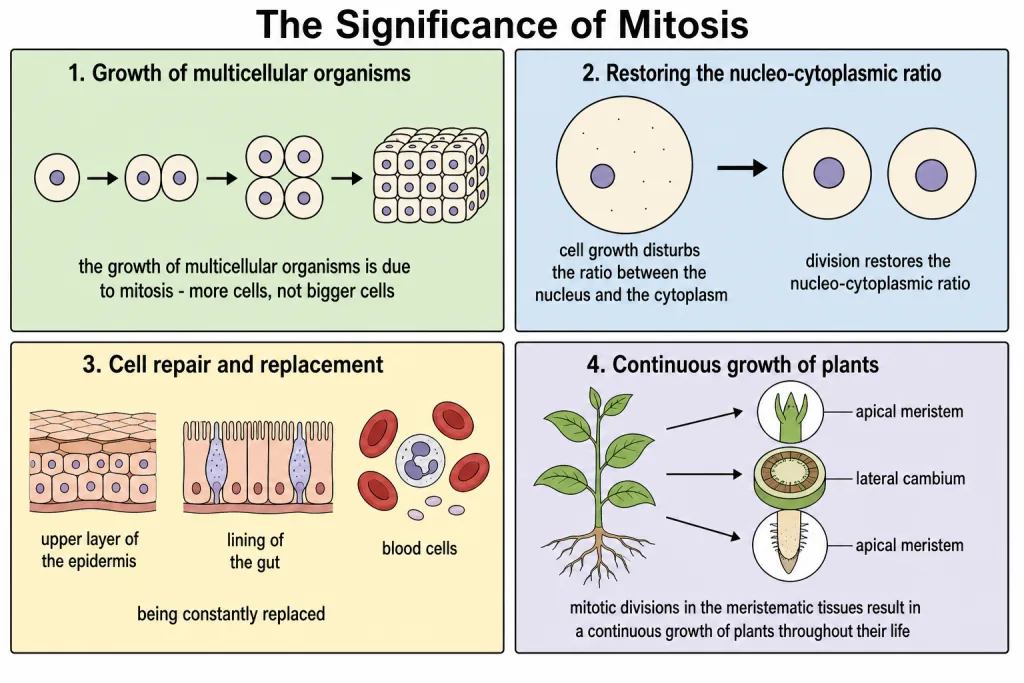
Why a body needs this. The growth of multicellular organisms is due to mitosis. An organism does not get bigger by inflating the cells it already has; it gets bigger by making more cells, each one carrying the same full set of instructions as the cell it came from.
[NEET Important] Two words in the first sentence carry the whole question: usually and diploid. Mitosis is usually restricted to diploid cells, but in some lower plants and in some social insects haploid cells also divide by mitosis - so any option that says mitosis occurs only in diploid cells is wrong. And keep the product clear: diploid daughter cells with identical genetic complement, never four cells and never haploid ones.
The Nucleo-Cytoplasmic Ratio, Repair and Replacement
Cell growth results in disturbing the ratio between the nucleus and the cytoplasm. A cell that keeps growing keeps adding cytoplasm, while the nucleus that has to service that cytoplasm does not keep pace, so the balance between the two is thrown off.
It therefore becomes essential for the cell to divide to restore the nucleo-cytoplasmic ratio. Division is not only how a tissue gets bigger; for the individual cell it is also how the working balance between nucleus and cytoplasm is brought back to normal.
Cell repair. A very significant contribution of mitosis is cell repair. The body is constantly losing cells and constantly making them again:
- The cells of the upper layer of the epidermis are being constantly replaced.
- The cells of the lining of the gut are being constantly replaced.
- Blood cells are being constantly replaced.
Growth that never stops. Mitotic divisions in the meristematic tissues - the apical and the lateral cambium - result in a continuous growth of plants throughout their life. This is a real difference between plants and animals: an animal stops growing, a plant does not, and the reason is that its meristems keep dividing by mitosis.
[NEET Important] The nucleo-cytoplasmic ratio is asked as a straight one-liner: cell growth disturbs it, and division restores it. For repair, learn the three examples as a set - upper layer of the epidermis, lining of the gut, blood cells - because the question is usually set as which of these is not constantly replaced, with heart cells slipped in as the distractor. For plants, name both meristems: the apical and the lateral cambium.
Quick Recap
- Mitosis, the equational division, is usually restricted to the diploid cells only.
- However, in some lower plants and in some social insects, haploid cells also divide by mitosis.
- Mitosis usually results in the production of diploid daughter cells with identical genetic complement.
- The growth of multicellular organisms is due to mitosis.
- Cell growth results in disturbing the ratio between the nucleus and the cytoplasm.
- It therefore becomes essential for the cell to divide to restore the nucleo-cytoplasmic ratio.
- A very significant contribution of mitosis is cell repair.
- The cells of the upper layer of the epidermis, the cells of the lining of the gut, and blood cells are being constantly replaced.
- Mitotic divisions in the meristematic tissues - the apical and the lateral cambium - result in a continuous growth of plants throughout their life.
Solved Examples
Question 1
Q. Which cells is mitosis usually restricted to, and what is the exception?
Answer. Mitosis, the equational division, is usually restricted to the diploid cells only. The exception is that in some lower plants and in some social insects, haploid cells also divide by mitosis.
Question 2
Q. Why is mitosis described as the equational division?
Answer. Because the chromosome number does not change. Mitosis usually results in the production of diploid daughter cells, so a parent gives daughter cells. Nothing is halved, which is what separates it from meiosis.
Question 3
Q. What kind of daughter cells does mitosis usually produce?
Answer. Diploid daughter cells with identical genetic complement - that is, cells with the same chromosome number as the parent and the same genes as the parent.
Question 4
Q. Are the daughter cells of mitosis genetically identical to the parent cell?
Answer. Yes. Mitosis usually results in the production of diploid daughter cells with identical genetic complement. This is why mitosis is the division used for growth and repair, where exact copies are what the body needs.
Question 5
Q. How does mitosis account for the growth of a multicellular organism?
Answer. The growth of multicellular organisms is due to mitosis. The organism grows by producing more cells, each of them diploid and with an identical genetic complement, rather than by enlarging the cells it already has.
Question 6
Q. What is the nucleo-cytoplasmic ratio, and what has it got to do with cell division?
Answer. It is the ratio between the nucleus and the cytoplasm of a cell.
Cell growth results in disturbing the ratio between the nucleus and the cytoplasm - as the cell keeps growing, the amount of cytoplasm rises while the nucleus does not keep pace with it. It therefore becomes essential for the cell to divide to restore the nucleo-cytoplasmic ratio. So division is not only about making more cells; it is also how a single cell brings its own nucleus and cytoplasm back into balance.
Question 7
Q. Name the contribution of mitosis that is described as very significant, and explain it.
Answer. Cell repair. A very significant contribution of mitosis is cell repair, because the body is constantly losing cells that have to be made again. The cells of the upper layer of the epidermis, the cells of the lining of the gut, and blood cells are being constantly replaced.
Question 8
Q. Give three examples of cells in the body that are constantly replaced by mitosis.
Answer. The cells of the upper layer of the epidermis, the cells of the lining of the gut, and blood cells.
Question 9
Q. How do plants keep growing throughout their life?
Answer. By mitotic divisions in the meristematic tissues. Mitotic divisions in the meristematic tissues - the apical and the lateral cambium - result in a continuous growth of plants throughout their life.
Question 10
Q. Name the two meristematic tissues whose mitotic divisions give plants continuous growth.
Answer. The apical meristem and the lateral cambium.
Question 11
Q. State the significance of mitosis in points.
Answer. There are four points worth writing, and together they are the whole of this topic.
- Mitosis, the equational division, is usually restricted to the diploid cells only, though in some lower plants and in some social insects haploid cells also divide by mitosis.
- Mitosis usually results in the production of diploid daughter cells with identical genetic complement, and the growth of multicellular organisms is due to mitosis.
- Cell growth results in disturbing the ratio between the nucleus and the cytoplasm, so it becomes essential for the cell to divide to restore the nucleo-cytoplasmic ratio.
- A very significant contribution of mitosis is cell repair - the cells of the upper layer of the epidermis, the cells of the lining of the gut, and blood cells are being constantly replaced - and mitotic divisions in the meristematic tissues, the apical and the lateral cambium, result in a continuous growth of plants throughout their life.