
Prophase II - Meiosis II Resembles a Normal Mitosis
Meiosis II is initiated immediately after cytokinesis, usually before the chromosomes have fully elongated.
In contrast to meiosis I, meiosis II resembles a normal mitosis. That is the organising idea of this whole section. Every stage of meiosis II does what the matching stage of mitosis does, and if you already know mitosis you already know most of meiosis II.
Prophase II itself is short:
- The nuclear membrane disappears by the end of prophase II.
- The chromosomes again become compact.
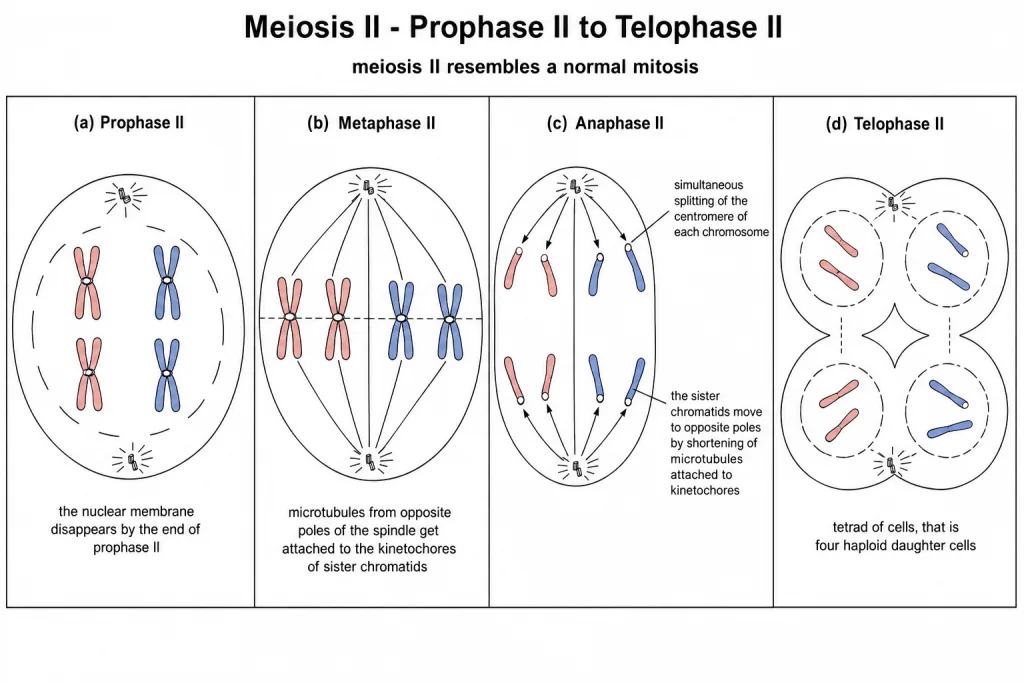
There are no sub-stages here. Prophase I had five - leptotene, zygotene, pachytene, diplotene and diakinesis - with synapsis and crossing over inside it. Prophase II has none of that: no pairing of homologues, no synaptonemal complex, no chiasmata, because the homologues were already separated at anaphase I and are no longer in the same cell.
[NEET Important] Two facts are asked as bare statements: meiosis II is initiated immediately after cytokinesis, usually before the chromosomes have fully elongated, and the nuclear membrane disappears by the end of prophase II. The trap is any option that puts crossing over or synapsis in prophase II - both belong to prophase I only, at pachytene and zygotene respectively.
Metaphase II and Anaphase II
Metaphase II: the chromosomes align at the equator and the microtubules from opposite poles of the spindle get attached to the kinetochores of sister chromatids.
Compare this with metaphase I, where the microtubules attached to the kinetochore of homologous chromosomes. The switch from homologous chromosomes to sister chromatids is the whole difference between the two metaphases, and it is exactly what makes meiosis II behave like mitosis.
Anaphase II: it begins with the simultaneous splitting of the centromere of each chromosome, which was holding the sister chromatids together, allowing them to move toward opposite poles of the cell by shortening of microtubules attached to kinetochores.
Break that sentence into the three things it says:
- The centromere of each chromosome splits, and it splits simultaneously in all of them.
- That centromere was the structure holding the sister chromatids together, so once it splits the sister chromatids are free.
- They move toward opposite poles of the cell by shortening of microtubules attached to kinetochores.
[NEET Important] Anaphase II is where sister chromatids finally separate - not anaphase I. Questions phrased as "at which stage do sister chromatids separate in meiosis" have the answer anaphase II, and the distractor is always anaphase I. Learn the mechanism word for word too: splitting of the centromere, then movement by shortening of microtubules attached to kinetochores.
Telophase II and the Tetrad
Meiosis ends with telophase II, in which the two groups of chromosomes once again get enclosed by a nuclear envelope; cytokinesis follows, resulting in the formation of a tetrad of cells, that is four haploid daughter cells.
Fix the two counting words side by side, because this is where marks are lost.
| End of | Number of cells | Name of the group | Chromosome number of each cell |
|---|---|---|---|
| Telophase I (meiosis I) | Two | Dyad | , each chromosome still with two chromatids |
| Telophase II (meiosis II) | Four | Tetrad | , each chromosome now a single chromatid |
Do not confuse this tetrad with the other one. Earlier in the chapter the word tetrad was used for a bivalent - the complex formed by a pair of synapsed homologous chromosomes, whose four chromatids appear clearly at pachytene. Here tetrad means four cells. Same word, two meanings, and the examiner knows it.
[NEET Important] Dyad after telophase I, tetrad after telophase II. And be ready for the word tetrad used in its other sense: at pachytene the four chromatids of each bivalent become distinct and clearly appear as tetrads. Read the stem to see whether it is talking about chromatids or cells.
Meiosis II Set Against Mitosis, Stage by Stage
Because meiosis II resembles a normal mitosis, the cleanest way to hold it is as a one-to-one match.
| Stage | In mitosis | In meiosis II | Same or different |
|---|---|---|---|
| Prophase | Chromosomal material condenses into compact chromosomes; the nuclear envelope disappears; each chromosome has two chromatids joined at the centromere | The chromosomes again become compact; the nuclear membrane disappears by the end of prophase II | Same in behaviour. Meiosis II starts from cells that are already , and starts immediately after cytokinesis, before the chromosomes have fully elongated |
| Metaphase | Chromosomes lie at the equator; spindle fibres attach to the kinetochores of the sister chromatids, one to each pole | Chromosomes align at the equator; microtubules from opposite poles attach to the kinetochores of sister chromatids | Same |
| Anaphase | Centromeres split, chromatids separate and move to opposite poles | Simultaneous splitting of the centromere of each chromosome, and the sister chromatids move to opposite poles by shortening of microtubules attached to kinetochores | Same |
| Telophase | Chromosomes cluster at the poles, a nuclear envelope forms around each cluster, the nucleolus reforms, cytokinesis follows and two cells result | The two groups of chromosomes get enclosed by a nuclear envelope, cytokinesis follows | Same in mechanism. The outcome differs: mitosis of a cell gives two cells, while meiosis II acting on both cells of the dyad gives four cells |
The one thing that is not the same is what went before. Meiosis II follows meiosis I and interkinesis, in which there is no replication of DNA, so the cells entering it are already haploid. Mitosis is preceded by a full interphase with an S phase.
[NEET Important] "Meiosis II resembles a normal mitosis" is a quotable line, and it is also why meiosis II is called equational - the chromosome number does not change during it, stays . The reduction already happened at meiosis I. An option saying meiosis II halves the chromosome number is wrong.
Quick Recap
- Meiosis II is initiated immediately after cytokinesis, usually before the chromosomes have fully elongated.
- In contrast to meiosis I, meiosis II resembles a normal mitosis.
- Prophase II - the nuclear membrane disappears by the end of prophase II, and the chromosomes again become compact.
- Prophase II has no sub-stages, and no synapsis, no crossing over and no chiasmata - those belong to prophase I.
- Metaphase II - the chromosomes align at the equator and the microtubules from opposite poles of the spindle get attached to the kinetochores of sister chromatids.
- In metaphase I the attachment was to the kinetochore of homologous chromosomes; in metaphase II it is to sister chromatids.
- Anaphase II begins with the simultaneous splitting of the centromere of each chromosome, which was holding the sister chromatids together.
- The freed chromatids move toward opposite poles of the cell by shortening of microtubules attached to kinetochores.
- Sister chromatids separate at anaphase II, not at anaphase I.
- Telophase II - the two groups of chromosomes once again get enclosed by a nuclear envelope; cytokinesis follows.
- The result is a tetrad of cells, that is four haploid daughter cells.
- Telophase I gives a dyad of two cells; telophase II gives a tetrad of four cells.
- The word tetrad is also used for a bivalent, whose four chromatids appear clearly at pachytene - read the question stem to see which is meant.
- Meiosis II is equational - the chromosome number stays ; the reduction happened at meiosis I.
Solved Examples
Question 1
Q. When is meiosis II initiated?
Answer. Immediately after cytokinesis at the end of meiosis I, usually before the chromosomes have fully elongated.
Question 2
Q. Why is it said that meiosis II resembles a normal mitosis?
Answer. Because every stage of meiosis II does what the matching stage of mitosis does. In metaphase II the spindle fibres attach to the kinetochores of sister chromatids, exactly as in mitotic metaphase. In anaphase II the centromere of each chromosome splits and the sister chromatids move to opposite poles, exactly as in mitotic anaphase. And the chromosome number does not change during meiosis II, so like mitosis it is equational. The difference is only that the cells entering meiosis II are already haploid.
Question 3
Q. When does the nuclear membrane disappear during meiosis II?
Answer. By the end of prophase II. The chromosomes also again become compact during prophase II.
Question 4
Q. Does crossing over occur in prophase II?
Answer. No. Crossing over occurs at pachytene of prophase I, between non-sister chromatids of homologous chromosomes. By prophase II the homologues have already been separated at anaphase I, so there is nothing left to pair with. Prophase II is a much simpler prophase than prophase I and has no sub-stages.
Question 5
Q. Describe metaphase II.
Answer. The chromosomes align at the equator, and the microtubules from opposite poles of the spindle get attached to the kinetochores of sister chromatids.
Question 6
Q. How does the spindle attachment at metaphase II differ from that at metaphase I?
Answer. At metaphase I the microtubules from the opposite poles attach to the kinetochore of homologous chromosomes - the two members of a bivalent face opposite poles. At metaphase II they attach to the kinetochores of sister chromatids of one chromosome, which is what happens in mitosis too.
Question 7
Q. Describe anaphase II.
Answer. It begins with the simultaneous splitting of the centromere of each chromosome, which was holding the sister chromatids together. Once the centromere splits, the chromatids are free to move toward opposite poles of the cell by shortening of microtubules attached to kinetochores.
Question 8
Q. At which stage of meiosis do sister chromatids finally separate?
Answer. Anaphase II. They do not separate at anaphase I, where the homologous chromosomes separate while sister chromatids remain associated at their centromeres.
Question 9
Q. Describe telophase II.
Answer. Meiosis ends with telophase II, in which the two groups of chromosomes once again get enclosed by a nuclear envelope. Cytokinesis follows, resulting in the formation of a tetrad of cells, that is four haploid daughter cells.
Question 10
Q. Distinguish a dyad from a tetrad of cells.
Answer. A dyad is the two cells formed at the end of telophase I, and each chromosome in them still has two chromatids. A tetrad is the four haploid daughter cells formed at the end of telophase II, and each chromosome in them is now a single chromatid. Both sets of cells have chromosomes.
Note that the word tetrad is used in a second sense earlier in the chapter, for a bivalent, because the four chromatids of each bivalent become distinct and clearly appear as tetrads at pachytene.
Question 11
Q. Find examples where the four daughter cells from meiosis are equal in size and where they are found unequal in size. This is one of the chapter-end exercises.
Answer. Both examples come from gametogenesis in animals, which is where meiosis happens.
Equal in size - spermatogenesis. In the formation of male gametes, the cytoplasm is divided equally at each cytokinesis, so the tetrad is four cells of equal size, and all four become functional sperms.
Unequal in size - oogenesis. In the formation of the female gamete, the cytoplasm divides unequally. One cell keeps almost all the cytoplasm and becomes the large functional ovum, while the other cells are very small and are called polar bodies. So here the four cells of the tetrad are unequal in size, and only one of them is a functional gamete.
The chromosome number is the same in all four cells in both cases - each is haploid, . It is only the amount of cytoplasm that is shared unequally in oogenesis, and that is what gives the ovum the stores a zygote will need.
Question 12
Q. Why is meiosis II called equational when meiosis as a whole is reductional?
Answer. Because the chromosome number does not change during meiosis II. The cells entering it are already , and anaphase II only separates sister chromatids, so each of the four daughter cells is also . The reduction from to happened at meiosis I, when the homologous chromosomes separated.
Question 13
Q. A cell of the dyad contains 10 chromosomes. What does each cell contain after meiosis II is complete?
Answer. 10 chromosomes each, in four cells. Meiosis II is equational, so the chromosome number does not change - anaphase II only splits the centromeres and separates the sister chromatids, so each of the 10 chromosomes is now a single chromatid instead of two.