
Significance of Meiosis
Meiosis is the mechanism by which conservation of the specific chromosome number of each species is achieved across generations in sexually reproducing organisms, even though the process, per se, paradoxically, results in reduction of chromosome number by half.
Read that sentence twice, because it contains an apparent contradiction and the contradiction is the answer.
- Meiosis halves the chromosome number. A cell gives four cells that are each .
- Yet across generations the chromosome number of the species is conserved. Meiosis ensures the production of the haploid phase in the life cycle of sexually reproducing organisms, whereas fertilisation restores the diploid phase. When the two gametes fuse, the chromosome number is restored to the value in the parent.
So the halving is not a loss - it is what makes the restoring possible. If gametes were formed by mitosis and stayed , the zygote would be , the next generation , and the number would double without limit. The reduction at meiosis exactly cancels the doubling at fertilisation.
The second contribution is variation.
Meiosis also increases the genetic variability in the population of organisms from one generation to the next, and variations are very important for the process of evolution.
Where that variability comes from was established earlier in the chapter: meiosis involves pairing of homologous chromosomes and recombination between non-sister chromatids of homologous chromosomes. Crossing over is the exchange of genetic material between two homologous chromosomes, it occurs at pachytene at the recombination nodules, it is enzyme-mediated by recombinase, and it leads to recombination of genetic material on the two chromosomes. Mitosis has none of this, which is why mitosis usually results in the production of diploid daughter cells with identical genetic complement.
[NEET Important] The word to keep is paradoxically. A full-mark answer says both halves: meiosis reduces the chromosome number by half, and precisely because of that, fertilisation restores it, so the specific chromosome number of the species is conserved across generations. Then add the second point - increased genetic variability, which is very important for the process of evolution.
Mitosis Compared with Meiosis
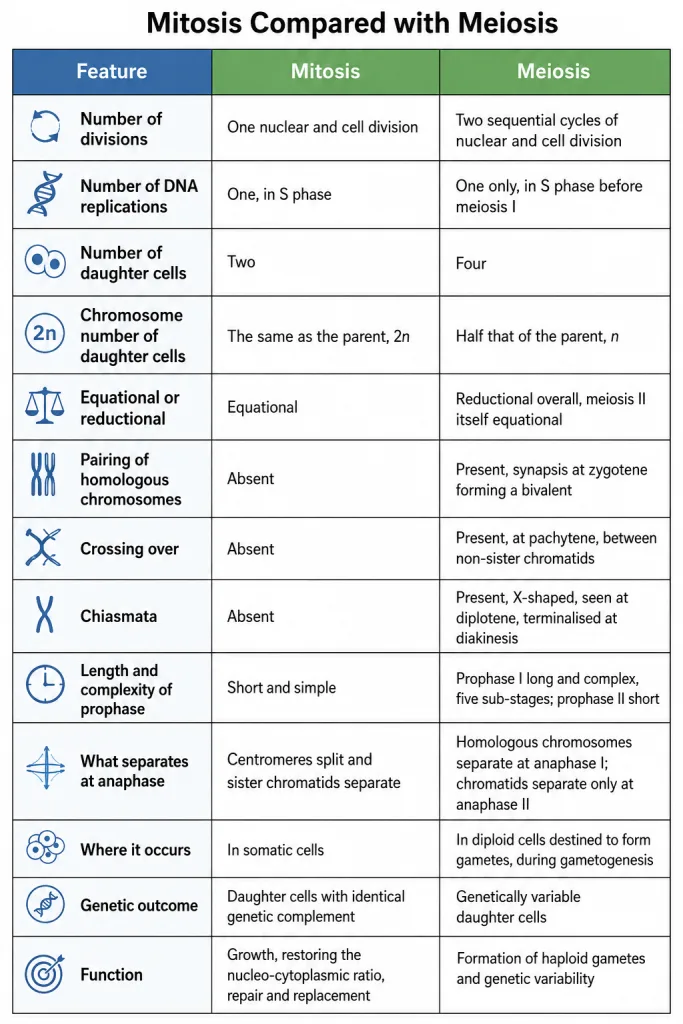
Everything in this table has already been established earlier in the chapter. Learn it as rows of contrast, because that is exactly how the question is set.
| Feature | Mitosis | Meiosis |
|---|---|---|
| Number of divisions | One nuclear and cell division | Two sequential cycles of nuclear and cell division - meiosis I and meiosis II |
| Number of DNA replications | One, in S phase | One only, in S phase before meiosis I - there is no replication of DNA during interkinesis |
| Number of daughter cells | Two | Four |
| Chromosome number of daughter cells | The same as the parent, | Half that of the parent, |
| Nature of the division | Equational | Reductional overall, though meiosis II is itself equational - the reduction happens at meiosis I |
| Pairing of homologous chromosomes | Absent | Present - synapsis at zygotene, forming a bivalent |
| Crossing over | Absent | Present - at pachytene, between non-sister chromatids of homologous chromosomes |
| Chiasmata | Absent | Present - the X-shaped structures seen at diplotene where the recombined homologues stay linked, later terminalised at diakinesis |
| Prophase | Short and simple | Prophase I is typically longer and more complex, with five sub-stages - leptotene, zygotene, pachytene, diplotene and diakinesis; prophase II is short and simple |
| Anaphase | The centromeres split and the sister chromatids separate | In anaphase I the homologous chromosomes separate while sister chromatids remain associated at their centromeres; the chromatids separate only at anaphase II |
| Where it occurs | In somatic cells - in animals it is restricted to the diploid somatic cells | In diploid cells destined to form gametes - during gametogenesis in plants and animals |
| Genetic outcome | Diploid daughter cells with identical genetic complement | Genetically variable daughter cells, because of crossing over and recombination |
| Function | Growth of multicellular organisms, restoring the nucleo-cytoplasmic ratio, cell repair and the replacement of cells such as the epidermis, the lining of the gut and blood cells | Formation of haploid gametes, and the introduction of genetic variability into the population |
[NEET Important] Three rows are asked far more than the rest: number of daughter cells (two against four), chromosome number of the daughter cells ( against ), and the anaphase contrast. The one row students get wrong is number of DNA replications - the answer is one for each, not two for meiosis. Two divisions, one replication.
The Contrasts Behind the Table
The table is easier to hold if you see that most of its rows follow from two structural differences.
Difference one: meiosis pairs the homologues, mitosis does not.
Meiosis involves pairing of homologous chromosomes and recombination between non-sister chromatids of homologous chromosomes. From that one fact come four whole rows:
- Synapsis at zygotene gives the bivalent - so pairing: absent in mitosis, present in meiosis.
- Crossing over at pachytene - so crossing over: absent in mitosis, present in meiosis.
- Chiasmata at diplotene - so chiasmata: absent in mitosis, present in meiosis.
- All of this takes time, which is why prophase I is typically longer and more complex than prophase of mitosis, and why it needs five sub-stages while mitotic prophase needs none.
Difference two: meiosis divides twice on one round of replication.
Meiosis involves two sequential cycles of nuclear and cell division but only a single cycle of DNA replication, and there is no replication of DNA during interkinesis. From that come the rest of the rows:
- Two divisions instead of one, so four daughter cells instead of two.
- The first division separates homologues, halving the number, so the daughter cells are instead of - reductional against equational.
- The second division separates sister chromatids, so meiosis II resembles a normal mitosis and is itself equational.
And the two purposes follow from the two differences. Because the number is halved, fertilisation can restore it and the chromosome number of the species is conserved. Because homologues pair and cross over, the gametes are genetically variable. Mitosis, which does neither, gives daughter cells with identical genetic complement and is used for growth, repair and replacement.
[NEET Important] When a question asks for "the main differences", do not list ten disconnected lines. Give the anchor difference first - meiosis has two divisions on one round of DNA replication, and it pairs homologous chromosomes - then hang the specific contrasts on it. That is also how the two-mark and five-mark versions of this question differ.
Quick Recap
- Meiosis is the mechanism by which conservation of the specific chromosome number of each species is achieved across generations in sexually reproducing organisms.
- It does this even though the process, per se, paradoxically, results in reduction of chromosome number by half.
- Meiosis ensures the haploid phase; fertilisation restores the diploid phase, so the chromosome number is restored to the value in the parent.
- Meiosis also increases the genetic variability in the population of organisms from one generation to the next.
- Variations are very important for the process of evolution.
- Mitosis - one division; meiosis - two sequential cycles of nuclear and cell division.
- Both have only a single cycle of DNA replication.
- Mitosis gives two daughter cells; meiosis gives four.
- Mitotic daughter cells are , the same as the parent; meiotic daughter cells are , half the parent.
- Mitosis is equational; meiosis is reductional overall, though meiosis II is itself equational.
- Pairing of homologous chromosomes - absent in mitosis, present in meiosis at zygotene.
- Crossing over - absent in mitosis, present in meiosis at pachytene.
- Chiasmata - absent in mitosis, present in meiosis from diplotene.
- Mitotic prophase is short; prophase I is long and complex, with five sub-stages.
- Mitotic anaphase - centromeres split and sister chromatids separate. Anaphase I - homologous chromosomes separate while sister chromatids remain associated at their centromeres.
- Mitosis occurs in somatic cells; meiosis occurs in diploid cells destined to form gametes, during gametogenesis.
- Mitosis gives daughter cells with identical genetic complement; meiosis gives genetically variable cells.
- Mitosis is for growth, repair and replacement; meiosis is for gamete formation and variation.
Solved Examples
Question 1
Q. What is the significance of meiosis? This is one of the chapter-end exercises.
Answer. Meiosis matters for two reasons, and a full answer gives both.
One - it conserves the chromosome number of the species. Meiosis is the mechanism by which conservation of the specific chromosome number of each species is achieved across generations in sexually reproducing organisms, even though the process, per se, paradoxically, results in reduction of chromosome number by half.
The apparent contradiction resolves like this. Meiosis ensures the production of the haploid phase in the life cycle of sexually reproducing organisms, whereas fertilisation restores the diploid phase. Gametes are formed from specialised diploid cells by a division that reduces the chromosome number by half, and when the two gametes fuse the chromosome number is restored to the value in the parent. If the gametes were made by mitosis instead and stayed , the number would double at every generation. The halving at meiosis exactly cancels the doubling at fertilisation.
Two - it increases genetic variability. Meiosis increases the genetic variability in the population of organisms from one generation to the next, and variations are very important for the process of evolution. The variability comes from the pairing of homologous chromosomes and recombination between non-sister chromatids: crossing over at pachytene is the exchange of genetic material between two homologous chromosomes, and it leads to recombination of genetic material on the two chromosomes.
Question 2
Q. List the main differences between mitosis and meiosis. This is one of the chapter-end exercises.
Answer. The two anchor differences are that meiosis has two divisions on a single round of DNA replication, and that meiosis pairs homologous chromosomes while mitosis does not. Everything else follows.
| Feature | Mitosis | Meiosis |
|---|---|---|
| Number of divisions | One | Two - meiosis I and meiosis II |
| Number of DNA replications | One | One |
| Number of daughter cells | Two | Four |
| Chromosome number of daughter cells | Same as the parent, | Half the parent, |
| Nature of division | Equational | Reductional, though meiosis II is itself equational |
| Pairing of homologous chromosomes | Absent | Present, at zygotene |
| Crossing over | Absent | Present, at pachytene |
| Chiasmata | Absent | Present, from diplotene |
| Prophase | Short and simple | Prophase I is long and complex, with five sub-stages |
| Anaphase | Centromeres split and sister chromatids separate | In anaphase I homologous chromosomes separate while sister chromatids remain associated at their centromeres |
| Site | Somatic cells | Diploid cells destined to form gametes, during gametogenesis |
| Genetic outcome | Daughter cells with identical genetic complement | Genetically variable daughter cells |
| Function | Growth, repair and replacement of cells | Gamete formation and genetic variation |
Question 3
Q. Why is it a paradox that meiosis conserves the chromosome number of a species?
Answer. Because the process itself reduces the chromosome number by half, which sounds like the opposite of conserving it. The reduction is what makes conservation possible: meiosis produces the haploid phase and fertilisation restores the diploid phase, so the chromosome number is restored to the value in the parent in every generation.
Question 4
Q. What would happen to the chromosome number across generations if gametes were formed by mitosis?
Answer. It would double every generation. Each gamete would be , so the zygote would be , its offspring , and so on. Meiosis prevents this by halving the chromosome number before fertilisation doubles it.
Question 5
Q. How does meiosis increase genetic variability?
Answer. Through the pairing of homologous chromosomes and recombination between non-sister chromatids of homologous chromosomes. Crossing over, the exchange of genetic material between two homologous chromosomes, takes place at pachytene at the recombination nodules and leads to recombination of genetic material on the two chromosomes. The gametes therefore carry combinations of genetic material not present in the parent.
Question 6
Q. Why are variations important?
Answer. Variations are very important for the process of evolution.
Question 7
Q. How many divisions and how many rounds of DNA replication does each type of division involve?
Answer. Mitosis: one division, one round of DNA replication. Meiosis: two sequential cycles of nuclear and cell division, but still only a single cycle of DNA replication, because there is no replication of DNA during interkinesis.
Question 8
Q. How many daughter cells does each type of division produce, and what is their chromosome number?
Answer. Mitosis gives two daughter cells, each with the same chromosome number as the parent, . Meiosis gives four daughter cells, each with half the chromosome number of the parent, .
Question 9
Q. Mitosis is equational and meiosis is reductional. Where exactly is meiosis reductional?
Answer. At meiosis I. Anaphase I separates the homologous chromosomes, so each cell of the dyad receives half the parent chromosome number. Meiosis II is itself equational - it resembles a normal mitosis and separates only sister chromatids, leaving the number at .
Question 10
Q. Which features of prophase I have no counterpart in mitotic prophase?
Answer. Synapsis, the synaptonemal complex, the bivalent, crossing over and chiasmata. Pairing of homologous chromosomes is absent in mitosis, and so is crossing over. This is why prophase I is typically longer and more complex than the prophase of mitosis, and why it is subdivided into five phases - leptotene, zygotene, pachytene, diplotene and diakinesis.
Question 11
Q. Where in the body does each division occur?
Answer. Mitosis occurs in somatic cells - in animals, mitotic cell division is only seen in the diploid somatic cells, with a few exceptions such as male honey bees, while plants show mitosis in both haploid and diploid cells. Meiosis occurs in the diploid cells which are destined to form gametes, and we come across meiosis during gametogenesis in plants and animals.
Question 12
Q. Compare the genetic make-up of the daughter cells produced by the two divisions.
Answer. Mitosis usually results in the production of diploid daughter cells with identical genetic complement - they are copies of the parent cell. Meiosis gives genetically variable daughter cells, because crossing over recombines genetic material between homologous chromosomes.
Question 13
Q. State the biological function of each division.
Answer. Mitosis is for growth, repair and replacement. The growth of multicellular organisms is due to mitosis, it restores the nucleo-cytoplasmic ratio disturbed by cell growth, and a very significant contribution of mitosis is cell repair - the cells of the upper layer of the epidermis, the cells of the lining of the gut and the blood cells are being constantly replaced.
Meiosis is for gamete formation and variation. It produces the haploid gametes needed for sexual reproduction, conserves the chromosome number of the species across generations, and increases the genetic variability in the population.