
Introduction to Conic Sections
A conic section (or simply a conic) is a curve you get when you slice through a double-napped cone with a plane. 🔪 Imagine a cone like an hourglass. Depending on the angle of your slice, you can create four different types of curves: a circle, an ellipse, a parabola, or a hyperbola.
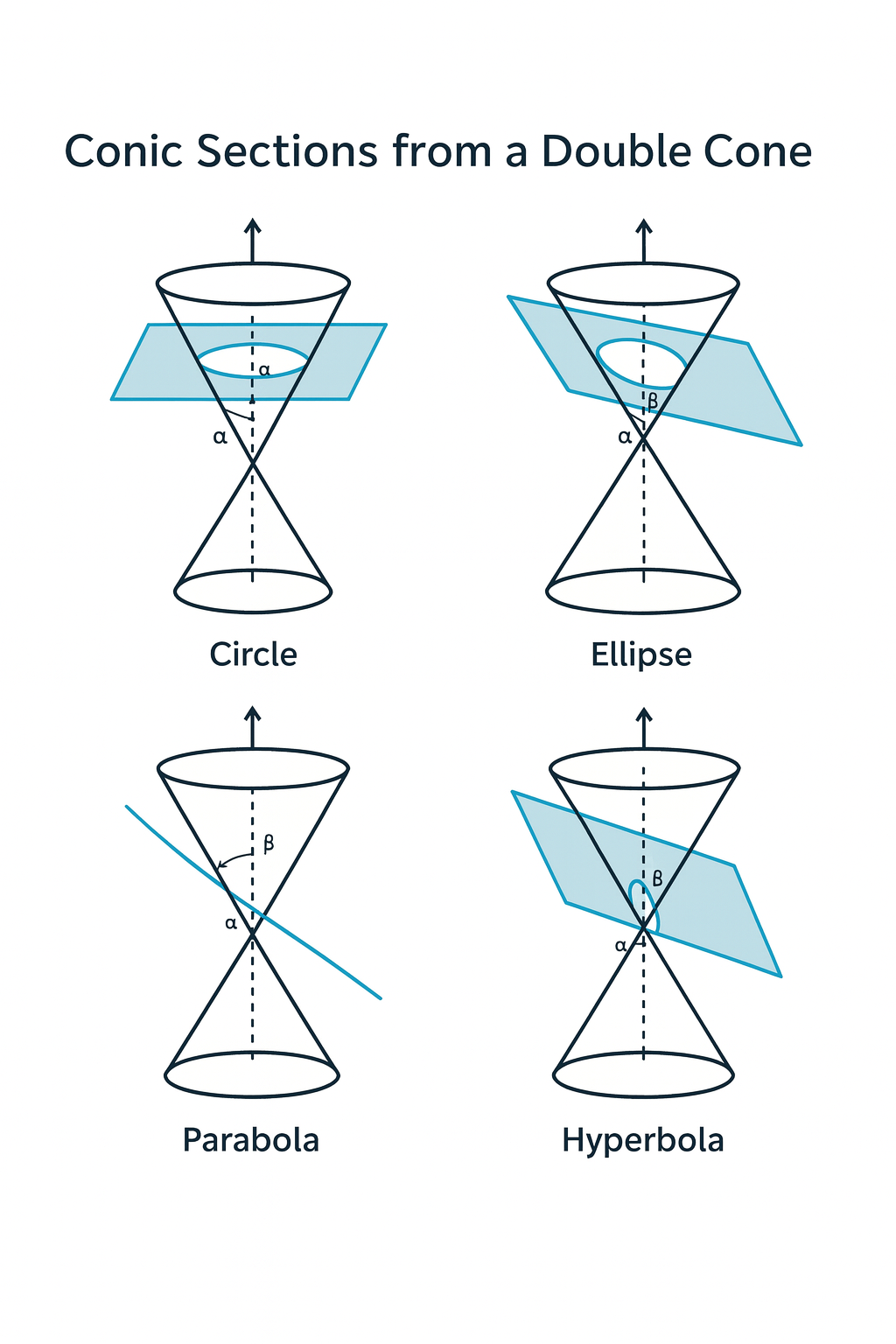
- Circle: Formed when the plane is perpendicular to the cone's axis.
- Ellipse: Formed when the plane is tilted but still cuts across one nap of the cone.
- Parabola: Formed when the plane is parallel to the side of the cone.
- Hyperbola: Formed when the plane is steep enough to cut through both naps of the cone.
The Locus Definition of a Conic
Another way to define a conic is by using a special property involving distances. A conic section is the locus (path) of a point P that moves in a plane so that the ratio of its distance from a fixed point (the focus, S) to its perpendicular distance from a fixed line (the directrix, L) is a constant. This constant ratio is called the eccentricity (e).
The value of eccentricity tells you exactly which conic you're looking at:
- If e = 0, the conic is a Circle. (The directrix is at infinity).
- If e = 1, the conic is a Parabola. (The point is equidistant from the focus and directrix).
- If 0 < e < 1, the conic is an Ellipse. (The point is closer to the focus than the directrix).
- If e > 1, the conic is a Hyperbola. (The point is farther from the focus than the directrix).
The Circle 🔵
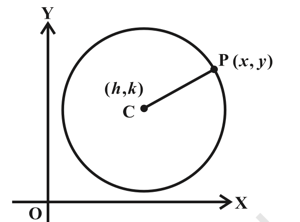
A circle is the set of all points in a plane that are at a fixed distance (the radius, r) from a fixed point (the center, (h,k)).
Equations of a Circle:
Standard (Center-Radius) Form: This form comes directly from the distance formula. For any point (x,y) on the circle, its distance from the center (h,k) is r.
General Equation: If you expand the standard form, you get the general second-degree equation for a circle. Any equation in this form represents a circle.
From this, you can quickly find the circle's properties:
- Center:
- Radius:
- For a real circle to exist, the term under the square root must be positive, so .
Diameter Form: This is a neat shortcut. If you know the endpoints of a diameter, and , any other point on the circle forms a 90° angle with the diameter. This geometric fact leads to the equation:
Parametric Equation: This form is useful for calculus and describing motion. It defines the coordinates of any point on the circle in terms of an angle .
Here, is the parameter, representing the angle from the center to the point, measured from the horizontal. It ranges from .
Example 1: Finding the Equation from Center and Radius
Question: Find the equation of the circle with center (-3,2) and radius 4.
Solution: This is a direct application of the center-radius form: . Here, and .
✅ Standard Form:
Expanding this gives the general form:
✅ General Form: .
Example 2: Finding Center and Radius from General Form
Question: Find the center and radius of the circle .
Solution: We compare the given equation with the general form .
- .
- .
- .
Now, we use the formulas for center and radius:
- Center: .
- Radius: .
Example 3: Using the Diameter Form
Question: Find the equation of the circle whose diameter has endpoints A(-2,3) and B(4,5).
Solution: Using the diameter form with and .
Now, expand the products:
Combining terms gives the final equation:
Example 4: Circle Touching an Axis
Question: Find the equation of a circle that is concentric with and touches the y-axis.
Solution: Concentric means the circles share the same center. concentric circles
Step 1: Find the center of the given circle. For , we have and . The center is .
Step 2: Determine the radius of the new circle. The new circle also has its center at (2, 3). For a circle to touch the y-axis, its radius must be equal to the absolute value of the x-coordinate of its center.
So, the radius is the horizontal distance from the center (2,3) to the y-axis, which is .
Step 3: Write the equation of the required circle. Using the center-radius form with center (2, 3) and radius 2: