
Definition of an Ellipse
An ellipse is the locus of a point P that moves in a plane such that the sum of its distances from two fixed points (the foci, F₁ and F₂) is constant. This constant sum is equal to the length of the major axis (2a).
Alternatively, it can be defined as a conic section with an eccentricity e such that . An eccentricity of 0 is a perfect circle, and as 'e' approaches 1, the ellipse becomes more elongated.
Standard Equation of an Ellipse
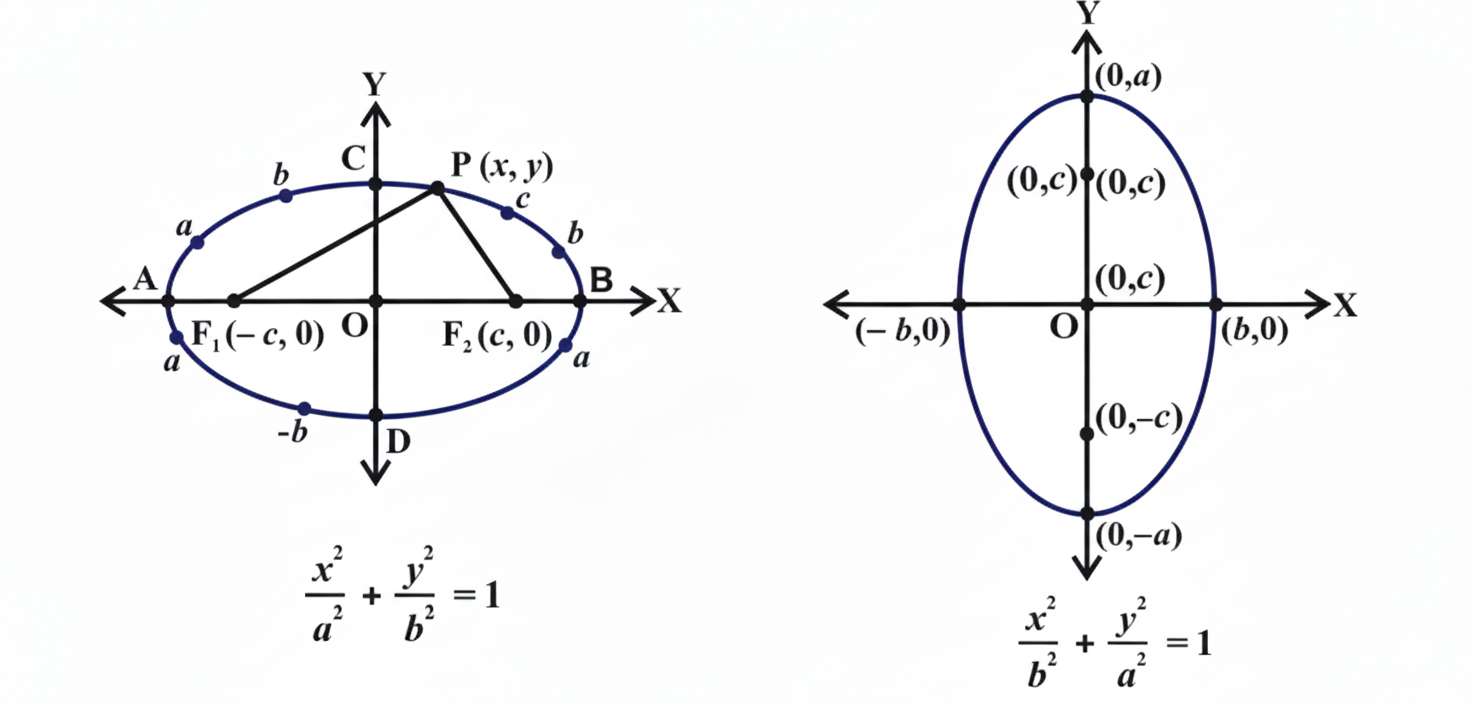
The standard equation assumes the ellipse is centered at the origin (0,0).
Horizontal Ellipse: (where )
Vertices:
Foci: , where .
Major Axis: Length (along the x-axis).
Minor Axis: Length (along the y-axis).
Vertical Ellipse: (where )
Vertices:
Foci: , where .
Major Axis: Length (along the y-axis).
Minor Axis: Length (along the x-axis).
Key Terminology and Formulas
For a horizontal ellipse (similar formulas apply for a vertical one):
- Relationship between a, b, and c: The distances from the center to a vertex (a), center to a co-vertex (b), and center to a focus (c) are related by a formula resembling the Pythagorean theorem:
This also gives the key eccentricity relationship:
Directrices: The equations of the two directrices are .
Latus Rectum: The focal chord perpendicular to the major axis. Its length is a measure of the ellipse's 'width' at the focus.
Length of the latus rectum:
Endpoints of the latus rectum:
Parametric Coordinates
Any point on the ellipse can be represented by the coordinates , where '' is the eccentric angle, not the actual angle to the point.
Example 1: Finding Parameters from the Equation
Question: For the ellipse , find the lengths of the major and minor axes, the coordinates of the foci, and the eccentricity.
Solution:
Step 1: Convert to standard form by dividing by 400:
Step 2: Identify a and b. Since , this is a horizontal ellipse with and .
Major Axis: .
Minor Axis: .
Step 3: Find c and the foci.
. The foci are at .
Step 4: Find the eccentricity.
.
Example 2: Finding the Equation from Parameters
Question: Find the equation of the ellipse whose foci are at and vertices are at .
Solution:
From the vertices , we get . From the foci , we get . Since the foci are on the x-axis, it's a horizontal ellipse. We need to find .
Using the relation :
.
The equation is .
Example 3: Using the Latus Rectum
Question: Find the equation of the ellipse whose latus rectum is 10 and whose minor axis is equal to the distance between its foci.
Solution:
Let the ellipse be .
Condition 1: Length of latus rectum: . (i)
Condition 2: Length of minor axis = Distance between foci: . (ii)
Now we use the main relation . Substituting gives . (iii)
Now we have a system of equations. Substitute (i) into (iii):
. Since , we can divide by a to get .
Now find using (i): .
The equation is .
Example 4: Ellipse with a Shifted Center
Question: Find the center, foci, and eccentricity of the ellipse .
Solution:
Step 1: Group terms and complete the square.
Step 2: Divide by 36 to get standard form.
Center: .
Parameters: ; .
Foci distance (c): .
Foci: The ellipse is horizontal, so foci are at .
Eccentricity (e): .
Example 5: Using the Fundamental Definition
Question: A point P moves such that the sum of its distances from (4,0) and (-4,0) is 10. Find the equation of the locus of P.
Solution:
This is the definition of an ellipse. The two fixed points are the foci, and the constant sum is the length of the major axis.
Foci: , so .
Major Axis: , so .
We find using : .
The locus is a horizontal ellipse centered at the origin with the equation .