
Definition of a Parabola
A parabola is the locus of a point that moves in a plane such that its distance from a fixed point (the focus) is always equal to its perpendicular distance from a fixed line (the directrix). This is the key property of a parabola, which corresponds to an eccentricity of e = 1.
Standard Equation of a Parabola
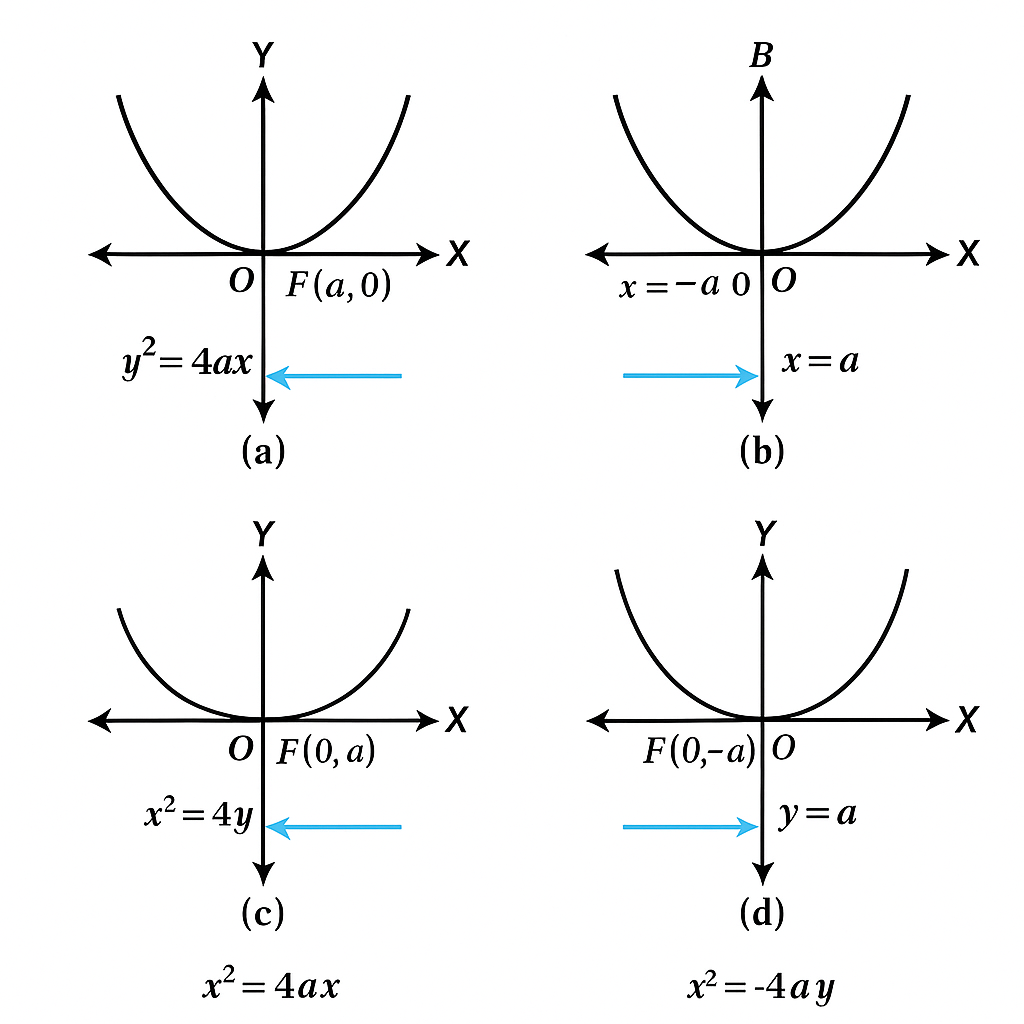
The simplest form of the equation is when the vertex is at the origin (0,0) and the axis of symmetry is one of the coordinate axes.
Right-handed Parabola: (opens to the right)
- Vertex: (0, 0)
- Focus: (a, 0)
- Directrix:
- Axis: (x-axis)
Left-handed Parabola: (opens to the left, focus at (-a,0), directrix at x=a)
Upward Parabola: (opens upwards, focus at (0,a), directrix at y=-a)
Downward Parabola: (opens downwards, focus at (0,-a), directrix at y=a)
Key Terminology
- Axis of Symmetry: The line passing through the focus and perpendicular to the directrix. The parabola is perfectly symmetric about this line.
- Vertex: The point where the parabola intersects its axis of symmetry. It is the turning point of the curve and lies exactly halfway between the focus and the directrix.
- Focal Chord: Any chord (a line segment connecting two points on the parabola) that passes through the focus.
- Latus Rectum: This is a special focal chord that is perpendicular to the axis of symmetry. Its length is a measure of the 'width' of the parabola at the focus.
- For , the length of the latus rectum is .
- The endpoints of the latus rectum are (a, 2a) and (a, -2a).
Parametric Coordinates
For complex problems, describing points on a parabola with a single variable, or parameter, is incredibly useful. Any point on the parabola can be represented by the coordinates . The parameter 't' is the slope of the line joining the origin to the point on the parabola if the vertex is at the origin.
Example 1: Finding Parameters from the Equation
Question: For the parabola , find the coordinates of the focus, the equation of the directrix, and the length of the latus rectum.
Solution: Step 1: Compare the given equation with the standard form . Step 2: Use the value of 'a' to find the parameters.
- Focus: .
- Directrix: .
- Length of Latus Rectum: .
Example 2: Finding the Equation from Parameters
Question: Find the equation of the parabola with focus at (6,0) and directrix .
Solution: Step 1: Identify the type of parabola and the value of 'a'. The focus is at and the directrix is at . By comparison, we see that . Since the focus is on the positive x-axis and the directrix is on the negative side, the parabola opens to the right. The vertex is at the origin (0,0). Step 2: Write the equation. The standard equation is . Substituting , we get:
Example 3: Parabola with a Shifted Vertex
Question: Find the equation of the parabola whose vertex is at (2,1) and focus is at (2,4).
Solution: Step 1: Analyze the vertex and focus. The vertex is and the focus is at . The x-coordinates are the same, so the axis of symmetry is the vertical line . Since the focus is above the vertex, the parabola opens upwards. Step 2: Find the value of 'a'. The distance from the vertex to the focus is . Step 3: Write the equation. The equation of an upward-opening parabola with a shifted vertex is . Substituting the values, we get:
Example 4: Using the Latus Rectum
Question: Find the equation of the parabola whose latus rectum has endpoints (3,5) and (3,-3).
Solution: Step 1: Find the focus and the value of 'a'. The latus rectum is a vertical line segment (), so the parabola's axis is horizontal. The focus is the midpoint of the latus rectum: The length of the latus rectum is the distance between the endpoints: . This length is equal to . Step 2: Determine the possible vertices and equations. The vertex is at a distance 'a' from the focus along the axis. Since the axis is horizontal (y=1), the vertex can be to the left or right of the focus.
- Case 1 (Opens Right): Vertex is at . The equation is .
- Case 2 (Opens Left): Vertex is at . The equation is .