
Definition of a Hyperbola
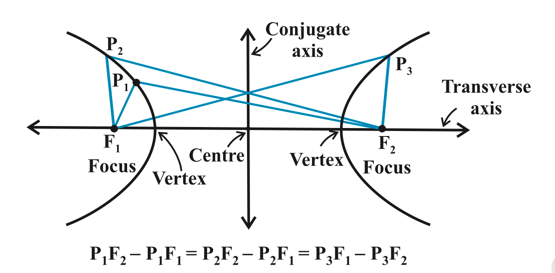
A hyperbola is the locus of a point that moves in a plane such that the absolute difference of its distances from two fixed points (the foci) is constant. This constant difference is equal to the length of the transverse axis (2a).
Alternatively, it can be defined as a conic section with an eccentricity e such that e > 1. This means any point on the hyperbola is farther from the directrix than it is from the focus.
Standard Equation of a Hyperbola
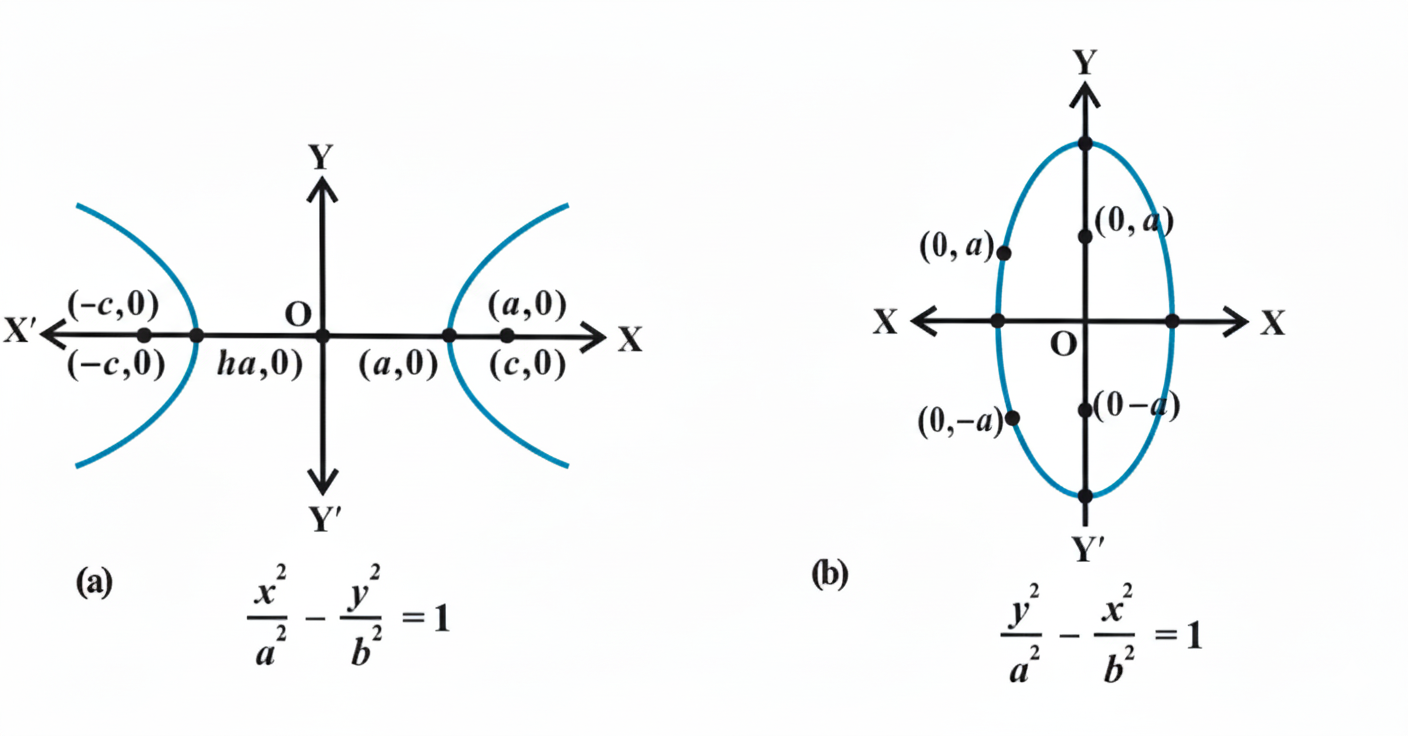
The standard equation of a hyperbola centered at the origin is characterized by a minus sign between the terms.
Horizontal Hyperbola:
- Vertices:
- Foci: , where .
- Transverse Axis: The axis connecting the vertices, length (along the x-axis).
- Conjugate Axis: Length (along the y-axis).
Vertical Hyperbola:
- Vertices:
- Foci: , where .
- Transverse Axis: Length (along the y-axis).
- Conjugate Axis: Length (along the x-axis).
Key Terminology and Formulas
- Relationship between a, b, and c: Unlike the ellipse, the relationship for a hyperbola is:
The eccentricity relationship is:
- Directrices: The equations of the two directrices are .
- Latus Rectum: The focal chord perpendicular to the transverse axis. Its length is .
- Asymptotes: These are crucial lines that the hyperbola's branches approach at infinity. They form a 'guide' for the shape of the curve. Their equations are for a horizontal hyperbola.
Rectangular Hyperbola
A hyperbola is rectangular (or equilateral) if its asymptotes are perpendicular.
- Condition: This happens when . Its eccentricity is always .
- Equation: The standard form is . When the coordinate axes are rotated by 45° to align with the asymptotes, the equation becomes .
Example 1: Finding Parameters from the Equation
Question: For the hyperbola , find the coordinates of the foci and vertices, the eccentricity, and the length of the latus rectum.
Solution: Step 1: Divide by 144 to get the standard form: .
Step 2: Identify parameters. This is a horizontal hyperbola with and .
- Vertices: .
- Find c: .
- Foci: .
- Eccentricity: .
- Length of Latus Rectum: .
Example 2: Finding the Equation from Parameters
Question: Find the equation of the hyperbola whose foci are and the length of the transverse axis is 8.
Solution: Foci are on the x-axis, so it's a horizontal hyperbola. From the foci , we get . The length of the transverse axis is .
Now find using : .
The equation is , which is .
Example 3: Hyperbola with a Shifted Center
Question: Find the center and foci for the hyperbola .
Solution: Step 1: Group terms and complete the square.
Step 2: Divide by 36: .
- Center: .
- Parameters: .
- Foci distance: .
- Foci: Horizontal hyperbola, so foci are at , which are .
Example 4: Using Asymptotes
Question: Find the equation of the hyperbola whose asymptotes are and which passes through the point (3, 8).
Solution: The asymptotes are , so we have . The equation of the hyperbola is .
Substitute : .
The point (3,8) lies on the curve: .
. Since must be positive, we take the negative sign: .
Then .
The original equation was (a vertical hyperbola).
Equation: .