
What Makes a Relation a Function?
Among all relations, one type is so important that the rest of mathematics is essentially built on it.
Key Point (Definition): A relation f from a set A to a set B is a function if every element of A has one and only one image in B. We write , and if we write — b is the image of a, and a is a preimage of b.
Unpack the definition into the two conditions you actually test:
- Every element of A is used — the domain of f is all of A; no input may be left without an image.
- No input has two images — no two distinct ordered pairs share the same first element.
A function is also called a map or mapping — picture it as a machine: feed in any element of A, exactly one element of B comes out. Feed in the same input twice, get the same output twice.
The test in action
- R = {(2,1), (3,1), (4,2)} from {2, 3, 4}: every input appears once — function. (Two inputs sharing an output is fine!)
- R = {(2,2), (2,4), (3,3), (4,4)}: the input 2 has two images (2 and 4) — not a function.
- R = {(1,2), (2,3), (3,4), (4,5), (5,6), (6,7)}: each input once — function.
- R = {(x, y) : y = x + 1} on A = {1, …, 6} (Section 2's arrow diagram): the element 6 has NO image — not a function from A to A.
[Board Important] "Same output, different inputs" never disqualifies a function; "same input, different outputs" always does. On an arrow diagram: every domain point fires exactly one arrow. On a graph: every vertical line meets the curve at most once (the vertical line test).
Real Functions, and the First Four Standard Graphs
Key Point (Definition): A function whose range is or a subset of is a real valued function; if its domain is also or a subset of , it is a real function.
From here on, our functions are real functions given by formulas like , and each deserves a mental picture — its graph, the set of points .
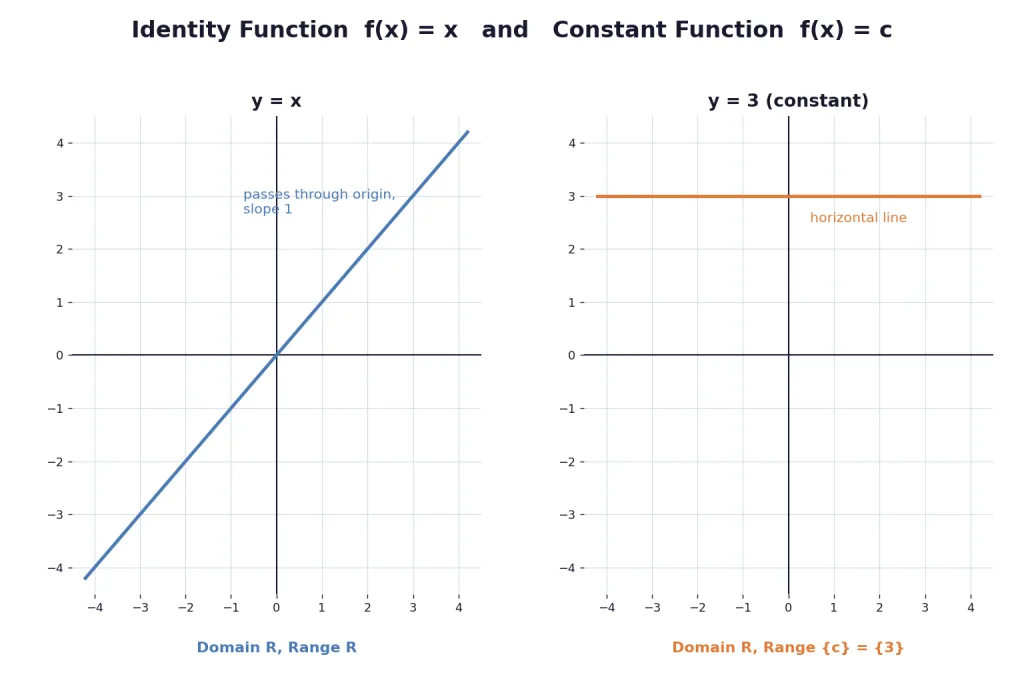
(i) Identity function:
Every input maps to itself. Domain , range . The graph is the straight line through the origin at 45°.
(ii) Constant function:
Every input maps to the same value c. Domain , range {c}. The graph is a horizontal line.
(iii) Polynomial functions:
Here n is a non-negative integer and the coefficients are real. Examples: . Non-examples: — the exponent is not a non-negative integer.
The two model graphs: (a parabola through the origin, range ) and (rising through the origin, range ).
(iv) Rational functions: , quotients of polynomials, defined where
The model: with domain and range — the two-branch hyperbola.
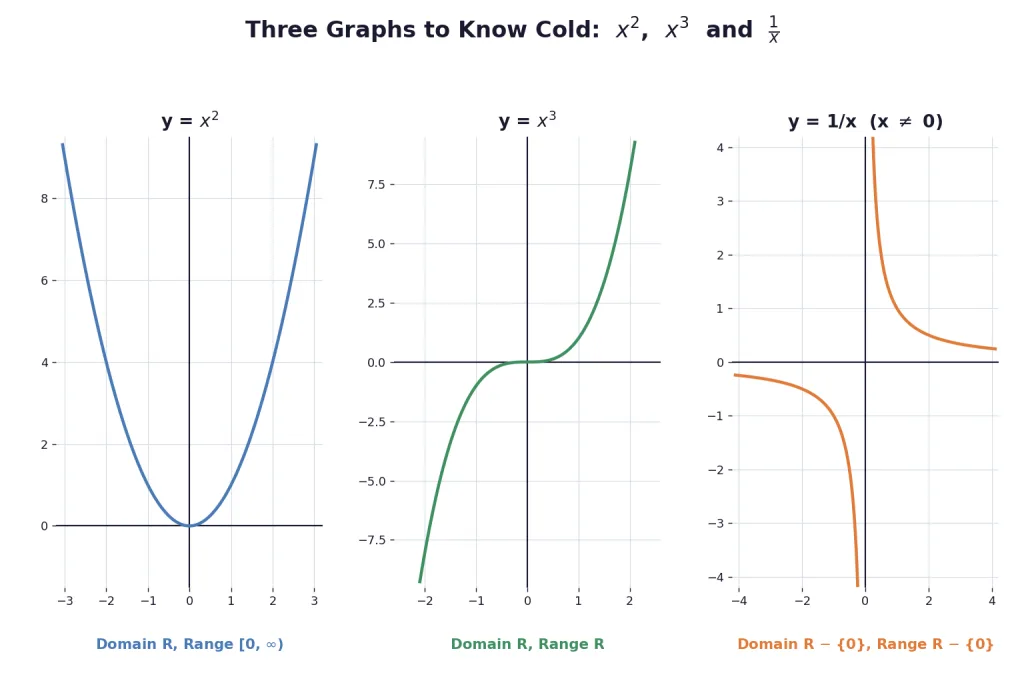
[JEE Tip] Memorise each standard function as a domain-range pair — half the MCQs on this section reduce to quoting one. : (, ); : (, ); : (, ).
Modulus, Signum and Greatest Integer
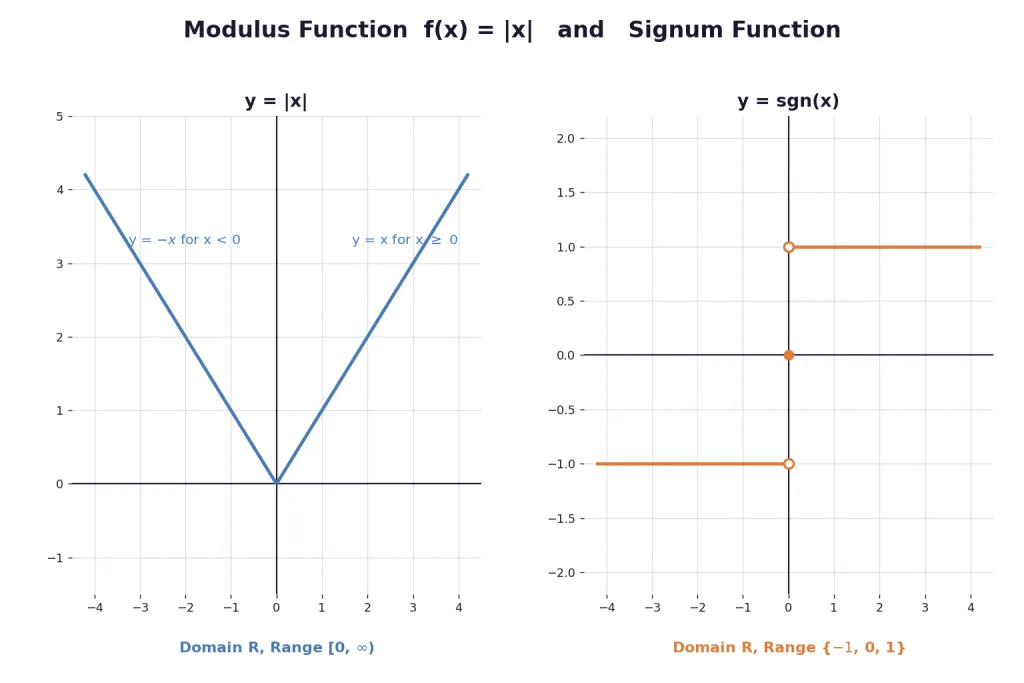
(v) Modulus function:
For negative x, the output is the negative of x — hence positive. Domain , range . The graph is the V with its corner at the origin.
(vi) Signum function
It reports only the sign of the input. Domain , range {, 0, 1}. For it equals (or ).
(vii) Greatest integer function:
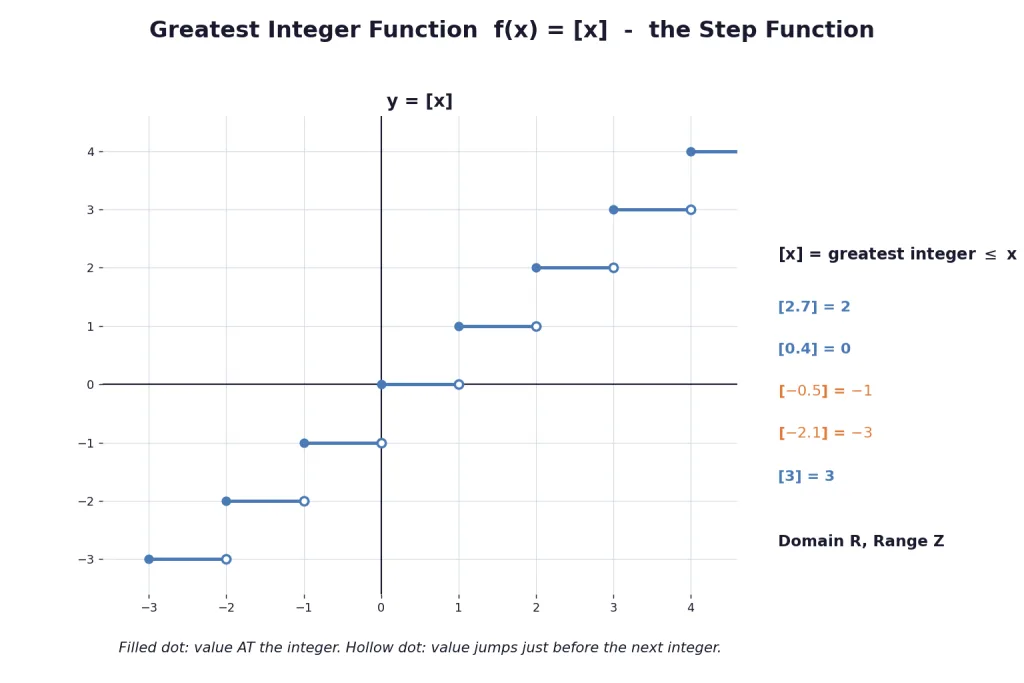
is the greatest integer less than or equal to x:
- , ,
- and — for negatives, round DOWN, not toward zero!
On each interval the value is the constant n, producing the staircase graph. Domain , range .
Key Point: . This equivalence is how every equation and inequality is solved.
[JEE Tip] The single most-tested value type: (not ). If this feels wrong, recall the definition — the greatest integer NOT exceeding sits below it on the number line.
Solved Examples
Example 1. Examine each relation and state whether it is a function: (i) R = {(2,1), (3,1), (4,2)} (ii) R = {(2,2), (2,4), (3,3), (4,4)} (iii) R = {(1,2), (2,3), (3,4), (4,5), (5,6), (6,7)}.
Solution.
Step 1 — recall the test. Scan the FIRST coordinates: a relation is a function exactly when no first coordinate repeats with different partners (and every domain element appears).
(i) Step 2. First coordinates 2, 3, 4 — each appears once. The fact that 2 and 3 SHARE the image 1 is irrelevant (same output is always allowed). Function.
(ii) Step 3. The first coordinate 2 appears twice, with images 2 and 4 — one input, two outputs. Not a function.
(iii) Step 4. First coordinates 1 through 6, each exactly once. Function.
Takeaway: \"same output, different inputs\" never disqualifies; \"same input, different outputs\" always does.
Example 2. R is defined on by R = {(x, y) : y = 2x, x, y }. What are its domain, codomain and range? Is it a function?
Solution.
Step 1 — check the domain. For every natural x, the image is again a natural number — no input is ever dropped: domain = .
Step 2 — codomain and range. Codomain = (the announced target). The images are — the even naturals: range = {2, 4, 6, …}.
Step 3 — function test. Each x determines the single value 2x — one image per input. Yes, a function.
Takeaway: range codomain is perfectly fine for a function — the odd naturals are simply never hit. (Whether range = codomain is what \"onto\" measures in Class 12.)
Example 3. is defined by . Complete the table for x = 1 to 7.
Solution.
Step 1 — substitute each value. ; ; ; ; ; ; .
Step 2 — observe the pattern. The outputs are consecutive odd numbers from 3 — each step in x adds 2 to the output, as the coefficient of x dictates.
Takeaway: a formula-defined function is evaluated by pure substitution; the coefficient of x controls the stride of the output list.
Example 4. A function is defined by . Find (i) f(0) (ii) f(7) (iii) f().
Solution.
(i) Step 1. .
(ii) Step 2. .
(iii) Step 3 — signs intact. . (Not — subtracting 5 pushes further negative.)
Takeaway: substitute with brackets around negative inputs; the double negative in (iii) is where marks are lost.
Example 5. The function t maps Celsius to Fahrenheit: . Find (i) t(0) (ii) t(28) (iii) t() (iv) the value of C when t(C) = 212.
Solution.
(i) Step 1. — freezing point: 0°C = 32°F.
(ii) Step 2. .
(iii) Step 3. .
(iv) Step 4 — reverse the function. Set the output: . Subtract 32: . Multiply by : .
Step 5 — physical check. Water boils at 100°C = 212°F ✓ — the algebra matches the physics.
Takeaway: part (iv) runs the machine backwards: fix the output, solve for the input — the first taste of inverse functions.
Example 6. Evaluate: (i) (ii) (iii) for . Where is the corner of the graph of ?
Solution.
(i) Step 1. — modulus strips the sign.
(ii) Step 2 — inside first. , then .
(iii) Step 3. .
Step 4 — locate the corner. The V-corner sits where the inside vanishes: , i.e. x = 1. The graph of is the V of shifted RIGHT by 1.
Takeaway: always work inside-out — evaluate the inside, then strip the sign; corners of modulus graphs sit at the zeros of the inside.
Example 7. For the signum function, find f(7), f(), f(0), and the range of f over the domain .
Solution.
Step 1 — apply the three-case definition. (input positive); (negative); (the special middle case).
Step 2 — restrict to . Every number in this interval is negative, so the signum is constantly there.
Step 3 — range over the restriction. Only one value occurs: range = {}.
Takeaway: signum ignores magnitude entirely — restricting the domain to one sign collapses the range to a single value.
Example 8. Evaluate: (i) 3.7 5 [1.99].
Solution.
Step 1 — recall the definition. [x] = the greatest integer LESS THAN OR EQUAL to x — on the number line, drop to the nearest integer at or below x.
(i) Step 2. (truncate the positive).
(ii) Step 3. : the integers at or below are ; the greatest is . (NOT , which exceeds .)
(iii) Step 4. — integers are their own floor.
(iv) Step 5. — even a hair below zero drops to .
(v) Step 6. — still short of 2, no matter how close.
Takeaway: positives truncate; negatives drop DOWN — the pair and covers both classic traps.
Example 9. Find the domain and range of .
Solution.
Step 1 — domain: keep the radicand non-negative. . Domain = (endpoints allowed: is fine).
Step 2 — range: track the radicand. As x runs over , runs from 0 to 9, so runs from 9 (at x = 0) down to 0 (at ).
Step 3 — take the square root. maps onto : range = . Only the principal (non-negative) root counts.
Step 4 — geometric check. squares to with — the UPPER half of a circle of radius 3, confirming both domain and range.
Takeaway: even-root domains come from radicand ; the range follows by tracking the radicand's own range through the root.
Example 10. Find the domain and range of .
Solution.
Step 1 — domain. is defined for every real number, and negation changes nothing: domain = .
Step 2 — range via the chain. always, so : outputs are confined to .
Step 3 — every such value is attained. For any , take : then . So range = .
Takeaway: the graph is the V of flipped upside down — an inverted V peaking at the origin; negating a function reflects its range about 0.
Example 11. Find the range of: (i) , , (ii) (iii) , x real.
Solution.
(i) Step 1 — chain the inequalities. . Every value below 2 is attained (solve for any : ✓). Range = — OPEN at 2 because x = 0 is excluded.
(ii) Step 2. with equality AT x = 0, so with the minimum 2 attained. Range = — CLOSED at 2.
(iii) Step 3. The identity function hits every real: range = .
Takeaway: track a chain of inequalities from the core piece, then decide open vs closed by asking whether the extreme is actually attained — (i) open, (ii) closed.
Example 12. The function f is defined by . Describe its graph.
Solution.
Step 1 — plot the left piece. For x < 0, : at the values are 2, 3, 4 — a line of slope rising leftward from near (0, 1).
Step 2 — plot the right piece. For x > 0, : values 2, 3, 4 at x = 1, 2, 3 — slope rising rightward.
Step 3 — the joint. closes the gap: both pieces approach (0, 1), so the graph is one connected V with vertex (0, 1).
Step 4 — recognise the function. For : ; for : . The whole formula is — the modulus V lifted one unit.
Takeaway: recognising a piecewise formula as a shifted modulus turns a graphing chore into a single sentence.
Example 13. The relation f is defined by and the relation g by . Show that f is a function and g is not.
Solution.
Step 1 — locate the danger point. In a piecewise definition the only risk of \"two images for one input\" is where the pieces OVERLAP — here the shared boundary point.
Step 2 — test f at x = 3. First formula: . Second: . The two claims AGREE, so x = 3 has the single image 9; every other x falls under exactly one formula. f is a function.
Step 3 — test g at x = 2. First formula: . Second: . Two DIFFERENT images for the input 2. g is not a function.
Takeaway: for piecewise definitions, check agreement at every overlapping boundary — that single check decides the matter.
Example 14. Let f = {(1, 1), (2, 3), (0, ), (, )} be a function from to defined by . Determine a and b.
Solution.
Step 1 — pick the easiest data point. : .
Step 2 — use a second point. : , and with : .
Step 3 — verify with the remaining points. ✓ matches (2, 3); ✓ matches (, ).
Step 4 — conclude. , i.e. a = 2, b = .
Takeaway: two points determine a line — use x = 0 first if available (it isolates b instantly), and spend the leftover points on verification.
Example 15. Let f be the subset of defined by f = {(ab, a + b) : a, b }. Is f a function from to ?
Solution.
Step 1 — understand the pairs. Each pair has first entry the PRODUCT ab and second entry the SUM a + b. A function would require: same product ⟹ same sum, always.
Step 2 — hunt among factorisations. The number 4 factors two ways: gives the pair (4, 5); gives the pair (4, 4).
Step 3 — verdict. The input 4 has two different images, 5 and 4. Not a function.
Takeaway: to disprove \"function\", exhibit ONE input with two images — numbers with multiple factorisations are the natural hunting ground.
Example 16. Let A = {9, 10, 11, 12, 13} and be defined by f(n) = the highest prime factor of n. Find the range of f.
Solution.
Step 1 — factorise each element. → highest prime 3. → 5. is prime → 11. → 3. is prime → 13.
Step 2 — collect the images. 3, 5, 11, 3, 13 — as a set (repeats once): range = {3, 5, 11, 13}.
Takeaway: a function needs no algebraic formula — any well-defined rule qualifies; note 2 divides 10 and 12 yet never appears, because it is never the HIGHEST prime factor.