
Why This Section Exists
The textbook chapter gives you the definitions; JEE tests how fast you can compute with them. The high-yield toolkit this section adds:
- Counting formulas — relations, functions, and functions with conditions;
- The domain playbook — the complete checklist for square roots, rational functions and their combinations;
- Greatest integer and fractional part — the properties of and that power a whole family of JEE one-liners;
- Modulus equations and inequalities — , , solved as intervals;
- A preview of one-one and onto — the Class 12 vocabulary that JEE assumes early.
The worked examples and practice questions here are modelled on the JEE Main and Advanced pattern and difficulty; they are practice questions in the exam style, not reproductions of specific past papers.
[Board Note] CBSE students: counting functions, and the modulus-inequality machinery sit beyond the Class 11 Board syllabus. Treat this section as a JEE investment — the domain playbook alone will repay it in the calculus chapters.
Counting Relations and Functions
Let and .
- Relations from A to B: subsets of , so .
- Functions from A to B: each of the m inputs independently picks one of n images: .
- Functions with a fixed value (say forced): the rest choose freely: .
- One-one functions (distinct inputs, distinct images; needs ): — images chosen without repetition.
- Non-empty relations: ; relations that are NOT functions: .
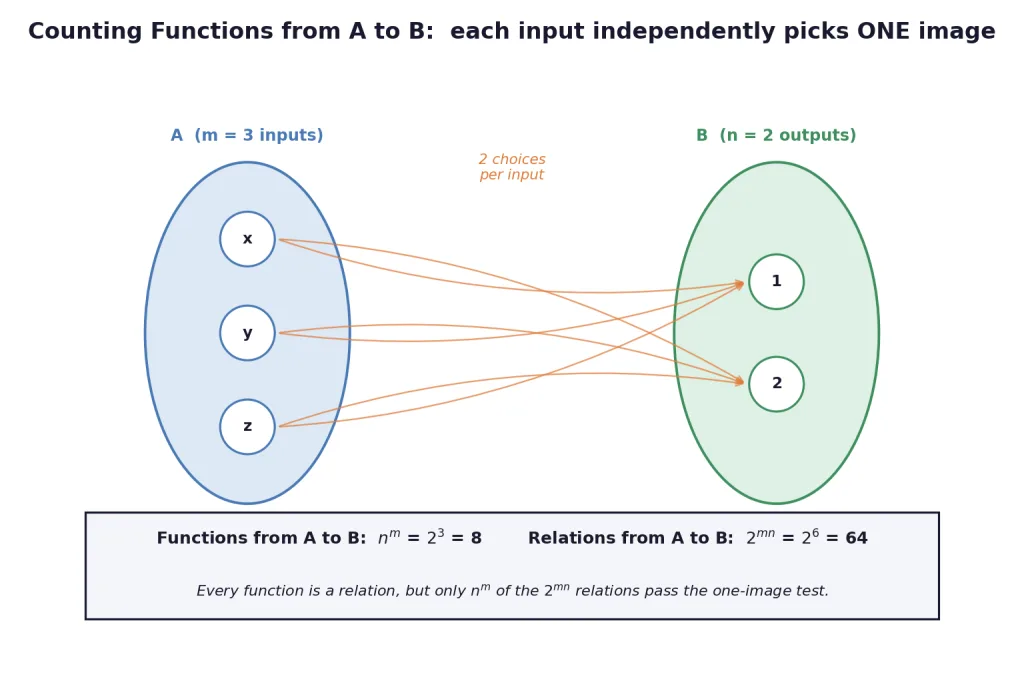
Worked contrast for m = 3, n = 2: relations ; functions ; one-one functions: impossible to squeeze 3 distinct images into 2 targets — zero.
Key Point: Read the exponent from the DOMAIN: has the domain size upstairs. Muddling with (or with ) is the single most common error in this topic.
[JEE Tip] "How many functions from A to B are not one-one?" = total minus one-one = . Compute the two counts separately; never try to count non-injective maps directly.
The Domain Playbook
Every JEE domain question decomposes into these atomic rules, applied together and intersected:
- Polynomial: domain — no restriction.
- : exclude the roots of g.
- : require .
- : require — strict, because the root sits in a denominator.
- -based pieces: needs , i.e. x outside .
Quadratic inequalities power rules 3 and 4: for an upward parabola with roots , we get outside the roots () and between them ().
Modulus equations and inequalities (a > 0)
- — a single interval
- or — two rays
- — an interval centred at c
These convert modulus conditions into interval language instantly. Example: the domain of needs : domain .
The range playbook (first tools)
- Solve for x in terms of y; the legal y form the range (used for , , etc.).
- Complete the square for quadratics: range = [vertex value, ) upward.
- Bound chains for compositions: .
[JEE Tip] For (c 0), the range is — solve for x and the only illegal output is the one that kills the x-term. Quote it; don't re-derive it in the exam.
Greatest Integer and Fractional Part — the JEE Pair
Define the fractional part . Then every real splits as x = [x] + {x}: integer part plus leftover.
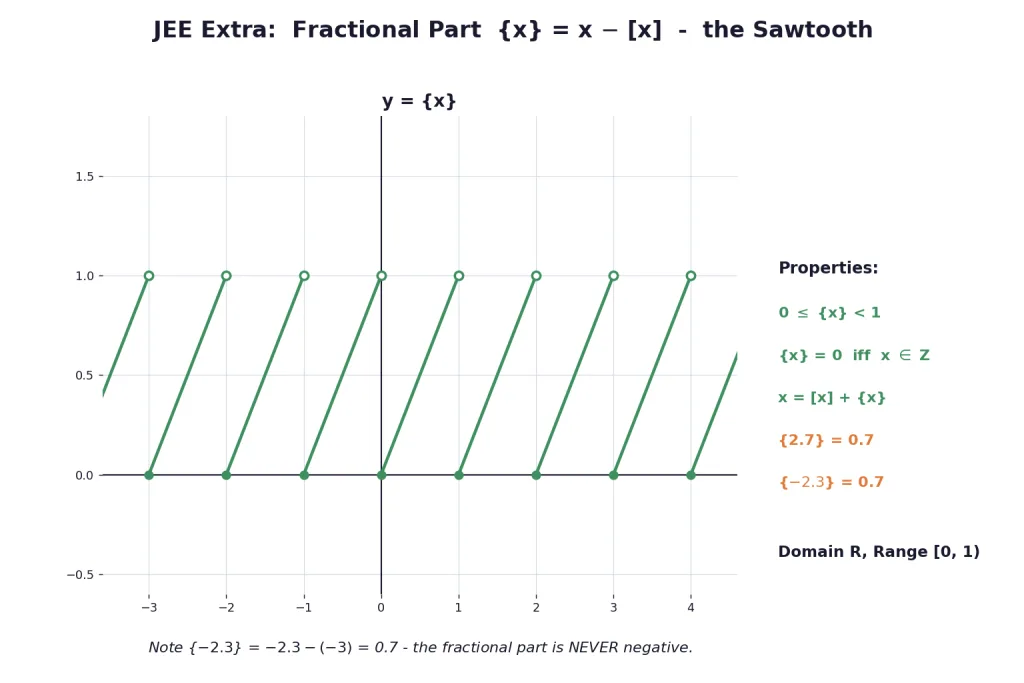
Properties of :
- and
- for any integer n (integers slide out)
- if x is an integer, otherwise
- ; (for integer n)
Properties of :
- always;
- for integer n — periodic with period 1
- for non-integer x. Example: , NOT or 0.3.
Solving with the bracket: to solve , translate to . To solve equations like : factor as a quadratic in — or 3 — then translate: .
One-one and onto — a preview
A function is one-one (injective) if distinct inputs get distinct images, and onto (surjective) if range = codomain. These are Class 12 Chapter 1 material, but JEE Main quotes the words freely — recognise them now: on is both; on is neither (f() = f(1), and negatives are never hit).
[JEE Tip] makes any equation mixing x and solvable: substitute x = n + t with , , and solve for n and t separately — the integer and fractional unknowns decouple.
Solved Examples
Example 1. A = {1, 2, 3, 4}, B = {a, b, c}. Count (i) relations from A to B (ii) functions from A to B (iii) functions with f(1) = a.
Solution.
(i) Step 1. Relations are subsets of : , so relations.
(ii) Step 2. A function lets each of the 4 inputs pick one of 3 images independently: . The DOMAIN size sits in the exponent.
(iii) Step 3. Fix f(1) = a — no choice there; inputs 2, 3, 4 still choose freely: .
Takeaway: three different formulas from one setup — identify WHICH object (relation / function / conditioned function) is asked before computing.
Example 2. How many one-one functions exist from a set with 3 elements to a set with 5 elements?
Solution.
Step 1 — first input. 5 possible images.
Step 2 — second input. Must avoid the first image: 4 choices.
Step 3 — third input. Must avoid both: 3 choices.
Step 4 — multiply. one-one functions.
Takeaway: one-one = images without repetition = a falling product ; if the domain outnumbered the codomain the count would be 0.
Example 3. Find the domain of .
Solution.
Step 1 — pick the right rule. The root sits in a DENOMINATOR: need , strictly.
Step 2 — factor. Product 2, sum : .
Step 3 — sign chart. Upward parabola, roots 1 and 2: positive OUTSIDE the roots.
Step 4 — domain. — endpoints excluded by strictness.
Takeaway: the only difference from a plain domain is strict inequality — it costs exactly the two endpoints.
Example 4. Find the domain of .
Solution.
Step 1 — radicand condition. , i.e. .
Step 2 — translate the modulus inequality. is the closed interval of radius a centred at c: .
Step 3 — domain. .
Takeaway: — one line, no case-splitting.
Example 5. Find the range of , .
Solution.
Step 1 — solve for x in terms of y. .
Step 2 — legality check. The expression exists for every ; at y = 2 the equation collapses to the impossible .
Step 3 — range. .
Step 4 — the shortcut confirmed. For the forbidden output is — the horizontal asymptote.
Takeaway: quote the shortcut in exams; re-derive it only when a problem modifies the template.
Example 6. Find the range of , using only the fact that .
Solution.
Step 1 — bound the denominator. — never zero, so f is defined for ALL real x.
Step 2 — reciprocate the positive interval. Taking reciprocals of swaps the endpoints: .
Step 3 — check attainment. gives ✓; gives ✓ — both endpoints attained.
Step 4 — range. .
Takeaway: chain bounds through each operation, and remember reciprocation of a positive interval swaps its endpoints.
Example 7. Solve for real x.
Solution.
Step 1 — treat the bracket as an unknown. Set : , so or .
Step 2 — unpack each integer value. ; .
Step 3 — union. .
Takeaway: solve for the bracket as an ordinary unknown FIRST, then translate each integer value into its half-open interval — the answer is a run of reals, not two isolated points.
Example 8. Compute (i) (ii) (iii) (iv) .
Solution.
(i) Step 1. .
(ii) Step 2 — the negative case, by definition. (drop DOWN), so . Never : the fractional part is always in .
(iii) Step 3. Integers have zero fractional part: .
(iv) Step 4. — inevitable, since makes the four terms rebuild .
Takeaway: for negatives compute and trust the definition over intuition.
Example 9. Solve , if a solution exists.
Solution.
Step 1 — decouple integer and fractional parts. Substitute with and : the equation becomes , i.e. .
Step 2 — pin down n. must lie in : . The only integer is n = 2.
Step 3 — recover t and x. , so . Check: ✓.
Takeaway: the substitution turns any x-and-bracket equation into a one-line integer hunt.
Example 10. Find the domain of .
Solution.
Step 1 — the strict condition. Root in denominator: , i.e. .
Step 2 — case x 0. , so the condition reads — false everywhere here.
Step 3 — case x < 0. , and holds for all negative x (indeed ).
Step 4 — domain. .
Takeaway: memorise the split — is 0 on the non-negatives and on the negatives; exams reuse it constantly.
Example 11. Find the domains of (i) and (ii) .
Solution.
(i) Step 1. The two roots demand AND (i.e. ) simultaneously.
Step 2. The only number satisfying both is x = 0: domain = {0}, a single point (where ).
(ii) Step 3. Now the second condition is STRICT (, root in denominator), i.e. — which contradicts outright.
Step 4. No x survives: domain = — g is defined nowhere.
Takeaway: domains can legally collapse to a single point or to nothing — intersect honestly rather than assuming an interval must survive.
Example 12. Classify each as one-one and/or onto: (i) , f(x) = 2x + 1 (ii) , f(x) = (iii) , f(x) = .
Solution.
(i) Step 1 — one-one test. : distinct inputs cannot collide. One-one ✓.
Step 2 — onto test. Any target y is hit by : range = codomain = . Onto ✓. Both.
(ii) Step 3. : not one-one. Range (negatives never hit): not onto. Neither.
(iii) Step 4. Same collision kills one-one; but the DECLARED codomain is now = the range, so every codomain element is hit. Onto but not one-one.
Takeaway: onto depends on the declared codomain — (ii) and (iii) share the same rule and domain, yet differ in surjectivity; the property belongs to the whole triple (domain, codomain, rule).
Example 13. How many functions from A = {1, 2, 3} to B = {x, y, z, w} are NOT one-one?
Solution.
Step 1 — total functions. .
Step 2 — one-one functions. Falling product: .
Step 3 — subtract. Not one-one: .
Takeaway: complement counting — counting collisions directly is a combinatorial mess; total minus injective is two lines.
Example 14. Find the range of over , and of .
Solution.
Step 1 — f at integers. Both brackets are exact: .
Step 2 — f at non-integers. Write , : , , sum . Range of f = {, 0}.
Step 3 — g at integers. Both fractional parts vanish: 0.
Step 4 — g at non-integers. , so the sum is . Range of g = {0, 1}.
Takeaway: both ranges are two-point sets — derive them once from the identities and (non-integer case), then quote.
Example 15. Find the domain of .
Solution.
Step 1 — first term. : the ray .
Step 2 — second term (strict). Root in denominator: or .
Step 3 — intersect. .
Step 4 — audit the boundary points. : first term fine, second term defined ✓ — included. : second term divides by zero — excluded.
Takeaway: the full playbook in one problem — root rule, strict root-in-denominator rule, quadratic sign chart, intersection — the exact anatomy of an exam domain question.