
How to Use This Section
Here are 32 fully worked problems covering the entire chapter — ordered pairs and Cartesian products, relations with their domains and ranges, the function test, evaluation and graphs of standard functions, domain-range computations, and the algebra of real functions — arranged in a deliberate easy → medium → hard progression.
One suggestion that multiplies the value of every problem: attempt each yourself before reading the solution. Cover the solution, commit to an answer, then compare. Problems 1-10 warm up on products and relations, 11-22 build the function muscles, and 23-32 finish with domain-range and proof-style questions at Board and JEE difficulty.
Solved Examples
Example 1. Find x and y if: (i) (ii) .
Solution.
(i) Step 1 — split into coordinate equations. and .
Step 2 — solve in order. ; substitute: , so .
(ii) Step 3 — a genuine simultaneous system. and .
Step 4 — add the equations. ; then .
Step 5 — verify. ✓.
Takeaway: coordinates may interlock — treat the two coordinate equations as a small simultaneous system and solve by the usual elimination.
Example 2. A = {x : x , x < 3}, B = {x : x is a letter of the word FEE}. Find and .
Solution.
Step 1 — roster-convert both factors FIRST. A: naturals below 3 = {1, 2}. B: letters of FEE = F, E, E → drop the repeat → {F, E}.
Step 2 — multiply. = {(1, F), (1, E), (2, F), (2, E)}.
Step 3 — count. ✓ matches the listing.
Takeaway: hidden set sizes control everything — roster-convert before multiplying, and remember repeated letters collapse.
Example 3. For A = {1, 2, 3} and B = {2, 3, 4}, list the pairs of with equal coordinates.
Solution.
Step 1 — translate the condition. A pair (a, a) lies in exactly when AND — that is, .
Step 2 — compute the intersection. .
Step 3 — list the diagonal pairs. (2, 2) and (3, 3).
Takeaway: diagonal pairs of correspond one-to-one with elements of — a tiny identity that shortcuts several MCQ types.
Example 4. For A = {1, 2}, B = {1, 2, 3, 4}, C = {5, 6}, verify that .
Solution.
Step 1 — left side. : the sets {1, 2, 3, 4} and {5, 6} share nothing, so , and .
Step 2 — right side. Every pair of has second entry in B; every pair of has second entry in C. A common pair would need its second entry in BOTH — impossible since . So the intersection is .
Step 3 — compare. Both sides equal ✓ — the identity survives its degenerate case.
Takeaway: verifying an identity on an empty-overlap example stress-tests understanding — the equality holds with room to spare.
Example 5. With A = {1, 2}, B = {1, 2, 3, 4}, C = {5, 6}, D = {5, 6, 7, 8}, verify that is a subset of .
Solution.
Step 1 — list the smaller product. = {(1,5), (1,6), (2,5), (2,6)}.
Step 2 — test each pair against . First entries 1, 2 all lie in B (); second entries 5, 6 all lie in D (). All four pairs qualify ✓.
Step 3 — extract the principle. and together give — factorwise containment implies product containment.
Takeaway: the general principle spares you the listing whenever the factor containments are visible.
Example 6. An arrow diagram from P = {5, 6, 7} sends each number to its remainder on division by 3. Write the relation in roster form; give domain and range.
Solution.
Step 1 — compute each remainder. ; ; .
Step 2 — roster form. R = {(5, 2), (6, 0), (7, 1)}.
Step 3 — domain and range. Domain = {5, 6, 7}; range = {0, 1, 2}.
Step 4 — bonus observation. Each input has exactly one image — division leaves ONE remainder — so this relation is in fact a function.
Takeaway: modular arithmetic rules are single-valued, so remainder relations are always functions.
Example 7. On A = {1, 2, 3, 4}, let R = {(x, y) : x, y A, x < y}. Write R in roster form and find its domain and range.
Solution.
Step 1 — list increasing pairs, row by row. x = 1: (1,2), (1,3), (1,4). x = 2: (2,3), (2,4). x = 3: (3,4). x = 4: nothing exceeds 4 inside A.
Step 2 — count. pairs ✓ (equivalently : choose two distinct values, order them increasingly).
Step 3 — domain and range. Domain = {1, 2, 3} — the maximum 4 sends no arrow. Range = {2, 3, 4} — the minimum 1 receives none.
Takeaway: strict-order relations always lose the maximum from the domain and the minimum from the range.
Example 8. A has 2 elements, B has 3. Find (i) the number of relations from A to B; (ii) from B to A; (iii) on A.
Solution.
Step 1 — the rule. Relations from X to Y are subsets of : count .
(i) Step 2. : .
(ii) Step 3. : also — different pairs, same count.
(iii) Step 4. : .
Takeaway: only the SIZE of the product matters — reversing direction changes the pairs but never the count.
Example 9. Which are functions? Give reasons. (i) {(2,1), (5,1), (8,1), (11,1), (14,1), (17,1)} (ii) {(2,1), (4,2), (6,3), (8,4), (10,5), (12,6), (14,7)} (iii) {(1,3), (1,5), (2,5)}.
Solution.
Step 1 — the test. Scan first coordinates for repeats with different partners.
(i) Step 2. First elements 2, 5, 8, 11, 14, 17 — all distinct. Function (all inputs share the output 1 — a constant-like function). Domain {2, 5, 8, 11, 14, 17}, range {1}.
(ii) Step 3. First elements 2, 4, …, 14 — distinct. Function; domain {2, 4, 6, 8, 10, 12, 14}, range {1, …, 7}.
(iii) Step 4. The input 1 carries two images, 3 and 5. Not a function.
Takeaway: state domain and range only AFTER the function test passes — for a non-function the question is void.
Example 10. If (), find (i) f(0) (ii) f(1) (iii) (iv) an x with f(x) = 0.
Solution.
(i) Step 1. .
(ii) Step 2. .
(iii) Step 3. .
(iv) Step 4. A fraction vanishes exactly when its numerator does (and the denominator does not): , so x = 1 — consistent with (ii).
Takeaway: the numerator carries the roots, the denominator carries the exclusions — keep their roles separate.
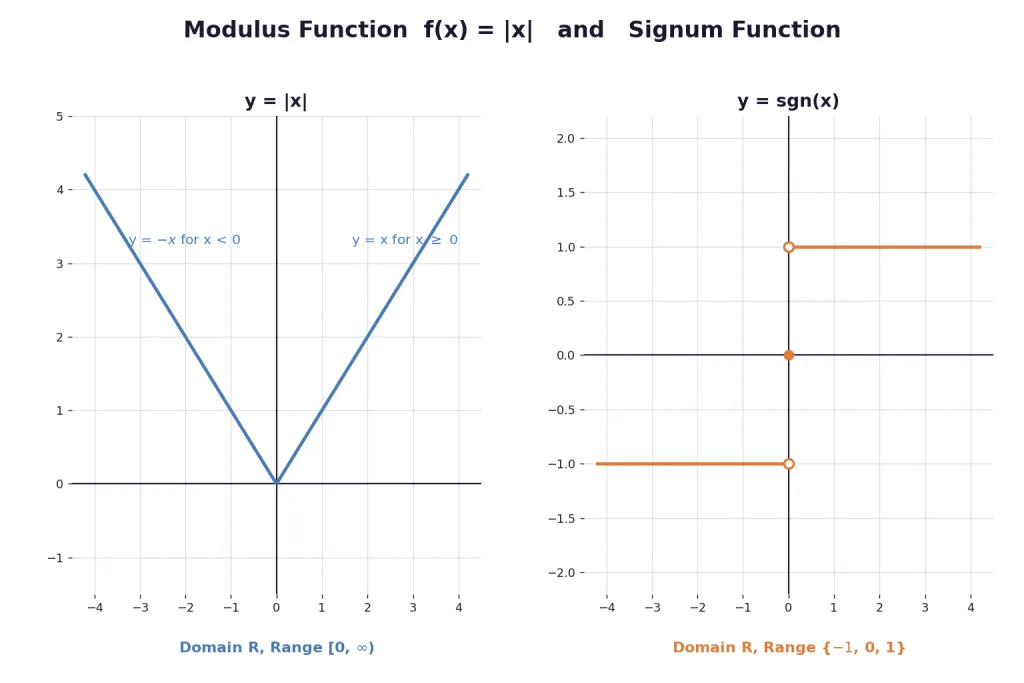
Example 11. Write as a piecewise function and evaluate f(0), f(1.5), f(5).
Solution.
Step 1 — find the corner. The inside vanishes at , i.e. — split the line there.
Step 2 — write the pieces. For the inside is non-negative: . For it is negative, so the modulus flips it: .
Step 3 — evaluate. (left piece); (the corner); (right piece).
Takeaway: every modulus is secretly a two-piece linear function split at the zero of its inside — write the split once and evaluation becomes mechanical.
Example 12. Evaluate sgn() for any real x, and sgn() at x = 1 and x = 3.
Solution.
Step 1 — sign of . Since , we get for EVERY real x: the signum is constantly 1.
Step 2 — sign of at x = 1. : sgn .
Step 3 — at x = 3. : sgn .
Takeaway: signum questions are pure sign-analysis — decide the sign of the inside expression, output , or accordingly.
Example 13. Compute (i) (ii) for x not an integer (iii) .
Solution.
(i) Step 1. ; (drop DOWN below ). Sum: .
(ii) Step 2 — the general pattern. For non-integer x with : and gives . Sum: — always. (For integer x both floors are exact and the sum is 0.)
(iii) Step 3. ; . Difference: .
Takeaway: equals 0 for integers and otherwise — a one-line result worth memorising.
Example 14. f = {(1, 1), (2, 3), (0, ), (, )} is a linear function from to . Find f(x).
Solution.
Step 1 — set the form. .
Step 2 — the x = 0 pair first. (0, ) gives immediately.
Step 3 — one more pair. (1, 1): , so .
Step 4 — verify on the unused pairs. ✓; ✓. Hence .
Takeaway: the pair with x = 0 hands you c for free — always spend it first, then verify with leftovers.
Example 15. f(x) = on . Tabulate f, and state the domain and range of the full real function .
Solution.
Step 1 — tabulate. x: → f(x): 16, 9, 4, 1, 0, 1, 4, 9, 16.
Step 2 — note the symmetry. : the table mirrors around x = 0, exactly as the parabola mirrors about the y-axis.
Step 3 — the real function. Domain: every real can be squared → . Range: squares are and every equals → .
Takeaway: the symmetric table is the numerical shadow of the parabola's mirror symmetry.
Example 16. For , tabulate f at x = and state its domain and range.
Solution.
Step 1 — tabulate. ; ; ; ; ; ; ; ; .
Step 2 — read the trend. Small inputs produce huge outputs and vice versa — the two branches of the hyperbola hug the axes without touching them.
Step 3 — domain and range. Domain: all reals except the forbidden 0 → . Range: solves to for any , and is impossible → .
Takeaway: the reciprocal's domain and range are the same punctured line — 0 is unreachable from either side.
Example 17. Find the domain of .
Solution.
Step 1 — set up the radicand condition. Need .
Step 2 — factor. Product 6, sum : .
Step 3 — sign chart. An upward parabola with roots 2 and 3 is negative BETWEEN its roots and non-negative outside: or .
Step 4 — domain. , endpoints included ( is fine).
Takeaway: root-of-quadratic domains are sign-chart problems — keep the outside of the roots for an upward parabola, the inside for a downward one.
Example 18. Find the range of on .
Solution.
Step 1 — complete the square. .
Step 2 — bound. with equality exactly at x = 2, so , and the minimum 3 IS attained.
Step 3 — coverage upward. As x moves away from 2 the square grows without bound, hitting every value above 3.
Step 4 — range. , closed at 3.
Takeaway: completing the square converts any quadratic's range into a one-line read: vertex value up to infinity (or down from it for a downward parabola).
Example 19. Find the range of , .
Solution.
Step 1 — solve for x in terms of y. .
Step 2 — solvability. The expression exists for every ; and is impossible (a reciprocal never vanishes).
Step 3 — range. .
Takeaway: \"solve for x, ask which y are legal\" — the universal range method; shifting the denominator moved the domain but not the range.
Example 20. Find the domain of .
Solution.
Step 1 — root condition. : the interval .
Step 2 — denominator condition. : delete x = 1.
Step 3 — combine. . Both endpoints survive — the root sits in the NUMERATOR, so its zero is harmless.
Takeaway: stack every condition, intersect, delete — and present the answer as a union of intervals showing the hole.
Example 21. Define by f(n) = if n is even, and f(n) = if n is odd. Compute f(1), f(2), f(7), f(10), and show f is a function but not one-one.
Solution.
Step 1 — evaluate by matching parity. f(1): odd rule, . f(2): even rule, . f(7): odd rule, . f(10): even rule, 5.
Step 2 — function check. Every natural number is even or odd, never both — the cases are exclusive and exhaustive, so each input gets exactly one image ✓.
Step 3 — shared image. : two different inputs, one output — allowed for a function, but it shows f is not one-one (injectivity is a Class 12 refinement).
Takeaway: piecewise-by-parity definitions are genuine functions when the cases are exclusive and exhaustive; sharing outputs is never a violation.
Example 22. f(x) = x + 1, g(x) = 2x 3. Find (f + g)(x), (f g)(x), , and evaluate each at x = 2.
Solution.
Step 1 — the three combinations. ; ; with .
Step 2 — evaluate the formulas at 2. ; ; .
Step 3 — cross-check pointwise. , : sum ✓, difference ✓, quotient ✓.
Takeaway: evaluating both ways — formula first vs pointwise — is a free, complete check of the algebra.
Example 23. and . Find the domains of fg and , and compute (fg)(1).
Solution.
Step 1 — ingredient domains. dom f: . dom g: . Intersection: .
Step 2 — the product. dom(fg) = , and .
Step 3 — evaluate. .
Step 4 — the quotient. Additionally delete the zeros of g: at x = 2. dom.
Takeaway: the quotient loses exactly the zero of the denominator — here one endpoint — from the product's domain.
Example 24. For , simplify ().
Solution.
Step 1 — expand the shifted value. .
Step 2 — subtract. .
Step 3 — divide by h. (legal since ).
Takeaway: as h shrinks, — you have computed the derivative of a year early; factoring h out before cancelling is the key move.
Example 25. Are f(x) = and g(x) = x + 1 the same function?
Solution.
Step 1 — simplify f where legal. For : — the values agree with g everywhere BOTH are defined.
Step 2 — compare domains. dom f = (the original formula divides by zero at 1); dom g = .
Step 3 — verdict. Equal functions require equal domains AND equal values; the domains differ, so — f is g with one point punched out.
Takeaway: a function is the PACKAGE (domain, rule); cancelling a common factor silently changes the domain — a favourite exam trap.
Example 26. A function's graph is the upper semicircle of radius 2 centred at the origin. Find the function, its domain and its range.
Solution.
Step 1 — start from the circle. ; the upper half keeps .
Step 2 — solve for y. — the non-negative root exactly matches the upper half.
Step 3 — domain. Radicand : .
Step 4 — range. The height runs from 0 (at ) up to the radius 2 (at x = 0): .
Takeaway: \"upper semicircle of radius r\" and are the same object — translate freely between picture and formula.
Example 27. A = {1, 2, 3, 4}, B = {1, 5, 9, 11, 15, 16}, f = {(1, 5), (2, 9), (3, 1), (4, 5), (2, 11)}. Are these true? (i) f is a relation from A to B. (ii) f is a function from A to B.
Solution.
(i) Step 1 — test membership of each pair in . First entries 1, 2, 3, 4, 2 all lie in A ✓; second entries 5, 9, 1, 5, 11 all lie in B ✓. So : a relation ✓.
(ii) Step 2 — function test. Scan first coordinates: 2 appears TWICE, with images 9 and 11. One input, two images — not a function.
Takeaway: every function is a relation, but not conversely — this relation fails by exactly one repeated first element.
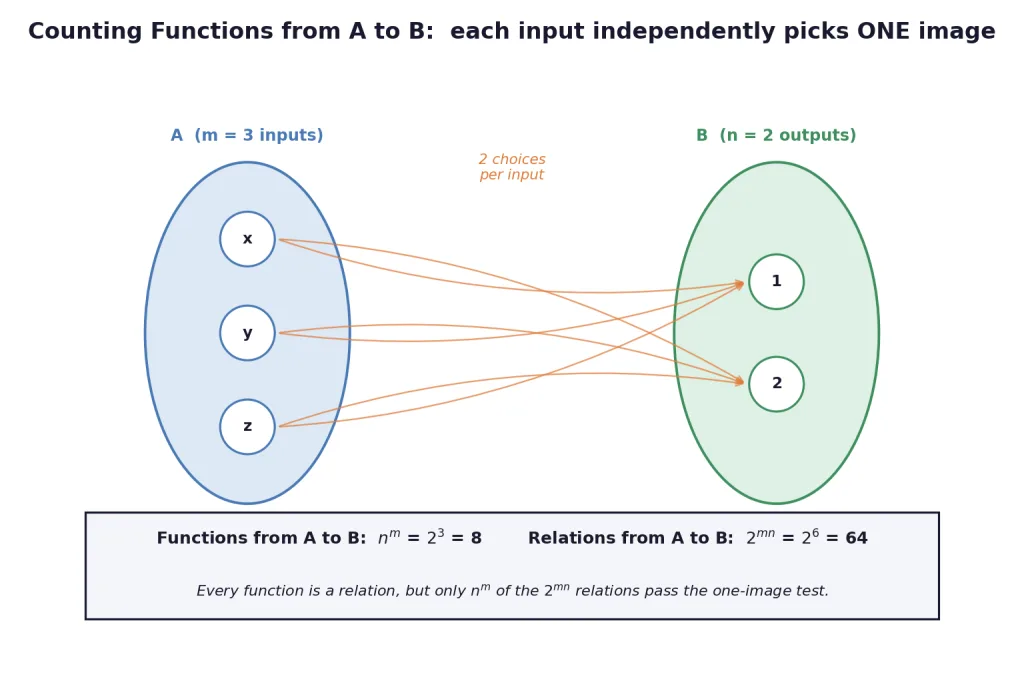
Example 28. A = {1, 2, 3}, B = {a, b}. Count (i) the relations from A to B, (ii) the functions from A to B.
Solution.
(i) Step 1. Relations are subsets of : , so relations.
(ii) Step 2. A function makes each of the 3 inputs pick exactly ONE of the 2 images, independently: functions.
Step 3 — compare. Only 8 of the 64 relations pass the one-image test — functions are rare among relations.
Takeaway: relations count as , functions as — never swap the two formulas.
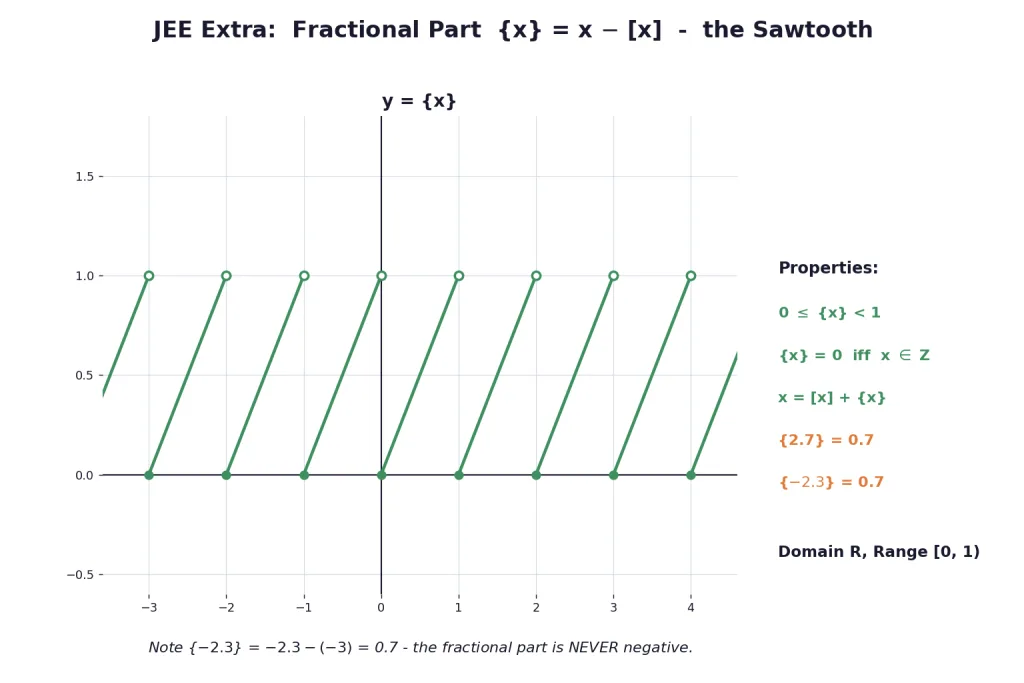
Example 29. Find the range of f(x) = for real x, and of g(x) = .
Solution.
Step 1 — recognise g. is the fractional part : it is 0 at integers and climbs toward (never reaching) 1 between them.
Step 2 — range of g. — 0 attained, 1 approached only.
Step 3 — f is the negative. : the range mirrors through 0 to — now is open and 0 closed.
Takeaway: negating a function reflects its range about 0 AND swaps which endpoint is open — track both effects.
Example 30. Find the domain of .
Solution.
Step 1 — root condition. , i.e. .
Step 2 — denominator condition. , i.e. .
Step 3 — combine. The two conditions together give the STRICT inequality : domain = .
Takeaway: a root in a denominator upgrades to — the boundary point falls to the division rule.
Example 31. For , evaluate , , f(1), f(4), and state the range of the middle piece.
Solution.
Step 1 — match each input to its interval FIRST. : first rule. : middle rule. : middle rule (the boundary belongs to the middle piece). : last rule.
Step 2 — evaluate. ; ; ; .
Step 3 — middle-piece range. The identity rule on outputs exactly .
Takeaway: locate the input's interval BEFORE touching any formula — boundary ownership (here 0 and 1 belong to the middle) decides close calls.
Example 32. Show that the range of (x real) is .
Solution.
Step 1 — upper bound, attained. gives , with equality exactly at x = 0 — the maximum 1 is attained.
Step 2 — positivity, never zero. Numerator 1 and denominator are positive, so for all x; as grows, f(x) shrinks toward 0 without reaching it.
Step 3 — everything between occurs. For any , solve: gives — a real solution exists.
Step 4 — conclude. Range = . ∎
Takeaway: a complete range proof has three parts — bound it, attain the attained end, and solve for x to certify everything in between.