
Introduction to Angles
An angle is formed by rotating a ray around its endpoint. The starting position is the initial side, and the ending position is the terminal side. The endpoint is the vertex.
Positive Angle: The rotation is counter-clockwise.
Negative Angle: The rotation is clockwise.
Systems of Angle Measurement
Degree Measure (Sexagesimal System):
This is the most common system in general use. One full counter-clockwise revolution is divided into 360 parts, each called a degree.
1 full revolution =
1 degree () = 60 minutes ()
1 minute () = 60 seconds ()
Radian Measure (Circular System):
This is the standard system for calculus and higher mathematics because it relates the angle directly to a length.
- One radian is the angle created at the center of a circle by an arc whose length is equal to the radius of the circle.
Relationship Between Degrees and Radians
The circumference of a circle is . The number of radians in one full circle is the circumference divided by the radius, which is . Since one full revolution is also , we have the fundamental relationship:
Conversion Formulas:
To convert from degrees to radians, multiply by .
To convert from radians to degrees, multiply by .
Arc Length and Area of a Sector
For a circle of radius 'r', and a central angle '' that must be in radians:
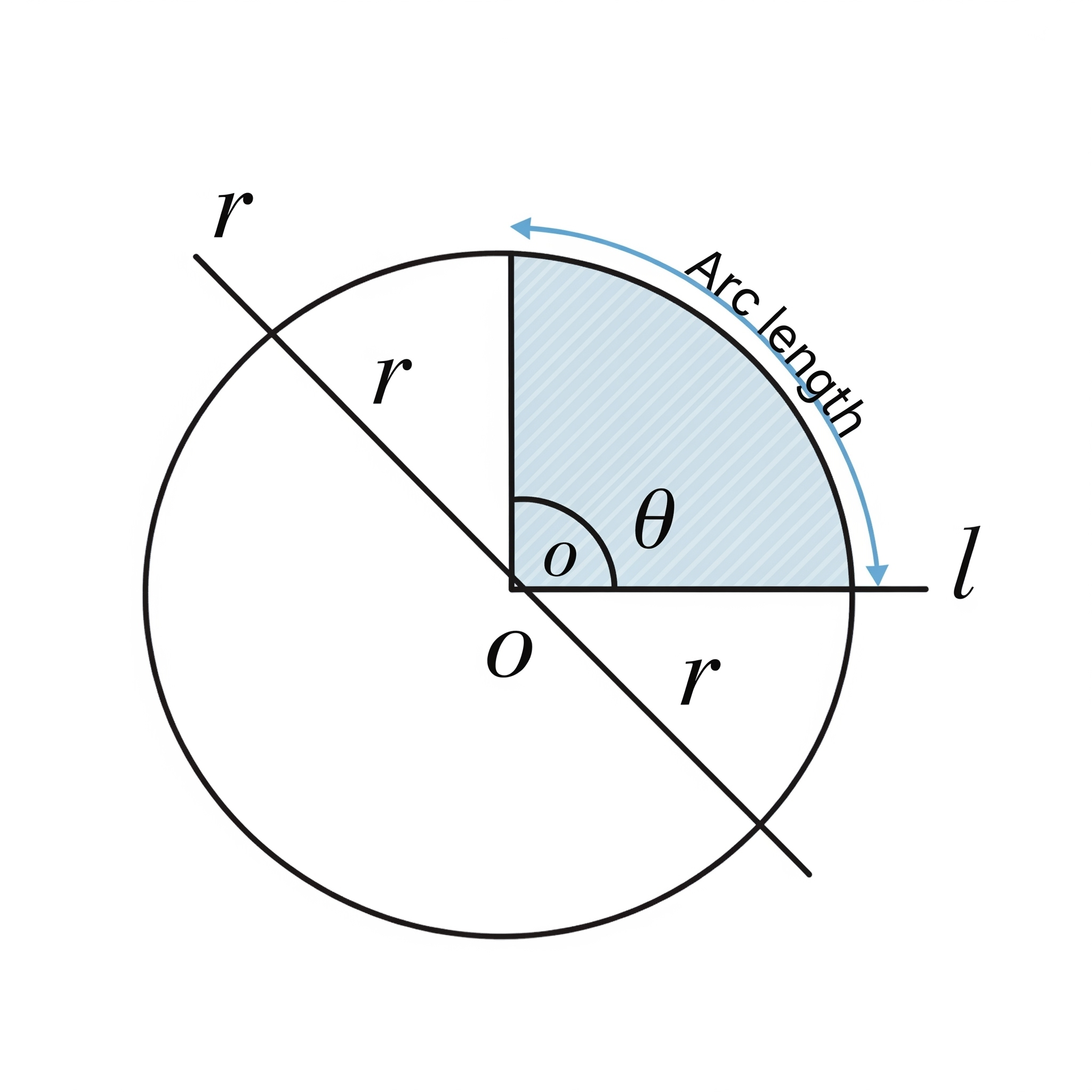
- Arc Length (l): The length of the arc intercepted by the angle .
- Area of Sector (A): The area of the 'slice of pie' created by the angle .
Example 1: Degree to Radian Conversion
Question: Convert into radian measure.
Solution:
Step 1: Convert minutes to decimal degrees. .
Step 2: Add this to the degrees part: .
Step 3: Convert the total degrees to radians: Radians = Degrees radians.
Example 2: Radian to Degree Conversion
Question: Convert 6 radians into degree measure.
Solution:
Step 1: Use the conversion formula. Degrees = Radians degrees.
Step 2: Convert the improper fraction to a mixed fraction. with a remainder of 7. So, we have .
Step 3: Convert the fractional part to minutes. . We now have .
Step 4: Convert the remaining fractional part to seconds. .
The angle is approximately .
Example 3: Arc Length Calculation
Question: Find the length of an arc of a circle of radius 5 cm subtending a central angle of .
Solution:
Step 1: The formula requires the angle to be in radians. Convert to radians:
radians.
Step 2: Use the arc length formula:
cm.
Example 4: Clock Angle Problem
Question: Find the angle between the minute hand and the hour hand of a clock when the time is 7:20 AM.
Solution:
We measure angles clockwise from the 12 o'clock position.
Minute Hand Speed: in 60 min = per minute.
Hour Hand Speed: in 12 hours (720 min) = per minute.
Position of Minute Hand: At 20 minutes past the hour, its position is .
Position of Hour Hand: At 7:20, it has been minutes past 12. Its position is .
Angle Between Hands: The difference in their positions is .