Trigonometric functions extend the concept of ratios in a right-angled triangle to any angle. This is achieved by using the unit circle, which allows us to define these functions for angles beyond the acute angles found in a triangle.
The Unit Circle Definition
A unit circle is a circle with a radius of 1, centered at the origin of the Cartesian plane. For any angle θ measured counter-clockwise from the positive x-axis, the point P(x, y) where its terminal side intersects the unit circle gives us the primary trigonometric values.
Cosine (cosθ) is defined as the x-coordinate of the point P.
Sine (sinθ) is defined as the y-coordinate of the point P.
The other four trigonometric functions are defined in terms of sine and cosine:
tanθ=xy=cosθsinθ(x=0)
secθ=x1=cosθ1(x=0)
cscθ=y1=sinθ1(y=0)
cotθ=yx=sinθcosθ(y=0)
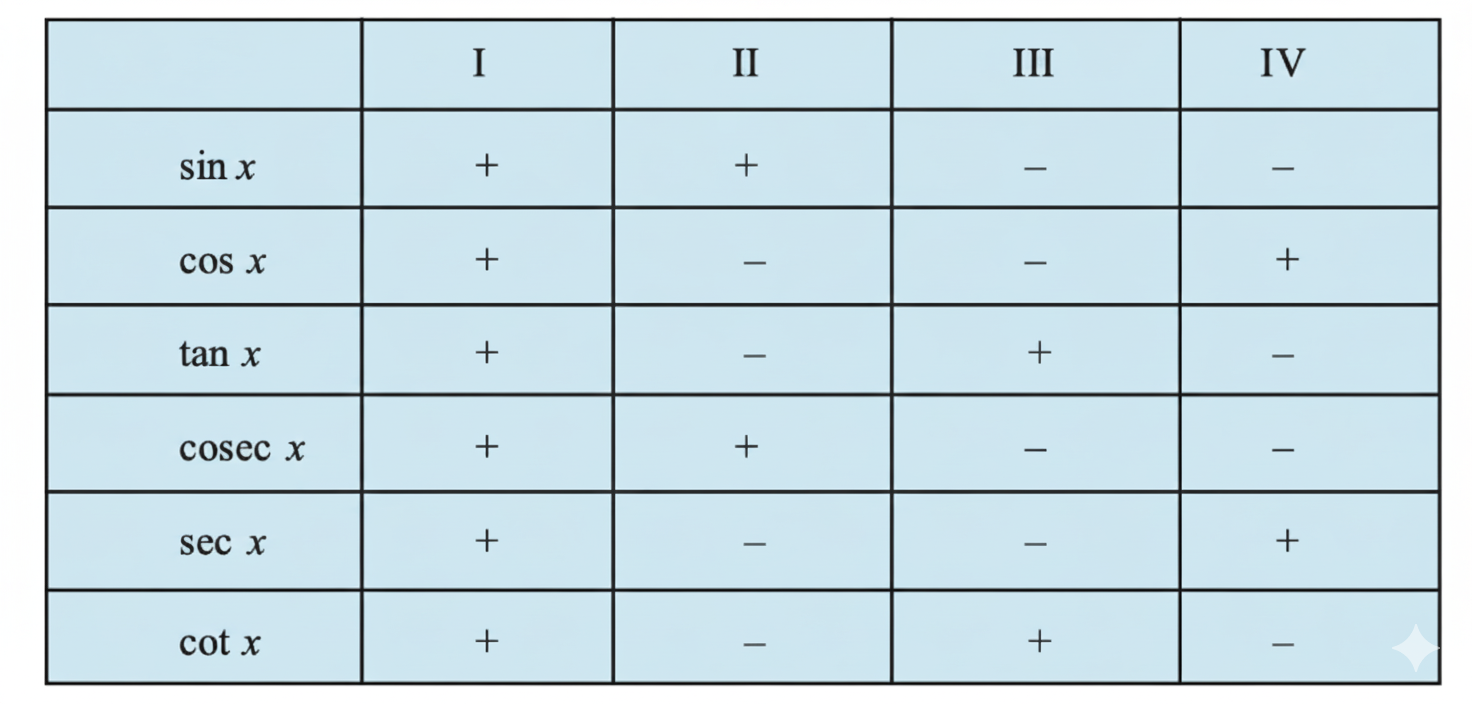
Signs of Trigonometric Functions in Quadrants
The signs of the trigonometric functions in each of the four quadrants are determined by the signs of the x and y coordinates. A useful mnemonic to remember this is the ASTC rule ("All Students Take Calculus") or the CAST rule, starting from Quadrant IV.
Quadrant I (0∘ to 90∘): All functions are positive (x and y are positive).
Quadrant II (90∘ to 180∘): Sine and its reciprocal, Cosecant, are positive (y is positive, x is negative).
Quadrant III (180∘ to 270∘): Tangent and its reciprocal, Cotangent, are positive (x and y are negative).
Quadrant IV (270∘ to 360∘): Cosine and its reciprocal, Secant, are positive (x is positive, y is negative).
Domain and Range of Trigonometric Functions
Function
Domain (Input values of θ)
Range (Output values)
sinθ
All real numbers (R)
[−1,1]
cosθ
All real numbers (R)
[−1,1]
tanθ
R−{(2n+1)2π,n∈Z} (all reals except odd multiples of π/2)
All real numbers (R)
cscθ
R−{nπ,n∈Z} (all reals except integer multiples of π)
(−∞,−1]∪[1,∞)
secθ
R−{(2n+1)2π,n∈Z} (all reals except odd multiples of π/2)
(−∞,−1]∪[1,∞)
cotθ
R−{nπ,n∈Z} (all reals except integer multiples of π)
All real numbers (R)
Example 1: Finding Values from a Point
Question: If the terminal side of an angle θ passes through the point (-4, 3), find the values of all six trigonometric functions.
Solution:
This point is not on the unit circle. We have x=−4 and y=3. First, we find the distance 'r' from the origin to this point, which acts as the hypotenuse.
r=x2+y2=(−4)2+32=16+9=25=5.
The definitions are then generalized as follows:
sinθ=y/r=3/5
cosθ=x/r=−4/5
tanθ=y/x=3/(−4)=−3/4
cscθ=1/sinθ=r/y=5/3
secθ=1/cosθ=r/x=5/(−4)=−5/4
cotθ=1/tanθ=x/y=−4/3=−4/3
Example 2: Finding Values from One Ratio and Quadrant
Question: If cosx=−3/5 and x lies in the third quadrant, find the values of the other five trigonometric functions.
Solution:
Step 1: Use the Pythagorean identity sin2x+cos2x=1 to find sinx.
sin2x=1−(−3/5)2=1−9/25=16/25. So, sinx=±4/5.
Since x is in the third quadrant, sinx is negative. Thus, sinx=−4/5.
Step 2: Use the found values of sin and cos to find the rest.
tanx=cosxsinx=−3/5−4/5=4/3.
cscx=1/sinx=−5/4.
secx=1/cosx=−5/3.
cotx=1/tanx=3/4.
Example 3: Evaluating at Large Angles
Question: Find the value of sin(765∘).
Solution:
Trigonometric functions are periodic. The period of sine is 360∘. We can add or subtract any multiple of 360∘ without changing the value. We find how many full revolutions are in 765∘.
765÷360=2 with a remainder. 765∘=2×360∘+45∘.
Therefore, sin(765∘)=sin(45∘)=21.
Example 4: Evaluating with Negative Angles in Radians
Question: Find the value of cot(−15π/4).
Solution:
Step 1: Use the identity cot(−θ)=−cot(θ). So we need to find −cot(15π/4).
Step 2: Simplify the angle. 15π/4=(16π−π)/4=4π−π/4.
So, we need to find −cot(4π−π/4). The period of cotangent is π, so we can ignore the 4π.
−cot(−π/4)=−(−cot(π/4))=cot(π/4)=1.
Example 5: Finding an Angle from Signs
Question: If sinx=1/2 and cosx=−3/2, find the principal value of x.
Solution:
We are given that sinx is positive and cosx is negative. According to the ASTC rule, this occurs only in the second quadrant. The reference angle (the acute angle with the x-axis) for which sinx=1/2 is 30∘ or π/6. The corresponding angle in the second quadrant is 180∘−30∘=150∘, or in radians, π−π/6=5π/6. The principal value is 5π/6.
Example 6: Determining the Sign of an Expression
Question: Determine the sign of the expression sin(2)⋅cos(3)⋅tan(4), where the angles are in radians.
Solution:
We need to determine the quadrant for each angle. We use the approximations π≈3.14 and π/2≈1.57.
2 radians: Since 1.57<2<3.14 (i.e., π/2<2<π), this angle is in Quadrant II. In Q2, sin(2) is positive.
3 radians: Since 1.57<3<3.14 (i.e., π/2<3<π), this angle is in Quadrant II. In Q2, cos(3) is negative.
4 radians: Since 3.14<4<3π/2≈4.71 (i.e., π<4<3π/2), this angle is in Quadrant III. In Q3, tan(4) is positive.
The sign of the entire expression is (+)×(−)×(+)=(−). The expression is negative.
Example 7: Range of a Trigonometric Function
Question: What is the range of the function f(x)=5cos(2x)−3?
Solution:
Step 1: Start with the range of the basic cosine function: −1≤cos(2x)≤1.
Step 2: Multiply by 5 (the amplitude): −5≤5cos(2x)≤5.
Step 3: Subtract 3 (the vertical shift): −5−3≤5cos(2x)−3≤5−3.
This simplifies to −8≤f(x)≤2. The range is [−8,2].
Example 8: Evaluating a Complex Expression
Question: Find the value of sec(270∘−θ)sec(90∘−θ)−tan(270∘−θ)tan(90∘+θ).
Solution:
We simplify each term using allied angle rules (ASTC and co-function identities):
sec(270∘−θ)=−cscθ (Q3, secant is negative, changes to cosecant)
sec(90∘−θ)=cscθ (Q1, secant is positive, changes to cosecant)
tan(270∘−θ)=cotθ (Q3, tangent is positive, changes to cotangent)
tan(90∘+θ)=−cotθ (Q2, tangent is negative, changes to cotangent)
The expression becomes (−cscθ)(cscθ)−(cotθ)(−cotθ)=−csc2θ+cot2θ=−(csc2θ−cot2θ).
Using the Pythagorean identity 1+cot2θ=csc2θ, we know csc2θ−cot2θ=1. The final value is -1.
Ready to test your knowledge?
Take a quick interactive quiz on this topic —
free, works without login.